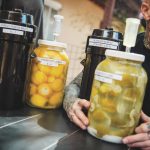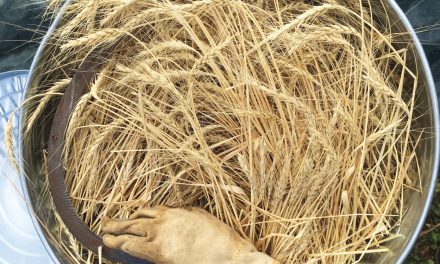

Textures of Squash (butternut squash three ways), photo by Tia Quintanilla Pioche.
I guess I am a true millennial. I graduated high school from the Santa Fe Indian School in 2005, the same year YouTube came on the scene, a year after the launch of Facebook, two years after WordPress, and five years before Instagram was born. I remember what a big deal it was for my class to get access to digital video cameras, editing software, and online blogs. It was the first time Native American kids could tell their own stories and share them with the world, uncensored and for free.
In the twenty years since, Indian Country has harnessed the power of the digital space to do incredible things, from founding independent news networks, to creating online art marketplaces that bypass exploitative middlemen, to organizing powerful social movements like the Water Protectors and #NoDAPL. While there are many tribal lands that still don’t have cell phone or internet access, almost every kid in America knows that through their phone or computer they can be part of a global conversation that reaches far beyond their reservation border or city limits.
All of this storytelling and transcontinental connection has also reshaped how folks experience food, and Indigenous food in particular. Where fry bread used to be something you could only get if you were connected to the right people, now you can follow a fry bread maven like Morris Navajo Grill or Manko Native American Fusion on Facebook. Chefs and Indigenous foods activists like Karlos Baca of southern Ute territory and Johnny Ortiz-Concha of the Taos area can cultivate their online presence, expanding the conversation about Indigenous cuisine and advocating for food sovereignty through the use of ingredients grown in their communities.
It wasn’t until I was in my twenties and attending the Institute of American Indian Arts that I realized that red chile, beans, and tortillas weren’t what Native people ate all over the country. That sounds naive now, but at the time, my experience of foods was what I grew up with and not much more. In college, I met citizens of far-flung tribal nations and started learning about those in Canada and the northern US states who ate bison and moose, who fished for salmon, who foraged for berries and maple syrup. I learned about how my own Diné people had grown orchards of peach trees and bred Churro sheep in our homelands, even leaving them with people who remained in hiding during the Long Walk. I learned how much history can be experienced around a table because food is the language with which we fortify our families, friends, and neighbors.
Today the idea of a neighbor has transcended the physical plane and we are able to talk to and share ideas and recipes with almost anyone in the world. Kids don’t have to go to college to be introduced to other cultures, find mentors, or attract an audience. They have the world virtually at their fingertips, and that not only exposes young people to what others are doing but can empower and inspire them to put their ideas out into the world. The internet and all the apps and platforms that have followed it give creative Natives the chance to self-promote, amplify their voices, connect across cities and states, and become a part of a global community of like-minded folks.


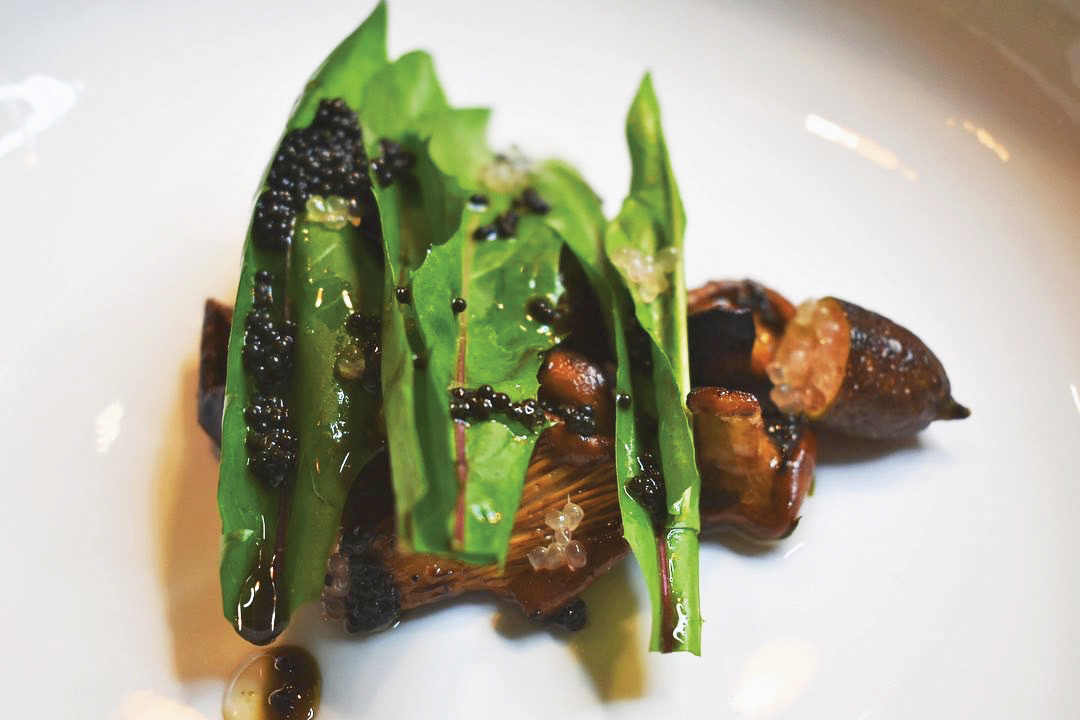
Justin Pioche picking Navajo tea on his late maternal grandmother’s land in Fruitland, New Mexico; blue corn cake with garlic aioli, popped corn, and scallion curl; sunchokes and dandelions. Photos by Tia Quintanilla Pioche.
An up-and-coming Native American chef in New Mexico can pop online and see what Oglala Lakota chef Sean Sherman is doing at Owamni in Minneapolis, winner of the 2022 James Beard Award for Best New Restaurant. Aspiring chefs can learn how Sherman practices foraging and fusing ancestral staples like elk, maple syrup, and wild rice with ingredients and dishes from other parts of the Americas, from chipotle to chimichurri. They can follow his work to educate people around the world about what the land has to offer and the importance of preserving its ability to provide, as well as to help redefine the boundaries of Native American food to include cuisine from Mexico and South and Central America.
For many Indigenous chefs, food sovereignty, ancestral foodways, and traditional farming practices are as much a part of their mission as the food itself. Having access to digital platforms gives them the chance to network, learn, and sometimes work both with one another and with non-Native chefs whose approach to the plate aligns with theirs. A commitment to hyperlocal sourcing and teaching land stewardship through foraging connects and motivates chefs from Ana Roš in Slovenia to Chris Erasmus in South Africa to Ortiz-Concha in New Mexico. This past year, Chef Justin Pioche, a 2023 James Beard Award semifinalist and owner of the Navajo Nation-based Pioche Food Group, staged at Noma Kyoto, Rene Redzepi’s Japanese pop-up.
Pioche’s pandemic-era launch is a prime example of how the digital can uplift the local. In 2020, Pioche Food Group became an official business, working with Farmington’s Juniper Coffee + Eatery, which had lost a lot of business when the San Juan College campus closed during the COVID shutdown. They crafted four-course meals that could feed families of four for just $65, using social media to get the word out. With the help of a website and a growing following on Instagram (@PiocheFoodGroup) and Facebook, Pioche and his sister Tia and mother Janice Brown run a successful catering company out of their homebase in Fruitland, New Mexico, a spot on the map that has never been noted for its culinary pursuits—until now. The group has garnered acclaim for their LorAmy Supper Club, a pop-up dinner series where Chef Pioche creates nine-course meals inspired by traditional Diné dishes. Pioche has guest-cheffed at the Michelin-starred Alinea in Chicago and is scheduled to collaborate with chef Sherman at the Turtle Island Dinner Series at Owamni in late February.

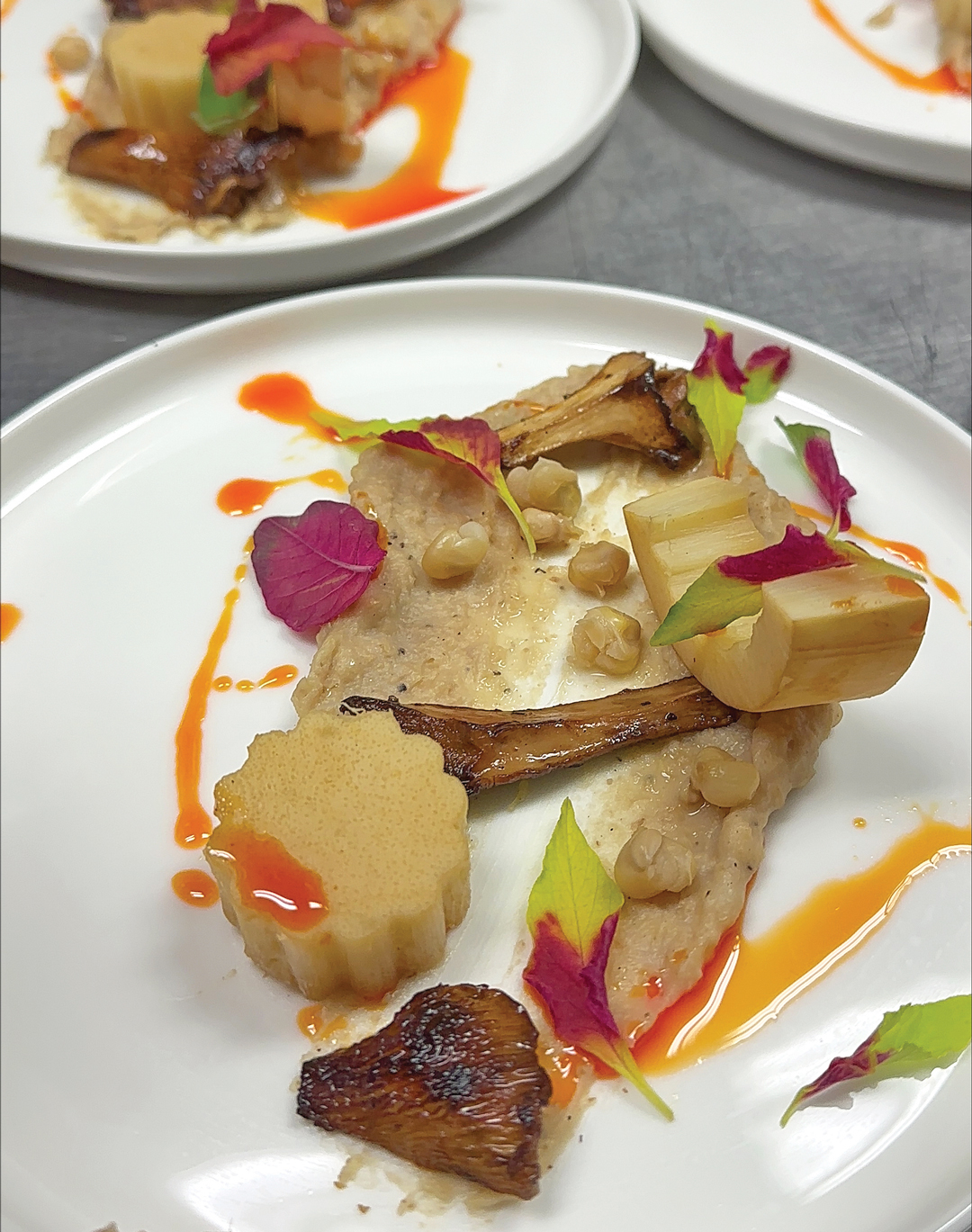
Tia Pioche at a Singletons fundraiser in Scottsdale, Arizona, photo courtesy of Pioche Food Group. Sunchokes with red chile gastrique, photo by Tia Quintanilla Pioche.
“We usually try to highlight Navajo foods on the menu in that modern, upscale setting. So, for example, we’ll play a lot with liquid nitrogen spherification, serving cold things, hot things, cold solids, liquid, and vice versa,” says Pioche. He will also design a menu around ingredients found in the area where they’re working. For instance, when their client in a southeastern state harvested an alligator, he asked Chef Pioche to use the meat in a catered dinner, and the chef combined it with mushroom in a puff pastry.
Operating out of their mobile food trailer or from clients’ kitchens, Pioche Food Group relies on their web presence to book catering events. But Pioche’s work doesn’t end at the table; it extends into the field, teaching students from local high schools about their Diné foodways, farming, water rights, and what it means to exercise tribal sovereignty.
“Justin always says his real goal is to spark interest in at least one of these kids, because that could change so much in how we use our Navajo land and being a farmer,” says his sister Tia. “Nowadays there are a lot of grandpas and grandmas out here that want their kids to take over their land and start farming, and a lot of them don’t want to, and they just move away to the city. But Justin is still here on the rez and trying to be a voice in our community and the farming community as well, because there’s so much land that’s being underutilized here on the reservations.”
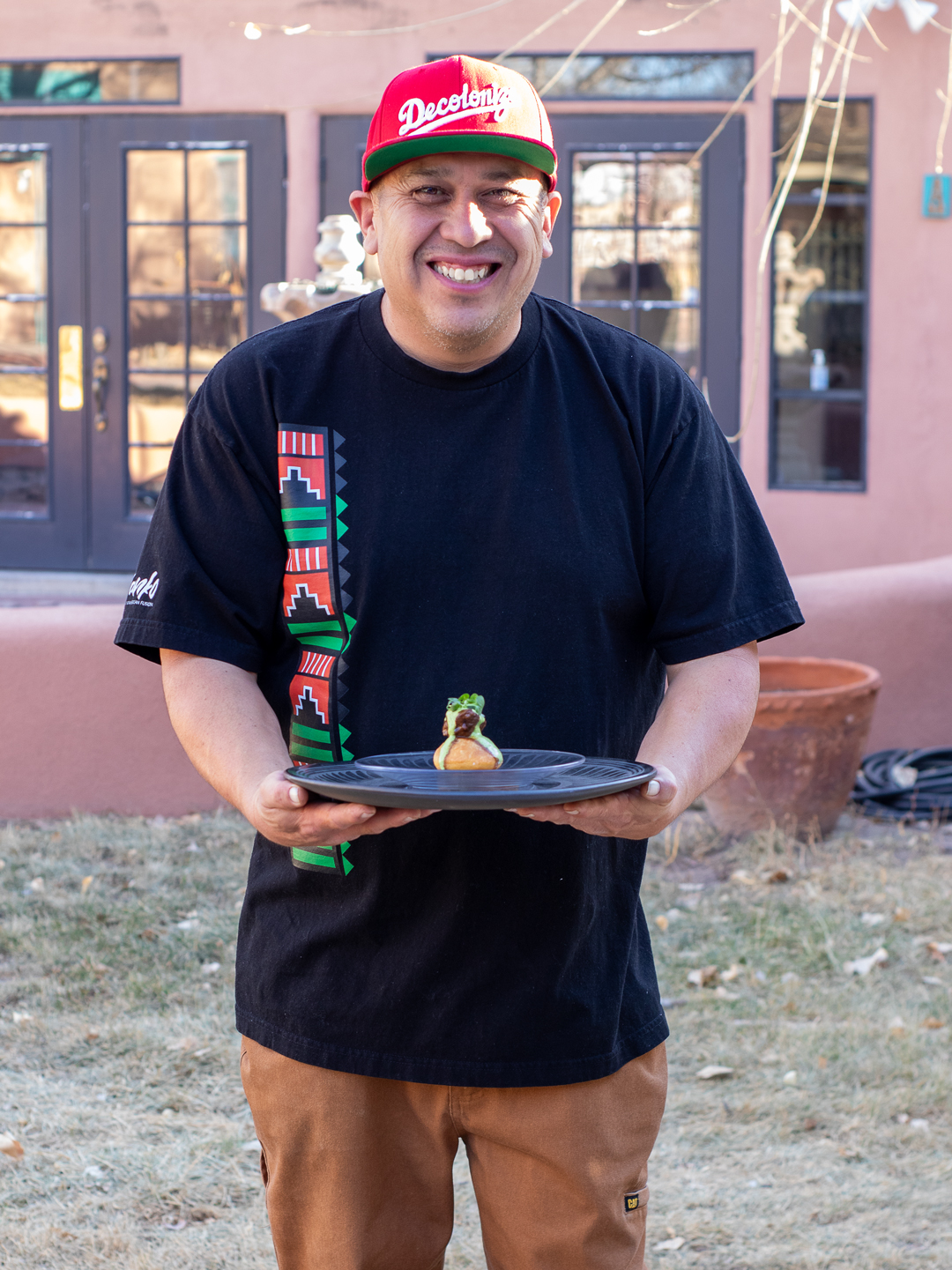

Ray Naranjo, owner of Manko Native American Fusion, photo by Stephanie Cameron. Manko food truck, photo courtesy of Manko.
Digital platforms have also been critical to the success of Chef Ray Naranjo of Santa Clara Pueblo. The owner of Manko Native American Fusion food truck, he primarily uses social media outlets to share his weekly menu and let patrons know where he will set up. With roughly five thousand followers (@chef_ray_naranjo on Instagram and @MankoLLC on Facebook), Naranjo relies solely on those platforms to advertise his business. So far, his following has been powerful enough to keep Manko in business and to win gigs providing food service to the Heard Museum in Phoenix and the Poeh Cultural Center in Pojoaque, among other venues. Naranjo is also featured in Eating History, a new documentary film produced by the Museum of New Mexico Foundation.
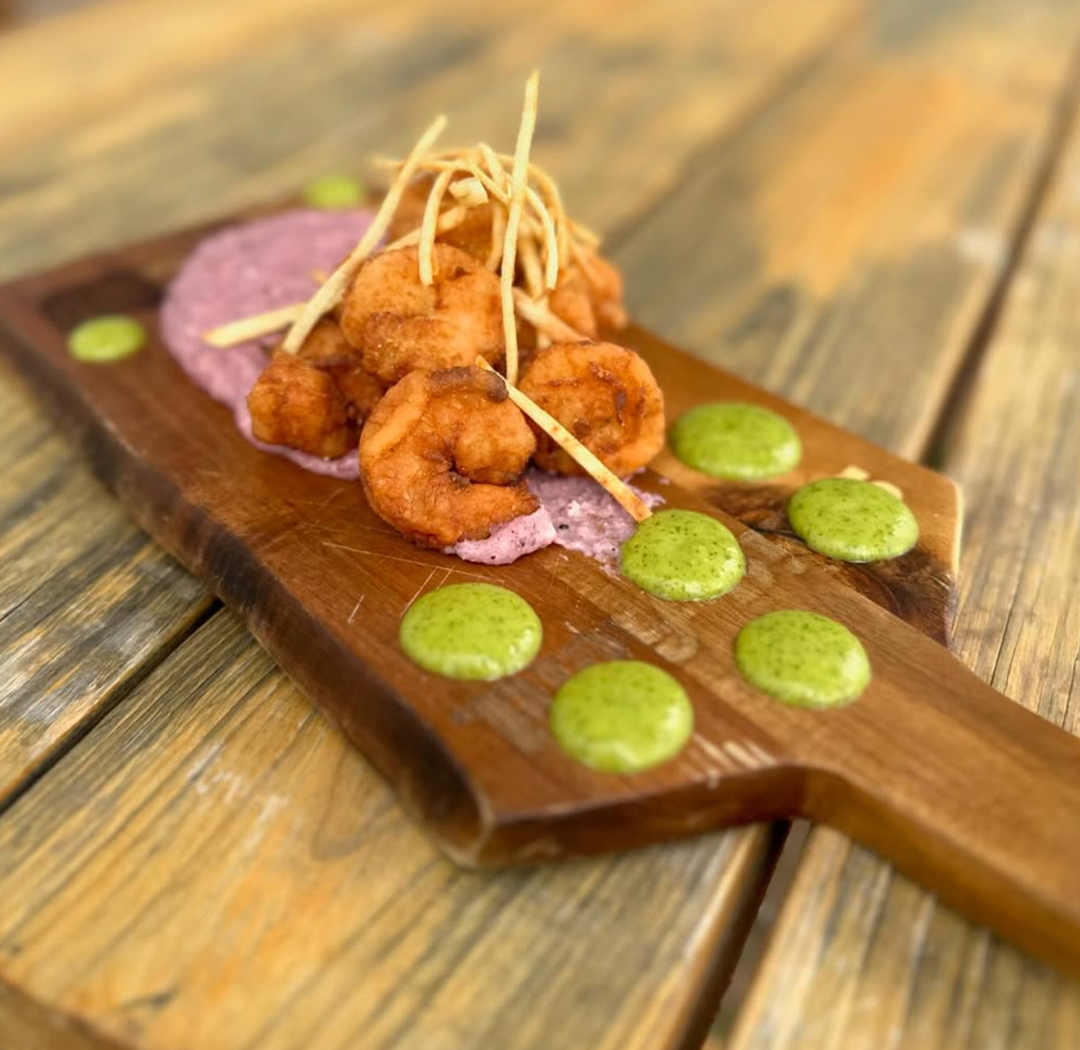

Shrimp dish at Manko pop-up, photo courtesy of Manko. Braised lamb fry bread tartine, photo by Stephanie Cameron.
“Social media was really critical for the exposure. It also helped with national-level exposure and connecting with [Native] groups from around the country, like Tocabe in Denver and Owamni in Minneapolis, that were able to see what we were doing,” says Naranjo. “It’s been critical for the elevation of my cuisine. Native American cuisine is almost a new concept, so seeing what everybody else is doing inspires you to elevate your food.”
Naranjo says that digital platforms have changed the game for Indigenous people by giving them a voice to share their stories, art, food, and culture. His menu presents contemporary Tewa favorites like fry bread green chile burgers and NDN tacos, as well as mash-ups like the Gangsta Meat Taco.
“Food is the heart of a community,” says Naranjo. “It’s kind of like giving the community back its soul.”

Ungelbah Dávila
Ungelbah Dávila lives in Valencia County with her daughter, animals, and flowers. She is a writer, photographer, and digital Indigenous storyteller.