
By Ungelbah Dávila

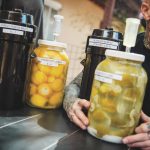
Golden plant dye brewing, photo by Ungelbah Dávila.
In central and northern New Mexico, this has been a wetter year. Rain has visited the state like a debutant, making the rounds from county to county. The sky gives. The earth drinks. Sprouts wiggle from their seeds. The arroyos and acequia banks flourish, and pollinators become giddy on five-foot wildflowers, animals fatten on cattails, and migrating birds gorge on “weed” seeds. Alfalfa fields pulsate with yellow butterflies, signaling for farmers the change in season. Bumblebees languish in the bosom of yellow flowers, coating their bodies in wintertime pollen. Unpicked apples ripen, drop, and become food for worms, beetles, the earth. As I write, it is harvest time for all those whose nails have spent the hot months encased in dirt, whose brows have borne droplets of mud, whose lips have whispered prayers for one more round of life to bloom from this unyielding desert earth.
Like many great recipes, this story begins with water, and a bit of lore. After months of wearing a pervasive gleam of sweat, I delight in driving up into the cool clouds and drizzle of La Cieneguilla to the home of artist Kathleen McCloud. It’s only a few miles south of Santa Fe, but on this September day it could be a world away from my home in the Rio Grande Valley south of Albuquerque, where, for several years now, only my bravest flowers have decided to grow.
From recipes to natural wonders, water is the main ingredient to life on this planet, for all the reasons we know—all life needs water to hydrate, and without it there would be no food, no medicine, no plants, no trees to purify the atmosphere. But there would also be no beauty. There would be no flowers to soothe the grieving or to celebrate with joy. There would be no shade from the sun, no fruit for the hungry, and no color for the artist.

“Thirsty Orchard,” Kathleen McCloud, 2024. Photo collage with homegrown indigo, acrylic, oil, and silk on BFK Rives paper. Courtesy of GF Contemporary.
It is within this thirsty desert’s palette that I find McCloud, who has immersed herself in the high-desert landscape since arriving at this homestead in the 1980s. From planting a grove of aspen trees to seeding and tending the bed of Maximilian sunflowers that greet me when I arrive, she has laid down roots in this lovely community along the Santa Fe River, where she continues to create art and experiment with natural dyes sourced from her garden and community.
We talk of the hues nature provides and I recall being a teenager on a trip with my father to New York City. We were looking out at the Statue of Liberty when a bird, most likely an extra-bodacious pigeon, hopped into my view. I’ll never forget commenting on its purple and blue iridescent feathers and my father saying, “Where do you think artists get their colors?”


Kathleen McCloud in her studio with indigo flower, photos by Ungelbah Dávila.
Back in La Cieneguilla, the juices of nature color the papers and cloths that pop off the walls of McCloud’s studio. Some present in subtle yellows or light avocado green, others in vibrant gold, reds, and shades of blue.
“I’m just part of this whole ecosystem,” says McCloud. “I’m not like up here, in control. So I wonder, Can I truly be part of it? And part of that was to ask the place where I live and love, ‘What colors would you do? What do you have to say?’ And so that was where the dyeing came in. And then it helped me ground and contain myself within a palette.”
McCloud discovered her passion for the color indigo while working as a restorationist of Navajo rugs in the 1980s. Indigo is named for the genus Indigofera, which encompasses more than 750 tropical species—a handful of which were historically important in producing indigo dyes. One of the plants most commonly used for indigo, she tells me, is Indigofera suffruticosa, which thrives in the southern United States and Central America and is sometimes known as Guatemalan indigo. McCloud feels that indigo-producing plants carry a healing frequency that she attributes not only to their dye’s color, which is associated with the third-eye chakra, but to the plant itself and the water, minerals, and sunlight that make every plant unique.
In 2012, after a hiatus from using plant dyes, she discovered that a strain of buckwheat whose leaves are a source of indigo dye can grow in New Mexico. Juliana Lopez, former director of horticulture at El Rancho de las Golondrinas, reached out to McCloud to share that they were planting an indigo-producing plant at the ranch.
“We were at some community meeting, and Juliana said how they’d be planting indigo at the garden at the ranch, and would do weaving demos, and my ear just perked up [at hearing] that you can grow indigo in New Mexico,” says McCloud. At those workshops, “we would do a fresh leaf indigo dye bath. That was really important to me, because I live here, and a lot of my artwork is close to home. It was important for me to know I wasn’t just buying powdered indigo in a store, from Asia, but [that there] was a dye that could be sourced here.”
Today, indigo is the prominent color in her artwork, which incorporates dyed silks, found materials, and collage. She begins her Persicaria tinctoria seedlings indoors in late March and transplants them to her garden once the soil is warm and there are no more chances of frost.
McCloud also uses pigments from many other flowers and plants from her garden and surroundings—marigolds, madder roots, juniper, sunflowers, and more—to create works on paper, cloth, and canvas. Like silk, these mediums derive from plant and animal fibers, but the story of the environment, she says, can be seen in plant dyes, which come directly from the earth and whose hues differ depending on location, rainfall, pollution, sunlight, and other factors—just like the foods we eat.
And, as with food, some chemistry is involved in the preparation of a good dye. The most common chemical, or mordant, that is mixed in to fix plant dye to a material is potassium aluminum sulfate, a.k.a. alum.
“Like cooking, curiosity and experimentation mixed with good ingredients and basic science go a long way in botanical dyeing,” says McCloud. “It’s very magical. The alchemy is alluring to people, and I think transformative.”
For those curious about using flowers and plants readily available in their gardens or local environment for small-scale projects, McCloud recommends a book called Navajo Native Dyes by Nonabah G. Bryan. She also finds recipes for natural dyes online at botanicalcolors.com.
The downside to natural dyes is that the elements, especially sunlight, will fade these colors over time. For artists like McCloud, this natural process is part of her aesthetic, but for many textile artists, getting sunfast dyes is crucial in meeting the market’s demands.

Artwork by Ephraim “Zefren-M” Anderson. Colors may fade using fiber blending, with only six colors to create all remaining colors, photo courtesy of Ephraim “Zefren-M” Anderson.

“Room-III” by Ephraim “Zefren-M” Anderson, made with indigo, cochineal, and natural black period materials and no mordants other than the natural fermentation of indigo and cochineal, photo courtesy of Gene Peach Photography.

Salt clan dress made with acid dyes, dyes from single vats of black, indigo, and red, photo courtesy of Ephraim “Zefren-M” Anderson.
For Diné weaver Ephraim “Zefren-M” Anderson, natural dyes are a double-edged sword. The market, they say, wants and will pay more for Navajo textiles that use natural dyes, but the reality of this, they feel, has its challenges to the environment and health of the weaver.
“I’m very hesitant in using natural dyes in my works, because I expect a certain degree of sunfastness to the pieces,” says Anderson. “You can spend a lot of time harvesting different chemicals, because pretty much for all mordants there are natural alternatives available on the reservation. But for a lot of them, you have to change the pH, you have to ferment, you have to cook. All that has positives and negatives—to harvest the dye [and mordants] and dye yarn that is going to turn back to the original color within a year or two.”
As they put it, “The sun breaks down those natural dyes and [the color] fades to just a light shade, or it disappears entirely. The only way to make them really sunfast, chemically, now is to use really powerful, dangerous, aquatic-killing mordants in really strong amounts.”
A lot of dyers don’t have the facilities to store and dispose of those chemicals properly, and if just a teaspoon gets into the water supply, Anderson says, “you’ve basically killed the reproductive cycle of all the plants or all the amphibians that will use that water for forever.”

Natural colors of Navajo-Churro wool, photo courtesy of Ephraim “Zefren-M” Anderson.
Anderson believes those chemicals can impact the health of artists who use them too. “I used all this dye so much without protection that there was a point where I was starting to feel it in my skin and my breathing,” they say, “and I have burnt my hair to where it would just fall out from following the concentrations of recipes.”
Like Anderson, McCloud worries about the natural dye trend becoming consumptive and fears that those looking to use these pigments, even in their desire to reconnect to or honor nature, might overlook the larger picture of land and water stewardship. She encourages curious new dyers to research which plants are invasive, and use those. Or to use tree branches that are being trimmed anyway. Or to plant intentional flower gardens and harvest blossoms and leaves after the pollinators have gotten what they need. Basically, to dye in sync with one’s environment.
“I think it’s to be aware,” says Anderson. “I would be totally great with natural colors if I wasn’t trying to placate the world market. We’re still slaves to whoever has the money. So we have to get these dyes. We have to play into the romanticism and tell those stories and risk what it is to get those colors.” Ultimately, synthetic and natural dyes both have impacts on Mother Earth, so for an artist like Anderson, choosing which to use, “that’s a hard ethical decision to make.”

Making golden plant dye, photo by Ungelbah Dávila.
RECIPE FOR GOLDEN PLANT DYE
By Kathleen McCloud
In late summer after the flowers have peaked, collect them and use them to dye fabric. I use a mix of Maximilian sunflowers, cosmos, marigolds, and chamisa.
First, you need to mordant the fabric; I use alum that I order online. There are other mordants that can be derived from household food scraps, so do a little research. A little alum goes a long way. The general rule is 12 percent of the weight of fabric to be dyed.
Start by soaking the fabric in water. Once thoroughly soaked, take it out and set it aside, saving the water.
For a pound of fiber to be dyed, I use a 5-gallon enamel kettle and 3–4 tablespoons of alum. Here’s how: Add the alum to some hot tap water to dissolve in a small cup reserved for dyeing; once dissolved, add it to the large pot of water and bring to a simmer. Simmer for 30 minutes before adding the fabric or fiber to be dyed; add the fiber and continue simmering for about 40 minutes.
Take out the fabric/fiber and set it aside; your materials are now more receptive to the color. The alum water will keep for a week if you want to store it. The mordanted fabrics can be dried and dyed at a future date.
The day of or day before you’re ready to dye, make your dye bath.
Take dried or fresh flower heads and put them in a nonreactive pot that you will use only for dyeing. Start with less and add more; use less for lightweight fabrics, like silk, and more for cotton or wool. More flowers, deeper color. Fill the pot with clean water (do not use the alum water). I use well water. Use whatever is available—the minerals, fluoride, etc. all potentially influence the dye results. Play around with the variables; the fun is in the experimentation.
Slowly bring to a simmer and steep the flowers for approximately
45 minutes. Take off the heat. I let the materials sit in the vat overnight for stronger shades of yellowy-gold orange (depending on flower mix). To darken or “sadden” the color, try adding rusted metal to your rinse water. Many ways to pop or dim the colors are based on tipping the pH by rinsing the dyed fibers with a teaspoon of ascorbic acid (vitamin C), cream of tartar, or iron via rusty metal.
After the final rinse, hang to dry. Put the boiled flowers in the compost.

Ungelbah Dávila
Ungelbah Dávila lives in Valencia County with her daughter, animals, and flowers. She is a writer, photographer, and digital Indigenous storyteller.