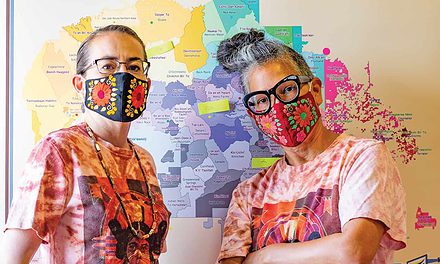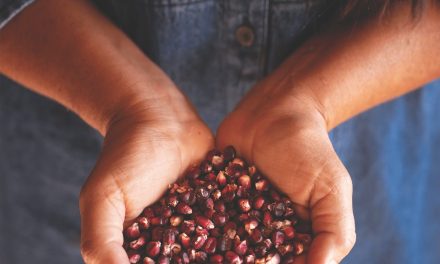

Siddiq Silguero, Armando Rivera, and Juan Gonzalez, core farm team at La Plazita Gardens.
1 LESSONS FROM THE GARDEN
The marigolds are peaking when I visit La Plazita Gardens. It’s a clear, calm October morning, and given the ground we’ve covered—turnips and carrots and toxic influences, self-hatred and soil and ceremony—it’s hard to believe that I’ve only been here an hour when the conversation turns to the colonial ban on amaranth. The amaranth here is an autumn pink, almost pale behind the bright orange rows. The heirloom seeds that former Secretary of the Interior Deb Haaland helped plant are now calabazas: hardy winter squashes in white, orange, deep and pale green.
“They would say it was a devil plant,” says farmer and kitchen manager Siddiq Silguero. Amaranth was banned, explains Jasmyne Muñoz, La Plazita Institute’s food justice navigator, because the nutrient-rich grains, consumed during Native ceremonies, were a source of power. “They were also banning the ceremonies,” adds Juan Gonzalez, farm lead and master gardener.
Growing amaranth here makes sense; reclaiming culture is central to the work at La Plazita Institute. The nonprofit, founded in Albuquerque’s historically agricultural South Valley in 2004, is rooted in the philosophy that la cultura cura, culture heals.
Amaranth is a companion plant, a teacher, and sometimes, the team admits, a pretty annoying weed. It’s also tempting as a metaphor: Amaranth is tenacious. Despite colonizers’ efforts to suppress it, the plant, now recognized as a superfood, survived. And the work at La Plazita is rooted in finding hope and possibility in what, and whom, many in society have written off.
“I looked up to killers and people that sold drugs. I sold drugs, I sold crack, I sold coke, I sold weed,” Silguero says, describing his teenage years. “I went to prison for armed robbery and selling drugs. I went to the federal penitentiary for possession of a firearm. . . . So, like, my life, it wasn’t in the garden at all,” he says. “Now I have kids, now I’m a dad, now I’m a leader in the community. Now I’m a farmer. I never saw myself as that.”
Like many farms in the South Valley, this one feels like a secret garden. It’s messy and beautiful and productive in the way that only small, diversified farms can be. It’s also, as Silguero points out, a classroom. At the south end, there’s a gathering place, a circle of seating with a whiteboard filled with words and phrases that resemble notes from a codex.
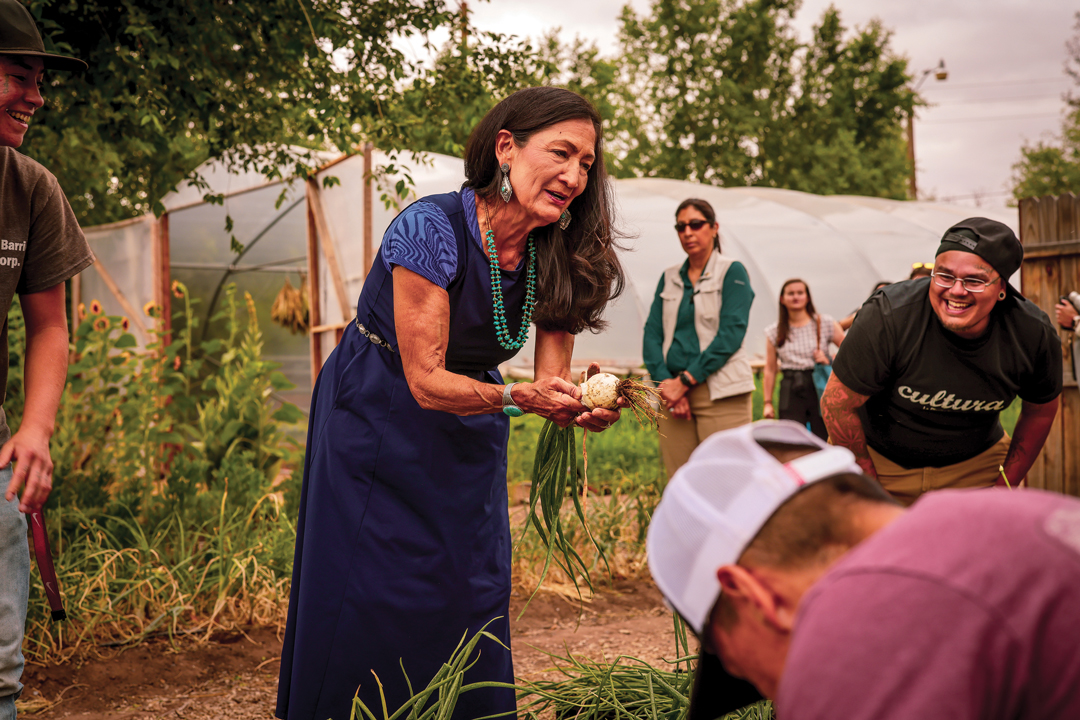
Deb Haaland with Siddiq Silguero and members of the Barrio Youth Corps at La Plazita Gardens, photo by Lonnie Anderson.
“The farm program originated as a way to give system-impacted or previously incarcerated people an opportunity to put some money in their pockets,” says Silguero. Now, the program has a small, full-time staff who, with the help of the Barrio Youth Corps, tend this garden as well as one at Bernalillo County’s Sanchez Farm; processes vegetables at the kitchen at La Plazita’s headquarters; and distributes vegetables, at no cost and no questions asked, to members of the community every Friday. They also sell some produce to the Bernalillo County Youth Services Center, the state’s largest juvenile detention center, where Muñoz leads a nutrition and garden program.
Visiting with members of the Barrio Youth Corps, funded last year through the Department of the Interior, was the occasion for Haaland’s trip to the farm in June 2024. La Plazita’s philosophy of healing through culture resonated with Haaland, a recovered alcoholic and the first Native American to serve as a US cabinet secretary. In addition to working with the farm program, the corps members, all system-impacted youth between the ages of seventeen and twenty-seven, also do some conservation work with the Ancestral Lands Conservation Corps.
“The earth gives us everything that we need to sustain ourselves. And I think that growing up, especially in the inner city, we’re so far removed from that,” says Silguero, who’s from Albuquerque’s International District and, like many youth he’s worked with here, had little access to fresh vegetables, much less to the experience of watching food grow from seed. “Yeah, we saw spinach on Popeye, but we never seen it grown,” he adds. “So to have the kids come in here and work the soil, get their hands dirty, plant the seeds, and then harvest the vegetables, process them—that’s what we call medicine.” Sharing knowledge and talking with the community, Gonzalez says, is also therapeutic. “That’s something that we take pride of, being able to share this fruit with everyone.”
Gazing over the rows, Muñoz reflects on how she sometimes looks at her work as “a full farm-to-table experience.” Because the use of tools at the detention center is limited, she often preps food in her kitchen at La Plazita’s headquarters, then guides the youths inside—some as young as eleven and twelve—in putting it together. “A lot of the work that comes from the programming is palate development, knowledge on what kind of nutritional content each vegetable holds, and then, how does that influence your mood? Because we deal with a lot of children who have behavioral health issues, we deal with symptoms of anxiety and depression. So using food to combat that . . . it’s kind of like building nutritional value.”
A few weeks later, I caught up with La Plazita’s founder and executive director, Albino Garcia, whose own lived experience underpins the nonprofit’s mission and work. Quoting Greg Boyle, the LA gang interventionist who founded Homeboy Industries, Garcia said, “Nothing stops a bullet better than a job,” then clarified, “Nothing sustains stopping a bullet better than a meaningful job.” And, he said, “There’s something meaningful about putting food in the mouths of others.” Turning back to the Barrio Youth Corps, he said, “A couple of them have car payments now, they pay insurance, they’re renters. And they’re doing meaningful jobs. Why can’t we build more of that up rather than more incarceration?”
That October morning at La Plazita’s headquarters, Muñoz met me in the little plaza formed by the buildings that house their various programs. We talked about the healing role of ceremonies—there are two sweat lodges onsite, one Lakota style and one Aztec—and bent to pick some sage from the medicine garden. As I rubbed it between my fingers and breathed in its pungent, soothing scent, she described the herb as a grounding force, not only for her students but for herself. Plant medicine, she said, offers a different way of connecting and being accountable for our actions. I crawled into the temazcalli, an earthen dome with low entry points facing east and west. Briefly, I felt inarticulate fear, then a flood of calm.
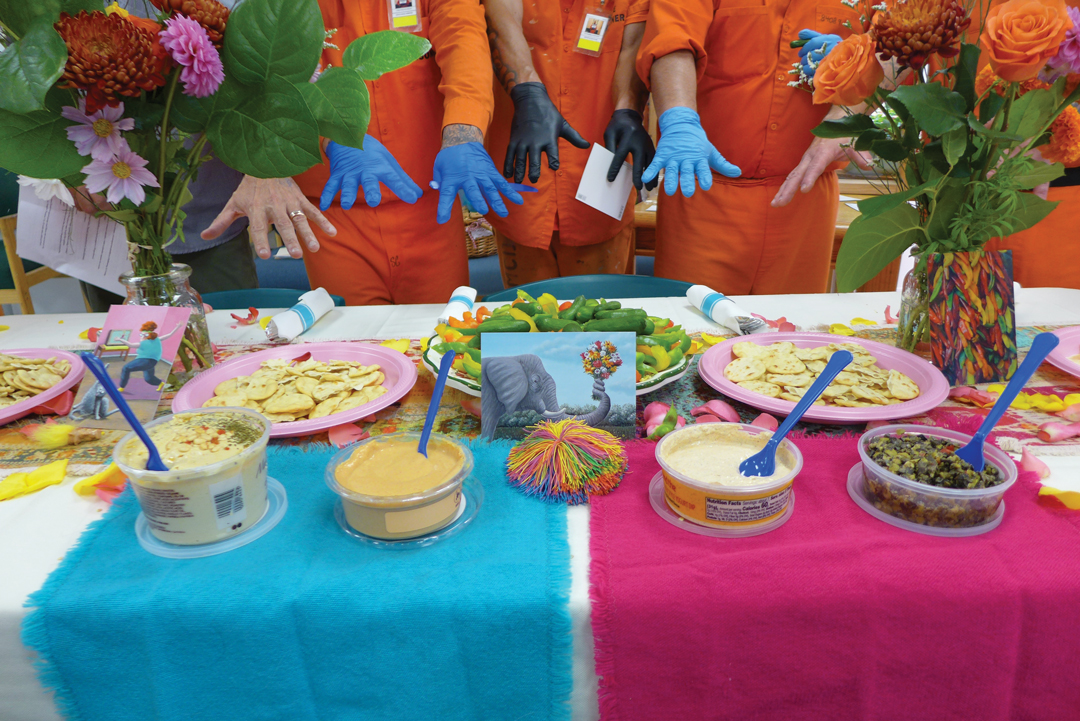
Seed & Bloom students with mezze and bouquets, photo by Briana Olson.
2 A FAR & AWAY PICNIC
It’s lunch hour when I pull up to Penitentiary Road on Highway 14. Like many, I tend to ignore this stretch of highway, but it feels uncomplicated to enter the Penitentiary of New Mexico. At the entry gate, a guard comments on my earrings as he checks my ID, then tells me that the MRU (minimum-restrictive unit) will be on the right. Views are long as I pass staff residences and a building emblazoned “Prison Industries”; landscaping is minimal. The MRU itself is unassuming, essentially a gray rectangle ensnared with razor wire, and a small yard abuts the fence that runs between the building and the parking lot.
Inside, I find Gunjan Koul, founder and director of Seed & Bloom, a horticulture and culinary arts program that’s been operating in the prison since spring 2024. Koul came to horticultural therapy as a nurse working in patient education in New York City; she did a residency at the oldest existing prison garden in the US, arguably the best feature at Rikers Island, and then worked with youth detention centers in all five boroughs before moving to New Mexico.
The makeshift classroom is bright and festive, with stations set up at four tables, each holding a basket full of ingredients. I mill about, hearing from one student about his vision for a transitional program with tiny homes and greenhouses for people to grow and be able to feed themselves when they first get out of prison. Then I sit down next to a large vessel filled with blooms—marigolds, orange roses, baby’s breath—and inhale their rich aromas as Koul presents an overview of the day’s class. “This event is a celebration of your spirit,” she says.
One of the students’ first tasks is to put together a bouquet for their table—something they tell me they’ve practiced in two previous sessions, which might explain how naturally they go about it.
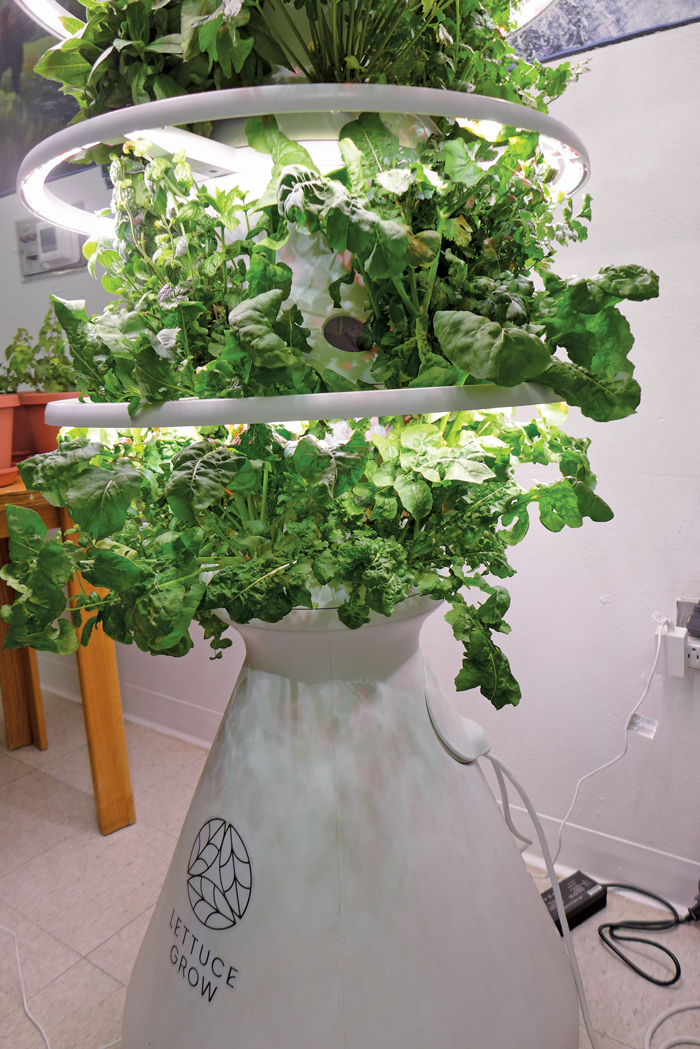
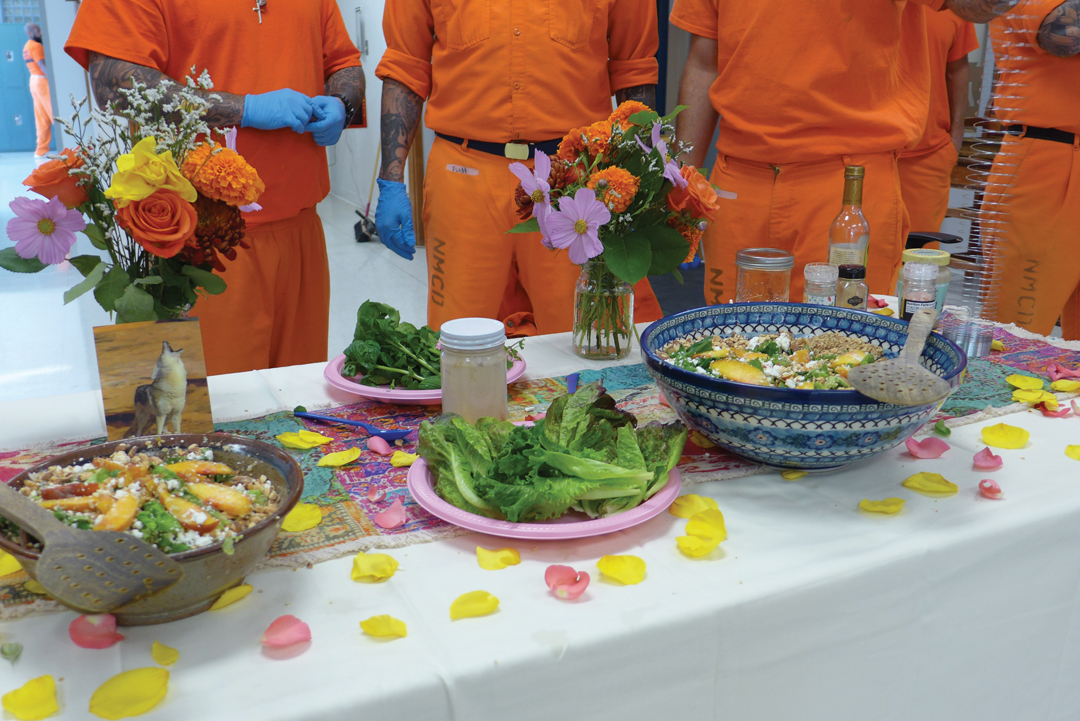
Hydroponics tower and Seed & Bloom students with freshly harvested greens, photos by Briana Olson.
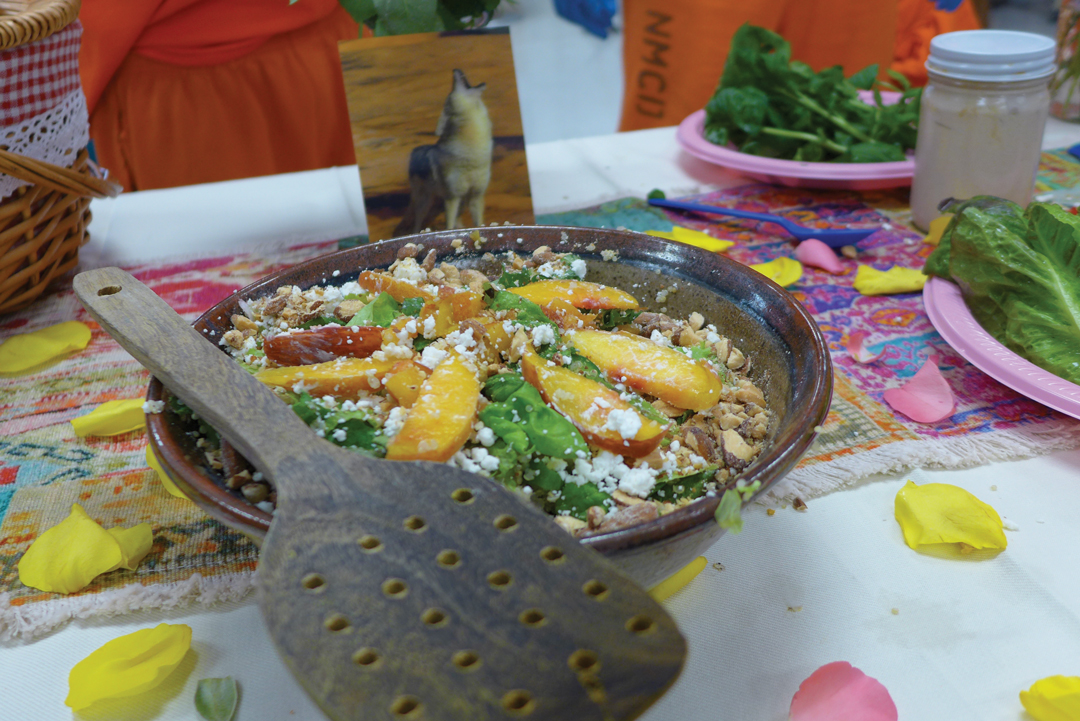
Because the kitchen is available only in the evening and access to tools in this room is limited, Koul has designed a mostly raw menu and brought some premade components. A bottle of white vinegar, a jar of tahini, and a container of chopped almonds are lined up on the table where one group has been assigned to prepare a salad made with quinoa, peaches, and greens. At another table, students chop bell peppers and cucumbers using a plastic butter knife.
As the students assemble their dishes, they tell me what appealed to them about this class. Many have a personal connection to growing: a grandfather who grows chile, a mother and girlfriend who love plants, growing up with a garden or in a farming community. One student says he’s writing a prison cookbook called “Shrimp Soup,” with tips on how to create kitchen tools using resources available in prison, like turning an empty can of Nescafé into a shredder. Another describes his plan to go off grid and be self-sufficient when he gets out. Growing food, he says, is “a good trade to know—maybe the best one,” and he wants his kids to have that skill.
Students have already completed a food safety course with New Mexico Grown, in the hope that they can sell produce they grow through mobile markets and/or to the prison itself. First, with the help of Ashokra Farms, a handful of students will repair two onsite greenhouses; then the whole class will test growing conditions with winter crops. In the meantime, they’re taking lessons in hydroponics from Charlie Schulz, academic director of Santa Fe Community College’s Controlled Environment Agriculture Program. Partway through the meal preparation, Schulz leads a huddle by the hydroponics tower. He quizzes students on what plants need—CO2, light, water—and reviews the basics of managing the tower, then shares one of his earliest lessons in gardening: You always give the first harvest away.
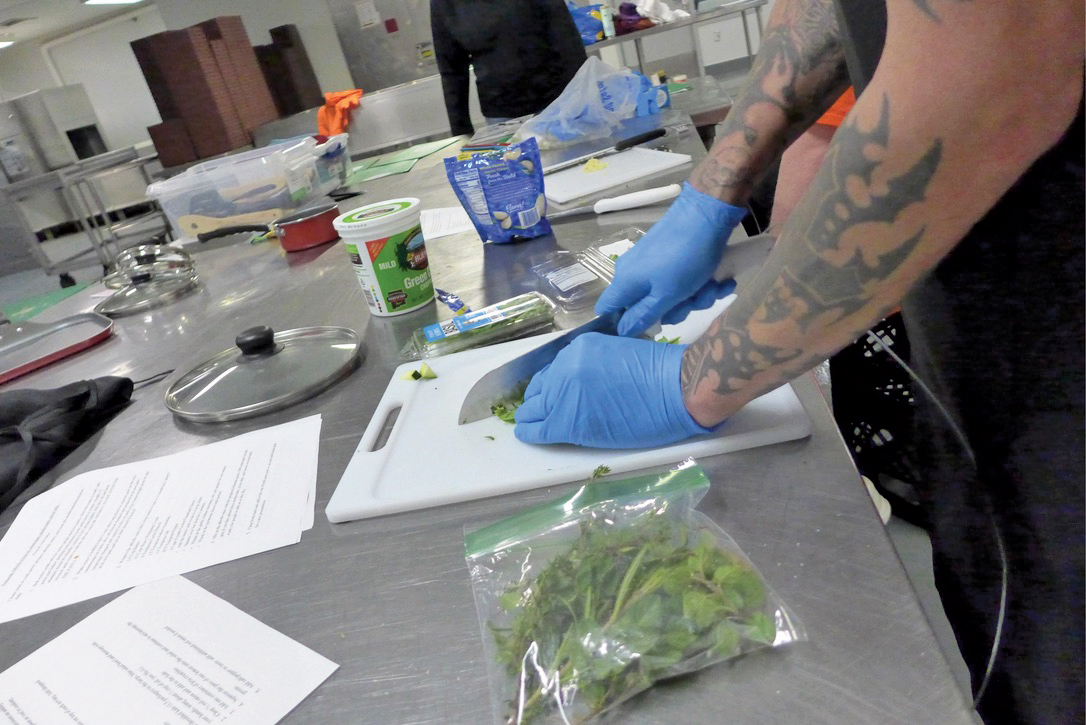
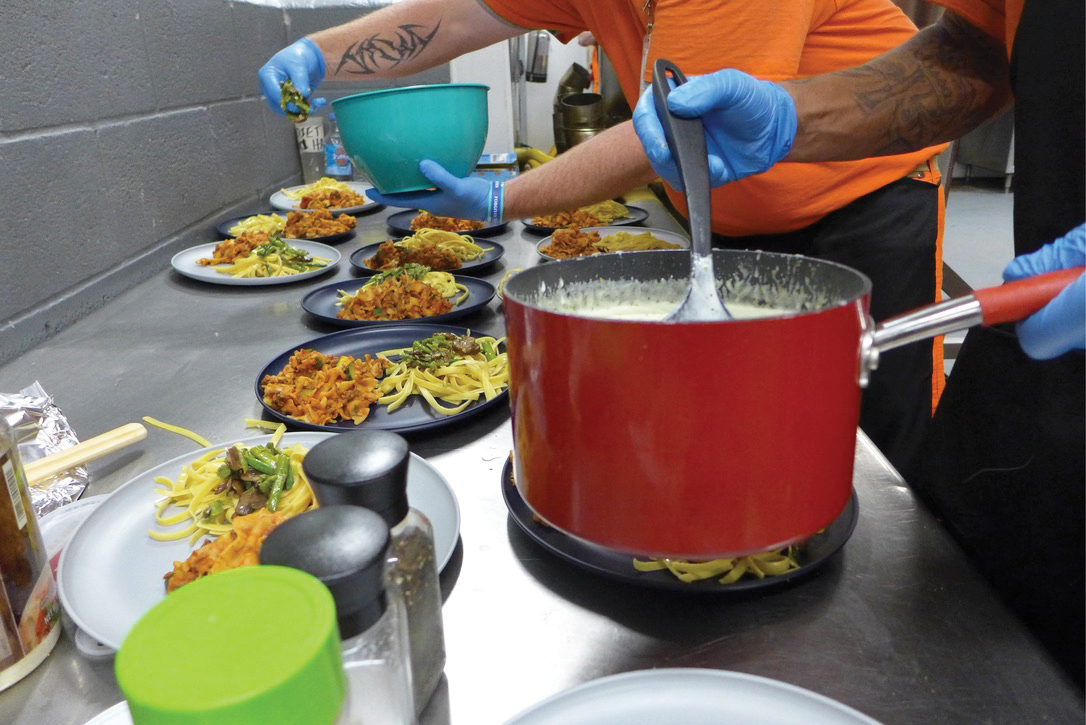
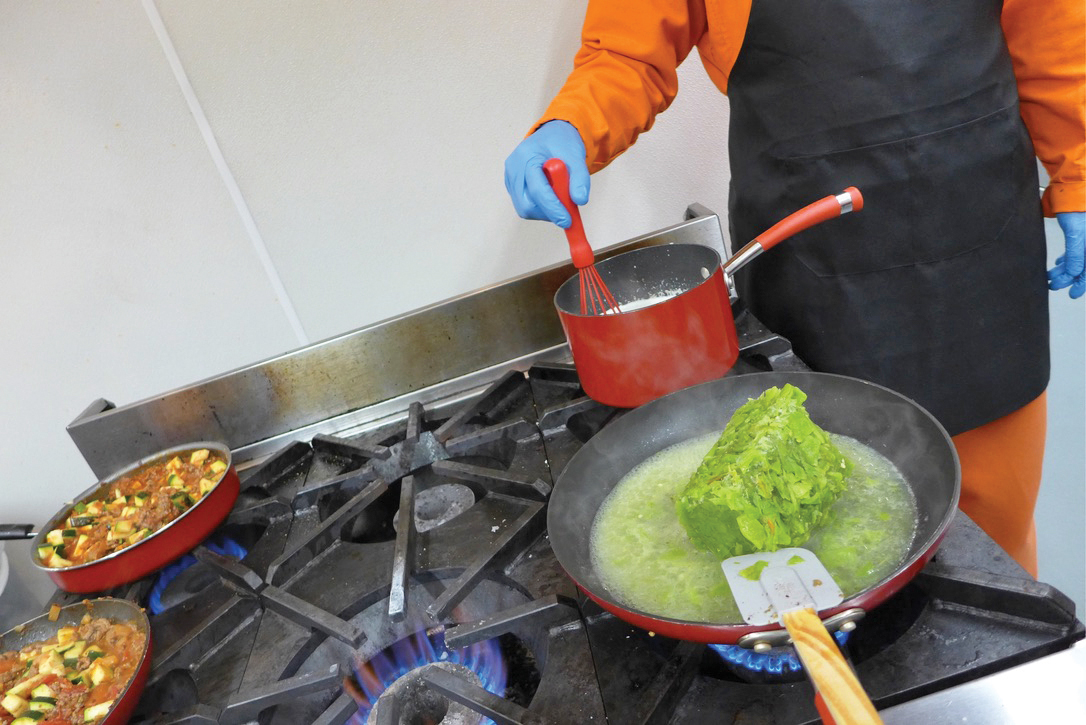
Scenes from a Seed & Bloom session in the kitchen at the state penitentiary; quinoa salad for Seed & Bloom’s Far & Away Picnic. Photos by Briana Olson.
Central to Seed & Bloom’s mission is that the participants themselves derive something from their work, that it be “a food program that feeds the students in the program.” But as all growers and cooks know, there is joy in sharing, and Deputy Warden Ralph Lucero, roaming the room, is pressed to partake of the dishes the students have made.
Later, Lucero tells me that for the first eighteen years of his career, he was old school: “Let’s lock them down and don’t let them do nothing.” Then a warden made him participate in a seminary program and he saw how it changed people’s lives, made them accountable, and decreased violence. Now his vision is to offer as much programming as possible, to increase the chances of success on the outside, because most incarcerated people will get out, “and they’re going to be my mother’s neighbor, and I would rather have a productive member of society, know that I gave him the tools to be successful.”
As the room loses its adornments after the class, Koul draws my attention to the way it normally looks: bureaucratic and beige. It strikes me that teaching her students how the accumulation of details creates an atmosphere is both a lesson in professional presentation and an exercise in imagination.
A month later, when I return to attend a Seed & Bloom session in the prison’s kitchen, the students are even more self-directed. At one point, a student appears with a kitchen towel tossed over his shoulder and offers me a sample of the asparagus that will be added to one of the dishes, a spin on fettuccine alfredo inspired by his own recipe. Food and joy, food and power, food and connection, food and beauty—these were prompts for reflection assigned to each group at the Far & Away picnic, but tonight I witness something else: pride.
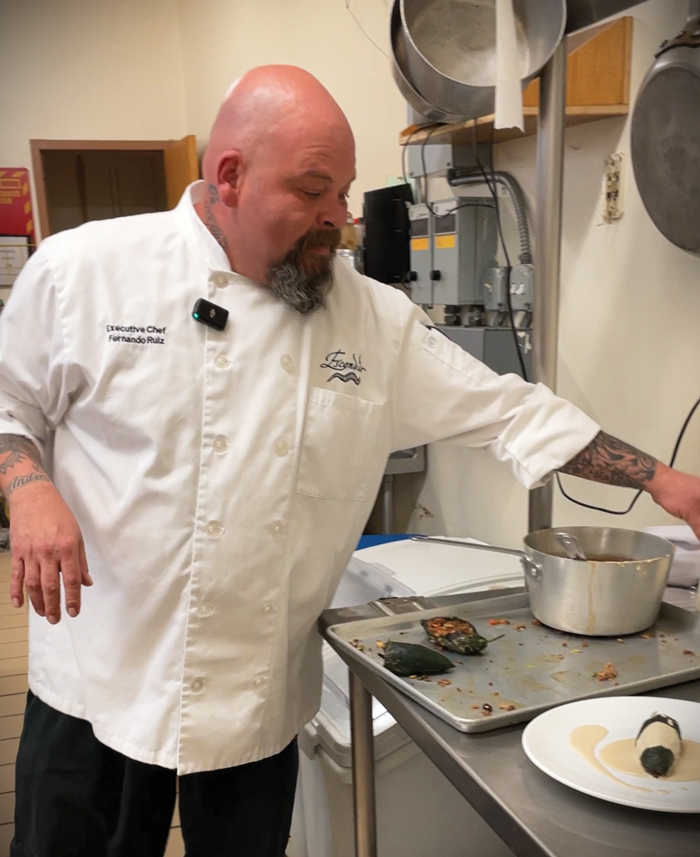
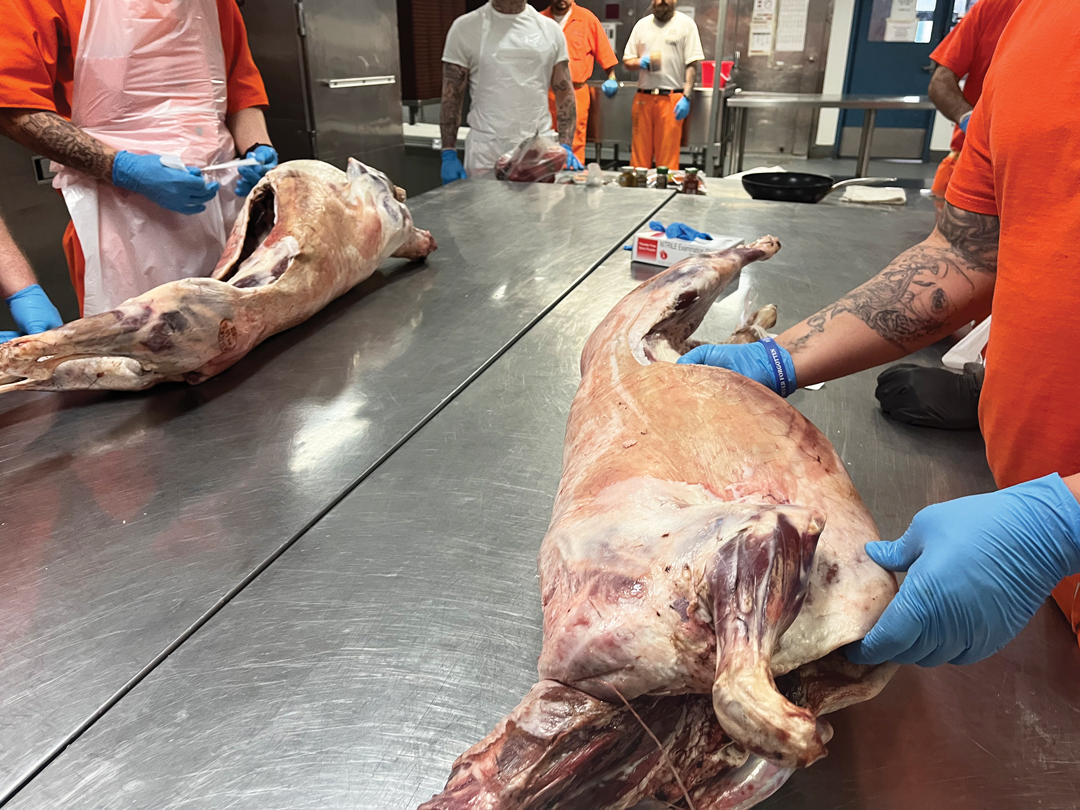
Chef Fernando Ruiz in the kitchen at the state penitentiery; EINNM culinary program students prepare to break down whole lamb. Photos by Brittany Roembach.
3 AMENDS, WITH A SIDE OF TACOS
“I don’t know what it is about prison or jail, but you’re always gonna be hungry,” says Chef Fernando Ruiz. We’re sitting on the patio at Escondido, talking about the path that led him here. With us is Ralph Martinez, his partner in kick-starting a culinary program in the penitentiary and creating the nonprofit Entrepreneurial Institute of Northern New Mexico (EINNM).
Ruiz talks about the perks of working the kitchen in prison—all the food you want, occasional access to T-bone steaks, food to trade for cigarettes—and about his teenage years, when he embarked on what could have become a life (or death) sentence but instead became the detour that led him to the life he has now, celebrity chef and co-owner of this restaurant.
“I grew up in Phoenix, in a little town called Guadalupe,” he says. “I got jumped into a gang at thirteen. I got shot when I was fifteen. Started selling drugs at thirteen, carrying guns at fourteen. First time I got busted I was fifteen, and I got busted with a pound of methamphetamines, a quarter kilo of cocaine, and four stolen guns. At fifteen.” Eventually, he ended up in Maricopa County’s infamous Tent City jail, angling for jobs in the kitchen. There, he discovered that he could cook, and that cooking was fun.
Martinez tells me an inverse but parallel story: As a young father, he became addicted to cocaine and heroin and, within five years, lost everything. “I lost my family, I lost my home, I lost my self-identity.” Homeless, he spent six years living under bridges, in the bosque, and in and out of jail. “I remember I would get clean when I was in jail. I would start looking good, thinking good, and I would say, ‘You know what? This is it. When I get out, that’s it. I’m done,’” he says. But he’d burned bridges with family and friends, so after a few days out, feeling defeated, he would turn back to the life he knew.
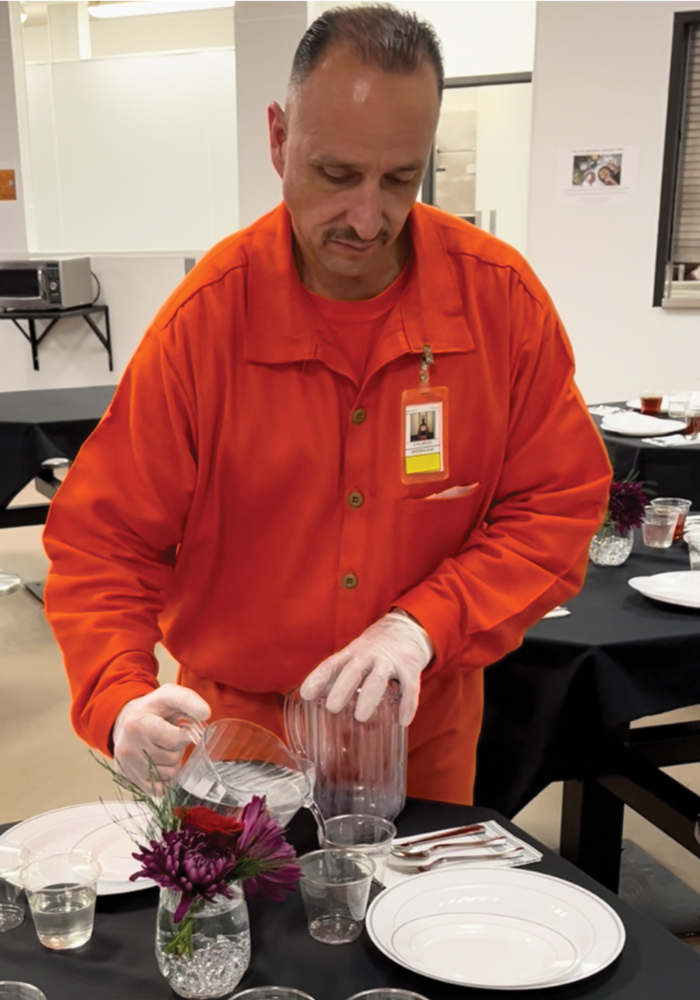
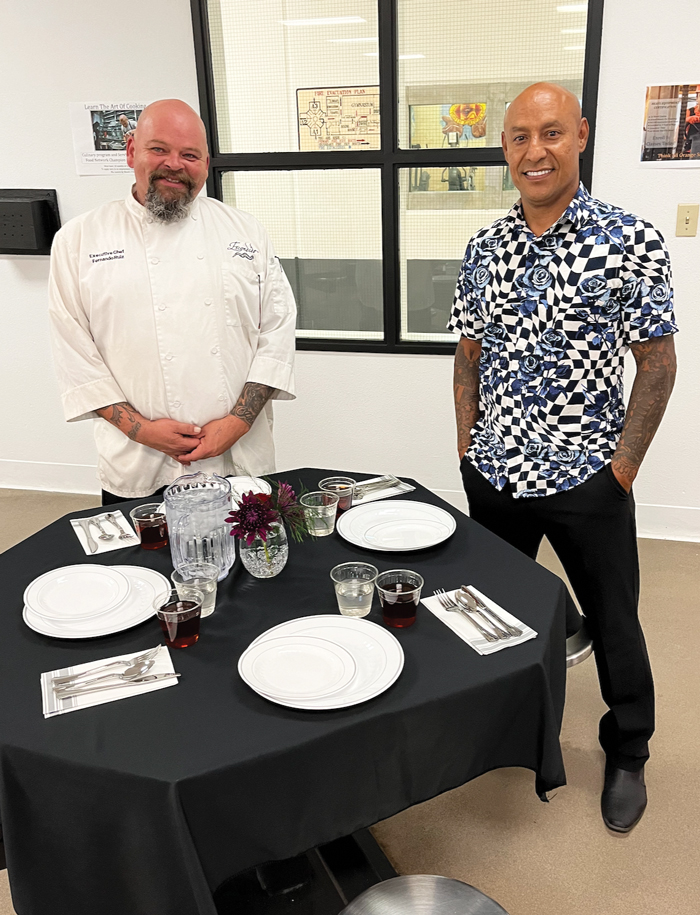
Miguel Tapia setting a table for the formal dinner at the end of the EINNM culinary program’s first in-prison session; Chef Fernando Ruiz and Ralph Martinez. Photos by Brittany Roembach.
That feeling, of being set up to fail, is what Ruiz and Martinez hope to counter not only with the culinary program inside the prison but by building pathways to employment for participants who get out. The model starts here, at Escondido, where Ruiz has already made a habit of offering jobs to folks that usual hiring protocols might filter out. Among the restaurant’s team members who have been arrested or incarcerated is one young man who completed a trial run of the culinary program, held at The Kitchen Table Santa Fe in spring 2024. And they tell me they’re planning to pick up Miguel Tapia, a top student from the first in-prison cohort, right from the prison gates.
When Ruiz first floated the idea of a culinary class in the prison, the two say, the restaurant wasn’t even an idea. During the pandemic, they’d collaborated on distributing Christmas gifts and care boxes to kids and seniors in Española, and Martinez, as the cofounder of Española’s first homeless shelter, was versed in making a case to elected officials. They got it off the ground with the help of Jamai Blivin, cofounder of EINNM and founder of the workforce-focused nonprofit Innovate+Educate—and no shortage of persistence.
“I didn’t think they would be supportive in any way,” Ruiz says of the prison, but “come to find out, there is a ton of programs in there . . . and apparently they’d been looking for someone to do a culinary program.” One reason for the interest, according to Deputy Director of Reentry Haven Scogin, is that they’re looking at “what positions have need, what industries are growing, and how can we create a workforce inside the prison facility that can meet the needs of the employers in the community?”
That doesn’t mean that the corrections department is directly funding these programs. The first material support for the culinary program came through Andrea Romero, a state representative for Santa Fe County who allocated $75,000 in seed money. Once the pilot at Kitchen Table was underway and the department officially approved the course, Blivin was able to help secure funds for the first in-prison session through the Workforce Innovation and Opportunity Act.
In the course, which met three evenings a week, students butchered whole chicken and lamb, something Ruiz first learned to do on his grandfather’s ranch in Sonora. They made salsas and tacos that attracted the attention of corrections officers. They learned the basics of culinary math as well as the basics of professionalism and resume writing. “We taught them pro skills without them even knowing we were teaching them pro skills,” Ruiz says. And according to Warden Chelsea White, the students also took away something as invaluable as it is intangible: evidence that somebody believed in them. As Scogin puts it, “It has a different hit to inmates when it’s someone from their own communities who come in, who say we want you, we’re going to educate you. And when you leave here? I want you to work at my business.”
Martinez glows as he describes the five-course meal that crowned that session. Participants prepared the meal and set the tables, and one joined high-level guests, from top prison brass to legislators, at each four-person table. “By this time, we already went through the whole pro-skills portion of learning how to conduct yourself professionally versus privately, right? Look at somebody in the eyes when you’re talking to them, speak with confidence.” Still, the graduates were nervous. Ultimately, they got a boost from learning “that these people that sit in high places are just normal,” while legislators learned more or less the same from them.
When I talked with Ruiz and Martinez again, Tapia had walked free two weeks prior, and it was his first day at work at Escondido. He was floored by the support he’d been receiving—they’d helped him sort out basic needs, from housing to securing an ID to opening a bank account, and launched a GoFundMe on his behalf. Speaking of the batch of house chorizo he’d made, Tapia commented that Ruiz has a good recipe. But the chef was intent on giving credit where it’s due: “Miguel just made it, he tasted it, and I said ‘You made it.’”
Ruiz expressed his thanks to the community for their support—and for listening. “I hope they prosper from it too,” Tapia said. “The people who’ve helped me, I hope they prosper from it too.”

Briana Olson
Briana Olson is a writer and the editor of edible New Mexico and The Bite. She lives in Albuquerque.