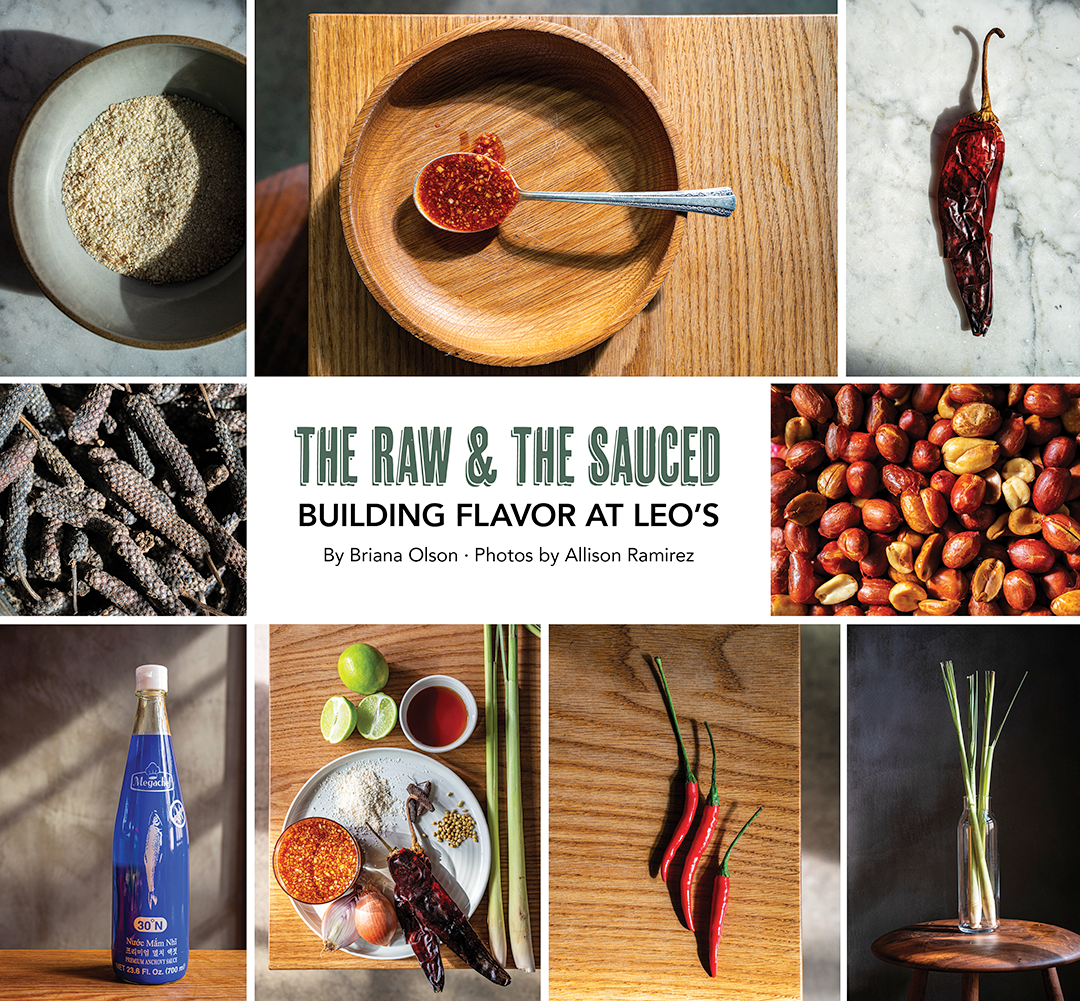
Clockwise, from top left: Toasted rice powder; dressing for nam tok in handmade bowl; guajillo; peanuts; lemongrass; Thai bird chiles; aromatics and sauces; fish sauce; long pepper.
Nothing could be further from sitting down on a tiny plastic stool on a sidewalk in Chiang Rai to eat pork belly out of a plastic bag than slipping onto a smooth walnut barstool to start the evening with a cocktail made from aged rum at a fine restaurant in Santa Fe. And yet Leo’s captures some of the thrill and magic of dining throughout Thailand and Southeast Asia. No small portion of that magic is assembled from flavors that come alive in the mouth as no others in the world: funky, bright, rich, salty, light, sweet, brooding, burning, soft. There’s also the energy, the way the restaurant’s intimate, organic vibe, with traces of the building’s prior lives flickering through, echoes the magic-trick quality of full-service dining establishments that pop up in Bangkok alleyways at 5 pm, only to vanish again overnight. Too, there is the primacy of sharing—sharing not only dishes and physical space but, cliché as it may sound, kindness.
Yes, the dishes on the menu are largely inspired by classics from Thailand and Malaysia, but the restaurant, in other ways, is very much of its place. Built as an auto shop nearly eighty years ago, then home for eight years to Boyd & Allister furniture studio, the restaurant’s design honors the building’s history. As the crisp winter sunlight spills in through the windows, glancing off the oak high top and the marble bar, bouncing over a stack of empty produce boxes, slanting into the tables soon to extend seating into the courtyard, chefs Zak Pelaccio and Stella Achenbach talk about how the project—and the menu—came together. The tale is a uniquely Santa Fe confluence of creatives. The chefs had worked together on a few events; both knew woodworker Jonathan Boyd, who’d preserved the bones of the building when converting it into his studio, and both had visited early on as Boyd worked toward a vision of turning it into a restaurant.
“I was just like, ‘This feels good,’” Pelaccio says of his first visit to the space—and it does. I can’t recall the last time, or another time, when I sat down in a restaurant where the love of making could be felt in every surface, from the seats to the tabletops to the boxes holding the paper towels in the restroom. “Jonathan made these,” Pelaccio says as we talk about their partnership, picking up one of the wooden bowls they’ve brought out for the photo shoot. The chefs, happily, share this passion—for making, for the food of Southeast Asia, for quality materials, for attending to the simplest and most fundamental details: peanut sauce made from peanuts (“not Jiffy!” Achenbach notes), curry pastes made from raw ingredients, “sauces where we hand squeeze all the lime juice.”
As Pelaccio tells it, the working relationship between chefs also evolved organically, with Achenbach effectively taking charge of the project in the months leading up to the restaurant’s opening. “And I was just like, ‘Wow, she’s got it.’ Like, ‘Hey, why don’t you be the executive chef?’”
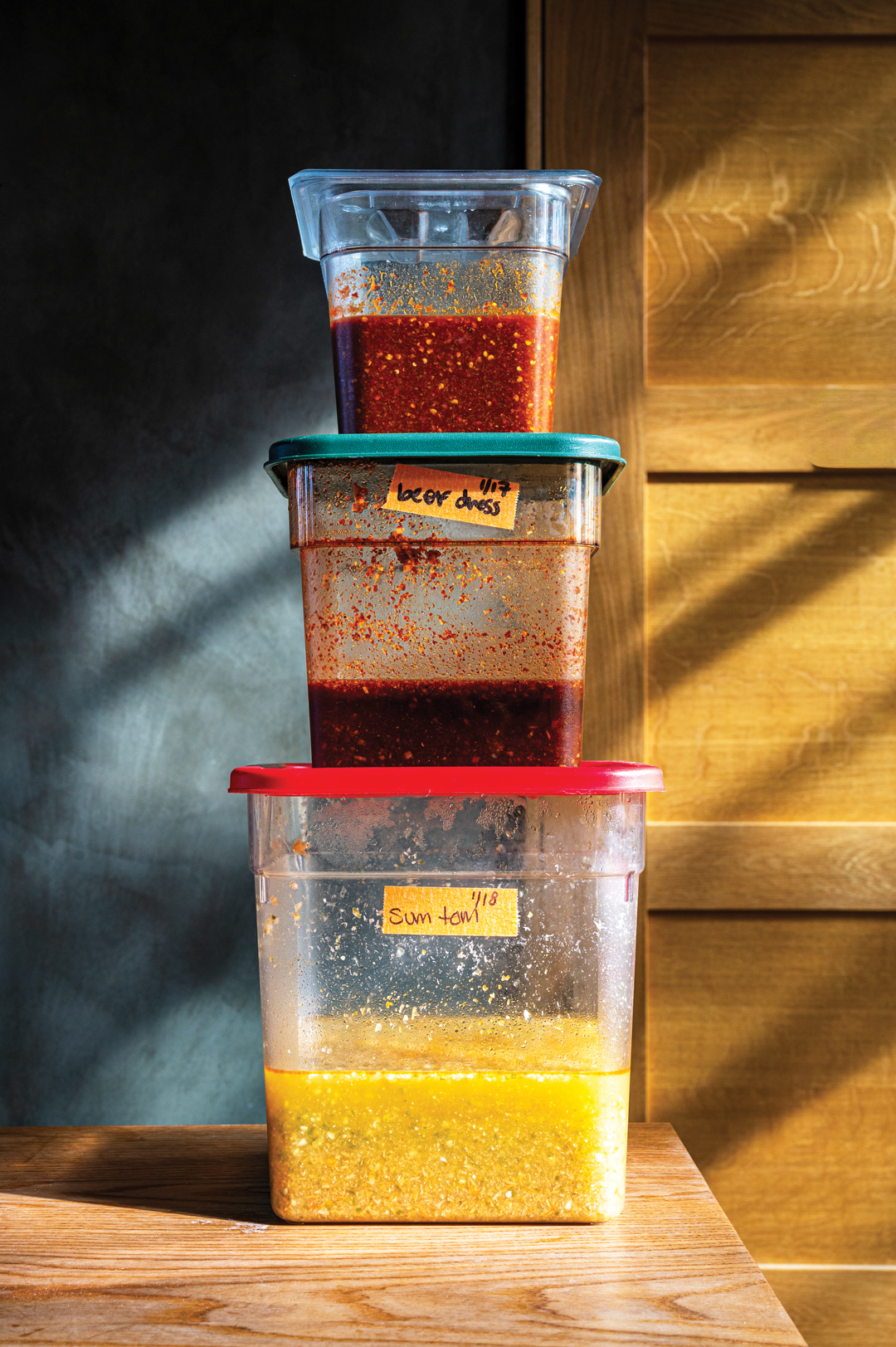
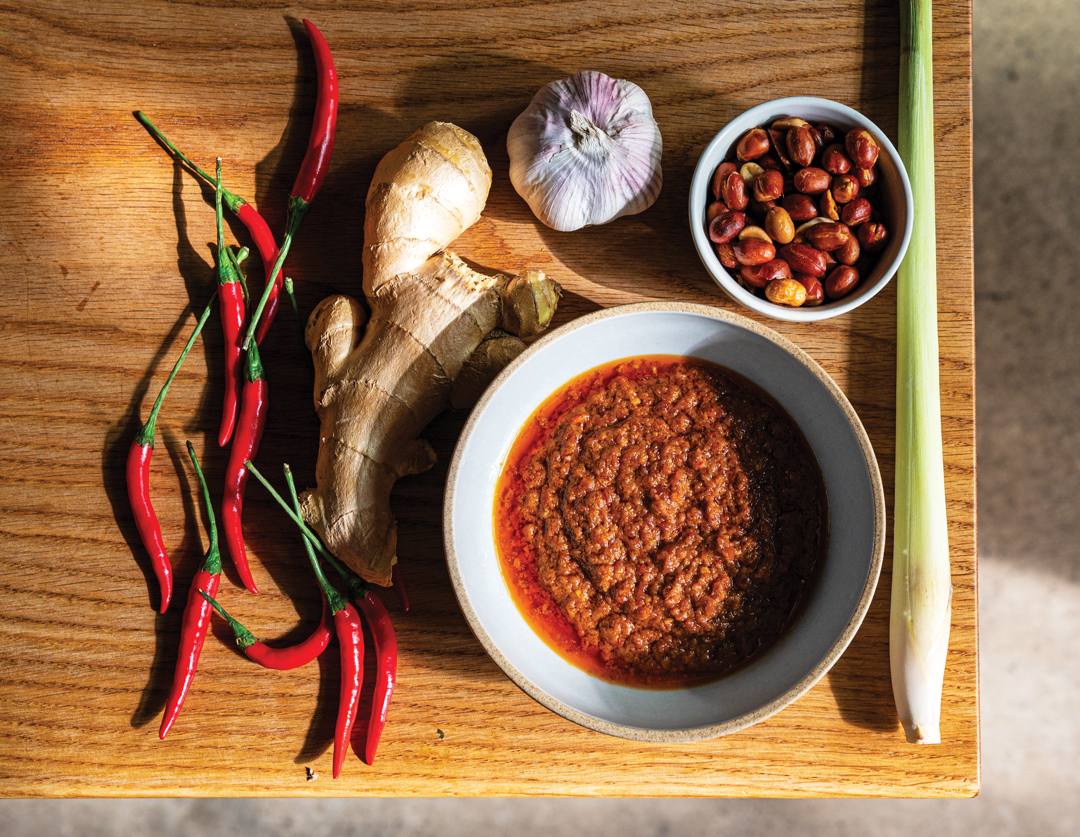
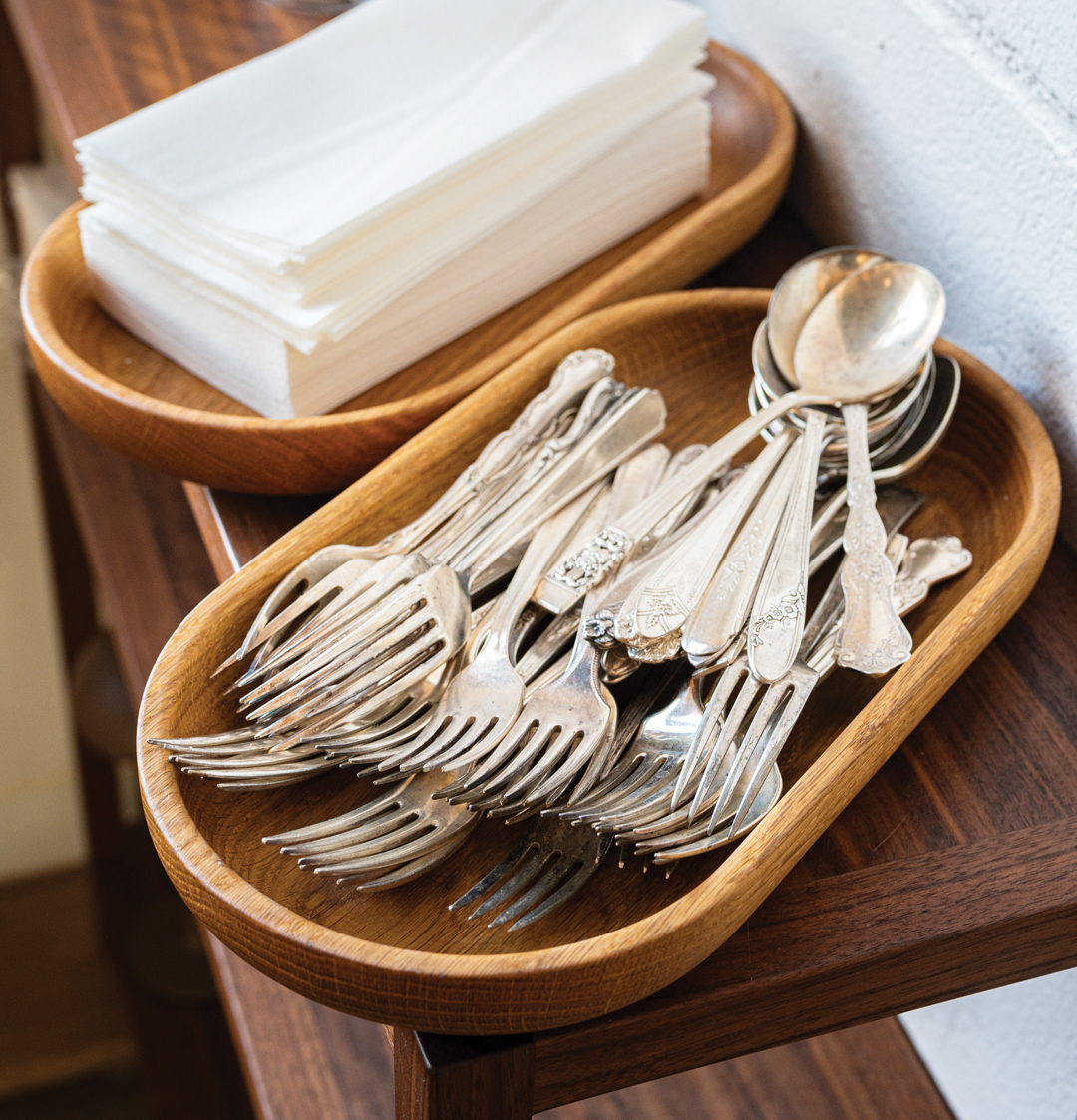
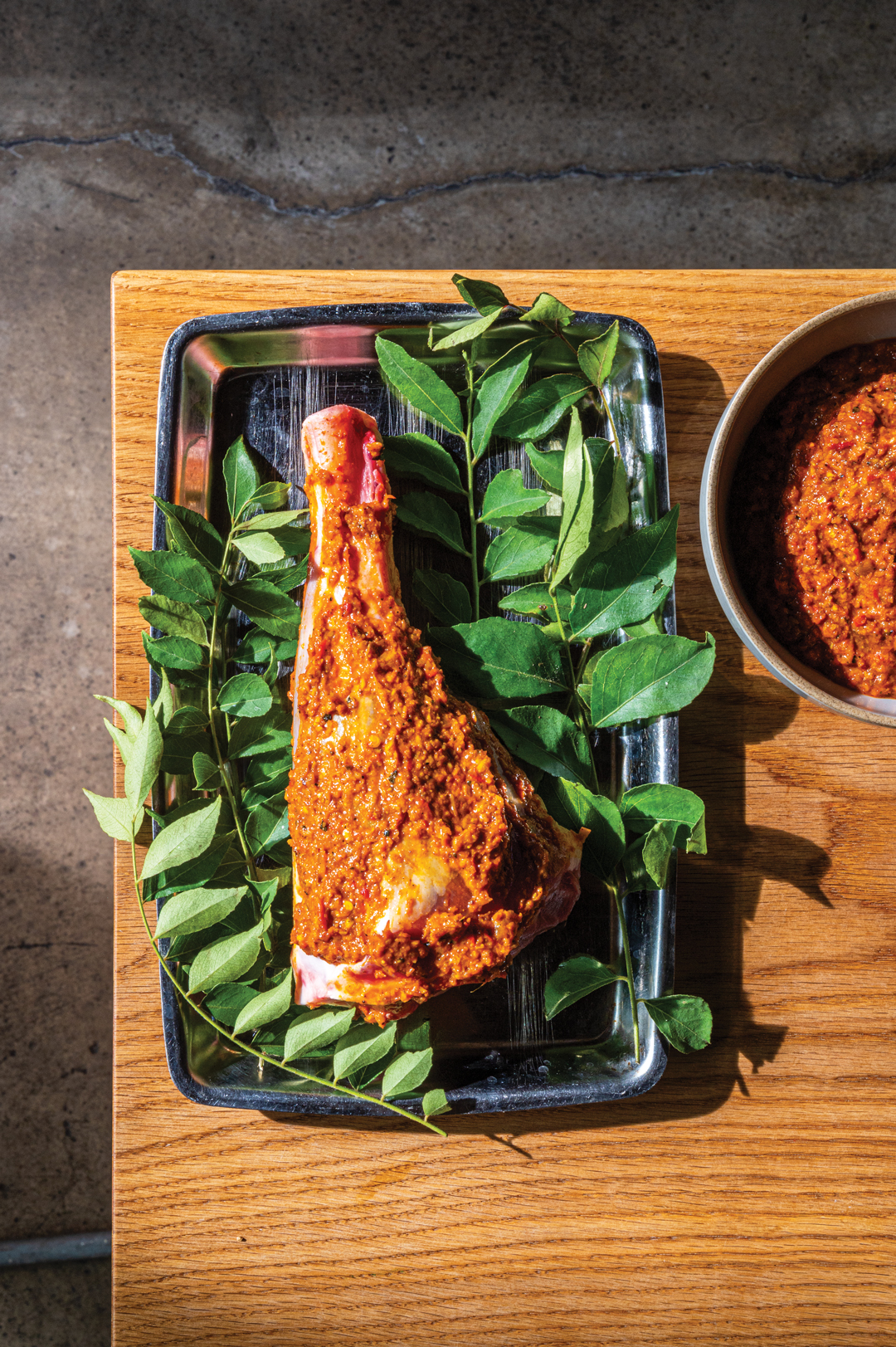
Dressings and sauces; tableware in handmade trays; raw lamb shank with curry paste and curry leaves; peanut sauce and some of its ingredients.
“I think that was unspoken between the two of us, in approaching this restaurant—of course, we’re going to make everything ourselves,” Pelaccio says. “Both of [us] have always been about quality ingredients and the integrity of the practice of actually cooking, and that is incredibly important and rare today.” That ethos informed Pelaccio’s early adventures in drawing from Malay cuisine for the hugely successful Fatty Crab in Manhattan, and deepened with Fish & Game, the farm-to-table restaurant he and his wife Jori Jayne Emde co-owned in the Hudson Valley (earning Pelaccio a James Beard Award) before opening Corner Office in Taos. Achenbach’s resume includes stints at the likes of Blanca in Bushwick and Monti (now Matia Lounge) on Orcas Island, and her time cooking and foraging with terroir guru Johnny Ortiz dates to / shed project’s early days in La Madera. Both, along with Boyd, have traveled widely and share a love for Southeast Asian cuisine. “We’re trying to cook it with an understanding of the Southeast Asian palate, and doing it justice by making everything from scratch,” says Pelaccio, “to build cuisine that is similar to what you get eating [at] a beautiful roadside stall where somebody is making dishes fresh every day.”
Condiments, relishes, sauces—no English term seems to quite encompass the role these components play in Southeast Asian cuisine. The Thai category of nam phrik—which, Pelaccio notes, translates literally as “chile water”—could alone fill a cookbook. And, as he says, “Shrimp paste and fish sauce are the base of all saucemaking, condiment making in both Thai and Malay food.” Both are characterized by the complexity imbued through fermentation, capable of lending notes that range from super funky to the subtlest dash of ocean umami. Both, I’ve observed, are also typically the first ingredients to be removed when adapting Thai cuisine for the American palate, often resulting in dishes that are far sweeter, flatter, and less balanced than anything you’ll likely eat in Thailand. Not so at Leo’s, where even the sum tum is aromatic and exciting, and the menu reads like a carefully distilled inventory of the region’s vast range of sauces.
“I don’t think there’s an argument against food being fun to eat,” Pelaccio says. “I feel like so many cooks get hung up in the technique and what, you know, they have this idea they’re trying to achieve. It’s like, what about the deliciousness? What about sitting down and experiencing your food?” That’s not to say there’s no technique in, say, the silky savory custard of the crab nam prik. But the dishes on the menu are also the fruit of collaboration between two people who love the food they’re making. That love comes through as they talk about using fresh ginger and turmeric rather than powders or pastes, deliberating over their source for fresh curry leaves, and buying whole spices—long pepper, black cardamom, a coriander with high notes of citrus—from the chef-owned spice company La Boîte. It took three months, Achenbach says, to get their vendors lined up.
Just as intentional is what Achenbach calls “the spectrum of spice,” which, along with the distinctiveness of each sauce, makes for a menu designed for endless combinations. There’s the garlicky prik phao that marries the richness of the pork belly bar steak; there’s the nam jim, made with fresh green chile, lime juice, and lemongrass, “an in-your-face bright sauce evocative of beach cuisine in Thailand,” says Pelaccio, which is served atop a steamed dorade piled with fresh herbs. They invite me to take a whiff of the rice powder, toasted with galangal and lime leaves, gorgeously pungent and floral, that’s used to finish the spicy, salty, bright jiao served with the fried chicken. A week later, I’m still thinking about the earthy vibrance of the dressing for the nam tok, made with toasted dried chiles and green Sichuan peppercorns, lemongrass and anise. In other dishes, chile and curry pastes are layered in through the cooking—as with the lamb, slathered with a curry paste made with both fresh and dried chiles, cooked overnight in just enough coconut milk, and topped with toasted curry leaves: a brothy, complex, comforting dish.
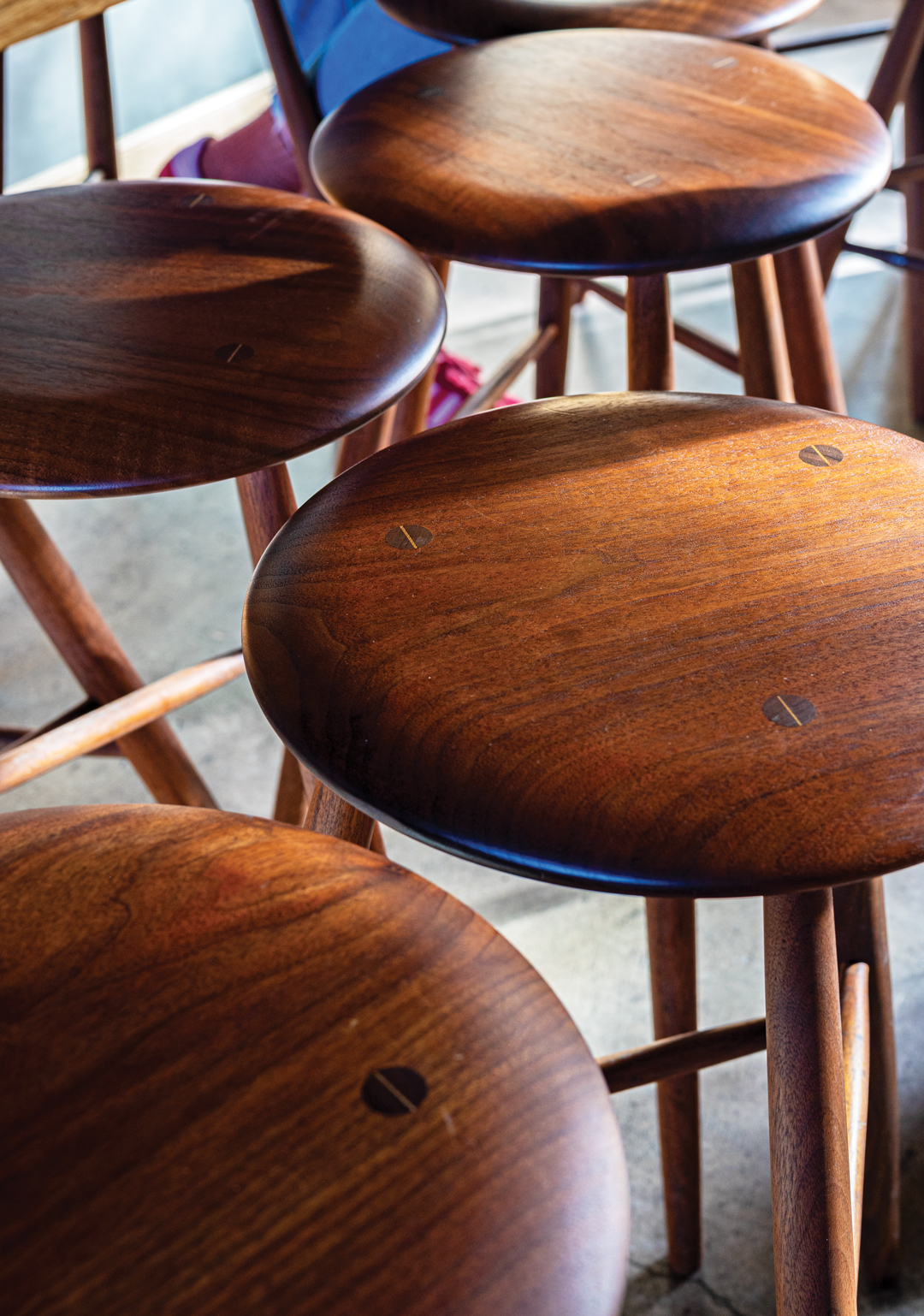
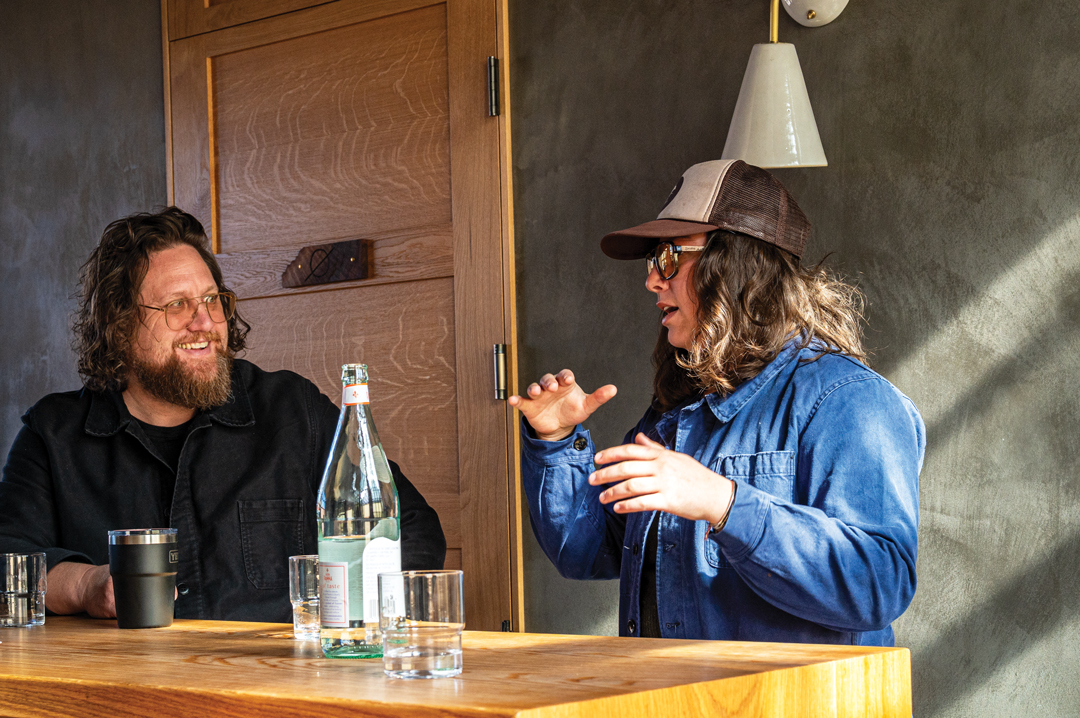
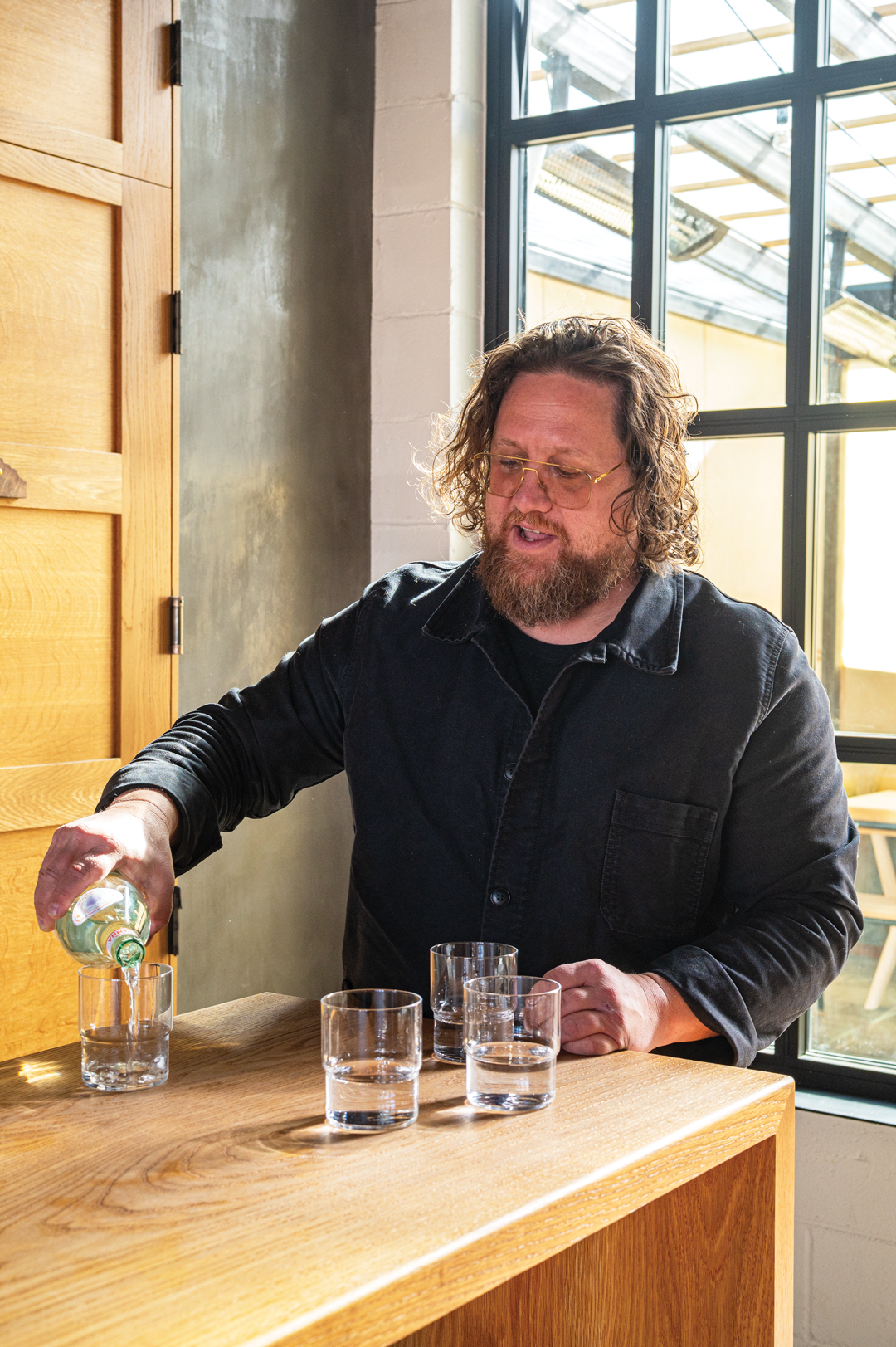
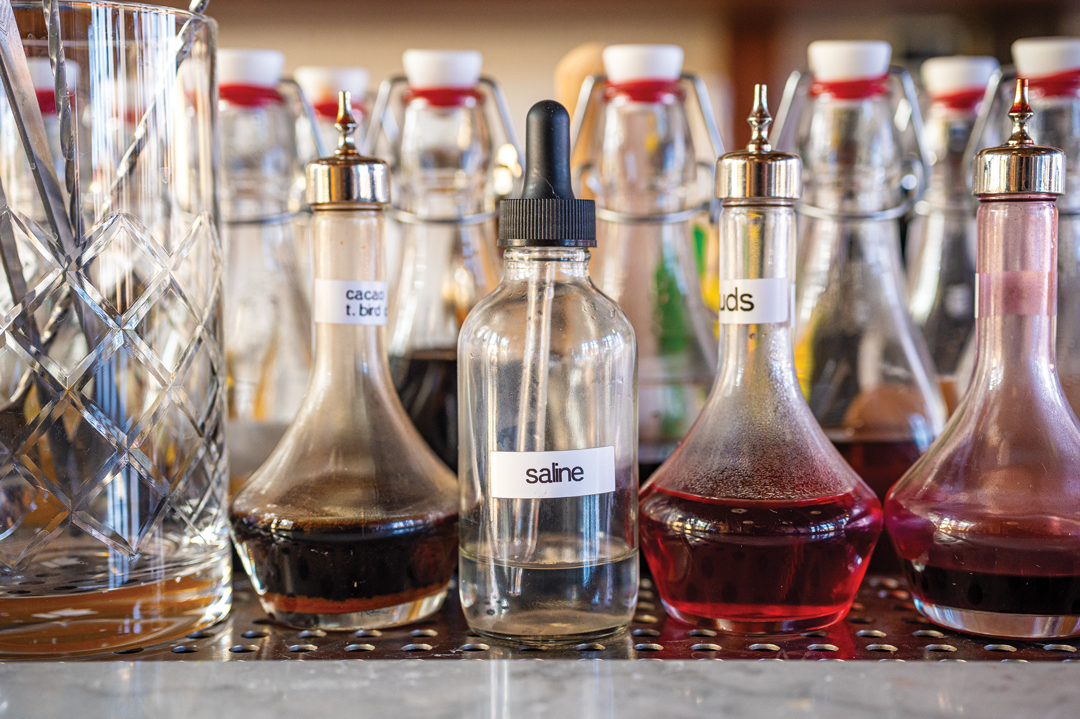
Walnut barstools; co-owner Zak Pelaccio; house-made cocktail ingredients on the bar at Leo’s; Pelaccio with executive chef Stella Achenbach.
Growing up between Taos and New York, Achenbach was fortunate to eat (and work) at amazing restaurants, but she dwells just as much on how she was influenced by her father’s nightly cooking at home. From that, she learned, “Food isn’t just about sustenance; it’s a way that you express care for people.” That sense of care comes through as she reflects on the trade-offs, at least for the moment, of not sourcing herbs locally and, in turn, being able “to buy this beautiful lamb from Antonio [Manzanares, of Shepherd’s Lamb] and serve it at a relatively affordable price,” and “to support this person who’s dedicated his entire life to the craft of ancestral sheep grazing.” Along with Pelaccio, she reiterates a goal to “rely more heavily on local farmers” as they grow.
As the chefs talk about each other, about Boyd, about their kitchen staff, something else becomes clear: The relationships at the crux of this endeavor are as integral to the project as the fish sauce and shrimp paste. “It doesn’t stop at the kitchen,” says Pelaccio, praising third partner and bar program manager Ian Wolff’s deep dive into Japanese whiskeys and aged rums. (I recommend the palmetto, made with Demerara rum and house-made bitters.) “We just brought in a ton of Central European wine,” he says. “It’s kind of a happy coming together of people who are just really passionate about it.”
Before accepting Pelaccio’s invitation to help open Leo’s, Achenbach was taking a break from the restaurant industry to assess and affirm her next steps. Speaking of how long she’s been working toward this goal, and of the various benchmarks she’d set for herself, she pulls out a photograph of her toddler self, adorably decked out in a chef’s cap. Just twenty-four now, with almost half her life already spent working in kitchens, she wanted to take a breath and make sure she was not being carried forward by the momentum of a childhood dream. If the success of Leo’s doesn’t confirm that she’s on the right track—“she’s really a superstar,” Pelaccio says—her ease would seem to. “I’m so content being here,” she says. And I suspect that, too, can be felt in the food.
1200 Hickox

Briana Olson
Briana Olson is a writer and the editor of edible New Mexico and The Bite. She lives in Albuquerque.