
Acequia Case Study
A Project by Jacob White
Coursework: Water, Land, Culture
Inaugural state poet laureate and Embudo Valley native Levi Romero is known for his cultural stewardship of acequias. He’s written of them, codirected two short films on acequia culture, and reflects on acequias, community, and storytelling in the 2023 film Acequias: The Legacy Lives On. In his role as a University of New Mexico professor in the Chicana and Chicano Studies Department, he also teaches about this unique irrigation system in his class Acequia: Water, Land, Culture.
In his courses, students from many disciplines examine what he calls “the acequia cultural ecosystem,” learning about its traditions and practices through readings, guest presentations, and interviews with acequieros, advocates, water managers, agrarians, and family and community members with ties to acequias.
For their midterm, students are asked to pre-sent a poster board that is a creative expression of acequia culture. One year, students focused specifically on the Santa Cruz Acequia Association. This spring, students posed questions such as “What is the present state of acequias in the state of New Mexico? What is the future of these acequias? Why are acequias important to preserve, and how do they teach us about stewardship of land and water? How can acequias adapt to modern times?”
One student focused on climate change; another focused on the Pajarito Acequia in Albuquerque’s South Valley. A student did their poster board on irrigation practices in Questa. Another student’s poster board was based on their research on the history of acequias in East Los Angeles. Jacob White reported on the acequia infrastructure of Corrales, the homeplace of his maternal grandfather’s family:
Corrales has been home to the cultures and people of New Mexico for countless years. Before the Spanish made their imprint on the landscape in the 1700s, Indigenous peoples stewarded this very same landscape. Land use in New Mexico is often predicated first and foremost by the presence or absence of water. Over time the landscape of Corrales has been transformed into a cultural and agricultural oasis through the integration of acequias among the landscape sustaining people, the land, and the relationships that engage both. This cultural landscape has evolved to adapt to the ebbs and flows of this forever shifting physical landscape.

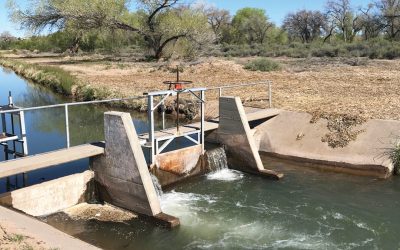
Corrales, like many other acequias in the Middle Rio Grande, once had a presa, a headgate, directly connecting these acequia systems to the river. When the Middle Rio Grande Conservancy District (MRGCD) was formed in 1923, they consolidated most of the existing headings, totaling more than 79, into one. As a result, the Corrales heading was removed, and the Corrales Siphon became the new headgate for the Corrales Main Canal. To consolidate the Corrales heading into the newly formed MRGCD system, they constructed a wooden siphon 5 feet in diameter. It was completed on August 19, 1933, and remained operational for over 90 years! The siphon transported water diverted upstream on the east side of the river at the Angostura weir via the Albuquerque Main Canal under the river, through the siphon, and into the Corrales Main Canal on the west side of the river. However, in recent years Corrales has been using pumps to pull water into the canal at Siphon Beach due to a failure of the original siphon.
The failure of the siphon hasn’t been without controversy, amplifying the impacts of an increasingly unpredictable climate and an inconsistent source of water along the Rio Grande. This in recent years has led to shorter irrigation seasons and an increase in irregular water deliveries, creating a difficult situation for parciantes and water managers alike.
Read Other Acequia Case Studies From This Issue

Tending the Seeds of Land-Based Leadership in Northern New Mexico
Poet and Taos native Victoriano Cárdenas talks acequias, farming, and genízaro identity with Dixon grower and mayordomo Joseluis “Agua y Tierra” Ortiz y Muñiz.
ACEQUIA CASE STUDIES
Here, we’re sharing reports on a few of the many ways that citizens and community leaders are working to preserve the acequias.

Prototypes: Tending to the Acequias
Emily Vogler experiments with non-concrete alternatives to acequia erosion that could also support the many interconnected functions of the ditches.

Story Riders
The Story Riders program combines bicycles, the natural beauty of the bosque and a sense of community to enrich the lives of young people.
Jacob White
Jacob White is an undergraduate student at the University of New Mexico and works as an ecological restoration practitioner for the nonprofit Rio Grande Return. He is driven by his passion for the outdoors, collective community transformation, environmental justice, and trying to foster a more sustainable environment. One of his favorite childhood memories is going for walks with his grandparents along the acequias in Corrales. He now often runs along the Corrales acequias. White continues to steward land in Corrales as his family has in the past.