
Acequia del Llano in Dixon, photo courtesy of Joseluis “Agua y Tierra” Ortiz y Muñiz.
An acequia runs with pure, cold water from the Sangre de Cristo Mountains, soaking a field of corn under the watchful eye of a parciante. Farmland is lush in the high desert of northern New Mexico because of these unique systems of irrigation and the tender care of their traditional stewards.
I’m native to Taos and while I now live in Albuquerque, I grew up learning how to irrigate from my grandfather, drawing water from the Acequia del Medio del Prado and the Acequia Madre del Prado to water our fruit orchards and alfalfa fields. I followed him all around our fields, learning when to plant, where to release the water, how to steer it where we needed it to go. A lot of kids went to the pool at the youth center to play in the water, but I had acequias in my backyard and that’s where I played—finding fossils and digging for worms, and making adobe bricks in empty SPAM cans. It was the perfect place to grow up, to learn about the ecosystem through a balance of work and play.
“Acequia technology is perfect technology; they are perfect systems. And it’s a social determinant of health: acequias flowing and corn growing,” says Joseluis “Agua y Tierra” Ortiz y Muñiz. “Not only to produce food, but people demonstrating traditional farming is in itself a healing practice. It’s healing, even just to see it.”
Ortiz y Muñiz is an Indigenous, land-based native New Mexican from his maternal village of San Antonio del Rio Embudo (Dixon) and the Llano de La Yegua in the Santa Barbara Land Grant (Northern Tiwa territory). Together with his family, he tends crops and livestock and stewards his ancestral lands within the Embudo River Basin. His roots in traditional agriculture were passed on intergenerationally and he maintains a traditional land- and acequia-based way of life. Today, he is the mayordomo for the Acequia del Llano and the community liaison and project director of the ¡Sostenga! Center for Sustainable Food, Agriculture, and Environment at Northern New Mexico College (NNMC). I talked with Ortiz y Muñiz, who now goes by Agua y Tierra, about his work revitalizing these ancestral forms of knowledge, and the challenges he’s faced along the way.

Agua y Tierra with his daughter, Corina, on their family farm in the Embudo River Basin, photo courtesy of Joseluis “Agua y Tierra” Ortiz y Muñiz.
Homecoming
Generation after generation, from colonization onward, so many of us have been uprooted from our lands. Still, some journeys back to the land begin with departure. Agua y Tierra left his homelands to move to the South Valley of Albuquerque, where he worked at La Plazita Institute, providing traditional healing to previously incarcerated and addicted youth and families, before returning to Dixon in 2019.
“Originally, I came up here with all this energy. I’d been in a bad car accident and broke my back. I had to relearn how to walk. After that, I moved back home, motivated and wanting to do some big work, only to face hurdle after hurdle. I came back hoping for welcome, trying to reestablish a sense of home, only to find myself homeless in my own homelands. I spiraled into a heavy depression when I realized those big changes wouldn’t occur overnight. Change has to be grassroots, from the ground up, and being able to appreciate that process helped me to root into this new person, focusing all of my intention around land and water.
“So I went on this inner search of identity and development of my genízaro consciousness, but my family has always bought into . . . that violent Spanish settler culture that was superimposed on us. And I thought, Who am I really? Do I want to be connected to that anymore? Don Bustos [of Santa Cruz Farm] mentored me through this process, and Richard Moore and Sofia Martinez through Los Jardines Institute mentored me in my recovery, which led to me entering this realm of leadership in my community, walking the same steps of my grandfather along the acequia and being a mayordomo, and defending the water and the land as an activist. I had this revival of self-identity as I began to understand my purpose . . . so I renamed myself Agua y Tierra, the Water and the Land.”

Community limpia in Dixon, photo courtesy of Joseluis Agua y Tierra Ortiz y Muñiz.
On Being Genízaro
Genízaro is the term used for Native Americans detribalized between the seventeenth and nineteenth centuries in New Mexico and the surrounding Southwest. Under Spanish settler rule, genízaros were forced to work as slaves or indentured servants, and were sometimes forcibly married or adopted into Spanish families. Gentrification and institutional violence continue to uproot us in the present day, not only from our land but from our food as well.
Like many New Mexicans, I didn’t understand my own family’s roots for a long time; we had only ever claimed Spanish identity. But I learned that several of my ancestors were detribalized from their original Indigenous communities—through displacement, conflict, and slavery—and forced to assimilate into a Spanish household, taking on new names, a new language, and a new religion. That erasure and many other violences still have effects on my family and, as Agua y Tierra says, in our wider communities today.
“I’m an heir to these land grant areas and to genízaro identity and history, and part of that history was settlers taking our land and resources by violence, and a mass erasure of our identity,” says Agua y Tierra. “Our ancestors’ systems were so dismantled that there was no capacity for the community to retain its leadership. They went defunct and weren’t able to self-determine by the systems governed by natural law. Part of the reason we’re so impoverished materially and in crisis is directly because of displacement and colonization. The descendants of the land and its stewards still exist but don’t know their history, identity, traditions. A big focus in my work is to bring out of obscurity the genízaro consciousness in the Indigenous peoples.”
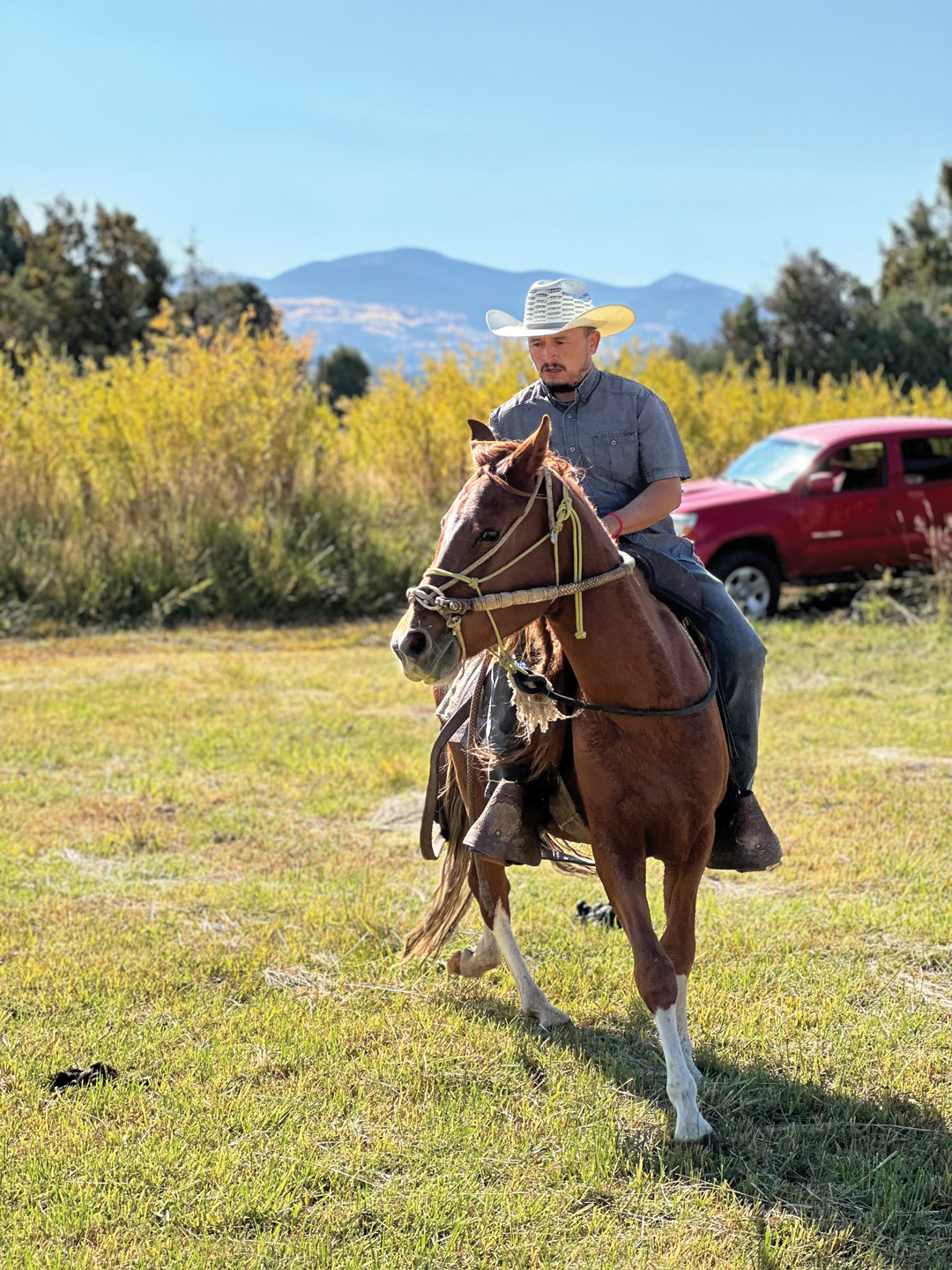
Agua y Tierra with one of his horses and greenhouse at ¡Sostenga! Center for Sustainable Food, Agriculture, and Environment, photos courtesy of Joseluis Agua y Tierra Ortiz y Muñiz.

Learning and Leadership
But how to develop leadership in a vacuum of understanding? In 2019, together with Don Bustos, founder and executive director of the Greenroots Institute, and Camilla Bustamante, former dean of community, workforce, and career and technical education at NNMC, Agua y Tierra helped to revitalize the ¡Sostenga! pilot program and turn it into a full-scale demonstration farm at the college, a crucial step in the growth of an agriculture program, unique to northern New Mexico, that aims to offer a support system to engage students in their own communities, farmlands, and businesses, and to use the classroom for teaching traditional practices.
“On my mom’s and dad’s sides, they weren’t the first generation [of] college graduates but instead stayed poor on the land as farmers, leaving behind a beautiful legacy of work with the land. I didn’t inherit anything when my grandparents died, but I inherited their stories and practices, and that is a great deal of wealth. That saved my life. If every descendant of northern New Mexico could hear these stories, they would feel such a strong sense of pride and an urge to go home, to return, and farm their grandparents’ land. Without that deep querencia for this place, as a recovering drug addict, and as a single father to an Indigenous baby girl, I didn’t know where I would land.”
Farming Is the Way Forward
Although there’s still plenty of work to be done, it’s easy to see that querencia for the land is alive at the ¡Sostenga! Center. After being a grassroots organizer for so long, Agua y Tierra is now stepping back to see how the seeds he’s planted have grown, focusing on being a father, and looking for the next generation of leaders to step up and lead the way.
“[Right now,] very few farms are producing food and most aren’t producing it commercially. We are not utilizing our traditional water-based/land-based networks, and so the water and land are not connecting to support mycelial networks in soil and other processes that can help to restore it. A return to the land would be a remedy for climate change and a lot of other issues our communities face. . . . Farming is our strength. Especially in a world where climate change is having such an impact, it is going to be our traditional wisdoms that pull us through, especially when it relates to food, to water. The land is forgiving, and there is still so much left of our culture. Our ancestors gave us tools to collaborate with nature and our connection to land and water. Engaging in land-based practices feels so familiar, it makes sense. We can feel the land calling us back home.”
Victoriano Cárdenas
Victoriano Cárdenas is a trans poet and writer from El Prado, and his ancestral home is El Torreón Hacienda. He grew up irrigating fruit orchards and fields of alfalfa with his grandfather, drawing water from the Acequia del Medio del Prado and the Acequia Madre del Prado. His debut book of poetry, Portraits as Animal, was published by Bloomsday in 2023.