
Acequia Case Study
By Emily Vogler

A range of edge conditions along the acequias, photos by Emily Vogler.


Looking at an aerial view of the city of Albuquerque, you’ll see miles of green ribbons formed by the acequias that run through the valley, contrasting with the brown high-desert surroundings. Once, the Rio Grande itself meandered back and forth across the floodplain, creating oxbows and distributing water and wetlands across the valley. Now, with the river confined by levees and dams, these historic irrigation ditches, our community acequias, mimic some of that floodplain ecology. The acequias divert water from the river and distribute it across the floodplain. Since the majority of the acequias are still earthen, they act as urban streams that interact with ecological and hydrological processes. They recharge the shallow aquifer that helps support the vegetation throughout the valley, including the cottonwoods in the bosque. Along many ditch banks, cattails, reeds, and other wetland plants grow, in turn supporting diverse aquatic species.
However, every year as the water flows in the earthen channels of the acequias, it slowly erodes the clay soils along the ditch banks. Over time, this has led to severe erosion along many ditches, especially near bridges, culverts, and irrigation gates. In some cases, the Middle Rio Grande Conservancy District and the City have responded by either lining the ditches with concrete or dumping chunks of concrete debris along the edge. Those who narrowly define the “beneficial use” of water argue that all acequias should be lined with concrete to avoid water “loss.” But when ditches are paved, the water can no longer infiltrate, the riparian vegetation along the edges is lost, the trees along the outer banks often die, and the paths along the embankment become noticeably hotter. When chunks of debris are discarded in areas that are eroding, it communicates a lack of care and value of these spaces. Both treatments impact the hydrological, ecological, and aesthetic functions of the ditches as well and often lead to worse erosion.

Modules for erosion-control mattress, graphic by Emily Vogler and Sophie Kaplan-Bucciarelli.
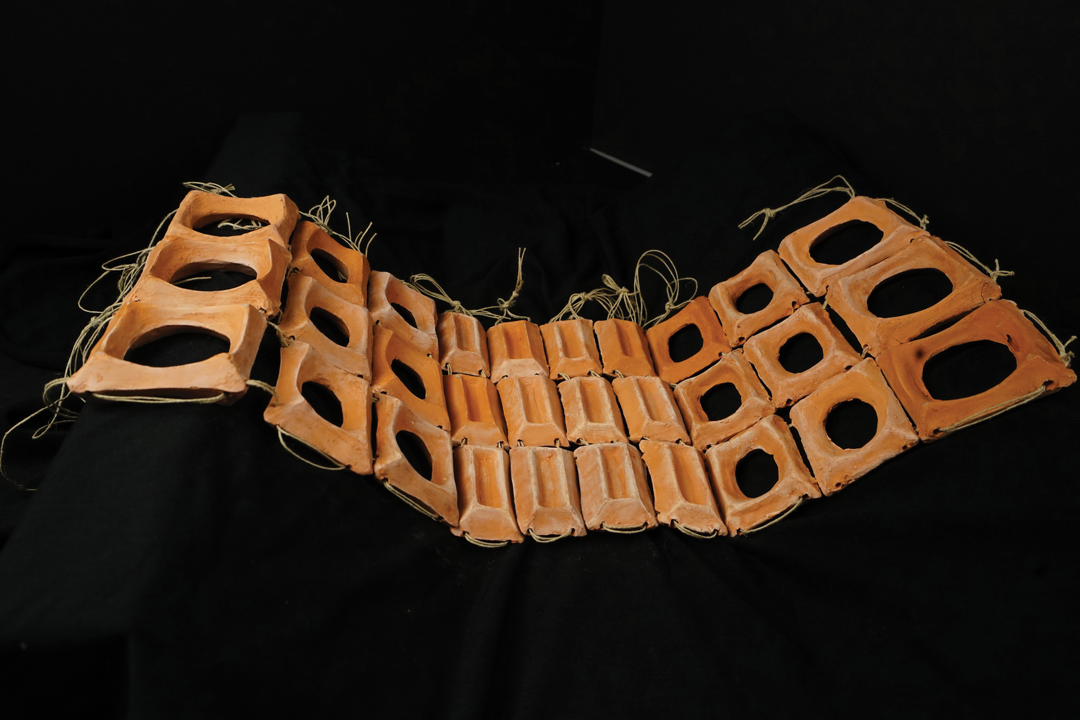
Prototype for erosion-control mattress, photo by Xiao Chen.
For the past couple of years, I have been exploring alternative ways to address erosion that could also help support the many interconnected functions of the ditches. One technique I’ve been experimenting with is an erosion-control mattress comprising a series of modules with an interconnected geotextile that could be used in areas prone to erosion. The modules are designed so that the voids can be planted with riparian species with the hopes that the roots can help stabilize the soil and reduce erosion. Like stabilized adobes, the modules could be made with local soil, and they would be designed to intentionally degrade as plant roots take hold. Moreover, the modular design allows it to be installed by community members.

Prototype for willow spilling, photo by Emily Vogler.
Another technique that may be relevant to acequias is willow spilling. This bank stabilization method uses live willow whips that are woven into the water’s edge to reduce erosion and provide habitat for riparian species. Coyote willow (Salix exigua) already grows along many ditch banks in the city and could potentially be harvested and then reinstalled in banks cut along the ditches. Willow spilling merges the art of basket weaving with restoration and can also be done by community members.
While these are still early experiments and prototypes, they offer a different approach to the management and care of the acequias—one that relies on community tending the acequias with care and love because they convey the water that sustains the unique agriculture, ecology, and life of the valley. I envision a more caring, nuanced alternative to the kind of large-scale infrastructure projects that tend to discourage community input. What if we return to the idea of the acequia as a commons and build an understanding that all species, both human and nonhuman, need to be included as commoners or parcientes in this system? What if neighbors saw themselves as stewards of the ditches and were encouraged to tend the riparian gardens along their edges, coming together to weed, install erosion control, and plant native trees along the outer banks to help shade the water, reduce evapotranspiration, and support the urban streams? If water is life, as the familiar saying goes, then what if we started to treat the ditches like the sacred spaces they are?
Read Other Acequia Case Studies From This Issue

Tending the Seeds of Land-Based Leadership in Northern New Mexico
Poet and Taos native Victoriano Cárdenas talks acequias, farming, and genízaro identity with Dixon grower and mayordomo Joseluis “Agua y Tierra” Ortiz y Muñiz.
ACEQUIA CASE STUDIES
Here, we’re sharing reports on a few of the many ways that citizens and community leaders are working to preserve the acequias.

The Tradition of Acequias in Corrales
Jacob White reports on the acequia infrastructure of Corrales.

Story Riders
The Story Riders program combines bicycles, the natural beauty of the bosque and a sense of community to enrich the lives of young people.
Emily Vogler
Emily Vogler grew up along the Duranes Acequia in Albuquerque. She is a landscape architect, environmental planner, and educator. She splits her time between New Mexico and Rhode Island.