By Brook Brooks · Photos by Allison Ramirez

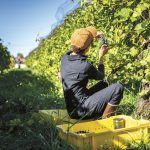
In June 2023, on one of those hot mornings when you’ve already sweat through your shirt and it’s only 9:15 am, I found myself sitting beneath a twenty-five-year-old grapevine, tenderly snipping off a handful of its heart-shaped leaves—giving it, essentially, a summer cut. A good trim does for a grapevine what a good haircut does for us all: cools things down, sweetens things up, and leaves us in a better mood.
Across the growing season, from April to October, the vineyard is a place I find myself foraging for food and medicine alongside tending the vines. In April, you might spot me nibbling on the feral asparagus stalks that push up between vines. Or in May, gathering the unopened buds of dandelion flowers to ferment into capers.
It was on that hot June morning, after trimming a handful of grapevines, with several hundred more to go, that I looked down and saw, scattered across the vineyard floor, my pay dirt. Dolmas, I thought.
Considering how long Vitis vinifera has been cultivated in the Rio Grande Valley—not to mention the much longer history of Vitis arizonica, whose tart blue-black berries were gathered for food, drink, and medicine by Puebloans, Apaches, and others for centuries prior to the arrival of Spanish colonists—I was interested to learn that it was not until the late nineteenth and early twentieth centuries that New Mexico would taste dolmas, via the migrations of Greek, Lebanese, Armenian, and Syrian families carrying the tradition.
Before I started rolling grape leaves in my own kitchen, my only experience of dolmas came from grocery-store tins and the glass cases at Greek and Middle Eastern diners. In following the tendrils with the dolma’s expansive diasporic range, I learned that both my Sephardic and Swedish ancestors likely made dolmas in their home kitchens and then brought these tastes with them when they immigrated across the Atlantic.


Those first couple of years of making dolmas, I borrowed a Greek recipe and filled the grape leaves with local ground lamb, imported rice, and herbs from my garden. I shaped the mixture into tiny meatballs, folded each one into a grape leaf, and simmered them in homemade chicken stock thick with olive oil and lemon juice. After a few years of making this Mediterranean-inspired dolma, I wondered how a dolma that is uniquely from this place, northern New Mexico, might taste. This past summer I started obsessing about stuffing dolmas with pine nuts and masa and red chile along with the lamb. So I called my friend Allison and begged a favor: Will you help me invent a dolma recipe filled with ingredients unique to northern New Mexico? One that celebrates the agricultural abundance of this place, our fervor for chile, and reknits my own ancestral foodways to the land where I’m living and growing grapes? The recipe that follows is the fruit of this collaboration.
In Gary Paul Nabhan’s opening to Why Some Like It Hot, he offers a clue as to why certain foods, like dolmas for me, might hit us differently: “Our ancestral homelands do not lie in some remote, nearly unreachable place, but instead are imbedded in our genes and cultural food preferences.” Unearthing the dolma in my own lineages has carried a deep resonance for me, one I want to honor by returning to the dolma season after season.
Red Chile Lamb Dolmas
Makes 50–60 dolmas
If you have access to grapevines, you can harvest new leaves in May and June and ferment them for dolmas. As you pick the leaves, keep them submerged in water to prevent browning. Once in the kitchen, take a dozen or so at a time, stack them on top of each other, and then roll them up like a cigar, packing the bundles into a jar as you go. Cover with a 5 percent salt brine (1 cup salt to 1 gallon water). You’ll want to place something heavy on top to keep the rolled leaves completely submerged under the salt brine in order to protect them from oxidation and unhelpful microbes such as mold. A ziplock bag filled with salt is quick and cheap. Let the leaves ferment on the countertop for 2–3 days, or until their bright green color softens. At this point, they’re ready to be rolled into dolmas, or you can store them in the refrigerator for up to six months.
Locally, you can find preserved grape leaves at Cafe Istanbul and Talin Market in Albuquerque, or at Kuane’s in Santa Fe, among other places.

Red Chile Lamb Dolmas
Ingredients
Filling
- 1 1/2 pounds ground lamb
- 1 large onion, minced
- 1 clove garlic, minced
- 1/4 cup pine nuts
- 4 tablespoons mint, chopped
- 4 tablespoons parsley, chopped
- 2 teaspoons dried oregano
- 1 1/2 teaspoons salt
- Black pepper, to taste
- 1 1/2 tablespoons New Mexico red chile powder (mild or medium)
- 1 cup dry masa
- 3/4 cup–1 cup warm water
- 16 ounces fermented grape leaves, rinsed, with stems removed (50–60 leaves)
- Plain yogurt with a sprinkle of red chile and a drizzle of olive oil, for serving (optional)
Broth
- 3/4 cup olive oil
- 1/2 cup crushed tomatoes
- 2 cups chicken broth
- Salt and pepper, to taste
Instructions
- In a large mixing bowl, combine lamb, onion, garlic, pine nuts, fresh and dried herbs, salt, and black pepper. In a separate bowl, hydrate the masa by slowly incorporating the warm water and kneading it until a ball forms. Break apart the masa and incorporate into the lamb mixture until all the ingredients are fully mixed; don’t overwork.
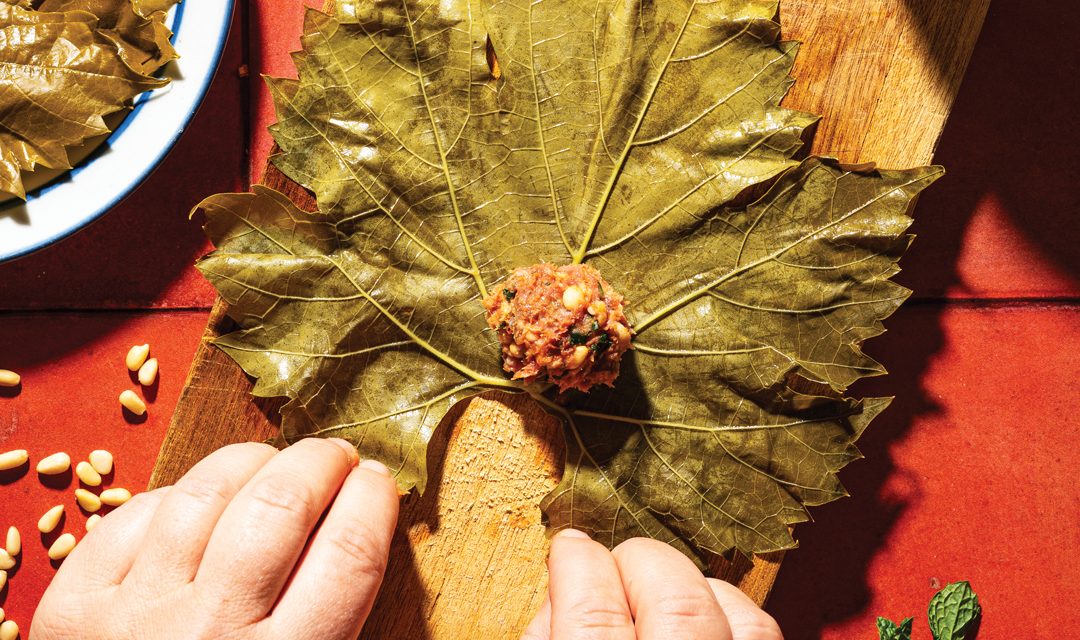
- Rinse the grape leaves and trim the stem off each leaf. Reserve any small or torn leaves and layer these across the bottom of a wide, lidded pot or Dutch oven. Take a grape leaf, lay it shiny side down, and place a tablespoon of filling near the bottom, or stem end, of the leaf. Fold the end of the leaf up and over the filling; then fold the sides over the filling and roll up the dolma. Place the dolma seam side down in the pot. Repeat with remaining filling and grape leaves, filling the pot with dolmas as you go.
- Season lightly with salt and pepper. Pour olive oil and crushed tomatoes over the dolmas. Layer any remaining leaves on top, then pour chicken stock over the dolmas. Place an inverted plate on top of the dolmas to weigh them down and prevent them from moving around while cooking.
- Cover with a lid and bring to a boil. Reduce heat and simmer for 45–50 minutes. Remove from heat, keep covered, and allow the dolmas to sit and absorb any remaining juices for at least 30 minutes.
- These are best at room temperature. They can also be refrigerated and enjoyed cold.

Brook Brooks
Brook Brooks is a viticulturist, garage winemaker, writer, and educator based in Santa Fe. They cofounded and co-organize Last Ditch, a grape-farming collective that hosts place-based experiential work and educational opportunities in vineyards and cellars across the region.