A Tour from River to Tap
Words and Illustrations by Erin Elder
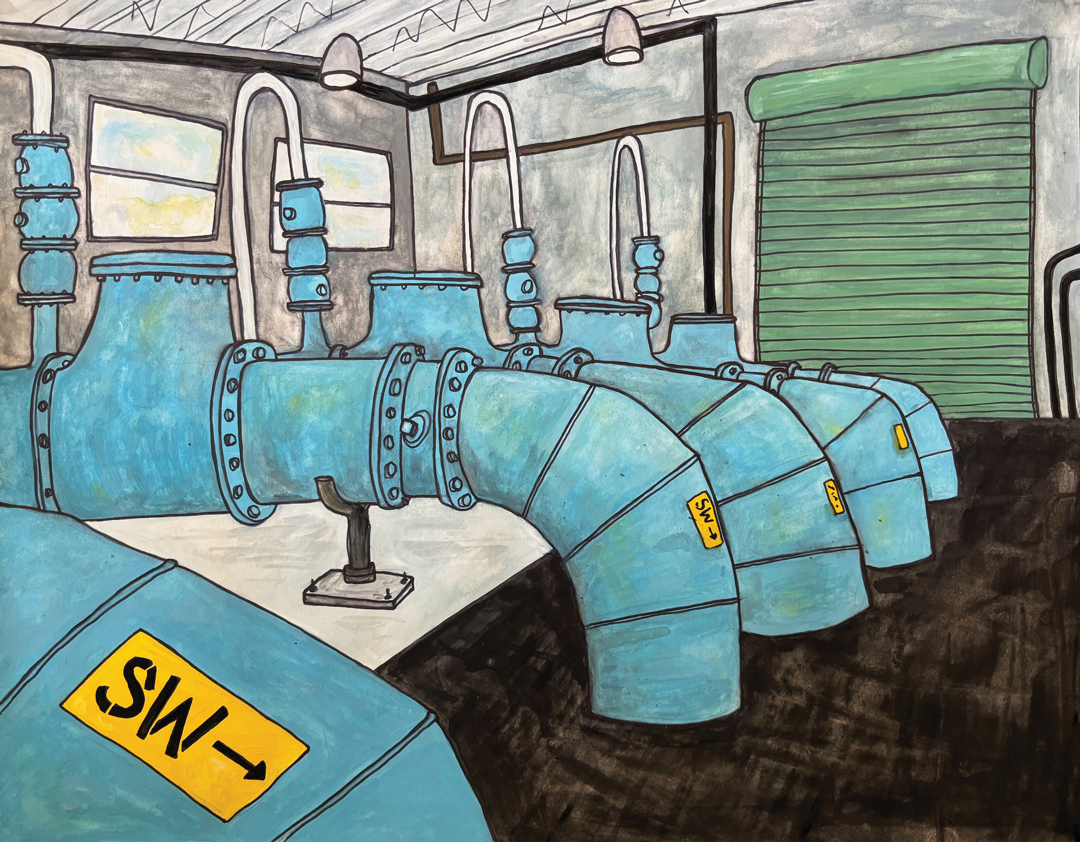
Pipe Room, 2025, gouache on paper.
Chances are you’re reading this article with a glass of water nearby. Chances are you have sipped from this water in the last few minutes and may sip some more while reading. Chances are, if you use municipal utilities, drinking water is not something you think much about, despite the fact that you do it many times every day of your entire life.
If you live in the United States, chances are that, thanks in part to the Safe Drinking Water Act, the water coming from your tap is safe to drink. Whether you filter your water or drink it straight from the faucet, you can, in most parts of this country, trust that tap water will not kill you. Thanks to the governance of American water since 1974, you are not likely to get cholera or dysentery or any number of diseases that could be contracted by drinking water in many other parts of the world; nor, with rare exceptions, are you likely to be poisoned by lead. You may know and appreciate this. But how does drinking water get to the tap? Where does it come from and how does it work?
Curious about such things, I recently toured the San Juan–Chama Drinking Water Treatment Plant, which is responsible for cleaning the majority of the water we drink in Albuquerque and Bernalillo County. The tour was led by Cassia Sanchez, the plant’s chief engineer, who met me and a few others in the visitors’ lobby. We gathered around a room-sized 3D model of the city’s water system; after donning hard hats and protective glasses, we walked out into the warm afternoon sun.
Opened in 2008, the plant is a sprawling complex of pools and piles, trucks and storage tanks, whirring buildings, winding staircases, metallic smells, and color-coded pipes. Encircled by chain link and razor wire, the plant is run twenty-four hours a day by thirty-three full-time operators who control every aspect of the system through a closed network of cameras, screens, sensors, mechanisms, and monitors. Solar panels adorn employee parking structures to provide 20 to 30 percent of the plant’s electric power. Currently serving 680,000 people, the plant produces 50 to 60 million gallons of clean drinking water each day of winter and, the river permitting, twice as much during summer months. It took four years and $160 million to build this facility. Considering the long history of humans drinking water in Albuquerque, the plant is expensive, high tech, and new.
People have lived along the banks of the Rio Grande for twelve thousand years and while its water has long been used for crops, the river, which has always been brown with silty sediments, has never been good to drink. Ancient people collected drinking water from intermittent springs and rain, storing it in clay vessels. Spanish colonists built acequias to channel river water for irrigation, but dug wells for drinking. The city’s twentieth-century water system was entirely supported by wells drilled into the underlying aquifer. For decades, it was believed that these groundwater deposits were massive, that they held as much water as Lake Superior and would never run out. But by the 1990s, it became clear that the Albuquerque aquifer—a fraction of its imagined size—was being depleted at an unsustainable rate.
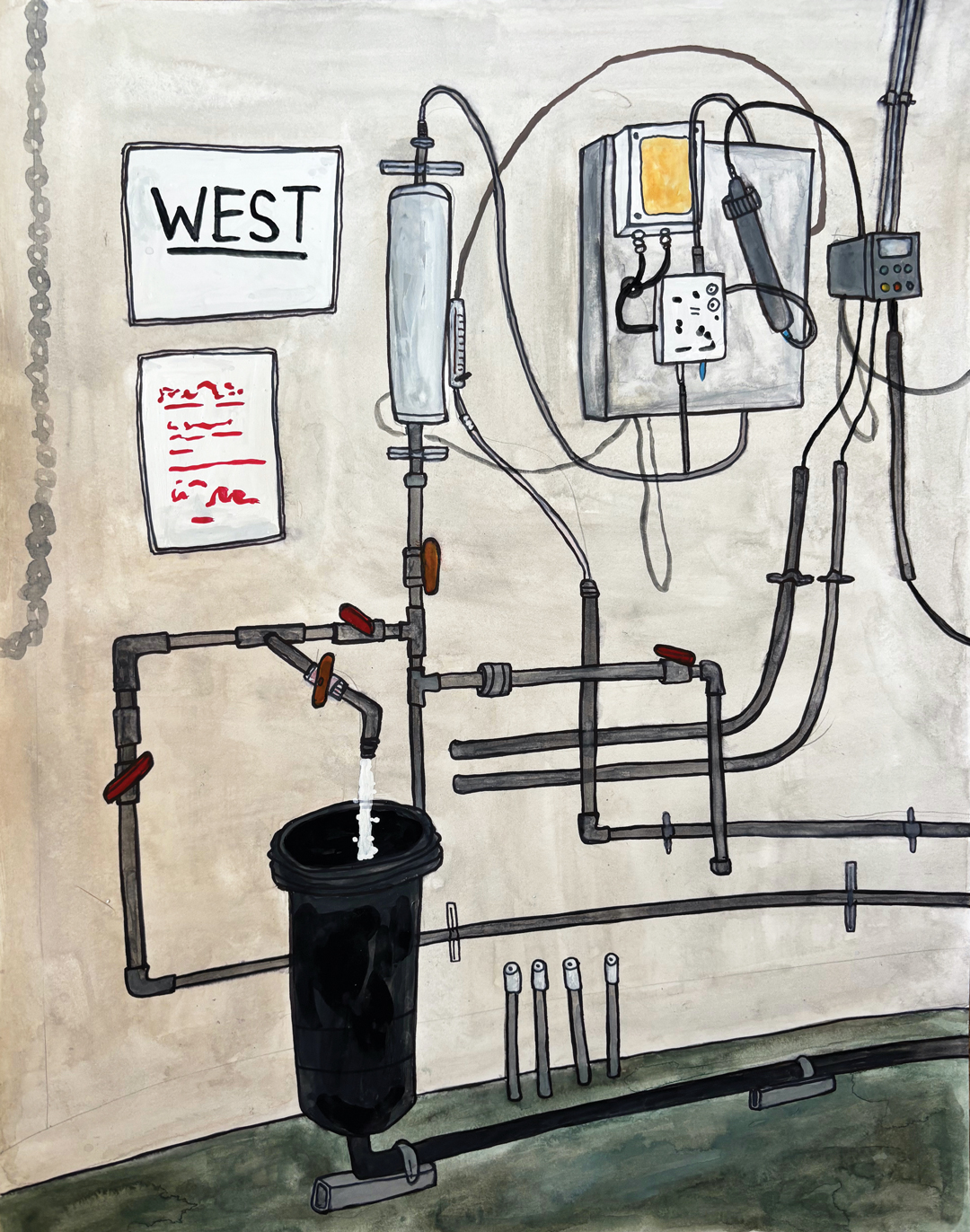
Finished Water, 2025, gouache on paper.
Meanwhile, New Mexico had been bolstering its water supply for irrigation and, through the 1948 Upper Colorado River Basin Compact, the state received rights to water from the San Juan River’s smaller tributaries: the Navajo, Little Navajo, and Blanco rivers. Because these rivers flow on the other side of the Continental Divide, a system of diversion dams and tunnels was built in the 1970s to move the water under the mountains and into the Rio Grande watershed. This imported water travels underground for twenty-six miles before joining up with the Chama River near its headwaters. Moving through a number of dammed reservoirs, the water eventually mixes with the Rio Grande and flows into New Mexico’s largest city.
The earth naturally filters groundwater; there is no need to purify it for drinking. But, with Albuquerque’s population growing and the aquifer shrinking, and with the San Juan River waters successfully delivered into its watershed, drinking river water became a twenty-first century imperative. It just needed to be cleaned.
If you have visited the Bachechi Open Space or walked the river just south of Alameda, you have likely seen the site where much of Albuquerque’s drinking water is drawn. There, a small inflatable dam stretches across the Rio Grande, diverting water into two mechanized structures on the east bank. That water flows into a large pump house designed in the style of a Spanish mission, then travels seven miles underground to the surface water plant where it is treated by Sanchez and her team.
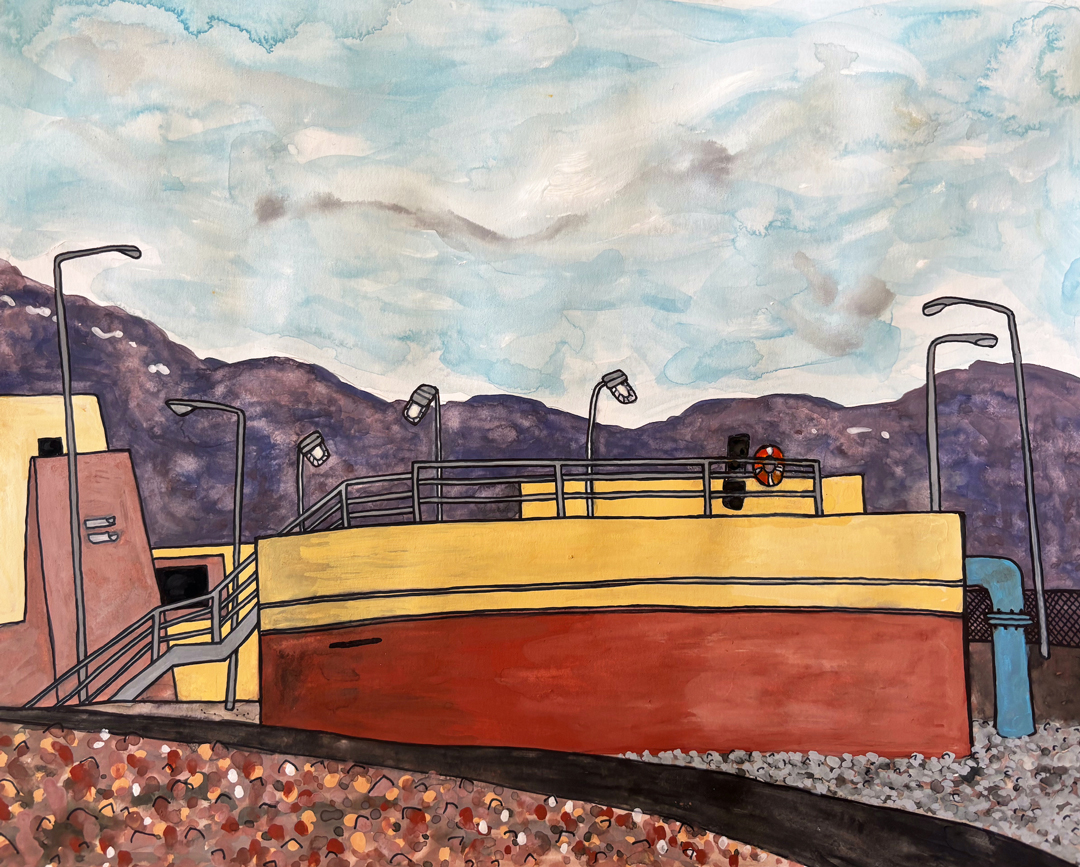
Plant Pool, 2025, gouache on paper.
“We treat every bit of water, and then we re-treat it,” Sanchez commented as she led us in and out of the plant’s many buildings. But what does that mean?
Water treatment is a technical process that begins with the removal of sticks, rocks, trash, and other debris that settles to the bottom of two huge storage ponds. Then the water begins its dizzying journey through columns and pipes and refinements, including the addition of ferric chloride, which bonds with tiny particles and settles out from the clarified water. Liquid ozone is pumped through the water to kill viruses and bacteria, and lyme is used to control its pH; a foot of sand and five feet of granulated carbon filter out any remaining toxins. Tiny bits of chlorine and fluoride are added to the water and once it is finished, the water is divided into reservoirs destined for the east and west sides of the city. Massive pumps move water uphill to large holding tanks, where it is then gravity-fed into individual homes and businesses through three thousand miles of underground pipes. Six hundred employees are responsible for the distribution of drinking water, working around the clock to ensure that whenever you turn on the tap—whether it’s to drink or to water your lawn—clean water comes out.
As we moved through the plant, climbing metal stairwells and peering into stories-tall pools, Sanchez shared ways that the plant is continually evolving as the team responds to new realities. One building held pallets piled high with LED lights that would soon replace less sustainable halogen bulbs. Outside, several large tankers were ready to transport stopgap emergency water to neighboring communities such as Las Vegas or the Navajo Nation, places that need clean drinking water when their wells become contaminated or run dry. Other forms of responsiveness were less visible, like the discussions and proposed plans about how to deal with PFAs and microplastics, which are increasingly present in water everywhere.
Standing in the shadow of a large storage tank, Sanchez told us how the surface water plant, designed to protect the depleting aquifer, has shut down every summer since 2020 because the river has not delivered enough water to serve the city as well as people and places downstream. This means that if you drink a glass of tap water at a Nob Hill restaurant in July, you’re probably drinking groundwater. Now the city’s water comes from a combination of both systems—which, when needed, can switch back and forth in the course of mere hours or days.
Meanwhile, the Colorado River Compact will expire in 2026 and is currently being renegotiated by elected officials from seven western states and thirty tribes. This extremely difficult compromise, already swollen with the uncertainties of climate change and population booms, is being overseen by the newly reduced Bureau of Reclamation. Forty million people depend on Colorado River water and these careful agreements about how it is used, moved, measured, valued, and cleaned.
I know that our bodies are 60 to 70 percent water and that water comes from specific places, but now, having toured the surface water plant, I recognize that we are ambulatory reservoirs, each made up of different water collections. Sipping from my glass, I imagine the journey this particular drink has taken. Can I taste the spring snowmelt in those San Juan River tributaries? Is the influence of Rio Grande water palpable? Or has this water come partly from the aquifer? Does it bear traces of the local storage reservoir from which it traveled to my home? Does the cumulative distance traveled somehow flavor these waters? Do the machines and chemicals and pipes and pumps? Do the laws and compacts and evolutions in technology? The countless hours of human care?
Feeling the confluence of my body’s waters meeting everything contained in each new gulp, I sip and sip again. Once emptied, I walk to the kitchen, turn on the faucet, and refill my glass.
Erin Elder
Erin Elder is an artist and writer using creative research methods to understand how people and landscapes shape one another. More of Erin’s place-based illustrated writing can be found on her Substack, site & scene. She lives on the banks of the Rio Grande, just outside Albuquerque.