

Tumbleroot Farmhouse Whisky
By Susanna Space

The mill at El Rancho de Las Golondrinas, a living history museum, photo by Jason Kirkman.
If you follow the Santa Fe River from its headwaters high in the Sangre de Cristos down into the foothills, through McClure Reservoir, past the adobe houses that line Upper Canyon Road, all the way along Patrick Smith Park and under Palace Avenue, you’ll find yourself traversing, as the land flattens, what was once fertile farmland irrigated by abundant acequias, their silver branches flowing north and south from the central trunk of the river.
Continue past the skate park, under the roaring traffic of Saint Francis Drive, and you’ll find the water rushing or trickling or absent altogether, depending on the season and the year. Past the tennis courts of Alto Park, just up the riverbank along the street named for the waters, among the gas stations and houses and dirt side roads, you’ll find the Agua Fria location of Tumbleroot Brewery and Distillery.

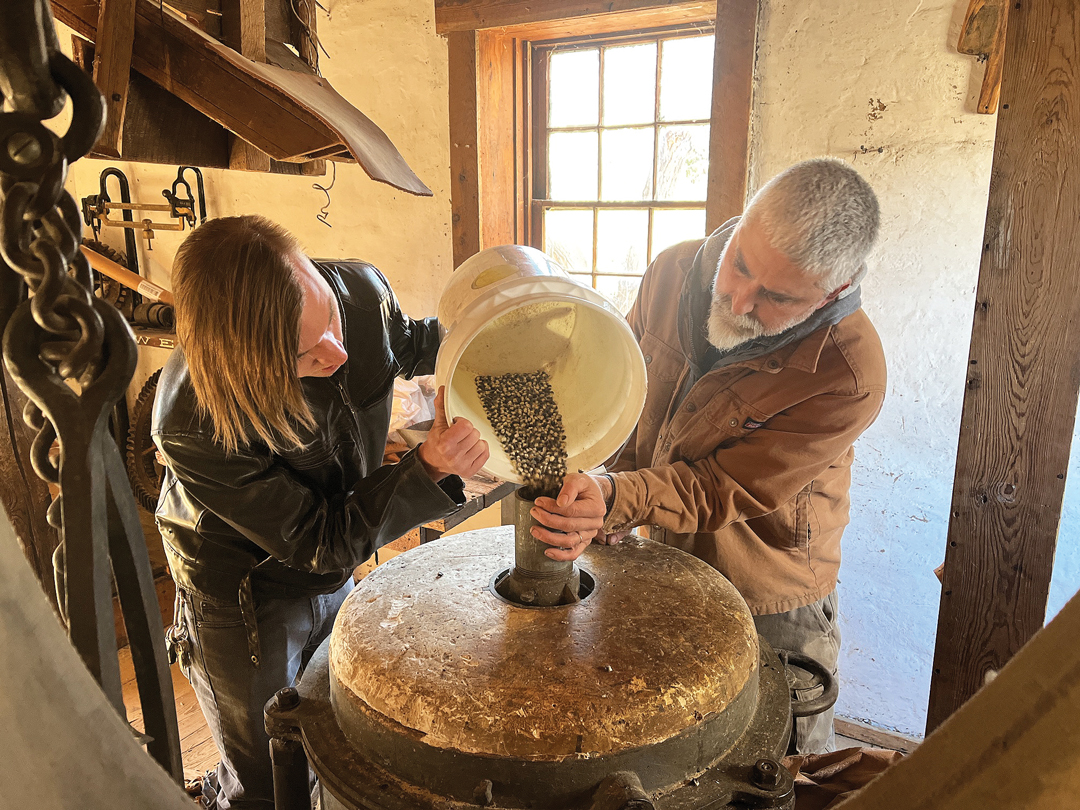
Las Golondrinas director of operations Sean Paloheimo watching the mill’s gears, photo by Jason Kirkman. Former lead brewer Andy Lane and Jason Kirkman grinding the blue corn for the Tumbleroot Farmhouse Whisky, photo by Michael Chavez.
Sitting on the taproom’s spacious patio, you could be forgiven for not taking in the riparian landscape in favor of enjoying the sunshine warming your back. And if you did connect the fact that you were patronizing a watering hole just steps from the flow of snowmelt for which Native people named the land O’Gah Po’Geh as you sipped a drink made with Tumbleroot’s Farmhouse Whisky, you could risk underestimating the strength of that connection.
But let’s back up. That whiskey’s raison d’être begins, as many things do, with beer. Among Tumbleroot’s staple brews is its Farmhouse Ale, a beer whose roots reach far from the Santa Fe River and the US Southwest and back a couple of centuries. Tumbleroot co-owner Jason Kirkman crafted the beer with inspiration from the saisons of French-speaking Belgium, lightly fruity, hoppy ales developed in the eighteenth and nineteenth centuries and brewed in winter to refresh farmworkers—les saisonniers—during the busy summer months. Of particular interest to Kirkman was what many brewers consider the saison de saisons, the one produced by Brasserie Dupont since 1844, well known to be a classic example of the type.
From the Farmhouse Ale, a whiskey companion was kind of a no-brainer. “We loved the idea of a malt whiskey based on one of our favorite beers,” Kirkman says. With the tools already in hand at their brewery and distillery, creating a malt whiskey was relatively easy. It didn’t hurt either that Kirkman has a thing for Irish and Japanese whiskies, which are malt based.
But Kirkman, a bona fide craftsperson, isn’t one to take the easy way. Like the river, the process meandered. “We wanted [the whiskey] to be local and we wanted it to have a variety of grains. And we wanted to use some zippy farmhouse ale yeast”—the kind used to make those Belgian saisons. For additional complexity in the grain bill and a dash of New Mexican terroir, he sought a source for local blue corn. And the waterway that threads past Tumbleroot’s back door followed.
“Brewers will normally use flaked corn or something that’s been precooked,” Kirkman says, rather than raw kernels. But the New Mexican blue corn he bought from Sunny State, outside of San Jon, was distinct and hearty—and not easily tamed. “Those huge corn kernels will jam our barley malt mill,” Kirkman remembers thinking.
“I thought, we could take it to this distillery or that,” Kirkman says, reflecting on the decision on how and where to have the grain processed. He’d been visiting El Rancho de Las Golondrinas for years and offering Tumbleroot’s beers at events there.
“They grow grapes and they make wine,” Kirkman thought as he made the connection. “They’ve been growing hops. They have their own wheat and they mill it and they make tortillas. So it really is a working farm.” After a conversation with Las Golondrinas’ director of operations Sean Paloheimo, a history-loving brew nerd’s dream plot surfaced—one that circles back to the Santa Fe River’s journey west across the city and into La Cienega.
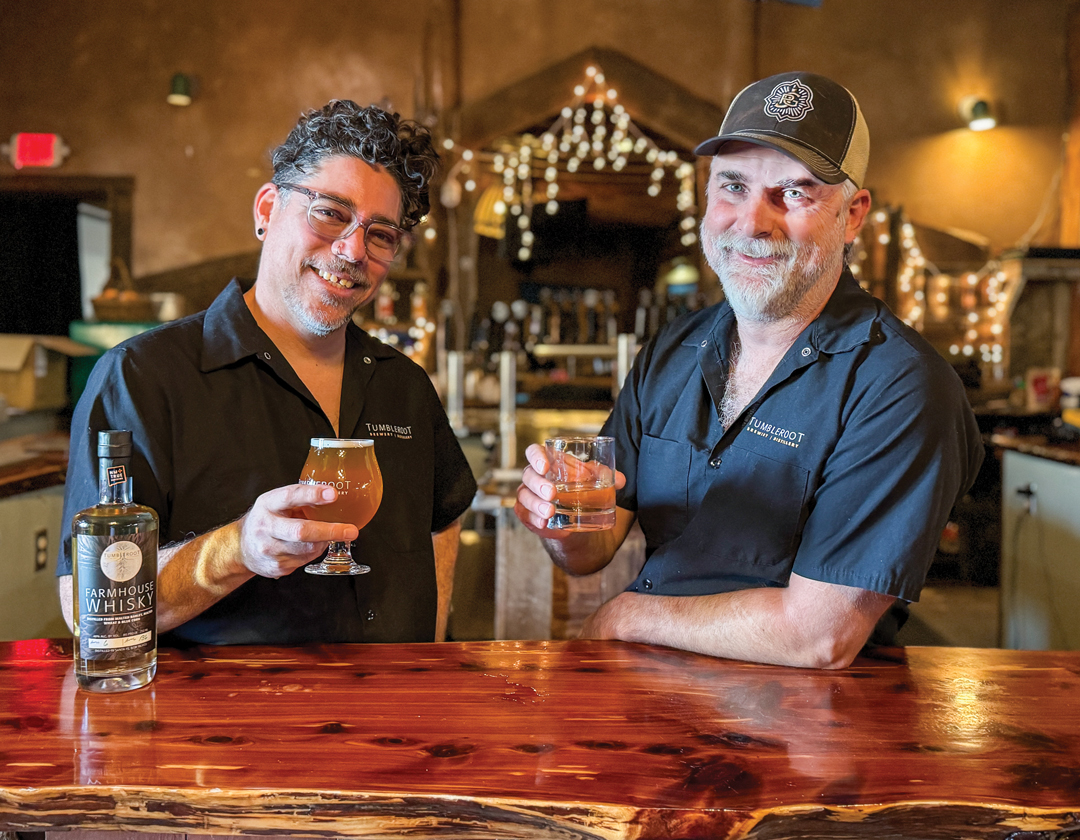
Tumbleroot’s head of production Michael Chavez and co-owner Jason Kirkman, photo by Stephanie Cameron.
You could say the idea took Kirkman and his production team across the parking lot behind Tumbleroot’s Agua Fria location, tracing the water as it trickled away from its namesake street, under NM 599, and alongside the geometric patchwork of the Santa Fe Airport’s runways. There, those waters meet La Cienega Creek, which has long been a source of irrigation of Las Golondrinas’ property, and, traditionally, the power behind the historic mills that sit there among the fields.
Each fall since then, when the tide of visitors has receded and as the museum is packing up for winter, Kirkman and his production team take a field trip. Sacks of blue corn in their arms, they enter the largest and most prominent of the mills, a structure so picturesque it could have been lifted from the page of a storybook. “It’s a huge wheel,” Kirkman says of the towering wooden waterwheel that powers the mill, and when the stone that grinds the corn gets moving, “it’s definitely loud in there, but it’s pretty cool.” Paloheimo gets a bottle of whiskey from Tumbleroot’s newest batch for his trouble.
Back at the production space, Kirkman cooks the milled corn in batches, adding it to the stainless steel tank, the mash tun, where it’s mixed with the grain mash to create the Farmhouse Whisky’s distinctive flavor profile. Finally, the whiskey is left to age in oak barrels. Two years later, the result is a springy and pleasantly sharp spirit with an effervescent warmth.
Served alone inside an aqua-blue, earth-shaped tumbler at the downtown Tumbleroot Pottery Pub—the location closest to the river’s source near Deception Peak—the spirit’s clarity and potency seemed to this writer to embody the river. And in a cocktail made with agave spirits, lime, and chipotle, the cool wash of flavor brought to mind mountain snow against a hiker’s warm palm. There at the bar, I thought of a walk I’d taken along the river when January’s cold snap hit and the young cottonwoods and willow branches were bare. The waters, unusually high for that time of year, had partially frozen over. I was struck by the play of light at sunset, and for a moment I stood still breathing the fresh air, watching my dog squint into the breeze, her paws balanced on the ice.
Multiple locations in Santa Fe

Susanna Space
Susanna Space is a writer and former associate editor of edible New Mexico and The Bite. Her essays have appeared in Guernica, Longreads, The Rumpus, the Los Angeles Review, and many other literary outlets. She lives in Santa Fe.