
Words and Photos by Marisa Thompson

Northern flicker in March, Los Lunas, taken through the author’s kitchen window.
Supporting climate-stressed wildlife in our urban landscapes is as essential as it is approachable and rewarding. To paraphrase restoration ecologist Dr. Brianne Palmer, this type of work/hobby/play is also an act of applied optimism.
“Every little bit of habitat counts,” says Laurel Ladwig, the ABQ Backyard Refuge Program director at the Valle de Oro National Wildlife Refuge. “We really want to get the idea of sharing space out there. Not everybody realizes how much you can do for our wild neighbors and how easy it is.” This popular backyard habitat program is not limited to Albuquerque; it extends across the state and has several levels of habitat commitment so that even those with a container garden on a patio or balcony can qualify. “It really does help—especially with pollinators—just having a little place to stop over before they get to another, larger spot of habitat.”
Food, shelter, and water. That’s it. These are the essentials.
Food: Most of us probably think first of birdseed when considering food for backyard wildlife. Birdseed is certainly a great option. High-quality nyjer seed, also called thistle and usually presented in a socklike mesh bag or feeder with tiny holes, is a sure way to attract small finches. I specify “high quality” here because nyjer seed has a short shelf life and the finches in my yard definitely prefer the good stuff. Black oil sunflower seed is my main go-to for other birds, like the northern flicker. And ladder-backed woodpeckers return year after year to snack on woodpecker cylinders.
For those of us who struggle to keep feeders refilled, plants are even easier! Of course they will need regular watering, particularly during establishment. In “Designing Your Habitat Garden,” a recent webinar in the New Mexico State University gardening series Ready, Set, GROW!, local landscape designer and garden writer Judith Phillips suggests several species that are climate-ready and wildly popular with birds and pollinators. Examples include Utah serviceberry, wolfberry, prickly pear, and broom dalea. “Don’t kill them with kindness!” Phillips warns that we tend to overwater our desert-adapted landscape plants, and broom dalea in particular. She also suggests providing food sources throughout the seasons. “Create a buffet for diverse insects, birds, and animals at different life stages. . . . If you want butterflies, that means supporting them in their caterpillar stage too.”
If you’re curious about creating a hummingbird haven in your yard, the book Hummingbird Plants of the Southwest by Marcy Scott is a great start. On top of excellent details about 120 hummingbird plants for our region, the New Mexico author profiles the fourteen hummingbird species found in the Southwest and provides precise information on how to create prime hummingbird habitats. “For beginners, especially, penstemons are great starter plants for the hummingbird garden and, given a mostly sunny spot and good drainage, they are easily grown most anywhere in the Southwest.”

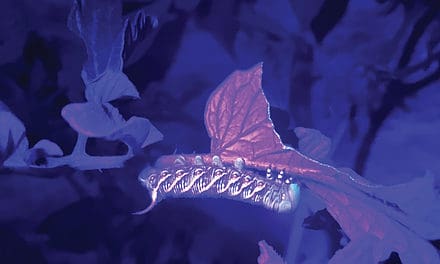
Left: Swallowtail butterfly on peach blossoms in April, Los Lunas. Right: Mantis in October, Los Lunas.
Shelter: Phillips recommends creating “layers of plantings for roosting and nesting, from tree canopies to organic mulch and bare ground [because many native bees are ground nesting].” Species that she highlights as shelter for wildlife include screwbean mesquite, chocolate flower, Apache plume, desert marigold, and desert four o’clock.
Phillips notes that desert willow is another important plant for both shelter and food. “Hummingbirds work the bottom part of the tree and orioles . . . the top, sometimes sharing at the same time,” she says. Also, “Boulders are great habitat for lizards—and moisture condenses around the edges, rewetting the soil and supporting plants nestled alongside.”
Water: Many of us overlook the importance of water. Early on in my home landscape journey, I talked myself out of having a water feature of any sort because I live within a mile of the river and thought it unnecessary. I was wrong. That second winter, when I’d barely started getting interested in backyard birding, I asked Santa (a.k.a. my mom) for a feeder. Santa and my aunt sent fun bird feeders, and a birdbath too. Within a few days, little birdies were flitting around the newest spot in town. My yard became a mini mecca. And later, during the hottest part of the summer, a gorgeous hawk would occasionally take a midday soak in that same small birdbath from Santa.
Moving water is the next step, as it attracts more diversity. Plus, adding an agitator is fun. The small floating solar water fountain pumps work great, even in smaller birdbaths. Just be sure to adjust the nozzle so water doesn’t splash out without being replenished.
If this still seems like a lot to take on, consider the other resources in your vicinity and focus on the one element that might be lacking. Finding and filling a resource vacuum is a great way to make a big impact with less input. Perhaps the person next door already has established trees and shrubs that offer excellent shelter but they don’t feed the birds regularly. Or maybe they have beautiful flowers in spring, but not much that blooms into the fall. Late-season sunflowers and marigolds offer great forage for fall birds and a host of insect friends. And any time of year is a good time to try a simple tray of water that you pour out, clean, and refill every few days. Thirsty wildlife will be grateful.
Here are a few more tried-and-true tricks from my own habitat adventure. Place some backyard wildlife features in spots that you can see from inside your house. Birds dining at the feeder suctioned to my kitchen window offer welcome distraction during dish duty. Also, try a hummingbird feeder with a perch. These busy bodies may not need to rest while drinking nectar, but they’re much easier to photograph while sitting still for a split second. When the weather gets quirky and takes a surprising turn, like a light snow or rain on an otherwise clear day or just before a windy storm sweeps in, look out your window or step outside for a moment. Those are the times when bird activity in my yard really escalates. It’s as though they’re all surprised and excited too.
I’m still wowed and still learning three years in. Sharing my backyard with local wildlife continues to bring joy and wonder. Like most hobbies that help you interact with the wonderful natural world around us, backyard habitating is, well, habit-forming—but in the best possible way. I’m excited to hear what you’ll discover too.

Marisa Thompson
Marisa Thompson is New Mexico State University's Extension Urban Horticulture Specialist, responsible for active extension and research programs supporting sustainable horticulture in New Mexico. In addition to studying landscape mulches and tomatoes, her research interests include abiotic plant stressors like wind, cold, heat, drought, and soil compaction. She writes a weekly gardening column, Southwest Yard & Garden, which is published in newspapers and magazines across the state and on her blog. Find her on social media @NMdesertblooms.