
Behind the Wheel with New Mexico Harvest
By Sophie Putka
Photos by Stephanie Cameron

Jon Agard off to deliver shares to New Mexico Harvest members.
It’s tricky to pin down just what New Mexico Harvest does—because when it comes to getting locally grown food onto New Mexican plates, they do it all. I get a taste of this over the course of a late morning at their small kitchen and processing facility in Albuquerque’s North Valley, where owner Thomas Swendson greets a local grower who’s dropping off crates of jewel-like tomatoes, demonstrates the sealing power of a machine that packages meals for schoolkids, and gifts me a selection of their prepared foods, wrapped in neat brown paper. It’s fitting that Swendson’s title on New Mexico Harvest’s website reads “El Presidente/Wearer of many hats.”
Yes, New Mexico Harvest runs a CSA (community supported agriculture) program, aggregating produce and meat from family-run growers and farmers, then distributing some 130 shares to members in their distinctive blue tote bags every week. But they also run an online farmers market with à la carte items; deliver local produce wholesale to restaurants, grocery stores, schools, and senior centers; prepare ready-to-eat items in their commissary kitchen; and by 8 am each morning, make 450 meals for kids at thirteen nearby schools.
For Swendson, it’s all part of a family legacy. His stepfather, Steve Warshawer, started the company as Beneficial Farms CSA in 1994, delivering eggs and cheese out of his car from a loading dock in Santa Fe. Warshawer handed the business off to Swendson about a decade ago, and Swendson renamed it in 2020 to reflect the network’s expanding reach. At times, Swendson has worked as a commercial truck driver, pouring what he made into keeping the operation afloat. All five of his siblings have worked for New Mexico Harvest at one time or another, he said, and three still pitch in, along with his partner, Electra Kennedy-Hall, who has worked in most areas of the business and continues to write their weekly newsletter. Swendson’s mother, Colleen Warshawer, runs Ewe Matter Farm & Dairy, which provides lamb for the food hub.


Meals being prepped for kids’ after-school program.
“I’ve dedicated my life to try and highlight the work that these farmers are doing,” Swendson said, speaking of the more than eighty-five farmers that New Mexico Harvest works with over the course of the year. “It’s incredible. Our local food movement is unique.” Part of what makes New Mexico’s food system so robust, in his view, is how supportive local farmers markets are—both of generational growers and newcomers entering into agriculture.
Over the years, New Mexico Harvest has expanded their CSA program to include a customizable membership option and an online marketplace, where anyone can order locally grown or made items for home delivery in an area that spans from the Albuquerque metro area to Santa Fe. (CSA members get a 10 percent discount on à la carte purchases.) Offerings include classics like heirloom tomatoes, Swiss chard, red onions, and mung bean sprouts, but also newer, prepared items like their addictive pumpkin spice candied pecans, chewy apple pie fruit leather, green chile corn bread, and, most recently, deli-style meals like sandwiches and salads made with local fare including M’tucci’s focaccia and Tucumcari Mountain Cheese Factory feta. These prepared items are not only convenient but pivotal to the local food economy. “Our new commissary kitchen and food hub are equipped to process surplus crops, extend the life of seasonal harvests, and reduce food waste,” a recent newsletter reads. “These efforts not only sustain our farmers but also build resilience in our food system.”
The marketplace option, on top of traditional CSA offerings and wholesale relationships with dozens of local businesses and institutions, can make for a dizzying weekly delivery system—meticulously planned and executed. Swendson reeled off daily pickup and distribution routes that reach as far as Dixon in the north and, in coordination with other regional food hubs, Las Cruces and Silver City in the south. Including volunteers and part-timers, just nine people make it all happen each week. As if this weren’t enough, the team adjusts their routines seasonally. “There’s a lot of complexity to it,” Swendson acknowledged.
Their participation in New Mexico Grown, a federally funded food-purchasing program whose aim is to provide fresh, locally grown food to children and older adults, takes New Mexico Harvest another step beyond the realm of a traditional CSA. It lets them act as a distributor for a broad network of midsize local growers, creating a values-based food supply chain and allowing schools and other institutions to rely less on food giants such as Sysco and Shamrock.


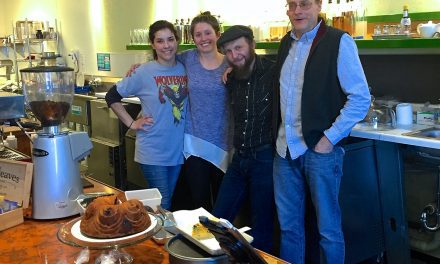
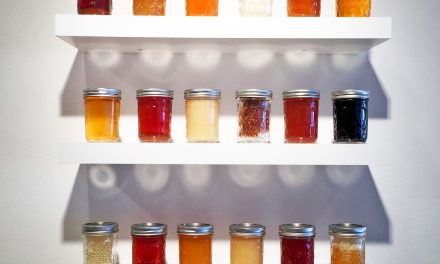
Top: CSA bags being loaded for weekly delivery and El Presidente/Wearer of many hats, Thomas Swendson. Bottom: A large variety of local products available to New Mexico Harvest members.
COVID-19 may have pushed New Mexico Harvest to focus more on delivery, but the ability to distribute local food more widely was ushered in, Swendson said, partially by the Food Safety Modernization Act, which put in place sweeping new food safety regulations, including for smaller food facilities. While it meant more stringent rules that could pose a challenge for small food producers (for example, food handling had to be moved indoors), Swendson said it also represented “a ‘between’ step for the very commoditized USDA regulations and these natural, local, organic movements of, not just the organic specifically, but trying to bring small-scale farmers to the bargaining table with the larger-scale [ones].” Swendson said their involvement with New Mexico Grown is a prime example of the lasting impacts of this transition: “Through going through those steps as farmers and our steps as a food hub, we can now sell directly to the institutions, whereas prior to the Food Safety [Modernization] Act, it was just—you had to be a big farmer.”
With the addition of the commissary kitchen two years ago, they also inherited a kids’ meal program—the one Swendson demonstrated packaging for on my recent visit. The meals serve kids enrolled in after-school programs run by Community for Learning, which provides support to low-income and at-risk children outside of school hours. It’s funded by grants from the state departments of health and education as well as the federal Department of Education. Recent threats to this department and cuts to the USDA have endangered New Mexico Grown and programs like it, Swendson said, but he’s hopeful. “The state is hugely behind it, and they’re going to find a way, I know they will.” Also uncertain are upgrades to their infrastructure—a flash freezer and dehydrator for prolonging the life of more food—that Swendson was hoping would be funded by a federal grant.
Still, there’s more in the works: Swendson wants to get New Mexico Harvest certified for jamming and pickling. Plans are underway to add more charcuterie boards, cookies, and other baked goods to the online marketplace. And, Swendson said, maybe soon he and his partner will add an even more personal contribution to the operation: pineapple and citrus fruits from a greenhouse in their own backyard farm.
505-585-5127, newmexicoharvest.com
Sophie Putka is a part-time food writer and mushroom farmer. In other lives, she has been a barista, nanny, salon receptionist, outdoor educator, camp cook, and medical journalist. She lives in Albuquerque with her dog Iggy.