
Reginald Punnett, Fabián García, and
the Consequences of Crossing Seeds
By Robin Babb

Bloody Butcher corn, a centuries-old heirloom variety of dent corn, photo by Nina Katz.
One of the only things I remember from my high school biology class is filling out Punnett squares. Devised by the British scientist Reginald C. Punnett, the square diagrams are used to predict and track the phenotypic and genotypic outcomes of crossing certain plants—in other words, their observable physical traits, and the particular genetic information that corresponds to those traits. Punnett originally devised the method to track generations of crossbred (or hybrid, as we say in the plant world) pea plants and manipulate their traits, things like flower color or whether the peas the plant produced were smooth or wrinkled. Although what I most remember is diagramming dominant and recessive traits like eye color in humans, Punnett squares were very much designed for plants, and edible plants in particular.

Drying chiles in Chimayó, photo by Pat Eby.
In a Punnett square, the first generation of a cross between two varieties is labeled f1; if you’re a gardener, you may have seen this appellation on some seed packets. Successive generations are called f2, f3, and so on. After several generations of selectively breeding these resulting hybrid plants with an eye toward a specific combination of traits, Punnett found he could stabilize that combination, thus ensuring that each seed saved from the parent plant would be highly likely to produce a plant with nearly identical phenotypic traits. After many generations of breeding a hybrid selectively for certain traits, the stabilized variety becomes open-pollinated, a prerequisite for all heirloom varieties.
But this kind of careful plant breeding across many generations takes many years of producing no sellable product—possible for a scientist like Punnett but not for a modern commercial farmer. Most hybrid seeds sold commercially are f1-generation seeds, not only because they have the most hybrid vigor (characterized by increased size, growth rate, and yield) but also because every following generation of that hybrid is highly genetically unstable: if you were to plant those f2 seeds the following spring, you’d have next to no idea what kind of plant will come out of them. Theoretically, seed companies could do the many years of work to stabilize a given hybrid into an open-pollinated heirloom—but why would they when they could keep growers feeling dependent on those reliable, vigorous f1 seeds year after year?
This is all a bit oversimplified, of course. There is no hard-and-fast, agreed-upon definition of an heirloom variety. Some people in the seed world believe that it requires a minimum of seven generations of careful breeding for a hybrid to gain heirloom status; for some, it’s only an heirloom if it was grown as is by their great-great-great-grandparent and has a name like One-Eyed Preacher’s Delight. The terms hybrid and heirloom hint at something immutable, but the truth is that most domesticated plant varieties exist on a spectrum between genetic extremes.
Although the Punnett square was created in 1905, farmers and gardeners have been selecting seeds for desirable traits and crossing plants since, well, since the beginning of agriculture. In The Seed Underground: A Growing Revolution to Save Food, author Janisse Ray gives this hypothetical on how humans began domesticating plants:
Out walking along some river, perchance the braided Nile, some long-ago human would discover a strange fruit and would taste it. She would not die. The tribe might save the seeds and begin to grow the plant in spots where they paused during a summer sojourn. Then someone would discover that a certain plant had a particularly large fruit, and that plant would be specially guarded and its seed saved to scatter the following spring. A plant with a large fruit might be crossed with a plant with a sweet fruit. And on and on.
Corn is perhaps the best example of a thoroughly domesticated plant—corn didn’t exist before farmers got involved. Long ago in what is now southwestern Mexico, a large grass plant with multiple stalks and small, hard kernels grew wild in the valleys and floodplains. This plant was teosinte, and it is the genetic ancestor of all corn. (Wild teosinte, a descendent of that earlier wild grass, still grows in the Balsas Valley of Mexico.) Ancient growers planted teosinte near their settlements, then saved the seeds from those plants that grew the biggest ears with the fattest kernels. They planted those seeds the next season, then selected again. They continued doing this for centuries, sometimes crossing one cultivar with another for more desirable traits, until they eventually produced something that looked a lot like the modern corn that we grow today.

Measuring chile peppers at the New Mexico College of Agriculture and Mechanic Arts Horticulture Department, circa 1950, photo courtesy of NMSU Library.
In the roughly nine thousand years since corn’s domestication, people have developed hundreds of varieties of it all over the American continent. Some varieties, growers discovered, did better growing at elevation and in dry climates, while others preferred floodplains; some were cultivated to be eaten fresh off the cob, others for making into meal for tortillas or corn mush. Glass Gem, Hopi Blue, Golden Bantam, Stowell’s Evergreen. Often, these heirlooms bear the name of the family or tribe that grew them, or of the region where they were traditionally grown. For some, the origin of the name is lost to time. Now, many of the varieties are lost to time themselves. In the same way that biodiversity of wild plant and animal life is waning now in the Anthropocene, so are the varieties that farmers grow. But these early domesticated varieties of corn, as of squash, chile, and other domesticated plants, are reliant upon human cultivation; they can’t be released into the wild and live without us. If farmers and gardeners don’t grow them, they disappear.
These old varieties are disappearing not just because farmers neglect to grow them anymore, opting, instead, for the more profitable monocropped varieties that fill so much of our country’s arable land, but also because of the issue of genetic drift. Corn is open-pollinated, meaning that it is naturally pollinated by wind, insects, and birds—and because of its anatomy, corn is especially promiscuous, shall we say. Some of the corn silks in a field are cross-pollinated by a corn plant of a different variety, perhaps one that’s growing up to a mile away. The resulting seed will bear genes from both of its parents, of course, whether those parents are Hopi Blue or Corteva Agriscience’s lovingly titled P9188 AMX. A farmer growing only one variety of heirloom corn on their farm may still wind up with seeds that bear patented genetic material—that’s right, many hybrid and genetically modified (GM) seed varieties are patented. Agricultural corporations like Monsanto, Syngenta, and Corteva Agriscience patent any seeds they develop as a matter of course, and will also buy patents from other seed companies. Other breeders, including universities, sometimes patent hybrids they develop. If that patented germplasm winds up in the field of a farmer who didn’t buy those seeds, they could potentially land in some legal hot water. And regardless, that farmer will then be producing seeds that they cannot legally grow the next season and that may behave a lot differently from what they were expecting.
This is where Mexico’s proposed ban on imports of GM corn for human consumption—and on glyphosate, the herbicide that many GM crops have been specially designed to be resistant to—begins to make a lot of sense. Not only does imported GM corn have the potential to contaminate the diverse landrace maize growing there, it also floods the market with cheaper corn and corn-based products. While Mexico has banned domestic cultivation of GM corn for a decade now, there is already evidence of some crop contamination there. If that ban were lifted, some farmers, quite reasonably, might find it hard to resist the siren song of efficiency and profitability that GM seeds sing, even knowing the long-term threats they pose to the genetic diversity and security of the country’s crops, not to mention their neighbors’ livelihoods and a cultural history rooted in the tradition of la milpa. Even knowing that these seeds come with the implicit contract to keep buying them, year after year—and to soak them in the herbicides sold by the same corporation.
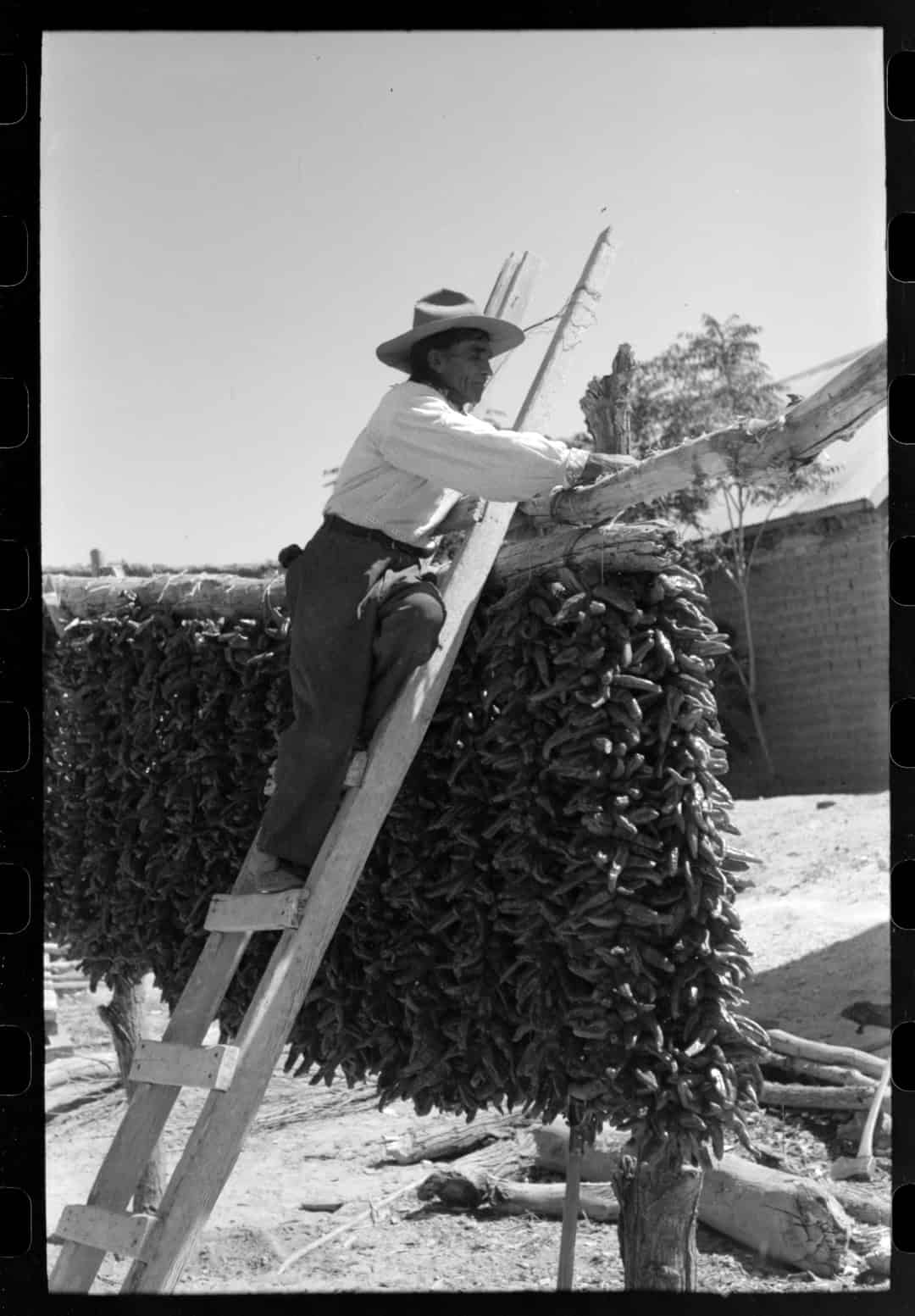


Left: Hanging up chile peppers to dry at Isleta Pueblo, circa 1940, photo by Russell Lee. Top right: Harvesting new corn from Jim Norris’s field in Pie Town, circa 1940, photo by Russell Lee. Bottom right: Chiles and bagged chiles in field in the Mesilla Valley, photo courtesy of NMSU Library.

Green chile, like corn, is also a product of careful crossing and selecting over generations. At about the same time Punnett was fiddling around with his pea plants in England, Fabián García, a horticulturalist at the New Mexico College of Agriculture and Mechanical Arts in Las Cruces (what is now New Mexico State University), was hard at work on an experiment of his own, trying to make the chile—and Hispano foods in general—more accessible and commercially viable around the United States. According to Willy Carleton in Fruit, Fiber, and Fire: A History of Modern Agriculture in New Mexico, García “bred for a more consistent, narrower, fleshier, and more peelable chile for canning purposes. He also sought a milder pepper to appeal to people elsewhere in the country unaccustomed to pungent flavors.” This experiment, in which he enlisted the help of many growers over the course of a decade, involved collecting and crossing many varieties of landrace chiles from across the Southwest, including several from Mexico. The work yielded New Mexico No. 9, the genetic ancestor of one of the more popular commercial strains of green chile still grown in the state today.
This was scientific plant husbandry, in the most classic sense. There is some confusion on this point, so let us be clear: a hybrid plant is not (necessarily) a GM plant. The labs of these early twentieth-century scientists did not include gene-splicing technology. Still, the implications of the type of crossbreeding García did can be tectonic. When plant crossing is done to create more commercially desirable (read: more uniform and thus easier to mechanically grow, harvest, and process in large quantities, and more universally palatable rather than suited to specific tastes) varieties, the consequence is often a variety that outcompetes (whether by nature or by human design) other older, more regionally specific varieties—the heirlooms and landraces. Since García’s time, and in no small part thanks to his work, we’ve seen an explosion in the popularity of New Mexico chile, which has become something of a double-edged sword. When you buy “New Mexico chile” at a grocery store now, there’s a not insignificant chance that it was grown in another state, or in Mexico. It has become such a cash crop even within the state’s borders that other chiles—the older, more regionally adapted and unique tasting heirlooms—have largely fallen by the wayside. Case in point: the Chimayó red chile.

Top: Drawings of variations of chile pods from the New Mexico Experimental Station, New Mexico College of Agriculture and Mechanic Arts, drawn by J. W. Rigney, image courtesy of NMSU Library.
“Chimayó chile is pretty much nonexistent,” says Anjel Ortiz, the grower at Zitro Farms in Chimayó. He says this despite the fact that you can buy Chimayó chiles at the store, as well as seeds and starts of it at the nursery. Ortiz knows, from his own experience and from talking with the old-timers in the village, that that’s not true Chimayó chile—not the landrace variety that has been grown in northern New Mexico for three hundred years. Heirloom Chimayó chile is a smaller, hotter chile that thrives in the heat and the scorching summer sun. The chile labeled Chimayó that you buy in stores might be a descendant of that heirloom, but Ortiz believes there’s been some crossing over the years that has diluted its genetics. For years, he’s been trying to un-dilute it.
“I found the families that claimed to have old, old Chimayó chile,” he says. “I grew four of the families’ chiles, based on what they told me. They explained the way it was forty, fifty years ago. So I started to grow out the chiles and save the seed that looked and tasted like what they explained it used to. I was trying to revert it to how it used to be.”

Zitro Farms in Chimayó, photo by Anjel Ortiz.
It’s very possible that genetic drift from fields planted in commercially bred chiles contaminated heirloom Chimayó chile at some point—either intentionally, in the case of growers who were actively trying to cross their chiles to make them bigger, milder, more sellable, or on accident, by that natural drift of pollen on the wind, on the fuzzy bodies of bees and other pollinators. However it happened, Ortiz is now trying to “back out” from the modern, crossed form of Chimayó chile, to select for and breed in the traits that old Chimayó chile had. This dedication resembles reinventing the wheel more than it does turning back the clock. While small-scale farmers like Ortiz can’t go through each of their plant’s genomes with a fine-tooth comb, editing out all the genes they don’t want, they can try to select seed for observable traits. Back to Punnett squares, garden notebooks, and talking to the other growers in your neighborhood. Back to the same process that generations of Native and Hispano growers have stewarded here for centuries: irrigation with acequia water, careful cultivation and saving of seeds, selective crossbreeding, and—as is required of growing anything—lots and lots of patience.

Robin Babb
Robin Babb is the associate editor of edible New Mexico and The Bite. Previously, she was the food editor at the Weekly Alibi (RIP). She’s an MFA student in creative writing at the University of New Mexico and lives in Albuquerque with a cat named Chicken and a dog named Birdie.