Soil Health in New Mexico
By Robin Babb
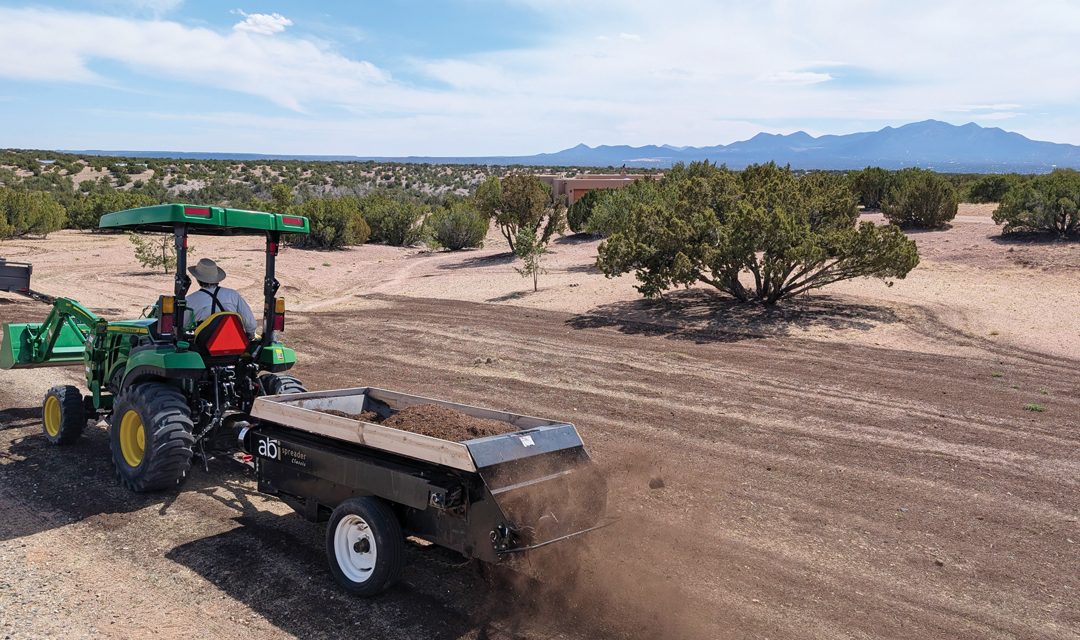
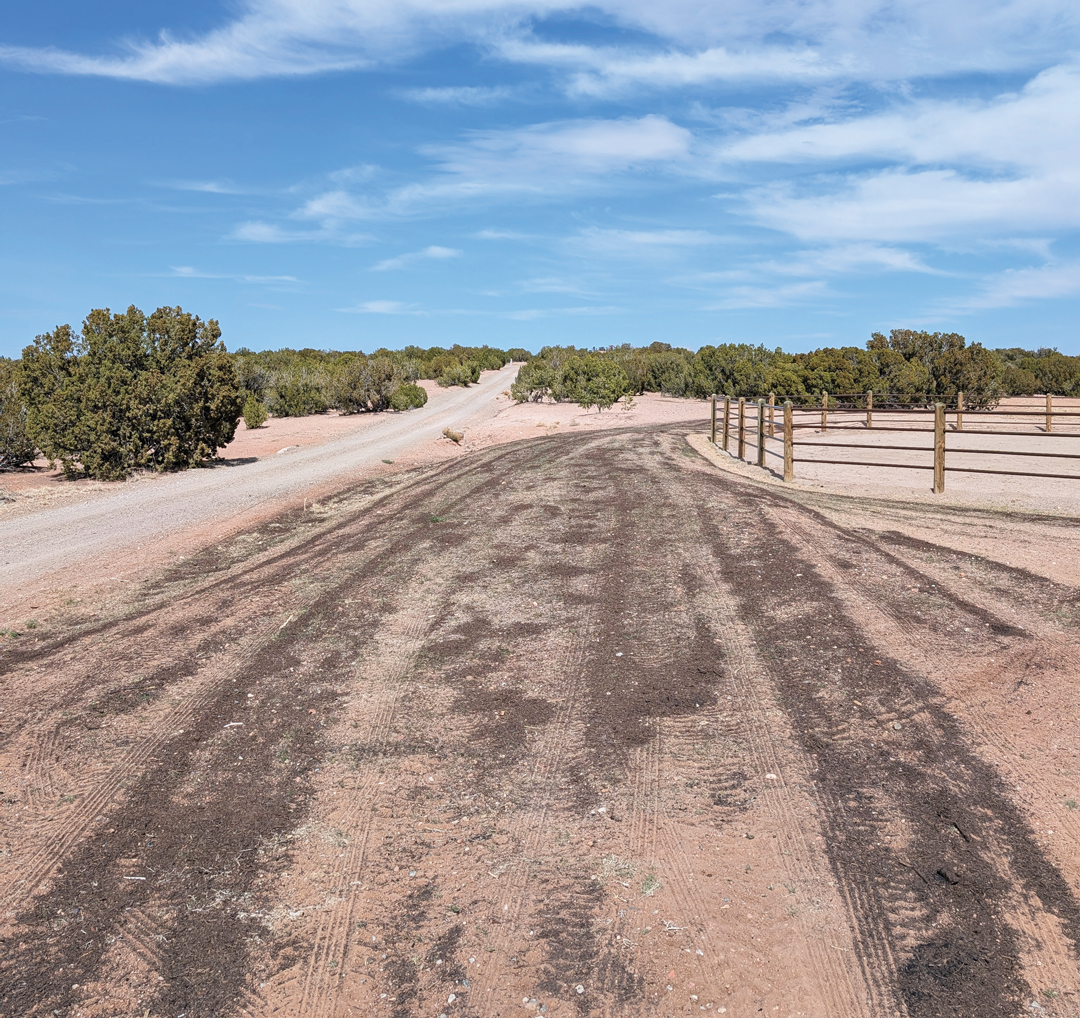
Casey Williams working on land rehabilitation for a Los Cerrillos property, photo courtesy of Growing Soil Health Collective.
We may have gotten a lot of rain this summer, but don’t be fooled: New Mexico is not exactly the Fertile Crescent. Crops are harder to grow here than in most places in the country, and not only because of the low precipitation rates—New Mexico also has a lot of particular issues when it comes to soil. You’ll be familiar with these issues if you’ve ever tried to garden here; you’ll know them intimately if you’ve ever farmed here.
In the most general sense, the soil health problem in New Mexico could be summed up with one word: exposure. Exposure to sun, wind, and rain is beneficial to soil in the right amounts, but too much of any of them can be just as damaging as too little. The flash flooding that devastated Ruidoso in July was precipitated by the deadly wildfires that area experienced last year, which left the soil dry, exposed, and hydrophobic—conditions that not only make it hard for new vegetation to grow but also make water run right off instead of sinking in. It is a cruel irony of nature that the soil that needs water the most has the hardest time absorbing it.
Which is why soil remediation often begins with covering the soil, according to Casey Williams, the owner of Full Circle Soil Health, a company specializing in providing compost, biochar, and hands-on soil health remediation solutions as well as coaching for land stewards on both large and small scales. Whether that cover is mulch, which makes economic sense for most small-scale gardeners, or planting your land in a cover crop that can serve as protective shade in the short term and green compost in the long term, some kind of cover will help ensure that less moisture is lost to evaporation. It also means that “when you do get rain, you don’t let it run off. You want to try to keep it there to sink in and recharge,” as Williams says.
But it’s not just lack of water that makes the soil in New Mexico such a tough row to hoe (pardon the pun). Rather, says Williams, the problem of nutrient-sapped soil is due to a combination of natural and human-made impacts: “climatic changes, poor land care practices, tillage, the heat, the wind . . . all of which are big issues that we deal with [in New Mexico].” Of course, “poor land care practices” could mean a lot of things, but Williams points to the “minimizing inputs, maximizing outputs” mindset of industrial agriculture as particularly damaging to soil health, as it seeks to get continually higher yields from land that’s not getting equivalently higher inputs of nutrients. While this seemingly paradoxical math may work out for a while with use of chemical fertilizers, the crop that it yields will have a lower nutrient density—which, as Williams says, “is going to be the next thing that we’re all paying attention to [in the ag world].” Tillage, too, which is used as a way to aerate soil, suppress weeds, and incorporate fertilizers and organic material, also has the unfortunate side effect of destroying the soil structure that’s needed to prevent erosion and encourage water saturation.
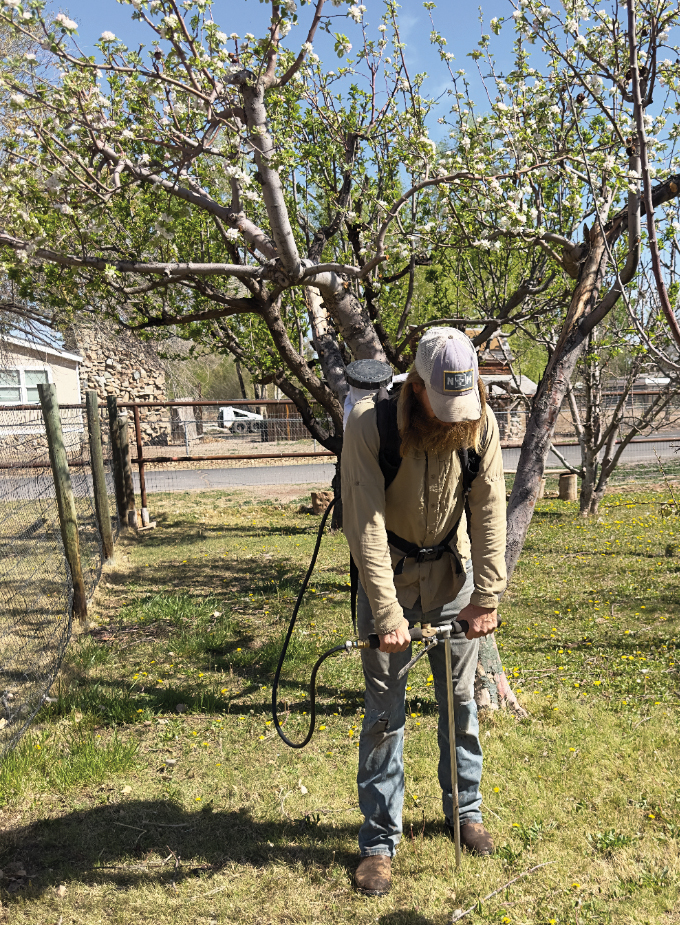
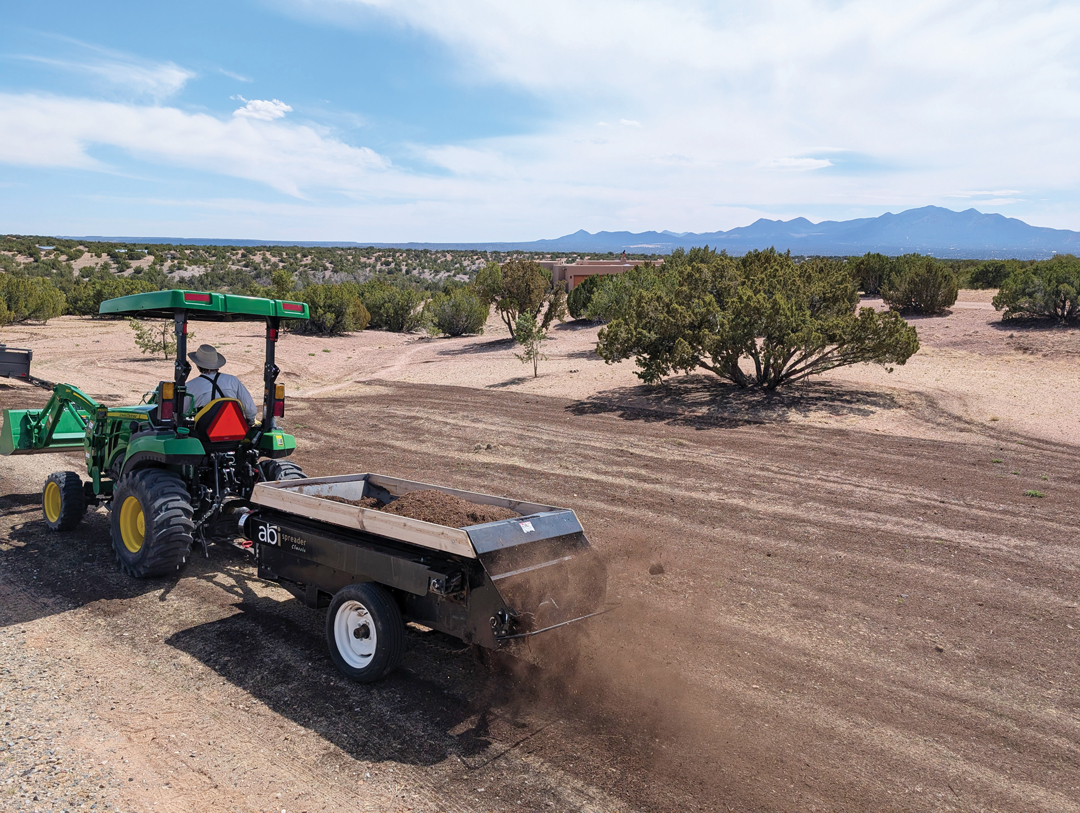
Left: Williams applying deep root injection of compost extract to apple trees. Right: Commercial compost, high-quality compost, and biochar being spread before seeding dryland pasture mix. Photos courtesy of Growing Soil Health Collective.
Thankfully, the unhealthy soil of New Mexico is unhealthy in relatively predictable ways, and there are some tried-and-true remediations that gardeners, farmers, and land stewards of all stripes can use to improve it. If you want to remediate the soil on your land (or, perhaps, do some vigilante civic engineering . . . I won’t tell), you ought to get that soil tested.
Generally, your two options for soil testing are to buy a home test kit from a garden supply store, or take a sample and send it off to a lab. The lab option will provide you with much more extensive data, generally sending back a report on the mineral, physical, and chemical components of your soil, providing a good basis for knowing what needs changing. New Mexico State University’s extension office no longer offers mail-in soil testing of their own, but they recommend the Soil and Plant Testing Lab at the Colorado State University Extension office in Denver.
As you’ll likely find out when you get those lab results back, much of the soil and water in New Mexico is alkaline (i.e., both have a high pH level), due to our high concentration of limestone deposits. This alkalinity can kill off helpful soil microorganisms and makes it harder for any plants to absorb the nutrients present in the soil. For raised beds or other small gardens, adding elemental sulfur or iron sulfate to your soil can help lower the pH; both are available at most garden supply stores. But the best solution—as with most soil problems one will encounter in New Mexico, to be honest—is some good compost.
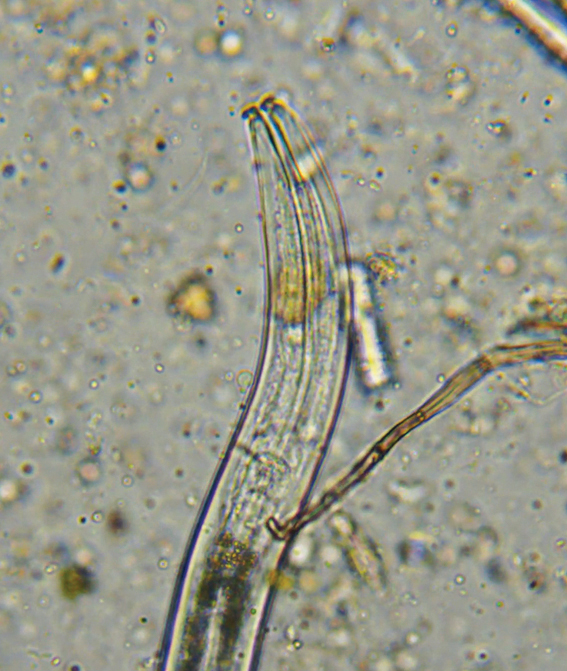
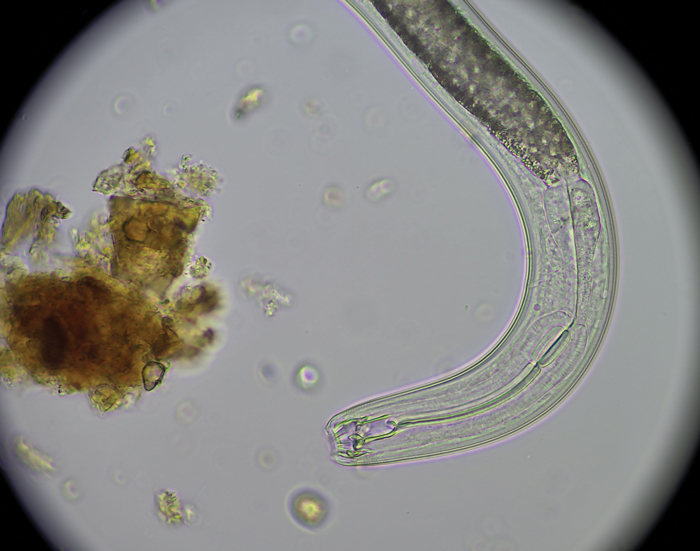
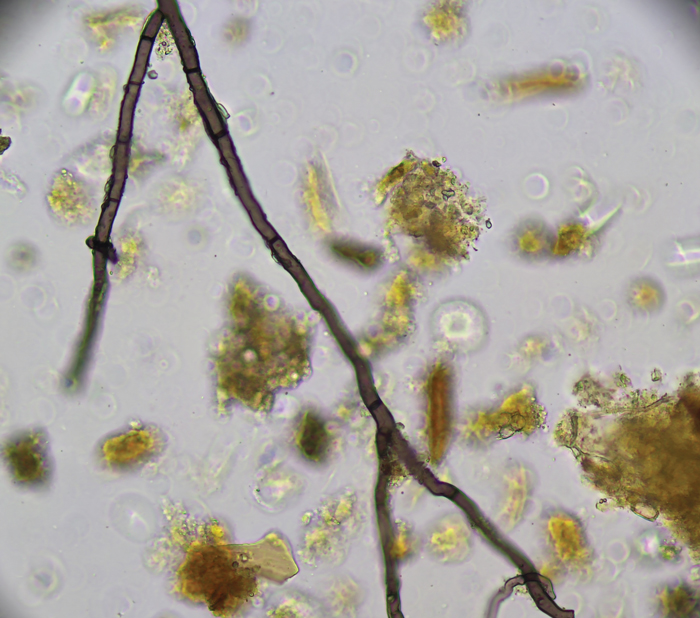
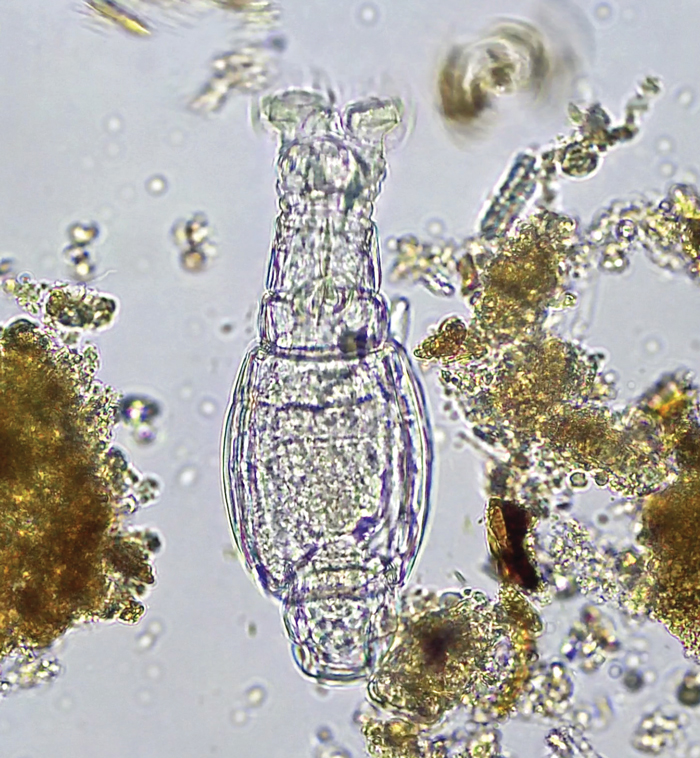
Soil microorganisms, clockwise from top left: Bacterial-feeding nematode, fungal hypha, predatory nematode, rotifer. Photos by Josh Weybright.
“My number-one prescription is to reinoculate the soil microbiology via high-quality compost,” says Williams. “I specify ‘high quality’ because commercial compost usually doesn’t have high numbers of soil microorganisms in it. It can be good for getting organic matter back into the land, [but] the goal for making good compost is high diversity and high number of microorganisms, so you use it kind of like an inoculation, like you would with a probiotic for the human gut.” It’s a good analogy: While it is the nutrients in compost that help plants grow, it’s the microbes that help break down those nutrients into forms that are more digestible (as it were) for plants. Some species of microbes that thrive in compost, like cyanobacteria, photosynthesize sunlight into oxygen and organic matter in much the same way plants do, and they can also fix atmospheric nitrogen, which makes soil more fertile. On Full Circle Soil Health’s website, Williams offers a database of compost producers/sellers that offer “highly diverse and microbially active compost.”
One of the most frustrating elements of soil remediation is that it often takes way longer than any of us would like it to—hence, the popularity of conventional fertilizers and pesticides, which promise a quick boost to your farm or garden’s productivity but offer diminishing returns in the long run. And if we humans want to make it in the long run, we’re going to have to start thinking of the dirt beneath our feet as more than just a resource to be mined. Soil, as I’ve learned, is a living thing, one that has needs of its own. Tending to the soil health of our gardens and farms is one way to address both our needs of the land and the land’s needs of us.
If you’d like some expert soil help for your garden, farm, or lawn, Full Circle Soil Health offers excellent resources at fullcirclesoilhealth.com. The weekly newsletter from the Growing Soil Health Collective, of which Casey Williams is a founding member, is also full of great info for getting even more nerdy about dirt.

Robin Babb
Robin Babb is the associate editor of edible New Mexico and The Bite. Previously, she was the food editor at the Weekly Alibi (RIP). She’s an MFA student in creative writing at the University of New Mexico and lives in Albuquerque with a cat named Chicken and a dog named Birdie.