By Cassidy Tawse-Garcia · Photos by Stephanie Cameron
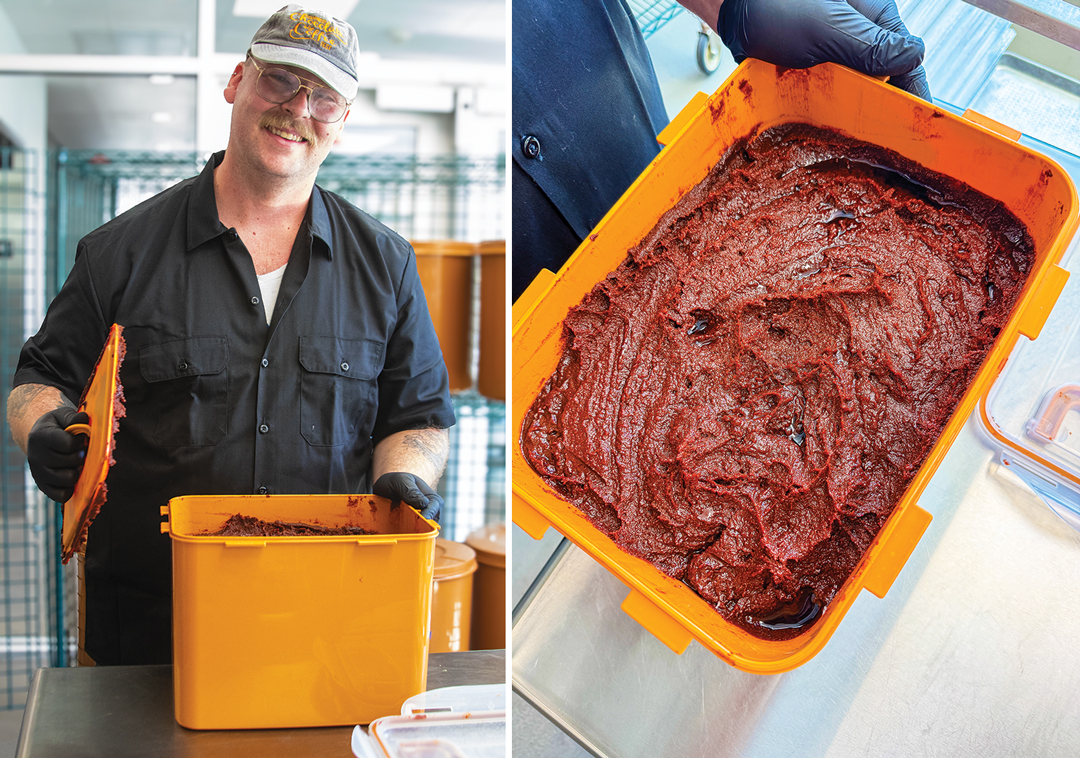
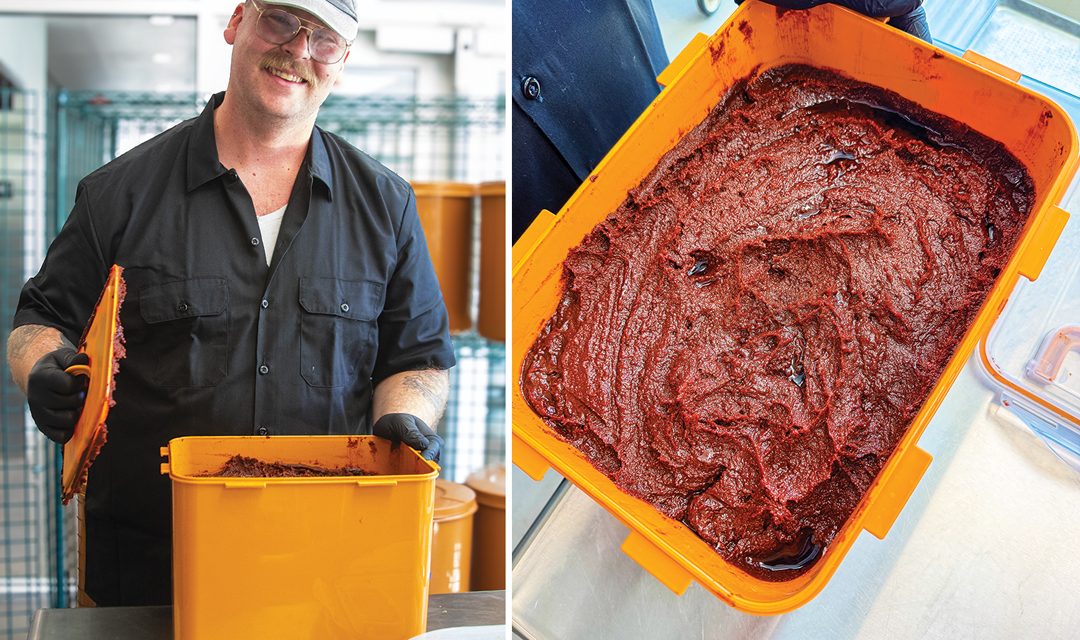
Left: Kyle Key of NM ChileJang. Right: Fermentation vessel full of gochujang.
On a bright and already hot Monday morning in late June, Kyle Key waves me in through the front gate of the Barelas Community Kitchen, the Street Food Institute’s new(ish) headquarters in Albuquerque. It could be the sun, or the fact that Key is wearing heavy paneled canvas overalls, but I note a distinct glow as he leads me into the kitchen space and introduces me to his fermented chile paste, which has amassed a nearly cultlike following in recent months.
Key, owner of NM ChileJang, is a modern-day devotee to old-world practices. He shares with me that he is currently one of only two retail producers of cottage-style gochujang in the United States. Gochujang, one of the three mother sauces of Korea, is a fermented chile paste that serves as the core flavor profile for many Korean dishes, including kimchi. Key’s is made with hot New Mexico–grown red chile, sourced from The Fruit Basket ABQ in Los Ranchos de Albuquerque.
“A traditional cottage gochujang is the way it was made in Korea about two hundred and fifty to three hundred years ago,” Key says. “The stuff we have in the stores now is going to be commercially manufactured, so it is a chemical fermentation process.”
I learn from Key that the gochujang I buy for my annual attempt at kimchi (when the napa cabbage from my CSA is truly too much to handle) is a sad imposter. “Everything that is made in the factory is produced that day, packaged, and shipped out, so there is no actual fermentation process,” he says. This is in comparison to the eighteen hours Key takes to combine the key ingredients in NM ChileJang—chile, rice, barley malt, rice syrup, meju garu (fermented soybean powder), and salt—followed by the ninety days he ferments the chile jang. In a word, Key is embracing slow. In doing so, he’s producing a more deeply flavorful, smoky, and umami-forward chile paste than any I have tasted before.
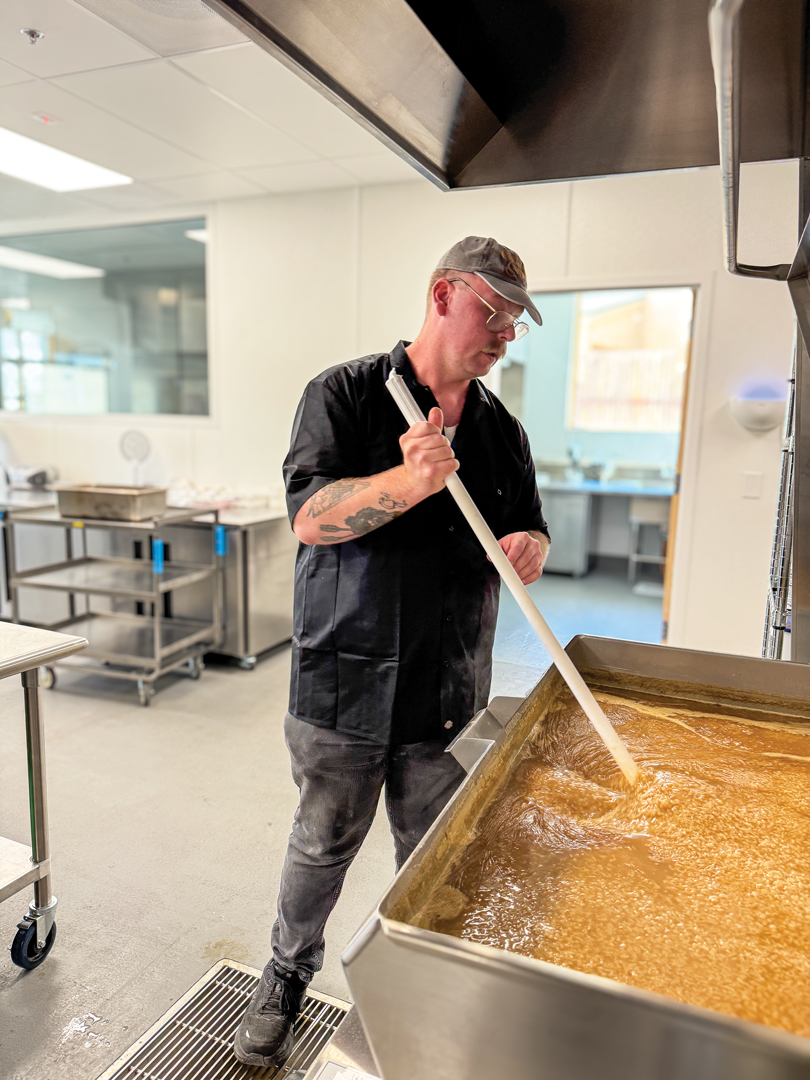
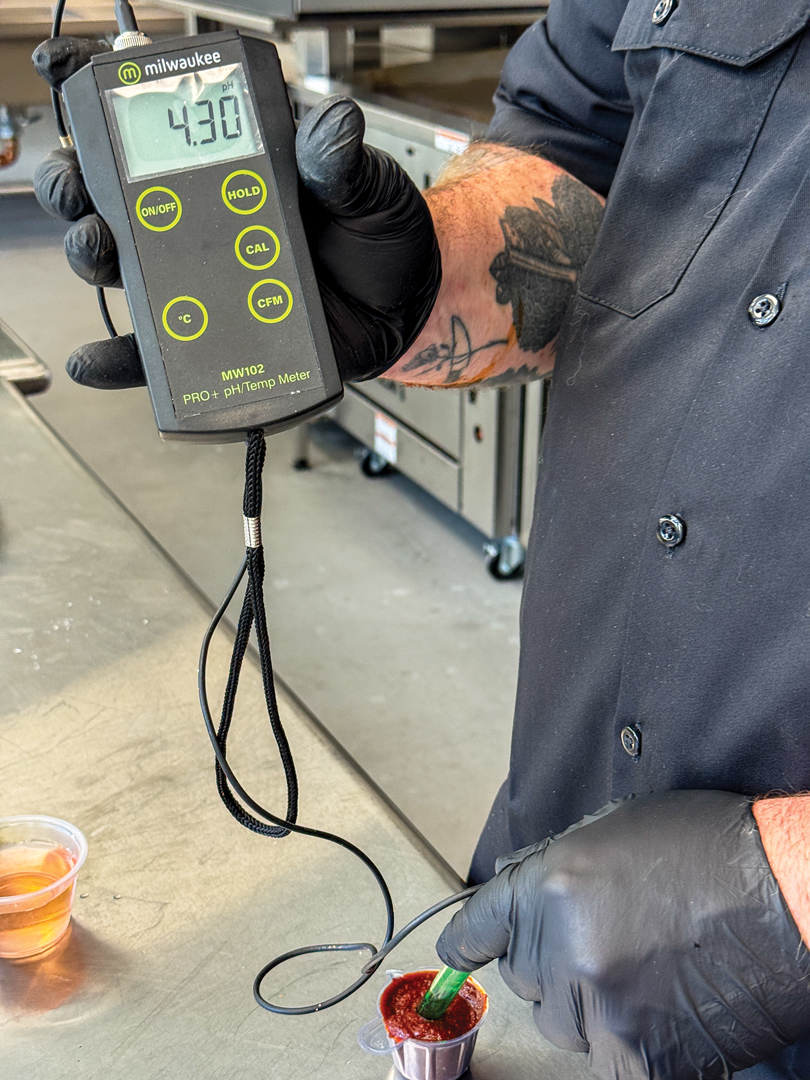
Key cooking the base for gochujang at Barelas Community Kitchen and checking the gochujang pH levels.
“In Korea, they do still have cottage gochujang . . . primarily made by matriarchs of families in clay earthen vessels,” Key tells me. These traditional vessels, called onggi, are why Key was inspired to make gochujang in the first place.
Key began his journey into the world of gochujang fermentation during the pandemic. Like many folks, he had taken up at-home fermentation projects like sourdough bread and vegetable ferments. He had always had a curiosity about Korean food and flavors, fueled by growing up in Las Vegas, Nevada, a city known for both the quality and diversity of its Asian cuisine. “My parents were sick a lot,” says Key, so he spent much of his childhood with his neighbors, who happened to be Asian Hawaiian. “They introduced me to the world of Asian food and flavors,” Key says.
In 2022, when he unexpectedly had to move back to Las Vegas from Albuquerque to care for his ailing mother, he consoled himself by going to various Korean spots for comfort food. It was a kind of “grief medicine,” Key says. After she passed, he traveled with a close friend to South Korea, and it was there, tasting the deep and spicy flavors of Korean cuisine, that he got to see onggi fermentation up close. During a cooking class, he realized that the pepper traditionally used in gochujang “looked almost identical to New Mexico red.” It was then, Key says, that “a light bulb went off.”
When he returned to Albuquerque later that year, he began experimenting with micro-batch gochujang in his home kitchen. During a six-month deep dive into all things gochujang, Key confirmed what Korean home cooks had known intuitively for centuries: If the pH of the ferment is below 4.6, no bacteria can grow in it. This means that while the chile paste is fermenting, it is safe at room temperature and does not require refrigeration. Key shared these early creations with friends, including Sunday Bagels co-owner Nick Fitzgerald, who loved the rich and layered quality and encouraged Key to make his home fermentation project legitimate. In the pursuit of this, the self-taught maker presented the City of Albuquerque food inspector with a three-hundred-page binder of peer-reviewed journal articles on the safety and efficacy of the fermentation process for gochujang. Nonetheless, it took more than a year to get his official food license, a requirement to be able to sell his products.
Key used the time from paperwork delays to hone his production process and complete the Food Business Training Program with the nonprofit Three Sisters Kitchen. He also did dozens of tastings with regional chefs and at the Albuquerque Rail Yards Market, successfully building hype for his product, even when he couldn’t sell any.
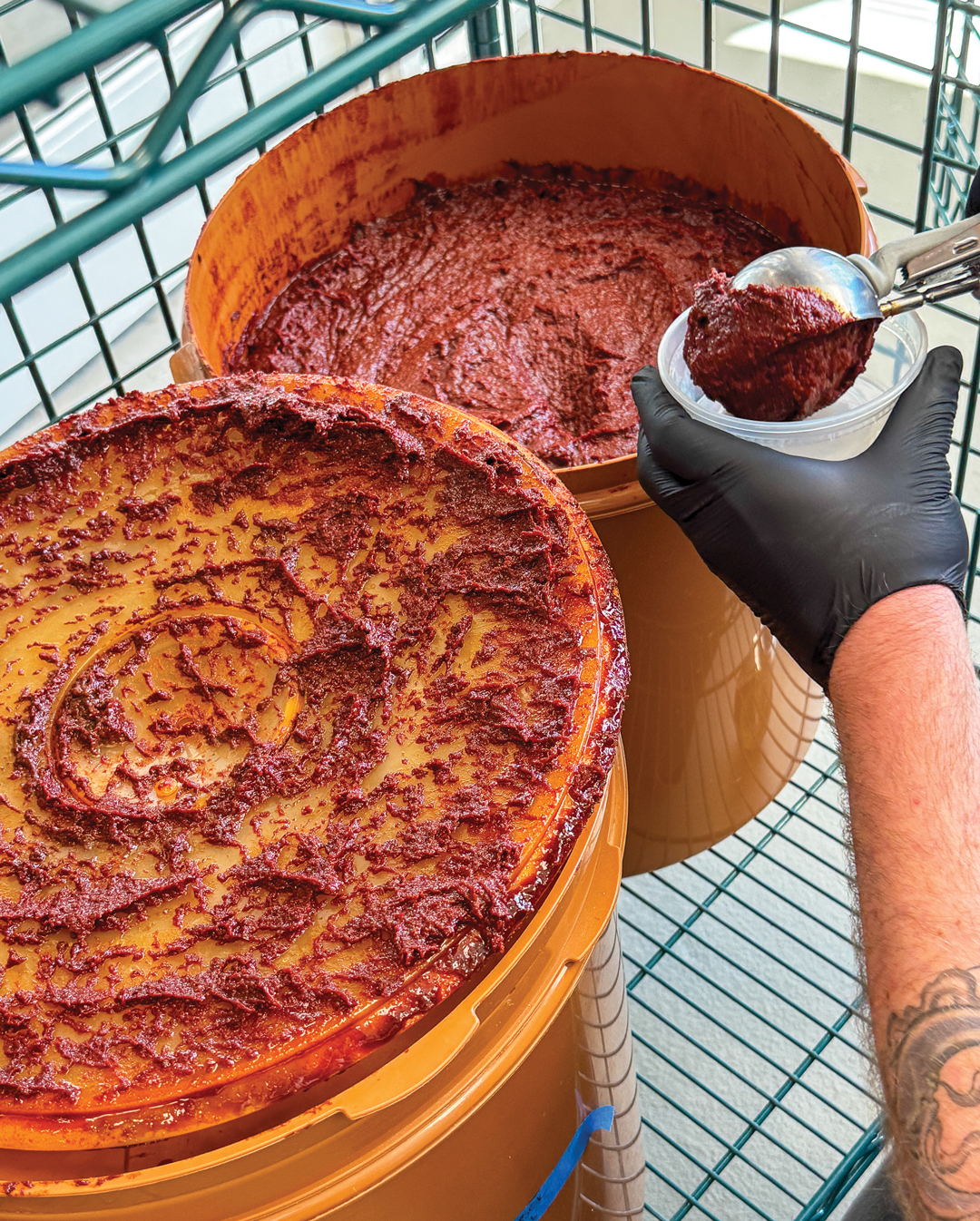
NM ChileJang’s gochujang being scooped for restaurant clients.
As of 2025, NM ChileJang is officially in business. Local chefs from Nathan Mayes (Mañana Taco) to Steve Riley (Mesa Provisions) are cooking with Key’s product, and Key tells me he is in talks with chefs in Brooklyn and Atlanta about using it too. Plus, he has plans for hot dog pop-ups featuring NM ChileJang and has begun working with New Mexico Fresh Foods on a trial run of shelf-stable pasteurized products that could be shipped nationwide. “If you want the flavor, we will ship anywhere. If you want the culture, come to New Mexico,” Key says.
Toward the end of our visit, Key shows me the vessels in which he ferments his chile paste. I can’t help but note that the large brown plastic containers, direct from Korea, are the same color as his overalls. While I feel silly pointing out he is “twinning” with his product, I will say that Key’s meticulous personality does match the product he is selling. It is clear, for Key, that slow and detailed wins the race.
As a parting gift, Key presents me with a container of Korean-style cucumber salad made with NM ChileJang. I take a quick bite, and the sweet and acidic sauce coating each cucumber offers delightful refreshment, a balm for the hot day I am about to move into. I stuff the container in my purse and go about my business, including a Costco run. Post-shop, I order my ceremonial “I made it through shopping at Costco” hot dog at the in-warehouse café and take a seat on the white, hard plastic seats to enjoy the all-beef goodness (and not think about the sad cows who made this moment possible for me). I remember the cucumber salad in my purse. “Should I?” I wonder, but before I think of a reason not to, I have fished out the NM ChileJang cucumber salad and am spooning it onto my dog. An older man seated at the table next to mine looks at me quizzically, but who cares? I take a bite, and wow, holy sh*t, Key was right. The combo is honestly so good—savory, vinegary, sweet, tangy, doughy, perfect—I consider giving the old man a bite. I also make a mental note not to miss that hot dog pop-up Key mentioned.
NM ChileJang is available for sale at Lost Cultures Tea Bar in Albuquerque, where you can try a chocolate chip espresso NM ChileJang cookie made by Bloom & Flour Pastry, or the 90 Day Pear, a nonalcoholic cocktail that, according to Lost Cultures bar manager Michael Rodriguez, is the “embodiment of New Mexico and Albuquerque.”

Cassidy Tawse-Garcia
Cassidy Tawse-Garcia is a storyteller, cook, and food justice advocate living in Albuquerque. Hailing from Colorado, she grew up on a small family farm, growing vegetables and flowers for market and community supported agriculture. Early in the COVID-19 pandemic, she started Masa Madrina (an ode to her great-aunt, a native of Arroyo Hondo), a prepared-food business focusing on sourdough and farm-sourced seasonal offerings, as a means to survive. Today, her work has evolved to focus on mutual aid and elevating marginalized voices in food justice and farming. She is currently pursuing her PhD in human geography at the University of New Mexico, where she studies community reciprocity and care movements.