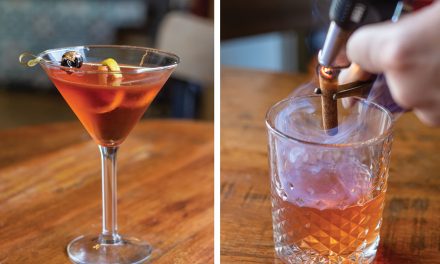

The White Rabbit, Caley Shoemaker’s take on the white Negroni.
Perhaps even more than with food, the visual element of drinks is a crucial part of our enjoyment of them. There’s a reason, after all, that cocktails are usually served in clear glasses rather than opaque cups. The addition of a big cube of ice, a glittering salt rim, or a twirl of citrus peel go a long way toward elevating a drink from good to exceptional. Although we’re (thankfully) no longer in the early 2000s trend of chemical-neon-hued party drinks, a colorful cocktail is still delightful—and few people know this better than Caley Shoemaker, cofounder and master distiller of As Above, So Below Distillery.
Since their founding, the Santa Fe distillery (which previously went by the name Altar Spirits) has focused on making spirits with an eye toward the ritual significance of drink and old folk medicine traditions. This historical connection is made very clear with their red amaro, which Shoemaker chose to name Aradia—a reference to a figure originally documented in a nineteenth-century book called Aradia, or the Gospel of the Witches. In it, Aradia is described as the daughter of the goddess Diana and a sort of teacher for local witches in rural Italy.


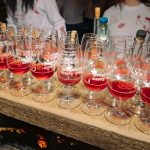
The Coven, with absinthe verte and root beer; Aradia aperitivo liqueur; The Palazzo with Aradia and bourbon.
“My understanding is that it’s based on a true story of a woman who used to travel the Italian countryside teaching peasants herbalism,” says Shoemaker. “And because she was teaching peasants how to treat themselves medically—well, the church didn’t really like that much. And so she was branded a witch.” Using the name of an Italian healing woman for the distillery’s amaro—which, at its origin, was an Italian medicinal preparation—just seemed to “tie it all together.”
The connection to witchiness both past and present is written all over As Above, So Below—from the name of the distillery itself (a saying found in several occult texts and illustrated in the Magician tarot card), to the labels on their bottles, to the beautiful concoctions made at the bar, all glittering like gems and fragrant with herbs and botanicals. The lovely reddish-pink Aradia gets its color from black carrot concentrate—an herbal (and vegan) alternative to both the traditional dye made from cochineal bugs and the now typical synthetic dye used in commercial amaros. Distilled with fresh and dried citrus peels and a dense recipe of roots and botanicals such as gentian, angelica, wild cherry bark, Turkey rhubarb root, and licorice, Aradia tastes sweet, lush, and herbaceous—indeed, like something the village wisewoman might prescribe you.
“I want[ed] to draw that citrus flavor down into a deeper earthy flavor. So you still get a really lovely Negroni, but you also get these lovely earthy baking spice notes,” says Shoemaker.
There is magic to be found as well in As Above’s absinthe verte, with its iridescent green hue and its delirious mythology. The drink of choice for the writers and artists of the belle epoque—and, several generations later, of American goths with a penchant for the dramatique—absinthe was illegal in the States until 2007 because of ideas that the chemical constituents of the wormwood used to make it caused hallucinations. Despite these ideas being (mostly) disproven, the “Green Fairy” has retained some of its mysterious allure in the present day, as the plethora of paraphernalia used in its serving attests.
Shoemaker, who clearly loves a good folktale, says of absinthe, “My favorite of the many stories . . . is that a pair of sisters started making it in Switzerland, and then a French doctor found the recipe, thought it was fantastic, and started promoting it back in France. And that’s how it sort of got this French [reputation].”
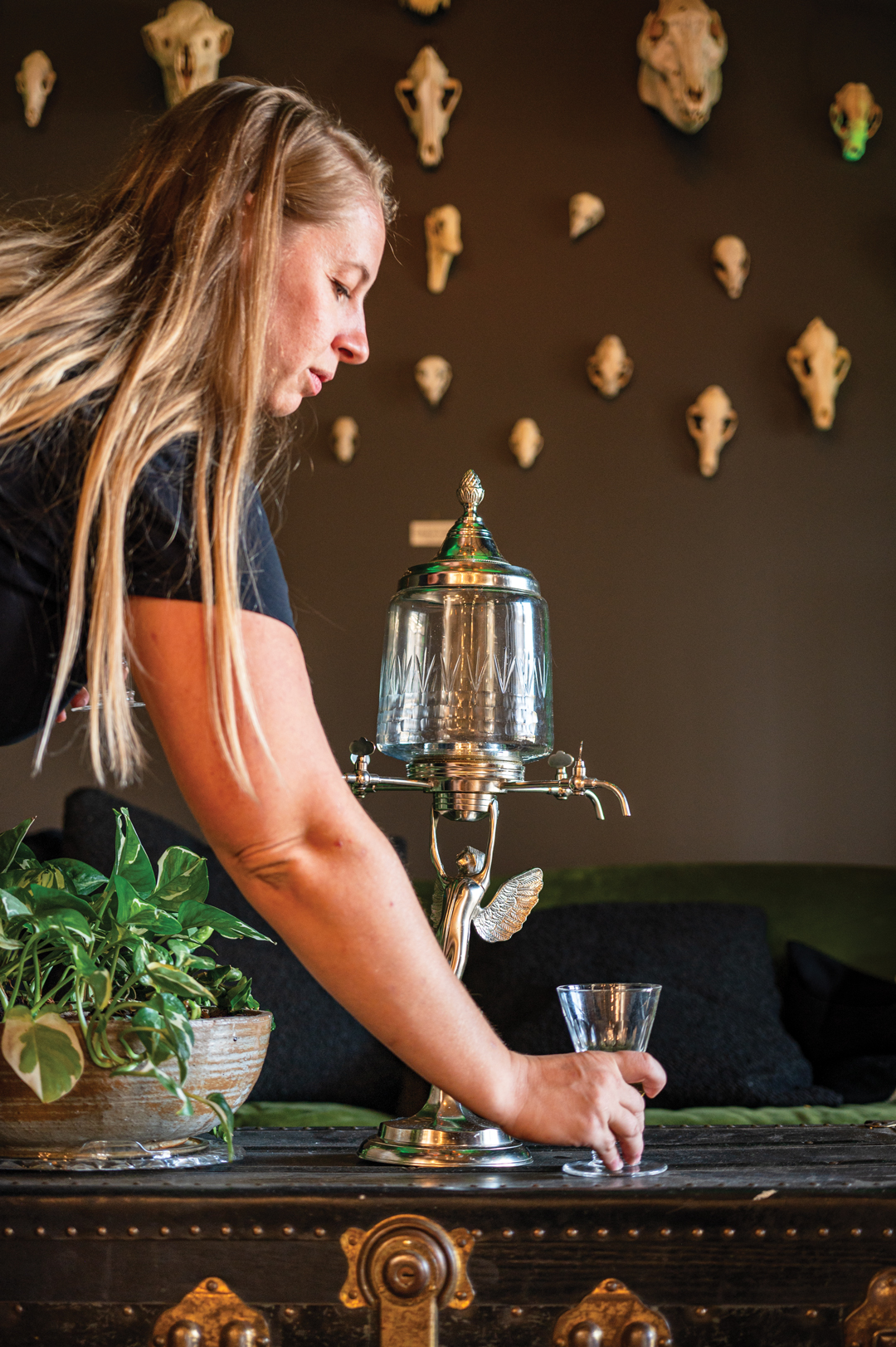

Caley Shoemaker prepares absinthe service at As Above, So Below.
The absinthe verte has many of the same components of the Aradia, with the crucial addition of wormwood, as well as anise and hyssop. It is also a very high proof—hence the tradition of serving it poured over a sugar cube on a slotted spoon and diluting it with a little water or ice. With these additions, the vibrant green from the bottle turns to a pale, slightly cloudy jade color in the glass. It is hard, indeed, not to think of it as magical.
It very well might be magical. Shoemaker distills all As Above’s spirits according to cycles of the moon, the same way many growers have historically planted and harvested their crops. The absinthe gets its distinctive flavor from sitting on macerations of various botanicals for three full moon cycles, starting, on the first full moon, with the wormwood. “And on the next full moon,” she says, “we add hyssop, cinnamon, angelica, and then all kinds of really lovely anise flavors. We’re talking fennel, anise seed, star anise, we add all those extra botanicals and allow those to macerate for another moon cycle. And then on the third full moon we load it all into the still—botanicals and everything.”


Absinthe service at As Above, So Below.
As for the spirit’s legendary green shade, that part happens after distillation is complete. Fresh hyssop and mint are steeped in the absinthe, which picks up some of that chlorophyll green, as well as some final herbal notes. “The day we take the steep out, it comes out this beautiful dark emerald color. And that fades to a light straw green within two or three days,” at which point the color more or less stabilizes. Still, she recommends keeping your bottle out of direct sunlight, as the color will continue to fade over time—it’s the natural result of not using any artificial coloring or stabilizers.
Making unique craft spirits like absinthe or Aradia is a bit more commercially viable in New Mexico than in other places because of some liquor laws particular to our state. In short, restaurants can get a discounted liquor license if they exclusively serve New Mexico–made products—which means you’re (blessedly) more likely to find Negronis made with Aradia than Campari or Aperol at many restaurants in the state. Additionally, bars operated by local distilleries, like As Above, So Below’s headquarters at the Santa Fe Railyard, can serve other state-produced spirits in addition to their own. This beneficial economic environment—one where a craft distiller can make direct sales both by the bottle and by the glass, and where restaurants have a financial incentive to serve local spirits—means that Shoemaker has a little more license to experiment.
So what sorts of spirits can we expect from her and As Above in the future? “We’re working on a black amaro right now,” Shoemaker says. “I love this idea of like an alpine amaro with minty, piney notes. . . . We’re in this high-altitude mountain town. A lot of folks don’t think of New Mexico as this beautiful mountainous place, people that aren’t from here. So I like the opportunity to highlight biodiversity in New Mexico.”
545 Camino de la Familia, Santa Fe, aasbdistillery.com

Robin Babb
Robin Babb is the associate editor of edible New Mexico and The Bite. Previously, she was the food editor at the Weekly Alibi (RIP). She’s an MFA student in creative writing at the University of New Mexico and lives in Albuquerque with a cat named Chicken and a dog named Birdie.