
Words and Photos by Sarah Wentzel-Fisher
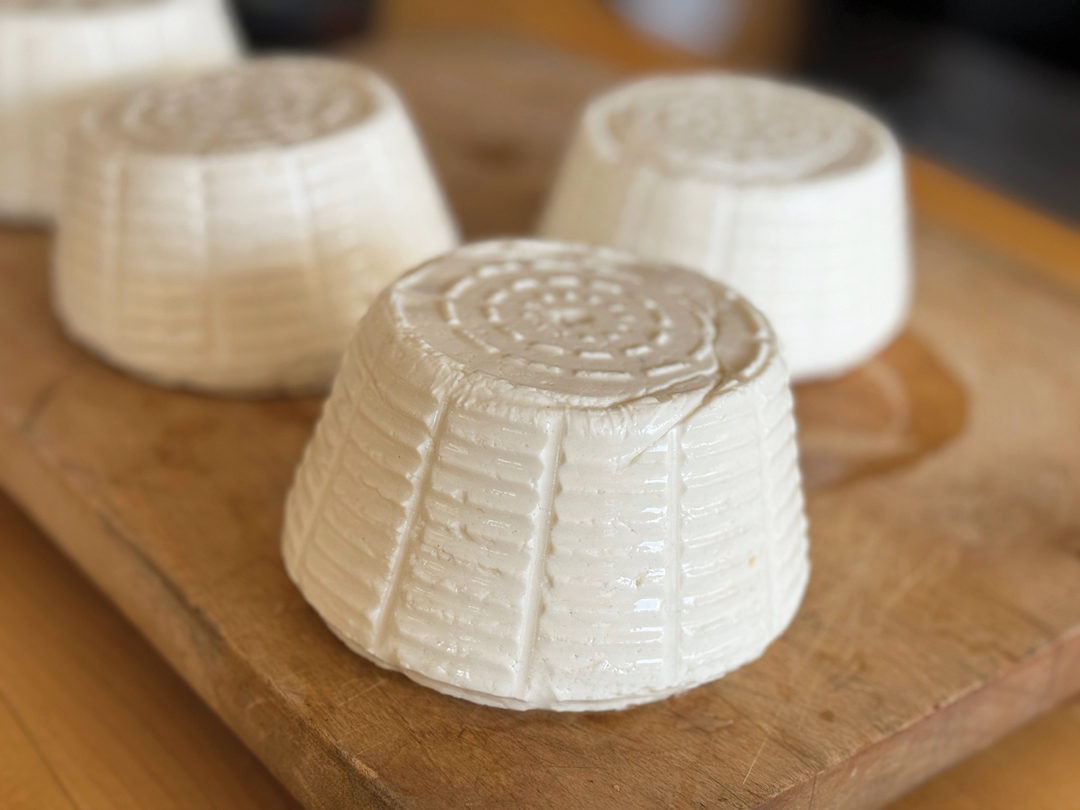
Halloumi, a fresh Mediterranean cheese, shaped in baskets.
Early last spring, Zach came back from a long day at the Polk’s Folly Farmstand with the particular bounce he gets in his step when he’s scheming something that he is both excited about and finds a little outlandish. The question often starts, “What would you think about . . . ?” This time the question was “What would you think about having fifteen people on the farm for a weeklong cheese school?”
While Polk’s Folly is a diversified livestock farm, we don’t milk any animals, nor do we make cheese.
An appreciative cheese lover, I looked at him with a raised eyebrow and responded, “Tell me more.”
The nascent New Mexico Cheese Guild, formed at the end of 2023, was looking for a farm to host an in-depth course on the art and science of cheesemaking. The guild’s mission is to promote and preserve the tradition of cheesemaking while fostering collaboration within the industry, and Lissa Knudsen, the guild board chair, had been in conversation with Trevor Warmedahl of the Sour Milk School about offering a workshop or two in New Mexico in the fall.
While hosting fifteen people and figuring out where we would source five gallons of fresh (ideally still warm) milk each day seemed a little daunting and unrealistic, we enthusiastically signed up to host a five-day workshop where Trevor would share his passion for natural methods of milk fermentation and cheesemaking.
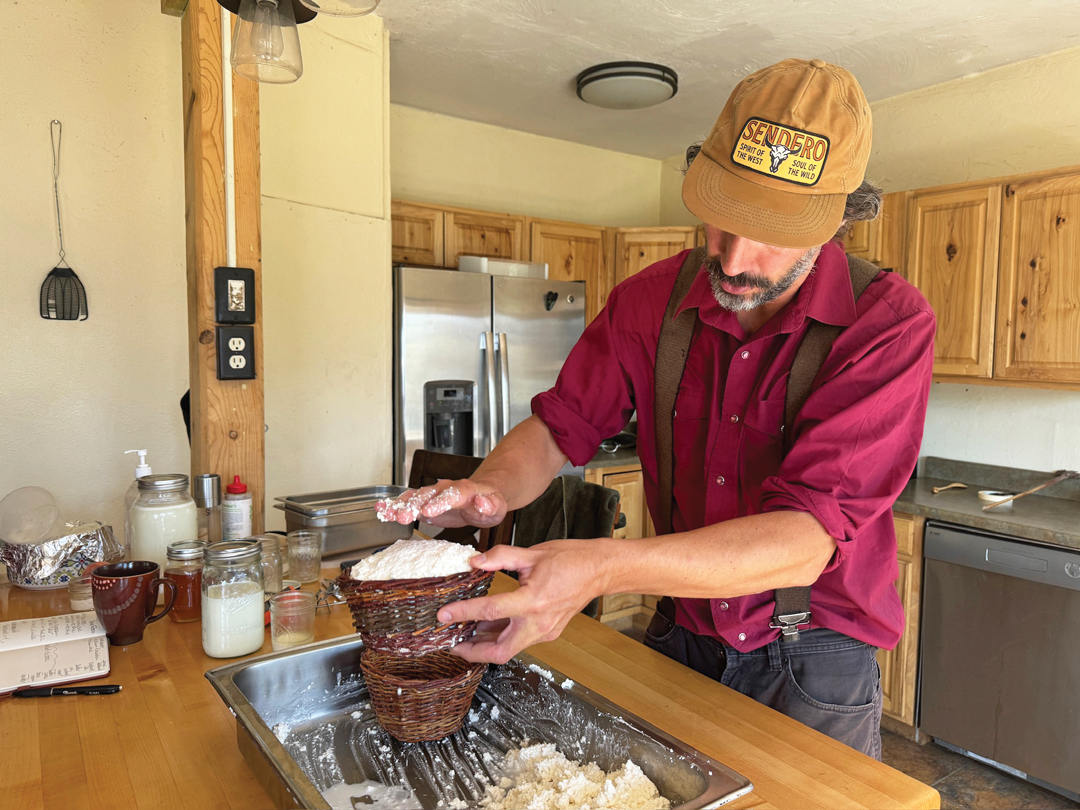
Using a willow basket, Trevor Warmedahl demonstrates the preparation of queso fresco. Native materials are often used to craft basket forms in artisan cheesemaking.
In New Mexico, dairy contributes $2.2 billion directly and $4.2 billion indirectly to the state’s economy, yet we don’t really have a culture (pun intended) of making artisan cheese. The New Mexico dairy industry—and it is an industry, one of the largest and most consolidated in the country—produces almost 4 percent of the milk in the United States, on 107 dairies with an average of 2,700 cows each. Most of that milk is made into cheese—about 7.4 percent of all cheese produced in the country—and most of that cheese is made at Southwest Cheese, a plant in Clovis where they process over 5.1 billion pounds of milk and produce more than 588 million pounds of block cheese as well as 36.8 million pounds of whey protein powders annually.
In other words, New Mexico has about one dairy cow per three people, but good luck finding a nice aged hard cheese or a soft ripened cheese made in the Land of Enchantment. Artisan cheese is usually made by hand in small batches from milk produced on small dairies with fewer than 100 cows—a size once typical in the Rio Grande Valley but true of less than a quarter of a percent of dairies in the state today. Artisan cheese relies on the quality of the milk, the microbiology unique to the place it’s made, and the quality and character of the rennet, as well as the unique strategies of the cheesemaker. This is some of what the NM Cheese Guild is aiming to inspire and revitalize in New Mexico.
In many ways, cheese is a perfect food. It is derived from milk, which we survive on almost exclusively for the first nine months of our lives. The making of cheese requires some very basic steps and processes: culturing the milk, which causes the lactose to convert into lactic acid, souring the milk; coagulation of the milk using rennet, which causes the milk to congeal; salting to add flavor and pull moisture from the curd; separating curds from whey; and shaping and, if desired, aging the finished product. The magic and diversity of cheeses comes from the myriad variations of milks, rennets, temperatures, and microbes, meaning that only in a large New Mexico cheese factory will any two cheeses taste the same.


Trevor talks through process and chemistry. Students examine their work, discussing flavor, texture, and process differences among the cheeses they’ve made. Nina Listro, New Mexico Cheese Guild board member, samples grilled Halloumi.
Over the five days of the school, participants made six different types of cheese. Trevor started with a basic method for a simple soured cheese and a ricotta made from the whey. As he worked through a variety of approaches to cheesemaking, he shared how technique may have developed in different places around the world based on the climate’s suitability for storage, people’s need or capability to transport the cheese, and facilities (or lack thereof) for making cheese. Ultimately, the group made several types of ricotta, cotija, a Halloumi style, brunost, and a failed feta.
We sourced our milk from cheese school participants. Students came to stay at the farm for the week, and several also brought milking animals from their goat herds. Each day started with goats being milked and still-warm milk being delivered to the kitchen, where it would set out to sour with the bacteria already active in the raw milk. Just as different strains of yeast will produce very different flavors in beer, different strains of lactic acid bacteria will produce different by-products and flavors in cheesemaking. During the cheese school, we leveraged existing cultures in the milk for the souring process.
So much can affect flavor in small-batch cheesemaking, even if you try to consistently replicate the process. Part of the zen of cheesemaking is letting go of an expectation of consistent results and finding pleasure in the fact that you will always have some degree of variation. While the goats were on the farm, their diets changed, so the flavor profile of the milk changed as well. Several of the farmers commented that the milk got creamier and sweeter when the goats were allowed to browse on elms, often considered a nuisance. So we chopped down several of these weed trees and fed them to the goats—indeed, the milk the next day was noticeably sweeter.
Cheesemaking is an ancient tradition, with archeological evidence of the practice found in 7,000-year-old clay urns in northeastern Europe. But humans were likely making cheese as soon as they domesticated sheep about 10,000 years ago. Shepherds probably discovered cheese by using the stomachs of young animals as vessels for storing and transporting milk. Rennet is a collection of enzymes found in the stomach lining of unweaned mammals, such as calves, lambs, or kids. These young animals primarily consume milk, and the enzymes in their stomachs help slow milk digestion by curdling it into a solid form, allowing better nutrient absorption. As mammals grow older, they stop producing these enzymes. Because of this, rennet is traditionally obtained from very young animals that are culled shortly after birth. Thankfully, the process allows a significant amount of rennet to be derived from each animal and substantial volumes of milk to be made into cheese.
In preparation for the school, the NM Cheese Guild sponsored a one-day workshop on the farm for those who also wanted to learn how to harvest rennet. A neighboring farmer with goats had a nanny who had given birth to twins, both male, whom he didn’t want to raise and so donated them to the workshop. We demonstrated how to conduct humane on-farm slaughter of these animals, then collaborated with another goat farmer who had experience processing rennet to harvest the abomasum, the fourth stomach of these ruminant animals. After separating it from the rest of the offal, we cleaned the abomasum and packed it in salt. When cheese is ready to be made, the abomasum is removed from the salt, rinsed, ground, combined with water, and then strained, leaving an extremely bitter liquid. About half a teaspoon of this liquid rennet will coagulate a gallon of milk, so one abomasum can turn 700 to 800 gallons of milk into cheese. While rennet harvest can be one of the most contentious topics associated with cheesemaking, it also is a critical part of maintaining herds that are right sized for the landscapes and farms where they will live and graze.
During our week together in September, we used the rennet we harvested in April to make cheese. Learning the process in its entirety transformed my appreciation for this ancient staple. I have a deeper appreciation for the flavors I experience when eating it but also gratitude for the hard work and skill that goes not only into making cheese but caring for the animals who produce the milk. The school also expanded my awareness of the potential for cheesemaking in New Mexico. While we may be unlikely to develop small creameries, it does give me hope that herd shares and a culture of cheesemaking—and, in turn, a greater community of cheese enthusiasts—might emerge through the directed efforts of farmers and groups like the New Mexico Cheese Guild.
Sarah Wentzel-Fisher
Sarah Wentzel-Fisher is a committed champion of the local food movement and of resilient and regenerative agriculture. A board member for both the Rocky Mountain Farmers Union and the Southwest Grassfed Livestock Alliance, she has worked as an organizer for the National Young Farmers Coalition, the editor of edible New Mexico, and the executive director of the Quivira Coalition. In her free time, you can find her feeding chickens, making pear butter from rescued fruit, and visiting with farmer friends around the state.