
Acequia Workshops for Newcomers and Old Hands
By Mariko O. Thomas


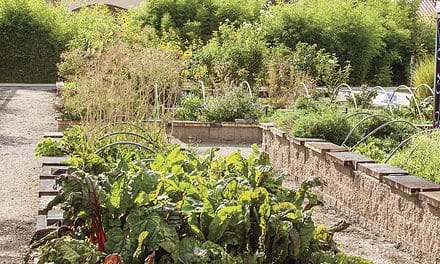
Acequias at the terraced orchard of Trinidad and David Arguello, photos by Stephanie Cameron.
On the evening of Acequia Irrigation for Orchards, a workshop organized by De La Tierra a La Cosecha Coalition, I turn onto NM 230 and head into the deep canyon cut where the farms of Valdez line the magnificent Rio Hondo. I’m so distracted by the apricot trees heavy with yellow and magenta fruit sweeping over the road that I miss the inconspicuous turnoff to the orchard hosting the workshop and have to do an awkward, million-point turn to right my course. The air is hot and heavy with the potential of summer rain as my tires finally crunch down the dirt road lined with shockingly pink sweet peas, where Gillian Joyce, the executive director of Alianza Agri-Cultura de Taos, is directing parking at the ancestral home and terraced orchard of Trinidad and David Arguello.
The cars are packed deeply, and I wander past a painted turquoise wagon wheel and a ceramic cherub, somehow made more charming by its missing arms, to where the workshop is starting. Understanding acequias is one of the most important bodies of knowledge that anyone can grab on to when learning how to live in northern New Mexico, whether or not the person has their own acequia rights. The waterways are not only utilitarian but also spiritual, and their systems of governance are deeply imbued with practices that simultaneously protect the waterways’ health and healthy community relations. One cannot speak much about acequias without also involving history, sense of place, plants, cultural norms, and geo-logy, nor can one keep an acequia flowing without the community help of many people knee deep in muck during the spring limpias.

Acequia Irrigation for Orchards workshop organized by De La Tierra a La Cosecha Coalition,
photo courtesy of Alianza Agri-Cultura de Taos.
Under the generous shade of a cottonwood tree, surely older than my grandmother, waits a circle of workshop participants. They are old and young. A handful wear cowboy boots—some fashionably, others occupationally. There are work pants streaked with mud and hipster tattoos, severe hair buns and tie-dyed shirts; the smells of essential oils, gasoline, hay, smoke, and more roll off them. Acequia management techniques for orchards, it seems, is a skill set that’s deeply desirable across demographics. As we wait, there is the murmur of conversation, talk of everything from how the beavers have scaffolded tiny stairs for themselves in the Rio Hondo streambed to which old apple trees had the bears going wild last fall.
David and Carlos Arguello, sons of Sabinita Argüello Córdova and grandsons of Francisquita Cordoba Prando Barela, move to start speaking. They are magnetic, so much so that I can’t recall even a throat clearing before the workshop attendees know it is time to listen. Opening with a broad, warm smile, Carlos says, “If you’re walking around here, you’re walking the steps of our ancestors.” The thunder grumbles and most of us look up nervously. His words seem like they’ve been approved by the skies. Carlos, who is commissioner on the Acequia del Monte del Rio Chiquito and a board member of the Taos Valley Acequia Association, tells us that everything started for their family in the mid-1800s, when they settled the east third of the valley of Valdez. He explains that this area survived the Great Depression, wars, and more because of the rich knowledge of the landscape that people like his family held. Additionally, he notes that a flourishing barter system made this valley self-sufficient—and the abundance of the San Antonio acequia, estimated to have been formed in 1790, made the resilient foodways of the valley possible.


Taos County extension agent Will Jaremko-Wright, photo courtesy of Alianza Agri-Cultura de Taos;
apples in the orchard, photo by Stephanie Cameron.
By now, the wind is starting to whip around, and David, wearing a straw hat with a bandanna wrapped underneath, takes over, privileging us with stories of how he sleeps twenty feet from the place where he was birthed and making fun of Carlos for being born “all the way in Embudo.” The brothers pass around a framed picture of the two of them bottle-feeding an orphaned lamb, and Carlos utters a word that I think encapsulates why so many people are standing around at the edge of a monsoon trying to learn about acequias. He says this place is his querencia, meaning the place where he draws strength, a deeply rooted knowledge of place. Querencia, I think, is what a lot of people arrive in New Mexico hoping to find.
At that point, the rain starts to fall in an enormous release, big fat droplets that kerplink, kerplunk, kerplonk off the nearby roof of the Arguello house, and we all speed-walk to the cover of their porch, hopping over a shallow carved waterway and basking in the heady green aroma that only a summer monsoon brings. Trinidad, David’s partner, takes up the storytelling, unspooling a narrative that stretches from growing up on 119th Street in Spanish Harlem to her move to Santa Fe in the 1970s, when the roads were still dirt, to her first sighting of David (a very funny story, but hers to tell) to showing up in Taos and committing her energy to this place. That’s when Will Jaremko-Wright from the Taos County Cooperative Extension Office politely interrupts to say that they might need to hurry and start the workshop. I am sad for the storytelling to end, as the generous sharing of these experiences of their lives helps give context to how what we’re about to learn fits into the history and heart of this place. Trinidad closes her narrative, and with heartbreaking seriousness, standing in this ancient valley on the porch of her home, she says, “All I ask is that you take care of the land, and take care of the water.”
Taking over, Will is friendly and innately trustable. He has a flair for breaking down complicated scientific concepts into the kind of digestible tidbits that participants at this workshop can use. On top of this, he is deeply entrenched in living what he teaches; after the workshop, he tells us, he will be rushing home to help his wife irrigate their land. Speaking about orchard-specific acequia irrigation, he explains how the traditional, unlined acequias increase overall infiltration of water and muses that multiple routes of water flow is not only excellent for tree roots but also crucial for overall watershed health. These earthen acequias help refill aquifers, he says, and support every living thing in the water’s path on the way to where it’s being directed. We crowd around a gnarled tree and Will shows us how water should be concentrated around the dripline of a canopy, where the roots are reaching, as opposed to the inner core, which helps us imagine the span of the roots stretching out below us.


Trinidad and David Arguello’s orchards and acequias, photos by Stephanie Cameron.
Much of what Will has to teach brings in how practices around water are inextricable from other aspects of the landscape, from insects to drought to geology. He details how established orchards can withstand drought for a few years but will hit a point of no or low return when “xylem cavitation” occurs. With this process comes the emission of a “snap” that reduces the tree’s ability to transport water from soil to leaves. Bark beetles, it seems, are especially attuned to hear this snap and have even been reported copying the sound of those snaps when mating. To conserve water and protect the soil, he recommends various cover crops, along with a “chop and drop” trimming technique that helps nurture and restore the soil around the tree. Planting small flowered plants like yarrow is beneficial, he says, as they attract wasps that are harmless to humans but lethal to the worms that love apples. As the discussion turns to ways of directing water, Carlos demonstrates the quick, efficient scraping motion best used to direct water through a terraced space, as well as how to make tiny dams from overturned patches of earth when one needs the water to branch off in a different direction.
By now, the rain is pounding down through a sparkle of evening sun. I am fully soaked and have had to stash my notebook for fear of losing everything I’ve learned, but standing there in a centuries-old orchard with this mishmash of farmers, there is a lovely camaraderie, and it’s as if just standing here together listening, to both the old stories of this farm and the scientific explanations behind the practices of Carlos and David’s ancestors, is the great success of the workshop.
As the rain starts to slow, Carlos reemerges to the center to close down the session. He’s been moving among us the whole time, pressing fresh cherries or sprigs of mint into our palms, and he leaves us with a final reminder as we stand in the drizzle encircled by hundred-year-old apple trees: To make sure to “land softly” if we are new to the valley. To volunteer at our local acequia if we really want to learn, to attend meetings, to keep our ears open, and to take time to understand the practices around acequias. As we all tramp back to our cars, rain still running off our faces, it seems the storm itself has welcomed us into this water education. Fat drops cling to the tall grasses like jewels on a necklace, reminding us that in this valley, true wealth looks a lot like water and the know-how to work alongside it.
Mariko O. Thomas
Mariko O. Thomas is an independent scholar, instructor, and writer living in Taos. She is interested in plant-human relationships, environmental justice, and storytelling.