
Sourcing Single-Origin Beans at Little Bear Coffee Co.
By Nina Katz

Tres Leches Cortado with Lactic Honey Cinnamon co-ferment espresso. Photo by Stephanie Cameron.
Fourteen countries. Twenty-eight producers. That’s how many growers and estates Albuquerque’s Little Bear Coffee worked with in 2025 alone—a big number for a small, yet ever-strengthening, muscle in the Southwest’s coffee scene. And these aren’t just farmers whose pictures the small-batch roasters have seen in promo materials from a third-party distributor; Little Bear’s buyers are on a first-name basis with their supplier partners situated in coffee-growing regions nestled in the “bean belt.”
Such decorum might seem like a low bar, but it’s a big part of what lands Little Bear among the high ranks of other specialty coffee roasters. For the uninitiated coffee drinker approaching one of Little Bear’s café counters, it’s important to grasp that, unlike “premium” and “gourmet” coffee, “specialty coffee” is more than a catchphrase; it’s effectively a grade, designated by what things look like all along the coffee supply chain, from soil to cup.
What goes into growing, processing, selling, roasting, and serving coffee is complicated and variable, but it’s good to know the basics: You can think of commodity coffee as Big Coffee: high-yielding varieties of beans (Bourbon and Typica varieties of the Arabica species are the industry’s current workhorses) grown on an industrial scale to meet global demand. Often, those beans are blended together to the point where they lose their inherent character and tilt toward the generic, like the flavor you’d expect from coffee ice cream or a standard cup from Starbucks. Due to the high-volume nature of these blends, the bean’s origins are harder to trace, further obscuring from the general consumer the labor exploitation on large coffee farms. What we can’t see won’t leave a bad taste in our mouths, right?

Sara Gutiérrez.

Coffee fermentation microbes under a microscope.

Coffee fermentation starter undergoing fermentation at the lab.

Green coffee on flat, raised drying beds. Photos courtesy of Sara Gutiérrez.
The rules for specialty-grade coffee are different. In fact, they are clearly articulated in a highly standardized process. Regarded as the highest-quality coffee in terms of flavor, these beans must be scored 80+ points on a 100-point scale set by the Specialty Coffee Association. This test, graded by tasting experts akin to sommeliers, evaluates beans on flavor factors such as aroma and acidity, as well as production factors such as farm or coffee estate traceability, plant cultivation, and precision in the harvesting process. Besides these technical standards, specialty coffee denotes a cultural shift in the professional relationships between producers in coffee-growing regions and the US roasters they’re exporting to. For Little Bear, this has meant supporting producers who focus on small-scale, sustainably grown beans.
The Albuquerque shop, established in 2017, has gained national acclaim for prioritizing relationships with their producers, thanks, in part, to Olivia Morris, Little Bear’s sales director and a key member of their green bean buying team. Morris had spent thirteen years working their way through coffee when they moved from South Carolina to New Mexico and joined Little Bear in 2024. “Our goal,” says Morris, “is, always, how do we build a relationship [with producers] that can turn into a friendship?”
Sara Gutiérrez, a fifth-generation coffee farmer in Quindío, Colombia, part of the Eje Cafetero (Coffee Axis), is one of those friends. Gutiérrez first met Little Bear co-owner Jacob Fox at a government-sponsored coffee event in Colombia where she was both showcasing her specialty coffee and representing the interests of coffee growers in Quindío.
Among the various single-origin beans at Little Bear, coming from estates and farms in India, Uganda, and Rwanda, as well as other farmers in Colombia, Gutiérrez had two of her limited-edition beans on bar at Little Bear this past winter. Both showcase what she is best known for in the coffee world: experimenting during the coffee bean’s fermentation stage.

Roasted beans in the cooling tray of the Loring S35 Kestrel coffee roaster.

Production assistant Jo Sutherland and head roaster James Reimann roasting coffee. Photos courtesy of Little Bear Coffee Co.
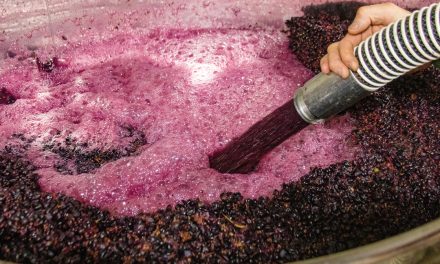
All coffee, commodity or specialty, goes through a fermentation process. It’s how producers separate the beans from the cherries: Microbes break down the outside layer of fruit, knocking loose the two interior seeds that eventually get bagged and sent off to roasters. But in the last ten years or so, there’s been an upswing in producers using a process called co-fermentation, where additional ingredients, like fruit and spices, are added to the fermentation tanks. Generally, when tasting notes are printed on the front of a bag of coffee (e.g., cocoa, molasses, apricot, toast), those are born from the good-smelling science of coffee roasting, as well as the microclimate the beans were grown in. But when additional ingredients, and their microbes, ferment with the green beans, their flavors linger even after roasting.
Because no food milieu is safe from a little drama, co-fermenting has proven to be a bit divisive in specialty coffee worldwide, with some arguing it muddles or cloaks true flavors. Sometimes Albuquerque feels decidedly old school, but Little Bear is not. Roasting unique beans is part of what makes them cool. Their support of growers doing the experimenting makes them even cooler.
Gutiérrez adds yogurt and cinnamon sticks to her Lactic Honey Cinnamon co-ferment, which has an undeniable tang and spice, or as she and Little Bear suggest, notes of cinnamon buns, vanilla frosting, cardamom, and milk chocolate.
“Sara is really steering the ship, and a lot of that is really intentional on our part,” says Morris when I ask if Little Bear has any input on Gutiérrez’s process. “The Western side of the coffee industry, in my opinion, has a really bad habit of feeling emboldened to tell coffee producers to do something different than what is working. [Little Bear’s] ethos is, if we are excited to be working with someone, why would we want to tell them to do something different?” Basically, whatever Gutiérrez wants to produce, Little Bear is excited to showcase.
“Little Bear Coffee has shown me what generosity, humanity, and tenderness truly look like,” reflects Gutiérrez. “Working with their team is just incredible. I feel like I am being held with care, openness, and genuine kindness.” Partnering with roasters like Little Bear within the specialty coffee industry has allowed Gutiérrez to continue her family’s coffee legacy. Gutiérrez’s vigor and knack for pushing the value-added envelope is what keeps specialty coffee an exciting industry in the first place.
These days, most of us take a brand’s motto with a grain of salt. But it’s clear from Little Bear’s partnerships with producers like Gutiérrez that theirs—“Love People, Use Coffee”—means something, and that it’s not just about what goes down in Albuquerque. It’s all love to the coffee drinker, local artisans you can find at their holiday markets and in the café gallery spaces, baristas from across the state who come to throw down in Little Bear’s coffee competitions, and last, but always before anything else can happen, the producers.
Multiple locations in Albuquerque
Nina Katz
Nina Katz is a food writer living in Albuquerque. They would like to see Froyo come back in a big way.