Shifting Temporalities of Hives and Honey Makers
By Mariko O. Thomas ∙ Photos by Douglas Merriam
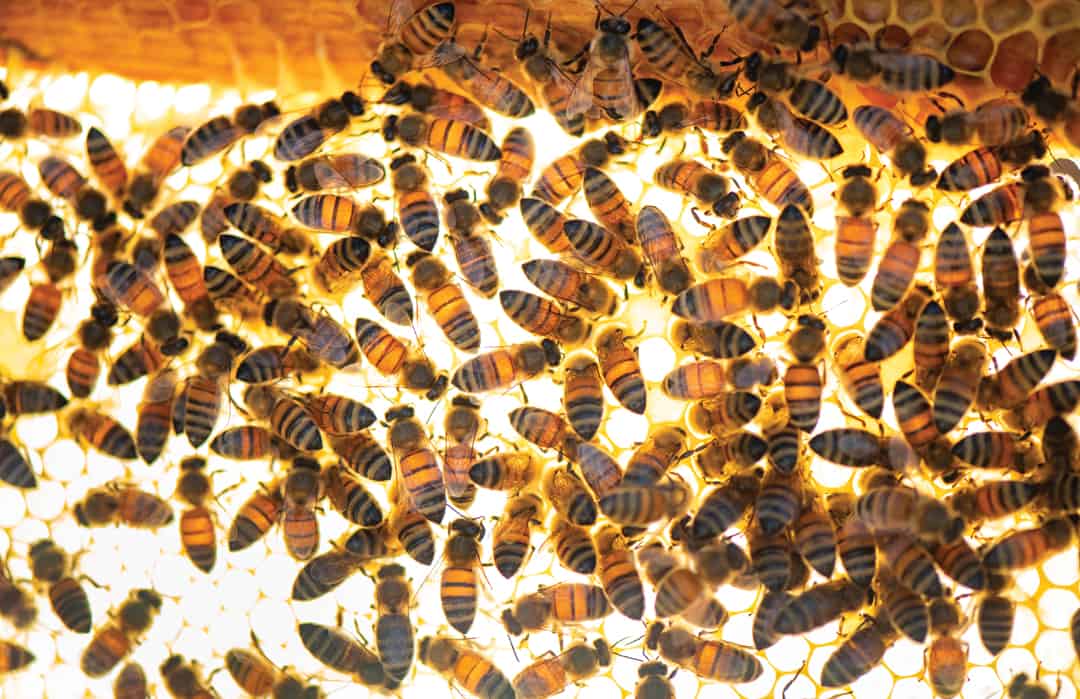
Bees in action at Taos Bee.
“Hate to break it to you,” says Melanie Kirby of Vadito-based Zia Queenbees, “but the bee clock is nonstop during the season.” I’m on the phone with her as she gets her oil changed on the way to the corn dances on a hot morning in July, thick tendrils of heat creeping through the window already at 8 am. I’m interested in the way that time works with beekeeping, curious about alternative ways of understanding the immense urgencies of our clocked world. Perhaps beekeeping is a more relaxing way of orienting? The answer is yes, and also, rather decidedly, no.
Kirby’s voice is warm, full of laughter, and radiates generosity. She tells me the life of bee relationships works for her because she herself identifies as a worker bee, and the dynamism of beekeeping keeps her invested—with each hive having a different personality and every bee season emerging with variation. A Native New Mexican with membership with Tortugas Pueblo, Kirby has kept bees professionally for twenty-seven years. In addition to running her nineteen-year-old queen-breeding operation, she teaches at the Institute of American Indian Arts (and all over New Mexico with other community partners) and has started a promising collective led by Indigenous matriarchs focusing on post-wildfire pollinator protection in northern New Mexico. Kirby gently puts me in my place concerning whatever misguided aspirations I had concerning beekeeping as relaxed. It’s much more nuanced than that. While it is true that it doesn’t operate like the Euro-Western work clock, it arguably moves in an interconnected, ever-shifting seasonal one.
Time in association with bees has several scales, Kirby explains. There’s the immediacy of the day-to-day acts of reactive care necessary for her practice, but also the wide-swathing stretch of past and future in human relations with bees, and the timescale of how bee genetics evolve from generation to generation, adapting to planetary changes. It’s a whole new way of making sense of years, but on the micro and macro level. As Kirby puts it, “The societal clock of humans falls away on the bee clock,” and that is a sentiment I’d hear multiple times while talking with beekeepers in northern New Mexico.
The bee clock is a way of orienting to time and space that beekeepers often adopt, allowing the bees and their intensely reactive intelligence, their sense of what should happen when, to take the lead, with human stewardship following their cues in reactive, cyclical care. Kirby explains that beekeeping has much to do with circadian rhythms and the presentations of equinoxes and solstices. The winter solstice starts the bee season, as after December 21, the bees (so in tune with the tilt of the planet) go into slow motion, shivering to stay warm. As the days get longer, they bulk up their queen with royal jelly, a nutrient-dense secretion that triggers the process of larvae developing into queens. By the spring equinox, they are built up in their hive to begin collecting nectar. Kirby says that this is a scientific art and an artistic science, allowing for a cyclical dance between plants, insects, and human stewardship. “The bees would be fine without us,” she remarks, “but we’re here, so what do we do with that? There is an importance in power, place, and purpose—and we have a responsibility to be good stewards in this time we are here.”
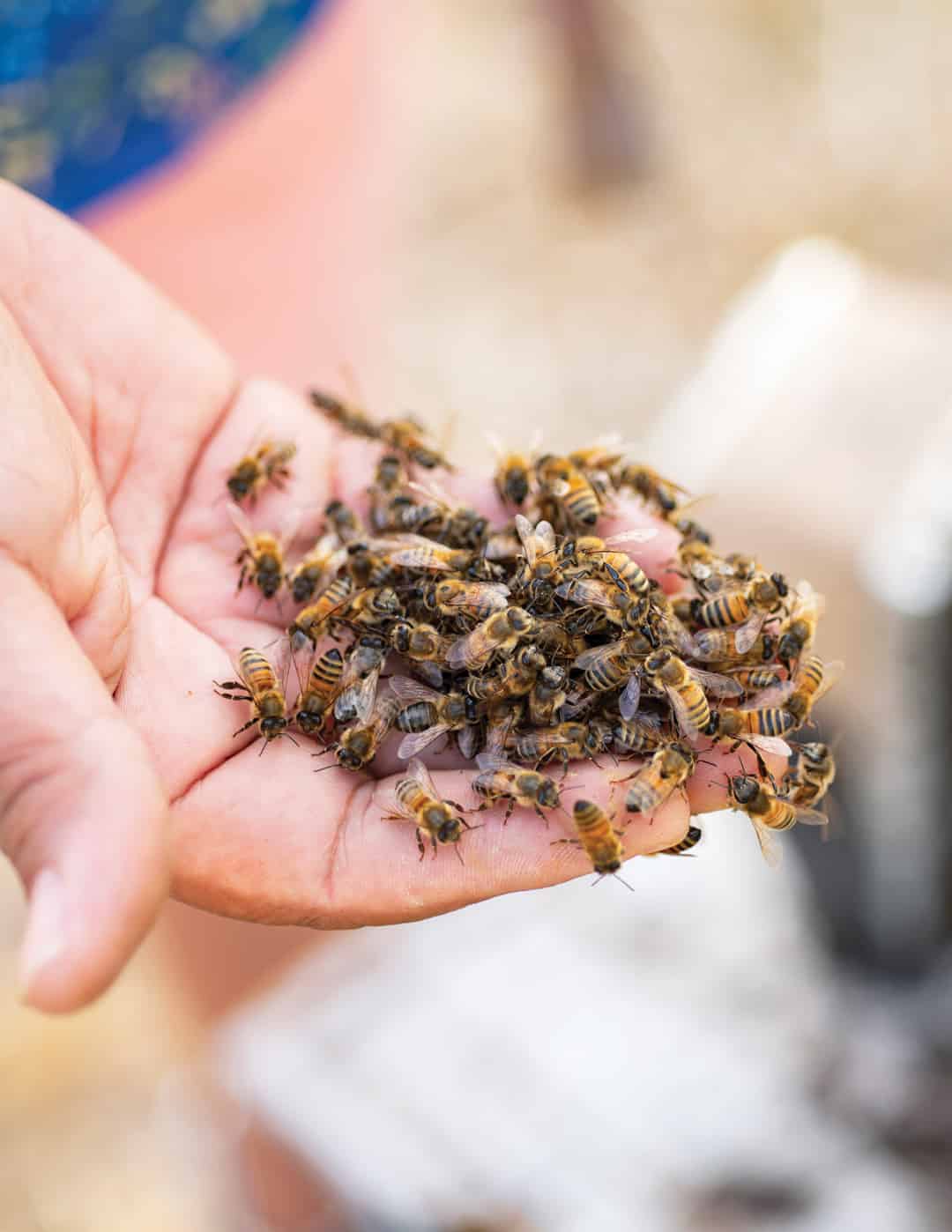
Melanie Kirby holds a handful of bees.
Kirby specializes in queen breeding, as opposed to honey or beeswax production, working to ensure the growth of healthy queens that can in turn help other humans start healthy hives with regionally specific queens who have uniquely adapted to the bio-region they come from. She teaches me that it takes twenty-one days from egg laying for worker bees to hatch and mature, fifteen and a half days for the queen to develop and mature, and thirty-eight days for a confirmed queen bee (a queen bee whose ovaries have developed and is considered a mated queen). Kirby is hyperattuned to the calendar of the bees because “when it’s related to their health, they won’t put things off for a day or week. They are on it.”
From her, I learn that of an estimated twenty thousand species of bees on Earth, eight make honey. The one most familiar to us is the Western or European honeybee (Apis mellifera), although to call it “one” is not quite right, given the immense diversity within this most commonly domesticated species. Some forty subspecies of honeybees have adapted to different regions, climates, and ecosystems, and it’s estimated that there are twenty-six subspecies of A. mellifera alone.
Honeybees visit flowers and collect nectar from blossoms by pulling it out with their proboscises and then store it in their “honey stomach,’’ which helps condense the nectar into a more honey-like consistency. The bees pass the nectar into the mouths of other bees, whose bodies continue the process. The honey is deposited in honeycombs built by the bees, and they fan it furiously with their wings to continue the evaporation process until the individual hexagonal compartments filled with honey are capped with wax. It’s much more complicated than this, but these are the basic mechanics.
Considering the ways that humans have learned to put off meals, naps, doctor’s appointments, and more to do “work,” I wonder what we have to learn from honeybees, whose most important work is their survival.
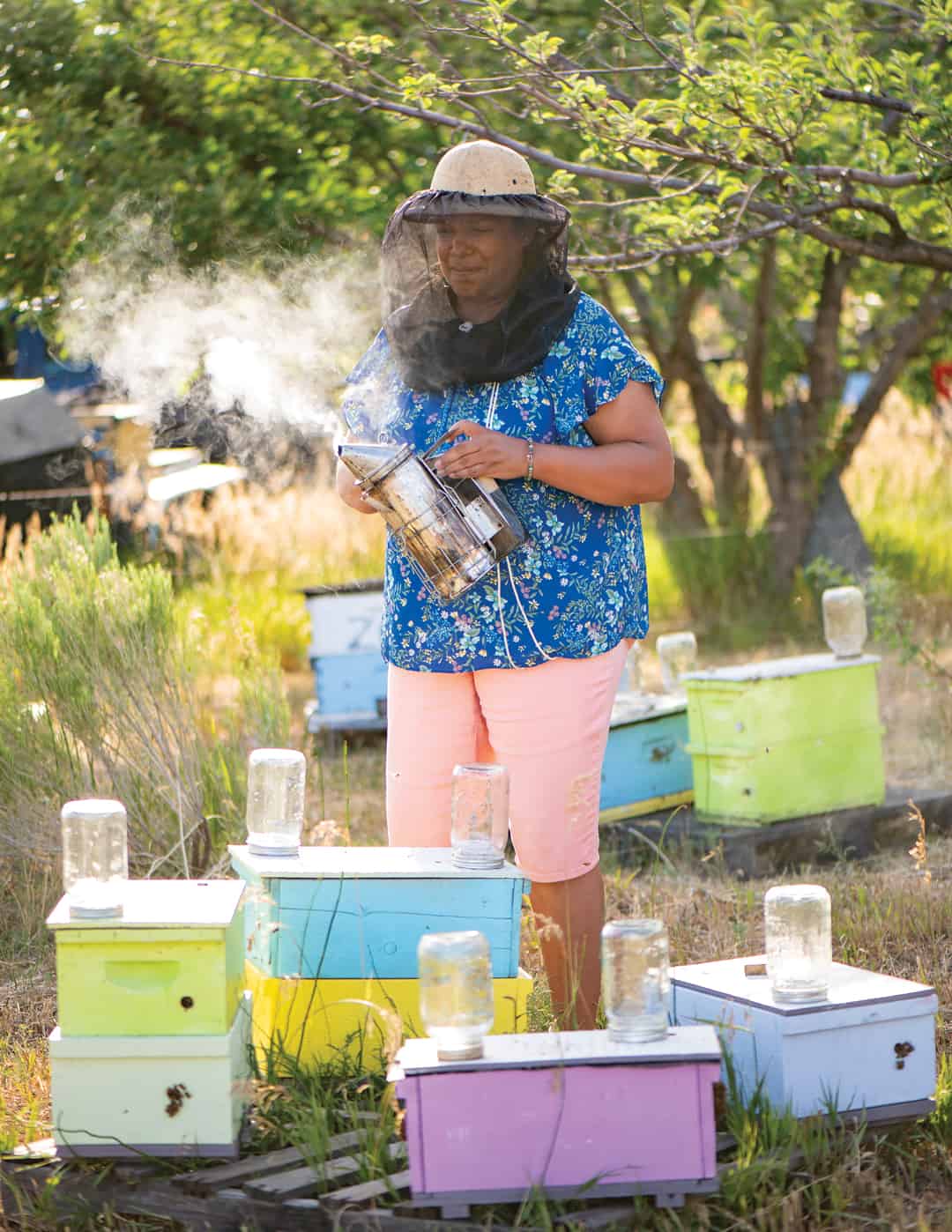
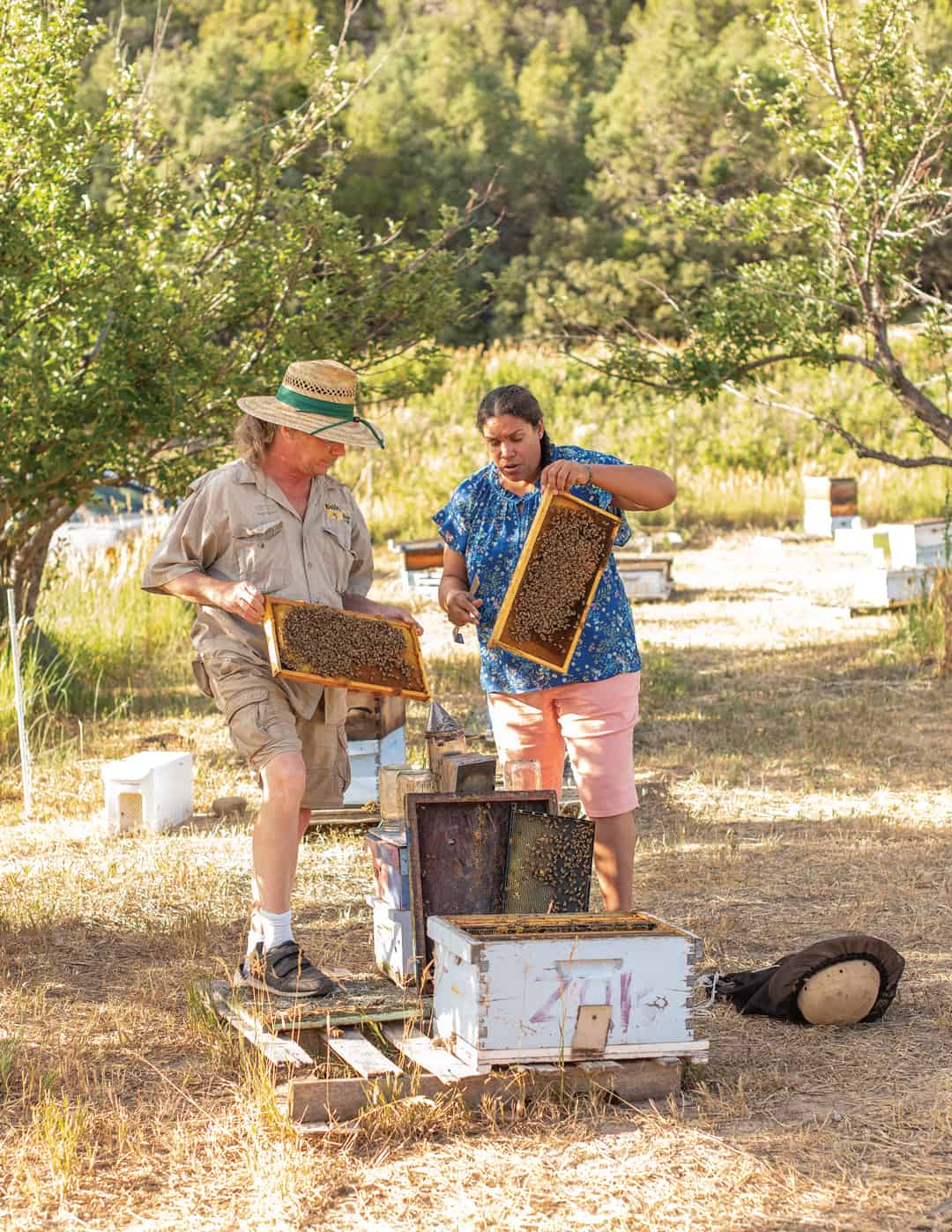
Left: Melanie Kirby of Zia Queenbees. Right: Mark Spitzig and Melanie Kirby tending the bees in Vadito.
There’s a sweep of gray clouds in a monsoon sky, the air pregnant with the possibility of raindrops, when I turn off Hondo Seco Road and park in the gravel outside Moira O’Hanlon’s house. All morning, I’ve been nervous that I was going to be late, trying to borrow from my experiences with beekeepers and sit with a different sort of timing, a sense of time that many land-based peoples have found through work for community connection, land stewardship, and more-than-human relations. I’m trying to tap into a sense of touch and go that has little to do with the aggressive notions of time that most of us have to live by. Still, I don’t want to be rude.
O’Hanlon is standing outside with a broad smile and a can that looks like a steampunk teapot, which is emitting smoke with an earthy, grassy aroma. She pumps some of the smoke into her palm and then into mine, and when I ask her what makes the smoke, she grins again and says, “Horse manure!” She explains that the manure burns at a temperature and rate that makes it difficult to hurt the bees, and we will be using the smoker to wake them and encourage them to emerge. (According to some beekeepers, the smoke also keeps them from getting collectively aggressive and communicating danger to the hive.) I ask her how long she’s been doing this project and she fixes me with a wry smile: “This isn’t a project; it’s my life.” While O’Hanlon is known for Taos Bee’s enchantingly smooth lip balms, medicinal salves, and sprays, which she collects her own propolis and beeswax to make, her real calling seems to be more about the relationship with bees than the products.
Two other cars roll up, containing O’Hanlon’s assistant, who works with her to make and sell delectable skincare products and cares for the bees with her, and a girl of maybe nine or ten who just wants to see the hives. She pulls out various parts of bee suits and we put the girl in a full suit, with O’Hanlon’s assistant and I donning shirts with long sleeves and netted hats. We wind around the electric fencing and O’Hanlon puffs smoke from the aforementioned smoker into the hive, but grimaces at the sky, acknowledging that bees are creatures of the sun and this is less than ideal weather for them. Her turquoise ring–covered hands gently pull up the vertical tray of a top bar hive (a type of hive with trays pulled out vertically). The bees scramble over the glistening hexagonal combs. I’ve never before had the privilege of seeing a hive up close, and I am blown away. What I anticipated as a potentially creepy moment—the beetle scene from The Mummy made a strong impression on me as a kid—is instead one of beauty and wonder. The bees tangle and crawl gently over one another, and the low hum they emit hits me deep in my bones with a reverberation of proportions I can only describe as spiritual. O’Hanlon tells us that propolis (used to seal the hives) is treasured, the smell so intoxicating that people will pay oodles to sleep on it. I roll a small piece in my hand, relishing the silky texture, before she stores it away in a glass jar. She will use it later to make propolis spray.
She then puts the bees away and tells us that it’s just not a good day for them, with the weather moving in. While I’m longing to see more, I appreciate this reactiveness, so contrary to expectations in the human world, where performance is expected regardless of the weather, day, or type of sleep one has had. We watch as O’Hanlon lovingly replaces the bar hosting the honeycombs in her hives, and we walk away. It is the bee clock striking (or maybe humming?) again, and to be in commune is to be in tune with their ever-dynamic ebb and flow, deeply connected to the ecological forces at play on a given day.
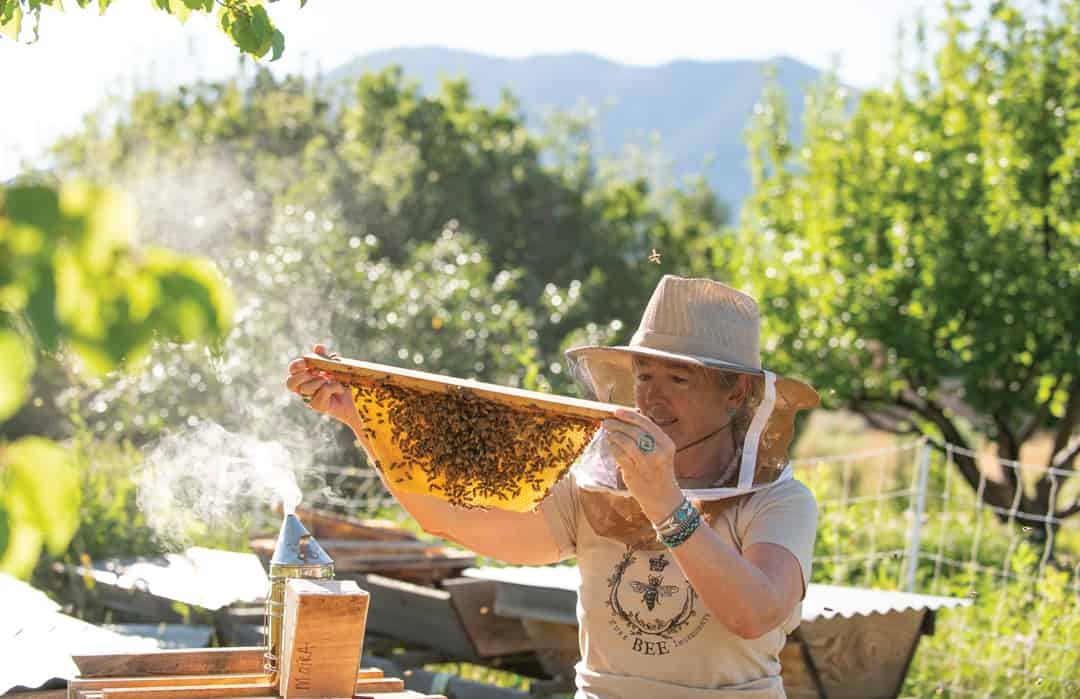
Moira O’Hanlon of Taos Bee in Arroyo Seco.
My last stop is with Mike McMannon, the owner of Taos Honey Company. I drive to meet him at Sol Food in Arroyo Seco, still feeling heady and inebriated from the scent of propolis on my fingertips. I’m thinking about how O’Hanlon remarked that the bees are not chickens but rather wild things with their own agendas, reframing my entire conception of what it means to “keep” bees. It seems that this might be better articulated as “supporting” bees. I find myself comforted by the fact that bees are not truly domesticated but rather in a constant, tenuous relationship with humans. Much like New Mexico’s beloved oshá, they cannot be truly committed to a capitalist system of production.
McMannon drinks black coffee and has a clipboard of notes. I have a vague memory of him from the farmers market when I was hugely pregnant a few years ago; he gave me a jar and said, “Free honey for mothers,” and it felt decadent and amazing to be gifted something so sweet and so difficult to make and collect.
Setting aside his clipboard, he tells me, candor and care in this voice, “I cannot take out a calendar and spec out all the timing on when I’m going to take on new queens, when I’m gonna check ’em, when I’m gonna feed them, or anything else. It can’t be more important to me to go to San Diego for the weekend. . . . I can’t do that, I choose not to. If I’m in San Diego that day and it’s time to do the queens, I don’t want to be there, I want to be here. And that is a thing that is a bigger deal than it’s ever been, because everyone is so mobile [except] when it comes to caring for animals and land stewardship.”
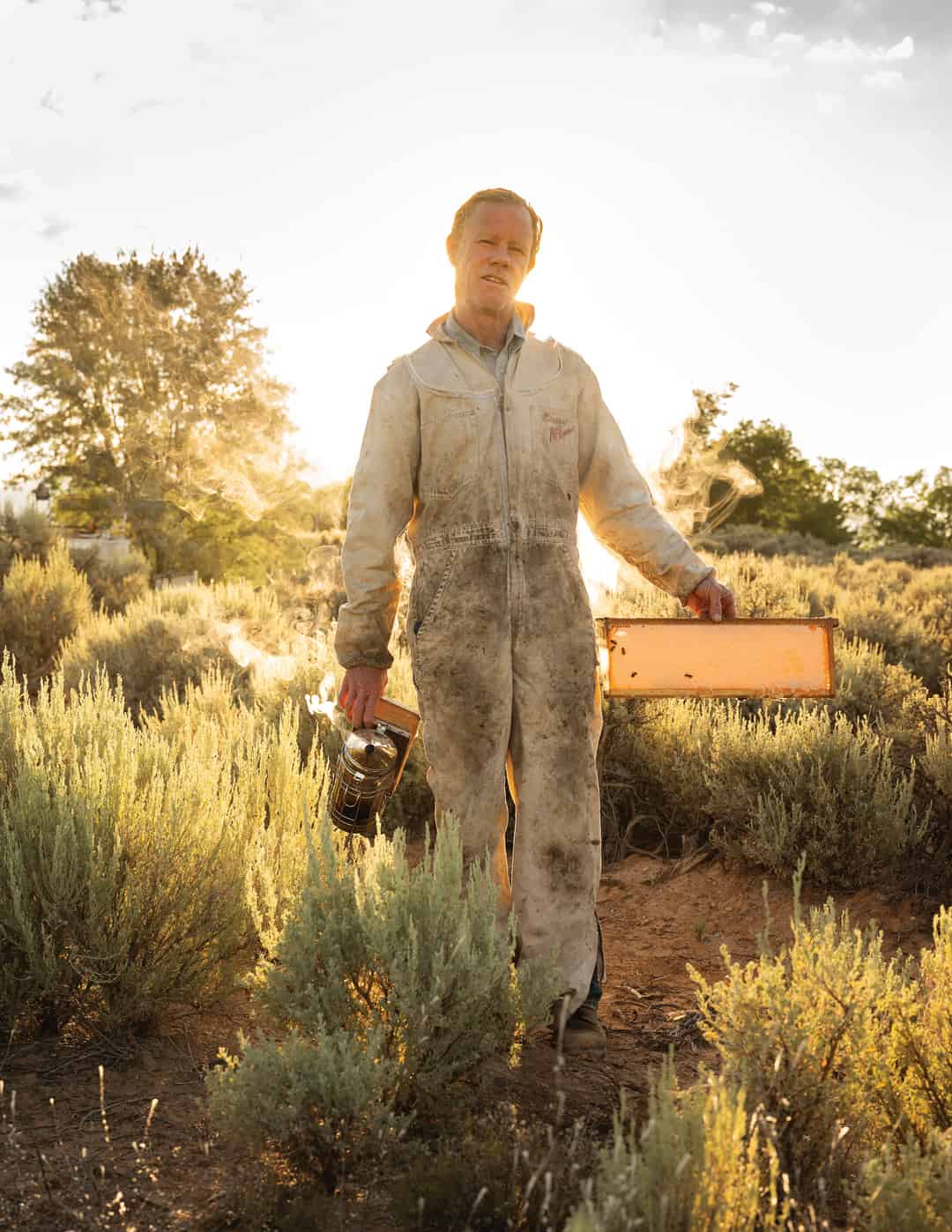
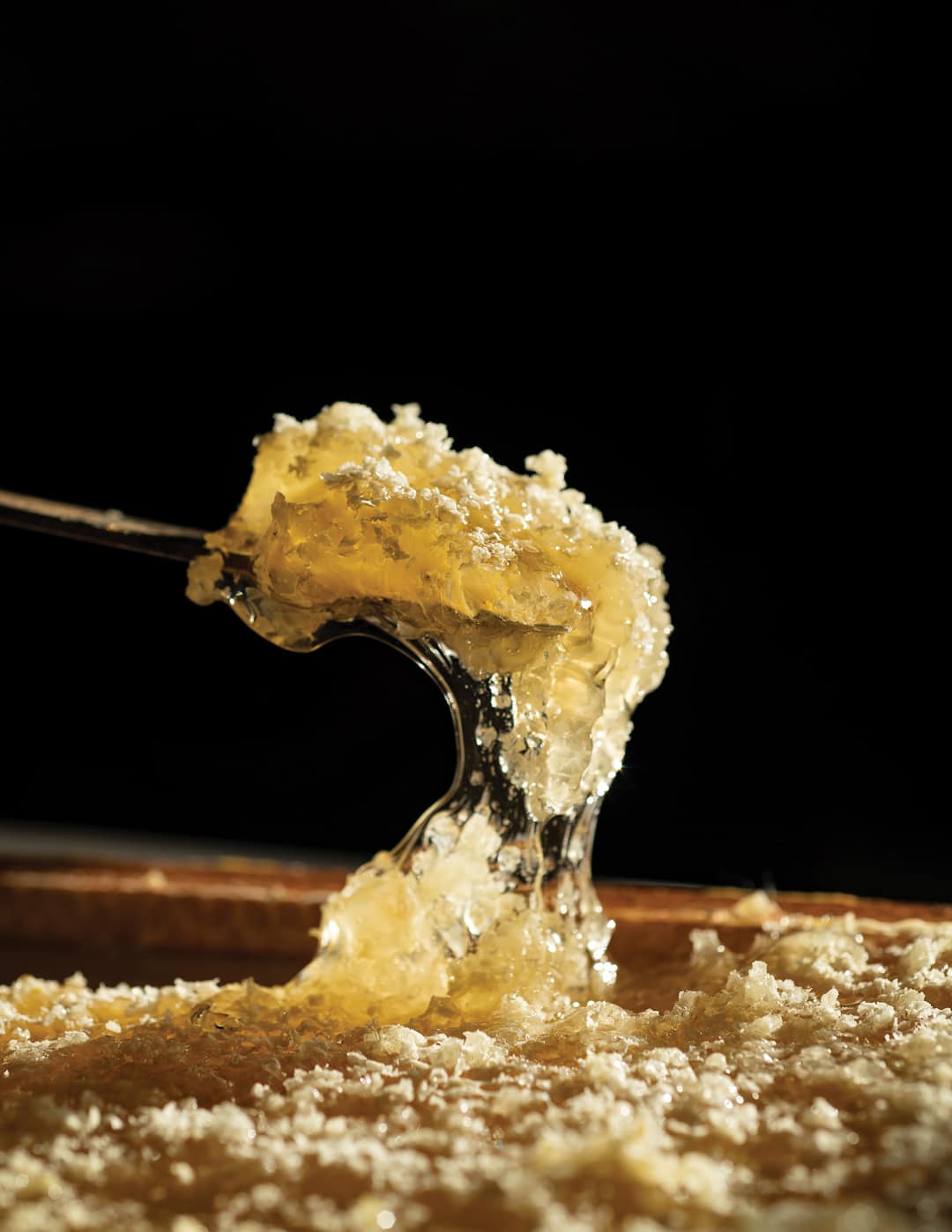
Left: Mike McMannon, owner of Taos Honey Company in El Prado. Right: Taos Honey Company honeycomb.
Taos Honey started as Taos Valley Honey, a company out of Questa where six people hanging out in a little room answered landline phone calls and took people’s orders from catalogs. When McMannon created Taos Honey, he also began to reinstate many of the partnerships that Taos Valley Honey had cultivated in the 1980s, circling back to relationships the way that is often only possible in places with a lot of familial connection to land.
Hives need to be spread around in clusters to support healthy pollinator populations, and the give-and-take model McMannon’s crew has with northern New Mexico farmers who host their hives feels like something from another era. The relationship they have seems reciprocal rather than contractual. The land hosts the hives; McMannon’s people, led by general manager Jeffrey Vasquez, take care of them; the pollinators support the orchards and crops; and the farmers get a portion of Taos Honey’s yield, which varies from year to year. McMannon feels good about the distance his operation has from industrial agriculture, and the way that being in commune with the natural world determines the pace of his life.
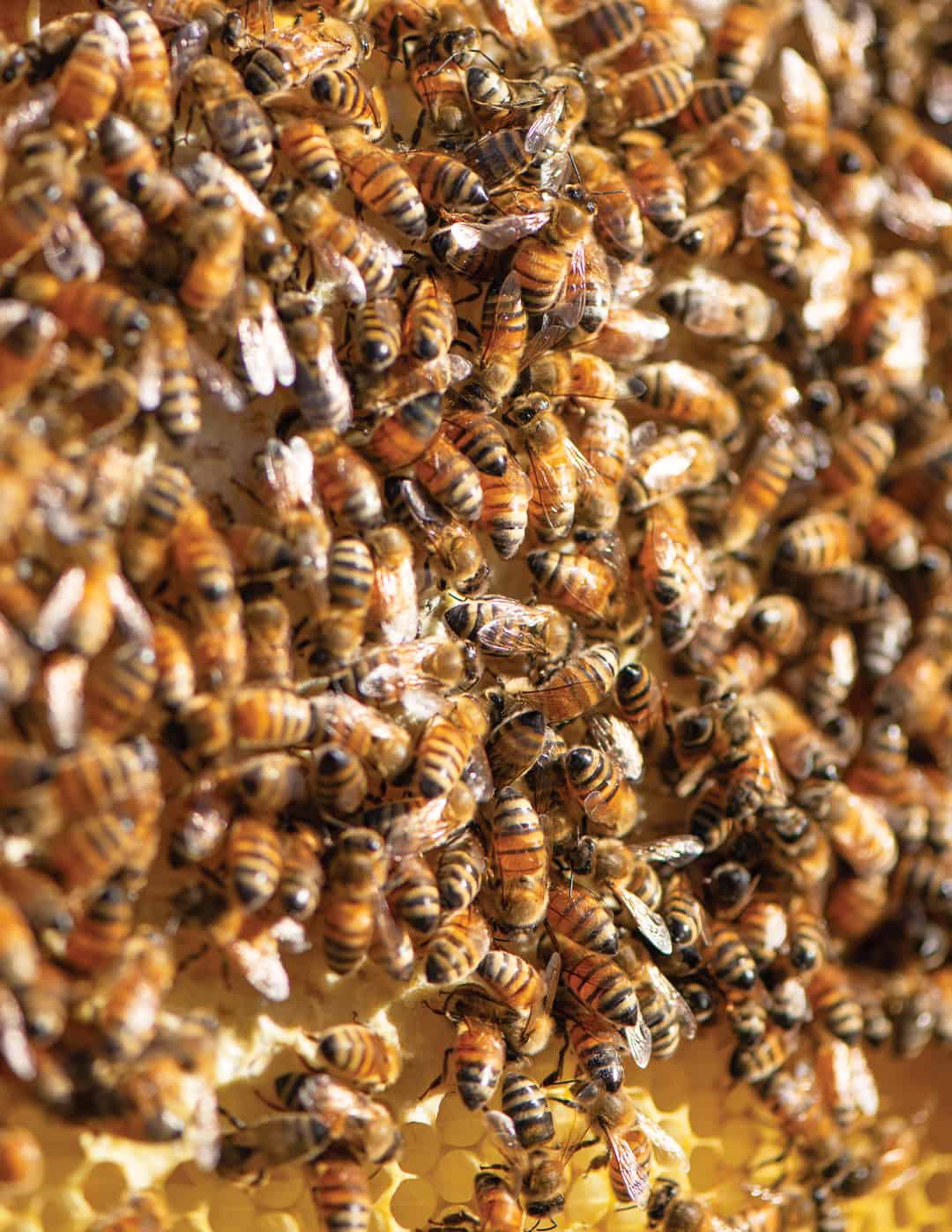
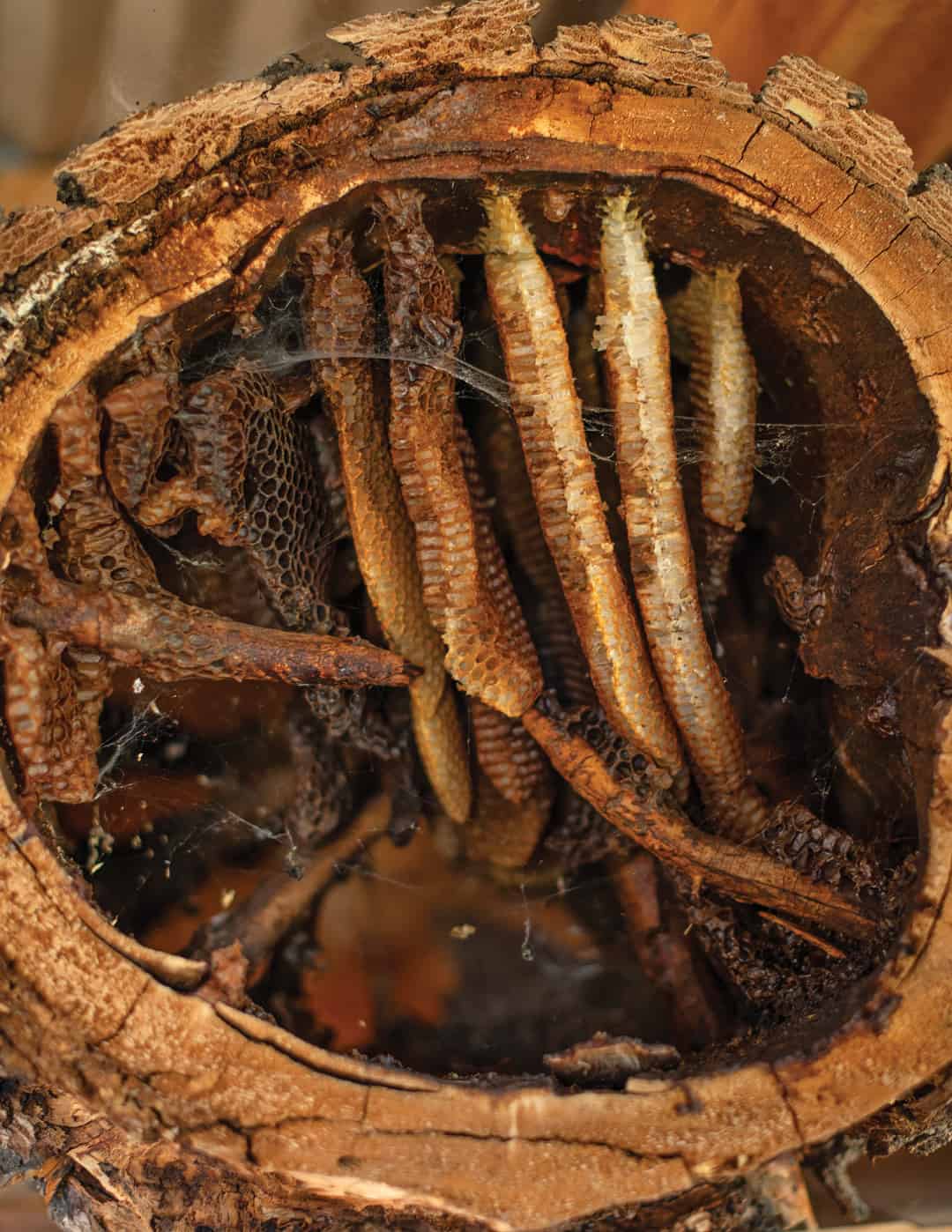
Left: Bees in action at Taos Bee. Bottom right: Cross section of honeycombs in a tree display at Taos Bee.
“The timing is very traditional,” he says. “It makes you into an old-fashioned person. Like the people with water here, they go to the reparto, hear if they have water now or the next day. . . . they are living in the day-to-day.” McMannon’s approach is full of care and clarity about his relationship to animals—including human animals, as he makes it very clear that the operation is very dependent on his relationship with Vasquez. He articulates the crucial nature of stewardship as an interaction of time and space and relationship, and, resounding with wisdom similar to O’Hanlon’s and Kirby’s, states, “It’s important for the animals that you’re taking care of to be your top priority, not a hobby in the background.”
Despite their widely varied practices and goals for beekeeping, this seems to be a view—and a commitment and a philosophy—shared by all three beekeepers. To be in commune with bee populations is to live by the bee clock.
Mariko O. Thomas
Mariko O. Thomas is an independent scholar, instructor, and writer living in Taos. She is interested in plant-human relationships, environmental justice, and storytelling.