By Tom Hudgens

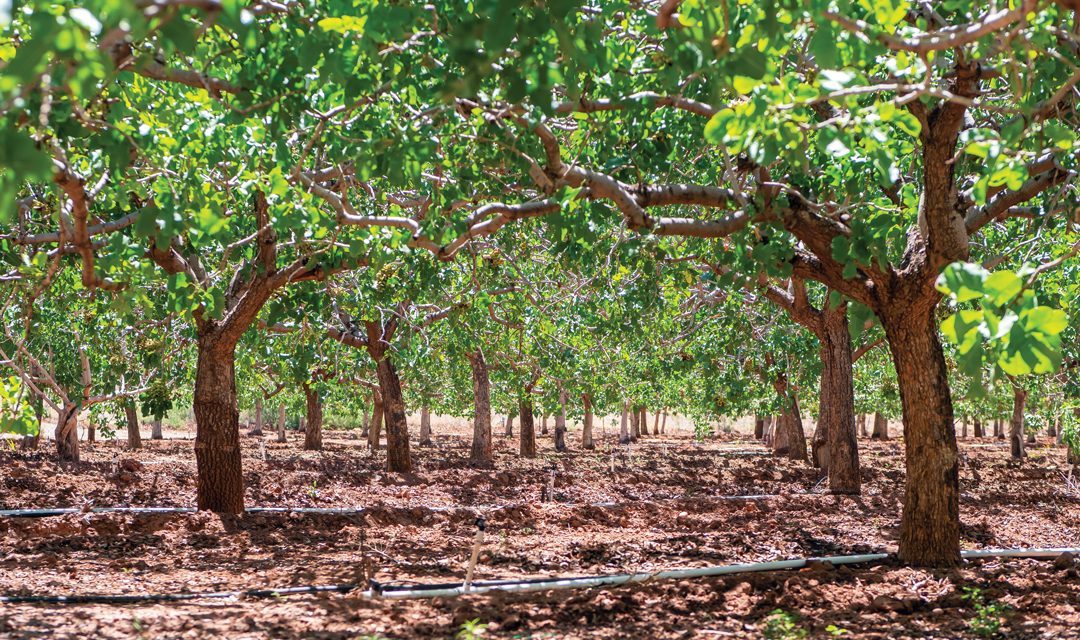
Heart of the Desert Pistachios & Wine pistachio farm, photo courtesy of Jennifer Strickland / USDA.
Pistachios are distinguished by their uniquely haunting, penetrating flavor and their astonishingly bright green color, to name just two of the traits that set them apart from other nuts. Growing up here in New Mexico, my first taste of pistachio was in the form of Jell-O brand pistachio pudding when it debuted in 1975. As an early lover of the color green, I was drawn to the pudding’s milky jade hue; eventually, its equally artificial flavor, mostly almond but with hints of pistachio, grew on me too. Pistachio ice cream was also popular in the United States, yet, with few exceptions, it contained no pistachios: It was merely a green-tinted, almond-flavored ice cream.
Little did I know that right around that time, Marianne and George Schweers were starting an actual pistachio farm just a hundred or so miles away from my childhood home. Pistachio cultivation, as I would learn, originated in what is now Iran and expanded into Greece by around 300 BCE; by the first century, it had been introduced to the rest of the southern Mediterranean, including Sicily. Over the centuries, likely influenced by pistachio-laden pastries and frozen confections made throughout the Middle East, the Sicilians perfected pistachio and other nut-based gelati. In the 1980s and ’90s, as waves of ever more varied, regional Italian cuisine hit US shores, so did gelato shops. Tasting pistachio gelato for the first time, North Americans promptly forgot about their silly old pistachio-free pistachio ice cream. Well-made pistachio gelato, containing a critical quantity of ground pistachio, is one of the nut’s clearest expressions, and is optimally enjoyed alongside a supporting quantity of dark chocolate gelato, as I learned in a particularly revelatory moment when I stopped into a shop in New York’s Grand Central Station about twenty years ago.


Marianne Schweers in a pistachio grove in the mid-1980s and George Schweers in the pistachio nursery in the mid-1980s, photos courtesy of Marianne and George Schweers.
Something else I didn’t know as a kid: Southern New Mexico’s Tularosa Basin bears a striking resemblance to the basin-and-range deserts of Iran, northern Iraq, and southeastern Turkey. This fact has not been lost on returning veterans from recent wars in those areas, nor did it escape agricultural extension agents in the 1950s and ’60s, who were analyzing US regions and investigating new crops that could thrive in their extremes. Just as pistachio cultivation began in those arid lands that were once part of the Persian Empire, so the idea of growing pistachios in New Mexico began to be explored.
George Schweers was stationed at Holloman Air Force Base in 1969 and loved the area so much that the family decided to stay. “We’re Midwesterners,” says his wife, Marianne, “and George came from a farming background, so we were looking for what would grow in the Tularosa Basin.” Their search ended in 1974 when they accepted an offer to buy a grove of four hundred young pistachio trees near Alamogordo. Their lives as pistachio farmers had begun. They had to learn by trial and error to master the nuts’ exacting growing and harvesting requirements. “They are the only nut that opens itself on the tree as part of the curing process,” Marianne says. “The shells form first, then get filled in with nutmeat, and the pressure cracks open the shell.” It’s imperative that the nuts not fall into the dirt during harvest, so the Schweers learned to use big catcher frames for the process.

Marianne and George Schweers in pistachio grove, photo courtesy of Kirsten Strough / USDA.


Heart of the Desert pistachios and wine, photos courtesy of Heart of the Desert Pistachios & Wine.
Today, the family cares for around thirteen thousand pistachio trees; their operation, Heart of the Desert Pistachios & Wine, is New Mexico’s oldest and largest pistachio farm. Several years ago, searching for a local product to send to faraway loved ones, I discovered Heart of the Desert’s “Sweet and Salty” tin—half roasted salted nuts, half pistachio brittle. But I became more intimately acquainted with the Schweers’ product when I worked for a year as an event chef at Los Poblanos Historic Inn & Organic Farm. Their restaurant, Campo, is committed to celebrating New Mexico crops, and is a big customer of Heart of the Desert pistachios. Chef Chris Bethoney features the nuts in Campo’s excellent field salad (for which I chopped innumerable quarts of them over the months), and in seasonal dishes like pistachio mole with seared fish and grilled farm asparagus. As event chef, I included the pistachios in a curried chicken salad for our fancy afternoon tea menu. Once, to begin a special vegetarian multicourse feast, I served guests a small glass of freshly pressed green pistachio milk, chilled and barely sweetened with honey.
In the early 1990s, when I worked at the legendary Chez Panisse in Berkeley, California, there was a day when many members of the pastry department labored over pistachio torte for two hundred guests for the restaurant’s downstairs prix fixe menu. Calling for little beyond ground pistachios, sugar, and separated eggs, the chefs used a small hand-crank nut grinder to render gallons of nuts into a feather-light texture for the cake. That evening I remember seeing beautiful pale green slices of delicate cake going out, adorned with citrus and cream. I recently made the recipe, from Chef Lindsey Shere’s 1985 Chez Panisse Desserts, at home. It’s an ideal vehicle for the flavor of pistachio, sometimes described as piney to account for its subtly camphorous quality. Orange flower water in both the cake batter and the accompanying citrus compote play unexpectedly well with the pistachio. The cake appears on winter menus at Chez Panisse to this day, invariably paired with a citrus accompaniment, often oranges and kumquats, and typically following savory courses that include warm spices, ginger, cardamom, and other understated Eastern touches.
That Middle Eastern connection continues to fuel the pistachio’s intrigue. The Dubai chocolate bar, a delectable mixture of crisp threadlike kadayif pastry and ground pistachios encased in dark chocolate, invented by a Dubai bakery, has become a runaway TikTok-fueled fad, spawning imitators across continents. In Albuquerque, many Middle Eastern restaurants and markets now sell the high-priced confection. At the Downtown Growers’ Market, I bought a homemade version: a mountain-shaped rich chocolate cookie with a pistachio-kadayif filling. It was very sweet, but no less delicious, evoking my sublime New York pistachio-and-chocolate gelato combination of long ago, while the fine crunch and saltiness of the pastry elevated it to a higher level.
Driving to Tularosa and Alamogordo, perhaps as part of a trip to White Sands, you can’t miss the various pistachio growers’ tourist–attracting billboards and the World’s Largest Pistachio. You’ll find a warm welcome at Heart of the Desert, and the opportunity to enjoy a taste of their pistachio rosé. Pistachios delight our taste buds and capture our imagination, underpinning a fascinating story of horticultural and cultural migration that we can now include in our New Mexican cornucopia of foods.
7288 US 54, Alamogordo, 575-434-0035
Get Tom Hudgens’ recipe for Pistachio Torte.
Tom Hudgens
Tom Hudgens has followed multiple career tracks over the decades, including writing and professional cooking, and is the author of The Commonsense Kitchen and The Deep Springs Cookbook. He currently works as a writer at the University of New Mexico Foundation, and cooks dinner at home from scratch almost every night.