
Single wool fleece roving from Cactus Hill Farm. Photo by Elena Miller-ter Kuile.
“Friends. Sisters. Mothers. Professors. When women affirm women, it unlocks our power. It gives us permission to shine brighter.” In this conversation between sheep farmer Elena Miller-ter Kuile and writer and weaver leticia gonzales, both invested in healing the world from the ground up, the truth in this quote by journalist Elaine Welteroth becomes reality. In a land traumatized by the brutality of history, healing begins with the soil, travels up into blades of grass, vanishing into the atmosphere and returning in summer rains and winter snowpack. It passes through the mouths of the animals we raise with reverence, into the fibers of a flock’s wool and their sacred flesh that eventually feeds our children and community with the DNA of kindness.
At Cactus Hill Farm in high-elevation Capulin, Colorado, Elena and her father, Alan Miller, have become healers through agriculture. At their ranch, which sits at nearly eight thousand feet, they are sowing the seeds of ancestral knowledge and readying the land for future generations. From eight wool sheep purchased through the Taos Wool Festival, they’ve built up a diverse and tenacious herd. With every lamb born, every sheep harvested, and every pelt processed, Cactus Hill Farm regenerates identities and lifeways on the brink of extinction.
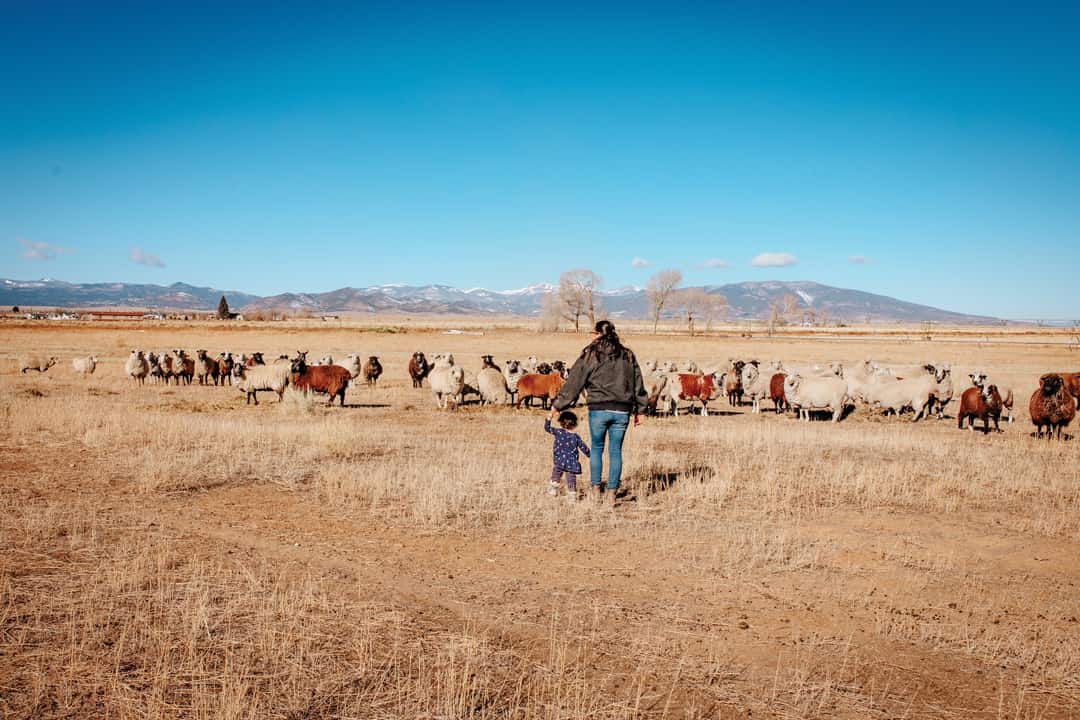
Elena Miller-ter Kuile and her daughter Amalia with sheep at Cactus Hill Farm in Capulin. Photo by Life Out West Photography.
leticia: I understand you’re trying to rehab the land you’re on and you’ve chosen to use sheep. Would you share some of the history around your family’s farm?
Elena: When this part of the United States was part of Mexico, the Mexican government created a series of land grants all the way through New Mexico into Colorado. Families were allowed to come in and homestead, and then make land claims. So that’s how my family ended up in New Mexico, and kept moving up north into northern New Mexico—Nambé and Española, Cuba—and then slowly started moving into Colorado in the 1850s. And then, of course, the Mexican-American War happened. So I always say we didn’t cross the border, the border crossed us, and we basically stayed in one place and became American citizens.
It’s such a complex history. And then—that’s the history of my farm, but my mother was born in Honduras and then came to the United States to study soil science. Genetically, she’s Dutch, but she mostly grew up in Central and South America. You know, we are very embedded in the community. We’ve been here since before Colorado was a state. But I think it is also good to have a little bit of an outside perspective.
leticia: What is the name of your community?
Elena: It’s Capulin, C-A-P-U-L-I-N.
leticia: Like the cherries.
Elena: Exactly. One thing I see, because I’m very ag-oriented, there used to be this identity around sheep, wool, and textiles, but also around food and community. I think policy has really marginalized these traditional farms, and we’ve lost so many. A lot of it is because they’ve lost their water. There is definitely this sadness of how these vital, beautiful little towns and communities that were based around agriculture are ghost towns now.
I think the economic part is key, too, because you had people that were able to make a living on a small acreage and then suddenly they had to get jobs and leave the community, and a lot of them never came back. I always think that our biggest export is talent, but there are weirdos like me that do come back home again.
leticia: That’s the legacy of trauma. Some people come back to life, and some people you lose. A lot of what I see in our communities are people who haven’t been allowed to come back to life after incredible trauma. As you say, the border crossed us, and how is it possible to come back to life? What are the things that make us feel lively? Music, dancing, food, culture, fiber, working the land.
I’m deeply interested in your vision for your land and your career and company.
Elena: I come from this generational farm. I went to school for agriculture at Cornell, graduated in 2010. As I was there, I did a study abroad program called Rethinking Globalization, and it really helped me rethink how we think about poverty, how we think about other cultures, how we think about other countries. I came home and was like, I don’t think aid work is for me. The other thing I realized through these travels is we have a lot of work to do here.
Anyway, I’ve been slowly taking over the farm from my dad, and one of the things I got into was knitting. If you look at Indigenous cultures, Hispano cultures, there is a strong fiber art tradition in every culture.
We’ve had sheep since—I don’t even know how many generations of sheep. We have family that came from the Basque region of Spain, and they had sheep. My great-great-grandfather brought his sheep to Colorado when he was eleven. He herded them over the mountains from New Mexico into the landholdings here.
My dad—he was more of a farmer and less of a rancher—he sold all the sheep before I was born, but my grandfather raised penco (orphan) sheep when I was little, and I remembered them, so I convinced my dad to get more. I got into that and have been working toward having wool products. I love sheep; I think they’re really neat animals. What I also love is that there’s this huge capacity to do regenerative work using livestock, and so that’s what I’ve been focusing on.


Left: Lamb pelts.Top right: Sheep on the ranch.
Photos by Elena Miller-ter Kuile.
leticia: When did you bring the sheep onto the farm?
Elena: In 2012. Somebody gave me some lambs, some pencos [Columbias], and I raised them. Then I bought eight wool sheep [CVM/Merinos]. And that was the start of my entire herd—I just found somebody at the Taos Wool Festival who won an award, and I was like, “Can I buy sheep from you?” From eight sheep, I built up to 350. I’ve downsized a lot, but I’m probably going to go back up again.
My dad has also done a lot of work on regeneration on our farm. There was a mining disaster on our river that killed all the fish, and [the US Army Corps of Engineers] straightened the river and killed all the trees. So he’s worked really hard to rebuild a beautiful river; that’s the kind of work my dad’s been doing. And I am excited to be buying the farm this year, which is a big deal.
leticia: Congratulations!
Elena: Yeah, and I have some ideas on how to kind of set the farm up a little differently so we can do some really intentional grazing. We’re already seeing some results. We have some farm fields that have gone from 1 percent organic matter to 3 percent organic matter. It’s made a huge difference as far as drought tolerance and water retention, so I’m really excited to expand that.
And then I have a dream of someday creating an educational farm where people can tie into culture in a really deep way. I want to create a space where people can teach and talk about where they’re coming from and base it in some sort of ranching tradition.
Priority one is creating a regenerative farm: Build some soil, fix some fences, and have some healthy sheep. Right now with my wool business I do a lot of online sales, but I also do shows in person. There’s a show coming up in October in Santa Fe, the Mountain and Valley Wool Festival (it moved from Taos to Santa Fe). I do a lot of raw wool. I’m not selling finished products. I’m not selling a shirt or a sweater; I’m selling wool products for others to make those things. I think it’s so awesome that there’s a strong enough community that wants to make things themselves that I can have a business doing this.
I have had every breed of sheep, and I think genetic diversity is super important. I have a lot of long-wooled heritage breeds and different genetic lines, and I carefully select the best from all over. I’ve seen it pay off. One year I had a bacterial outbreak, and I lost only certain family lines. A vet told me I could lose 75 percent of my lambs, but I only lost 10 percent. I do have a lot of Merino because I focus on colored Merinos, which is a little bit more rare.
I have a Merino line of worsted—that is a regular kind of knitting yarn. But then I like to push it and say, “Now have you tried this Wensleydale?” I want to show people that Merino is beautiful, but there are so many other traits of really amazing breeds. And I’ve really been focusing on natural colors. I have this dream that one day I won’t just dye wool because I’ll have all these wonderful, natural-colored sheep.

Lambs. Photos by Elena Miller-ter Kuile.
leticia: Do you find that the shows are a place where you’re able to get people interested in these other heritage breeds?
Elena: Yes, and also online. I think what’s really exciting is that there is this drive in the fiber world to keep these heritage breeds alive. And at shows, your enthusiasm is contagious. I’m always so enthusiastic about these new breeds that I’m messing around with, and I think people get excited about them too. A lot of these breeds have long wool, and if they’re spun properly, they are just as soft and wearable as Merino wool, but with so much more character.
And from a sheep perspective, which is where I come from, these breeds are the best mothers. They will fight off a coyote. They’re tough as nails; they do not die! They’re amazing. There are the meat breeds that are known for getting to market weight really quickly, but I find that these heritage wool breeds are just as good and will gain as fast. The problem with the meat breeds is that a lot of them have very low-quality wool or no wool (like the hair sheep). Heritage breeds can gain weight just as fast, and then they have this beautiful fleece.
I also sell lamb meat, mostly whole and half lambs. I used to do cuts of lamb because I would do the farmers market in Alamosa, but being a single mom, I’m not going to wake up at 5 am and drive to the farmers market. I’m hopeful that down the line I can go in that direction again because I want to be smarter, smaller. My experiment is how to be clever on a smaller acreage and expand in other ways, such as through offering educational opportunities. But this is how I make my income, and it is working in the way that it’s working now.

Miller-ter Kuile with sheep at Cactus Hill Farm. Photo by Life Out West Photography.
leticia: At the REGENERATE conference in Santa Fe, you made the point that the people of the world are fed by small farms. Maybe not in this country, but small farms feed the world. So the question is, How has that been true here and how can it continue to be?
Elena: One of the things I really struggled with when I came back to the farm was that it’s an export market. You raise a crop, you harvest it, then you export all your nutrients, all your organic matter. Because we have chemical fertilizers, and because we have pesticides, we haven’t thought about how to be strategic with organic matter, how to be strategic with food.
Here, we have such little water. I used to grow a huge vegetable garden and do a market garden, which was really fun. But I do think there are some areas, like the arid West, that are better suited to livestock operations than they are crops. We’ve used a lot less water having sheep versus trying to produce alfalfa. I’m not trying to give advice to the world, but I feel like what we’re missing in our conversations is that every solution should be place based. Growing soybeans is probably not a great idea in this area, but we can still make protein. It’s just animal based.
What I’m trying to do is very place based, very Southwest. I acknowledge that this ecosystem is a desert and I acknowledge what grows well out here. I’m trying to be clever and downsize and be smarter with less. I’m excited about the local foods movement, but we need to do more. We also need to focus on what we’re wearing because we’re in a terrifying situation; we’re using generations ahead of us in resources. We really need to step back the clock on a lot of damage that we’ve done and rethink how we consume. I don’t want my legacy to be for my father and grandparents—I want my legacy to be for my children and grandchildren.
Note: This conversation was edited for clarity and length.

leticia gonzales
leticia gonzales lives and works in Santa Fe, New Mexico.