By Lynn Cline
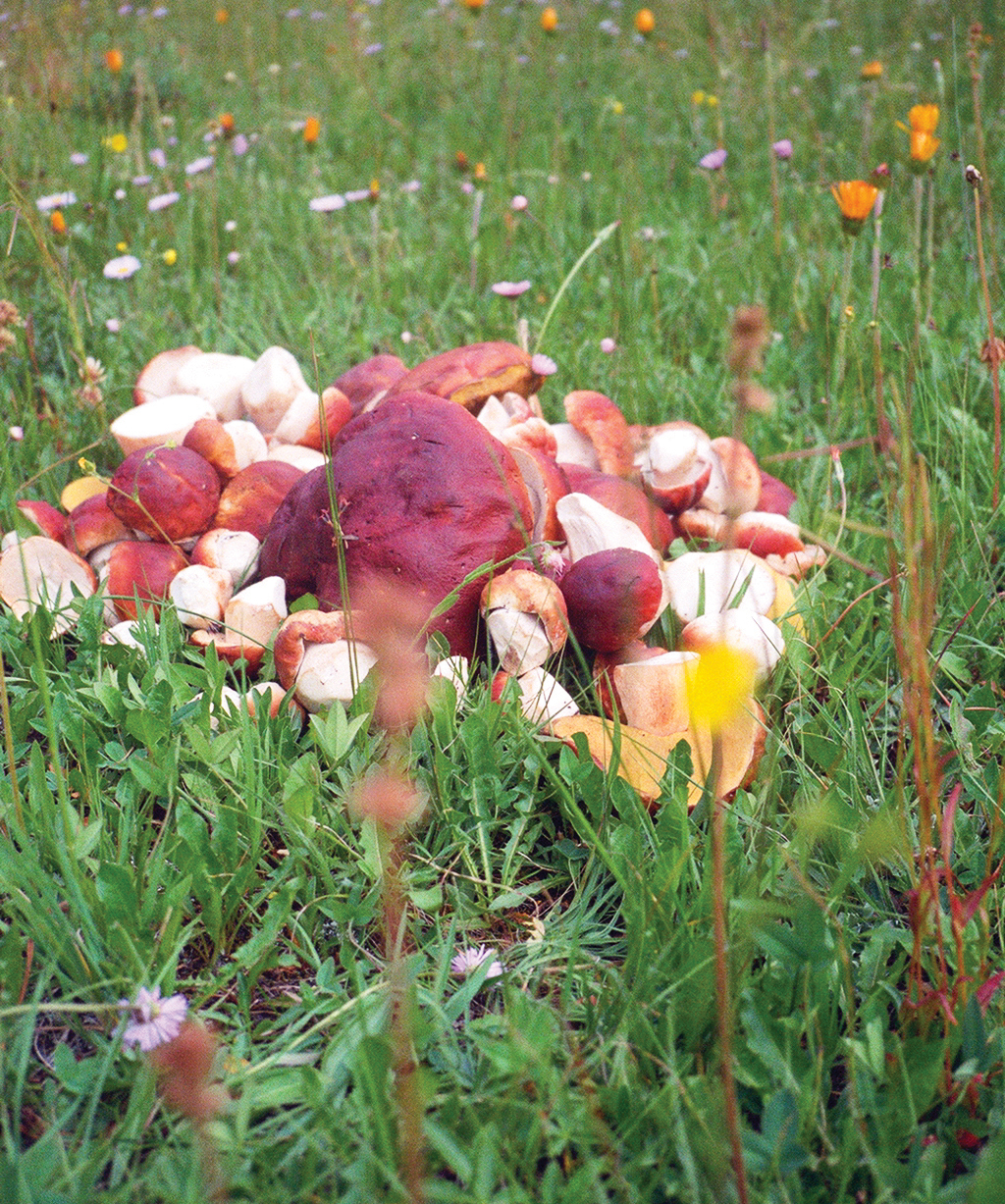
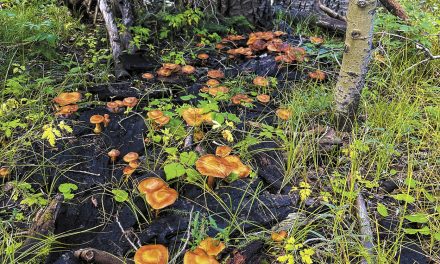
Foraging red-capped boletes, photo by Johnny Ortiz-Concha.
Northern New Mexico is known for its sagebrush-covered mesas, shimmering aspens, and deep river gorges—not an
obvious paradise for chefs who are passionate about locally sourced food. Yet land-based lifestyles are deeply rooted here, and a surprising number of farmers, growers, and gardeners coax grains, greens, chile, and an array of other fresh fruits and vegetables from the earth (and, sometimes, from the water in an aquaponics farm). Old and new generations of ranchers raise cattle and sheep for meat. These fresh-from-the-land foods steer seasonally inspired restaurant menus up and down the Rio Grande and well beyond its banks.
Some chefs bring the meaning of “locally sourced” even closer to home, and deeper to the ground, by foraging wild plants and fungi from the mountain forests, canyon floors, riverbanks, and meadows of northern New Mexico. A few chefs and restaurateurs even raise animals and grow food themselves. Not only are these chefs spotlighting local foods in their cuisine, but they’re inspired by northern New Mexico’s generational ingredients to create something new. Crafted around these ingredients, their menus tell a story about the land that produced them.
For insight into the art of sourcing local foods, I spoke with Patrick and Kelly Torres, co-owners of the Black Bird Saloon in Los Cerrillos, prized for its Old West ambience and playful menu. I also talked with Chef Johnny Ortiz-Concha, whose / shed, a membership-based dinner project in Taos, plunges diners into an intimate, shared experience of eating dishes made with canyon grapes, crow weed, juniper berries, and other foods foraged around his land and beyond. Our conversations revealed much more than how to find, grow, and prepare local foods. Indeed, these restaurant owners and chefs are as passionate about what they serve as they are about honoring the history and traditions of the land they inhabit.
“New Mexico has the largest diversity of food in the country,” says Ortiz-Concha. “We have many cactus that fruit in northern New Mexico that you don’t find anywhere else, and then you have rivers, lakes, canyons. The terroir does find its way into domestic things. Melons send their roots deeper, where they collect more flavor and energy. If you get a Navajo watermelon, you’ll never taste a better melon.”
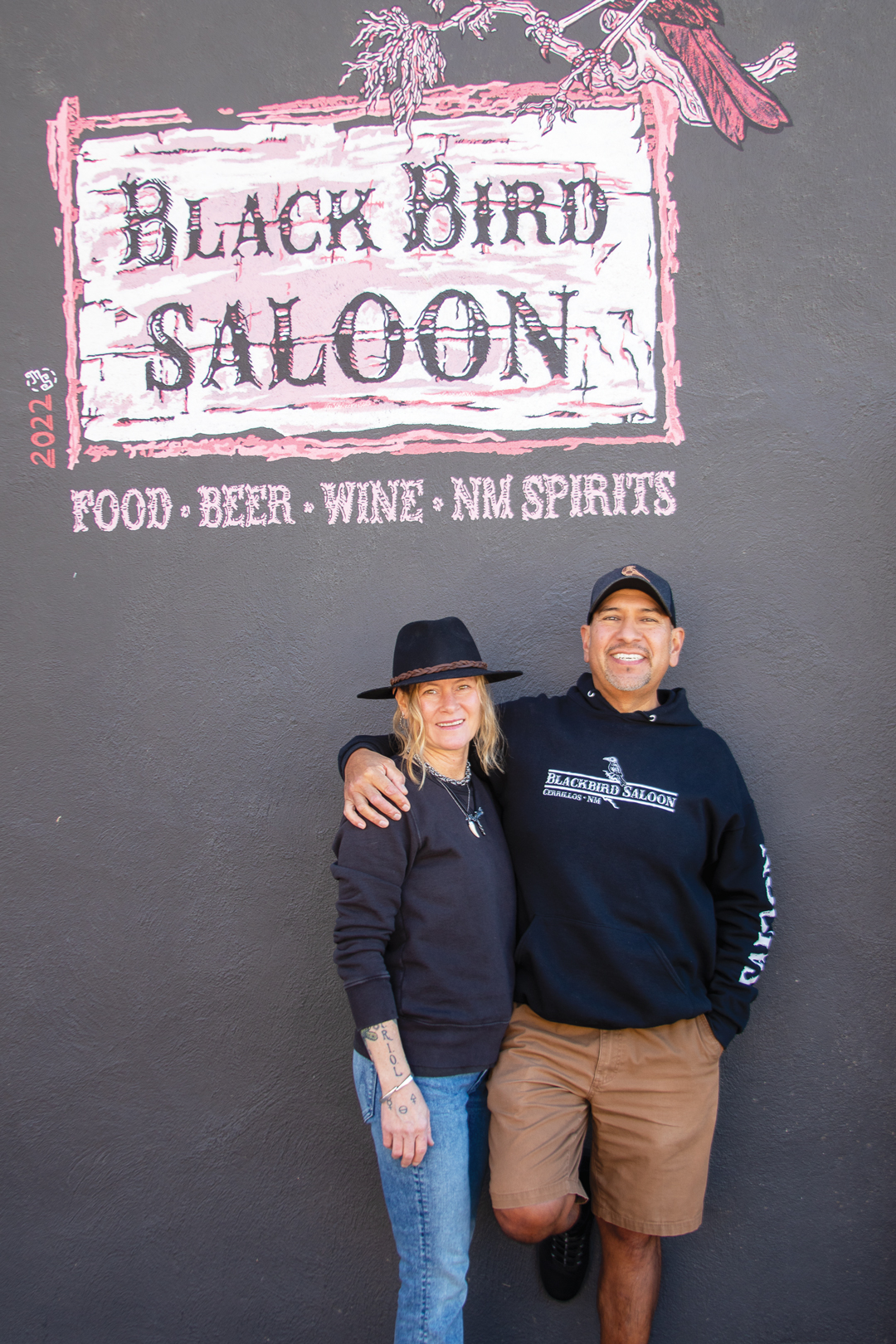
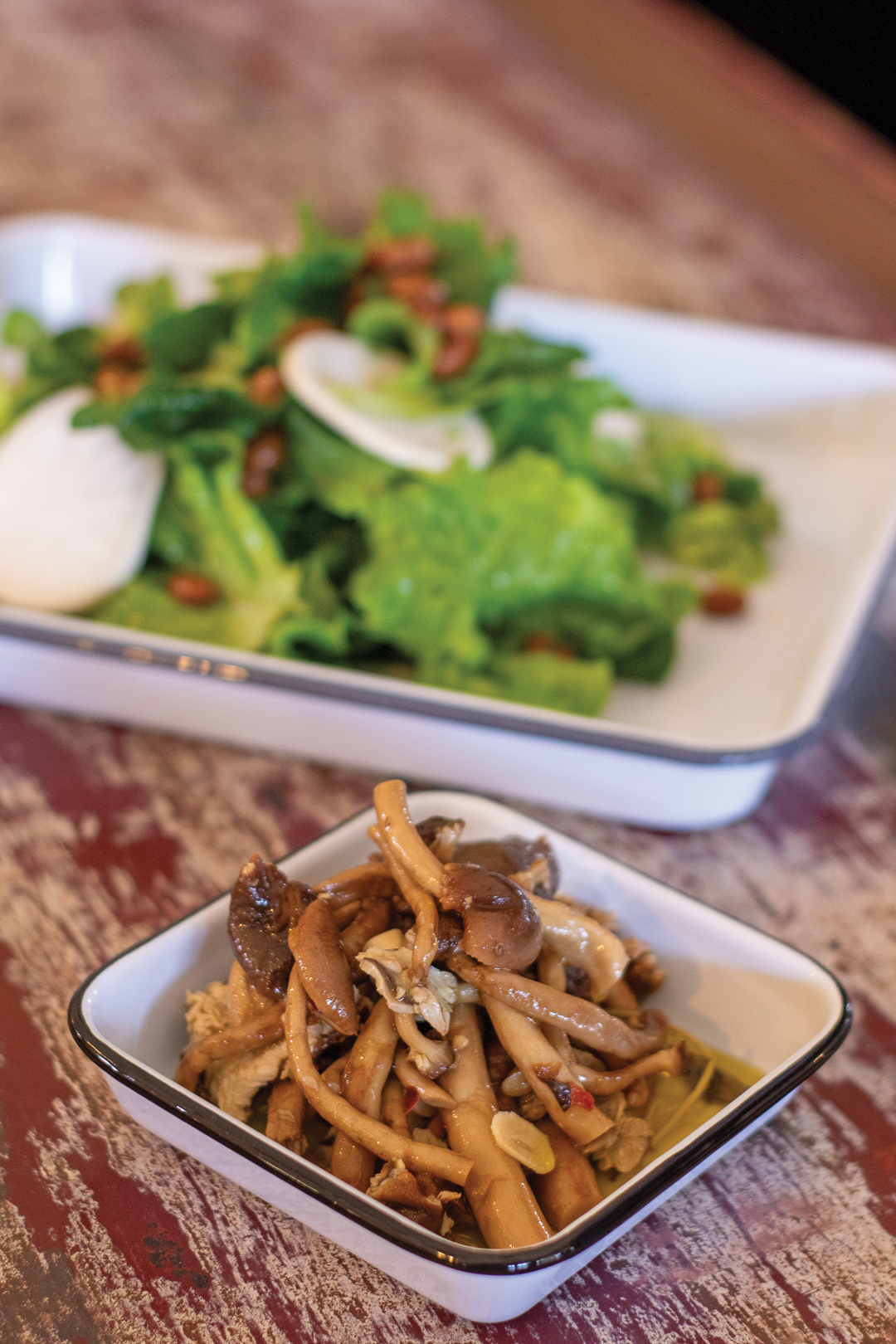
Kelly and Patrick Torres, co-owners of the Black Bird Saloon. Seasonal salad with buckeye beans, Khalsa Family Farms turnips, and pickled pioppino mushrooms from Enchanted Farms Mushrooms. Photos by Stephanie Cameron.
From Fertile Soil
When Kelly and Patrick opened Black Bird Saloon in Los Cerrillos in 2017, sourcing local ingredients wasn’t always easy. “Our sourcing has come a long way in a few years now that more is available,” Patrick says. “We’ve been able to work with reliable sources. In the beginning that was challenging because farmers are not typically businesspeople. It’s not that they’re not trying, it’s just that as far as planning, knowing what they’re going to have available wasn’t jibing with what our demand was.”
Getting locally produced food to Los Cerrillos, a small historic village off the Turquoise Trail National Scenic Byway, also posed a problem. “A lot of places don’t come out where we are, as far as delivery is concerned,” Patrick says. The challenge was overcome when Kelly came across New Mexico Harvest, an Albuquerque-based local food supplier that delivers fresh, local produce and other foods from eighty area farmers and producers to restaurants and other businesses in the Albuquerque, Rio Rancho, Placitas, Bernalillo, and Santa Fe areas. Still, sourcing from local producers is much more hands on than ordering from national wholesale distributors. Every Wednesday, Patrick makes the rounds in Santa Fe to pick up local items from places that don’t deliver, like Sage Bakehouse and the aquaponics-based Desert Verde Farm.
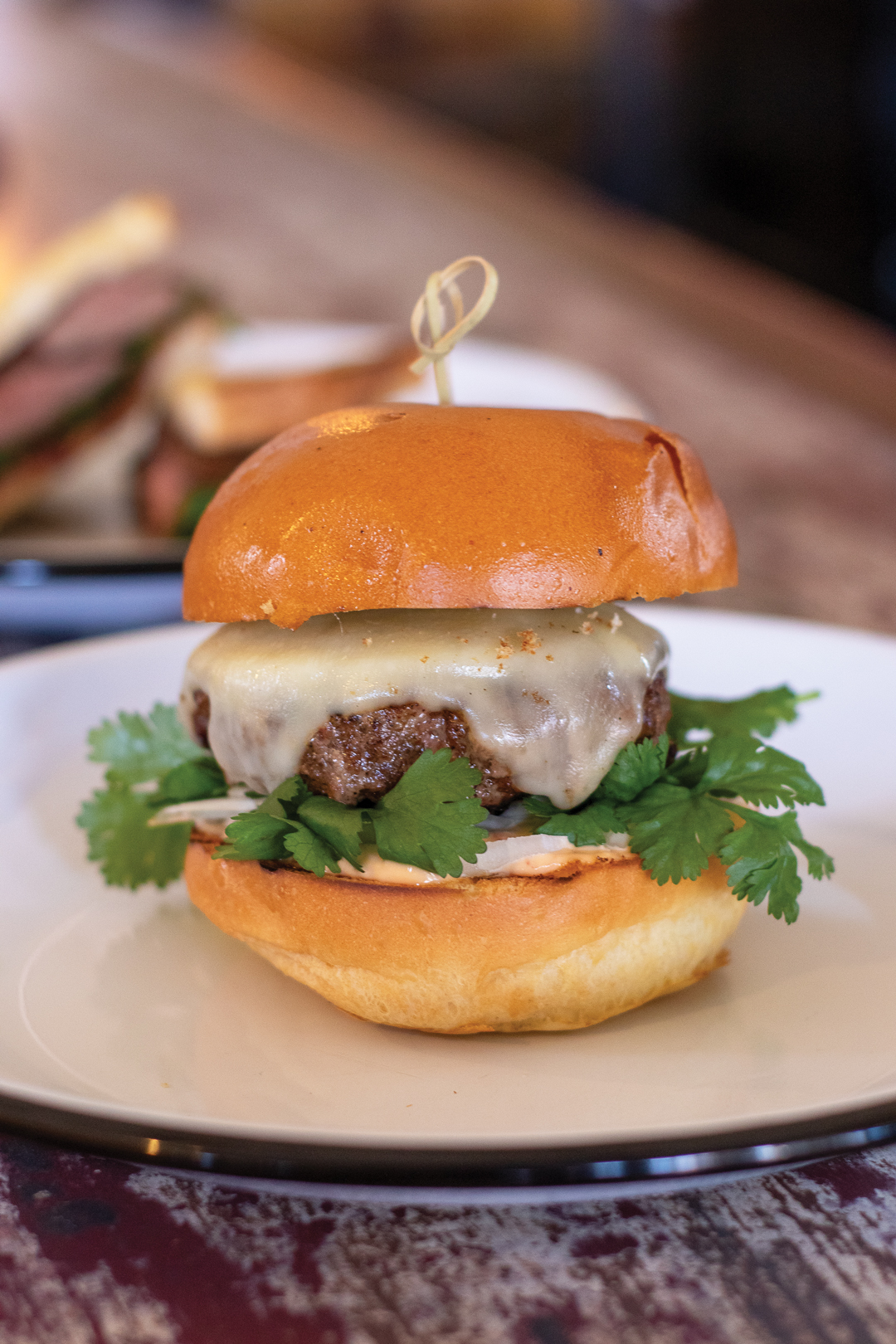
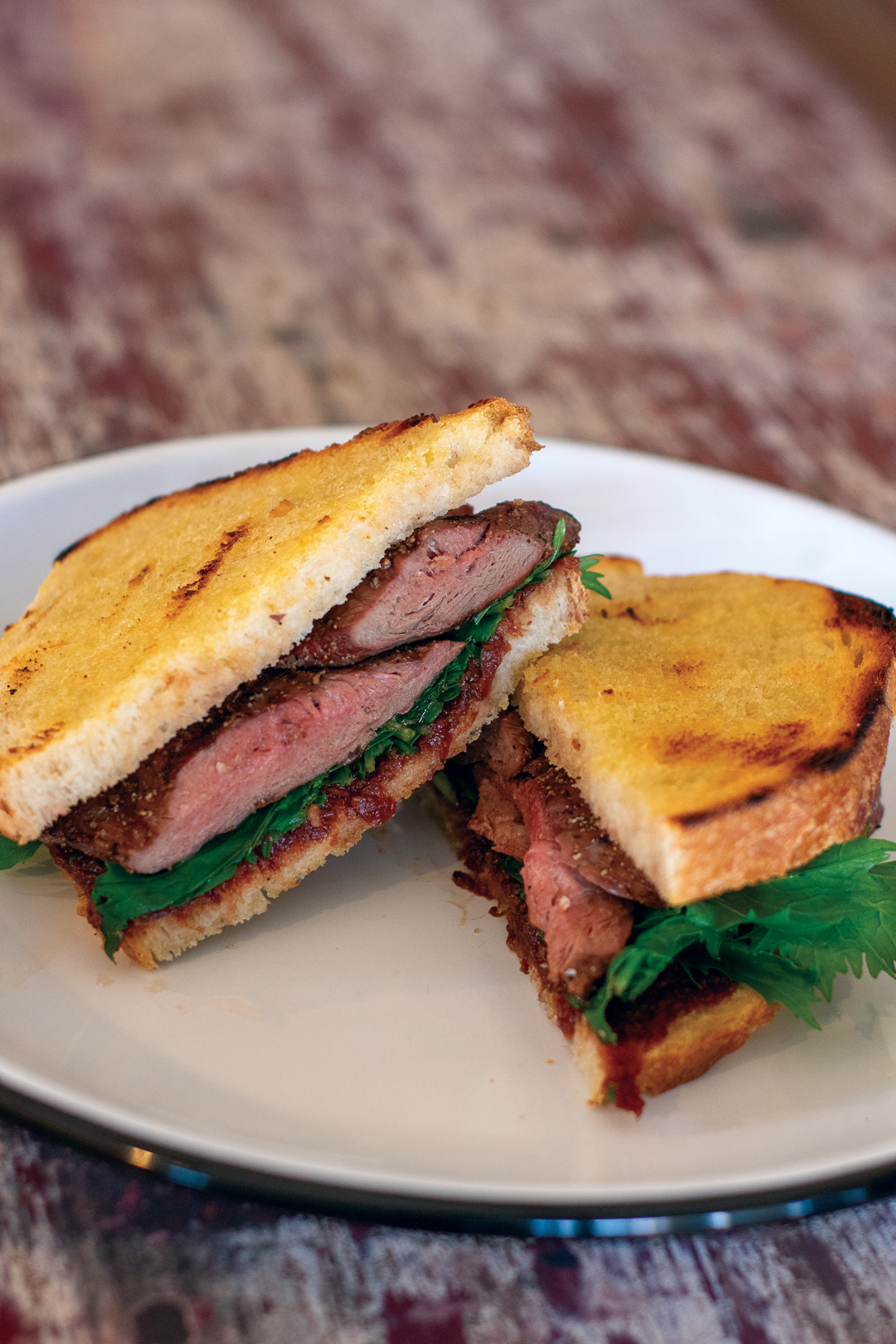
Black Jack Ketchum with Trilogy Angus beef, gunpowder chile rub, havarti cheese, onion, and bandit sauce. Hunter-Gatherer with grilled whitetail venison, savory cherry sauce, and mizuna greens. Photos by Stephanie Cameron.
“I look at a list that New Mexico Harvest puts out each week,” Kelly says. “I rely on whatever they print out and then order whatever I can build a menu on. Most recently, they have mushrooms that are coming from Enchanted Farms—three different types, shiitake, oyster, and pioppino! We get all of our greens, including mizuna, every single week from Desert Verde Farms out of Santa Fe and mostly all of our herbs, when I can’t source them from our garden. Then I try to build a salad from whatever’s in season.”
Thanks to this availability of fresh, local vegetables, Kelly can dream up innovative ways to use more local ingredients in both standing menu items and seasonal and weekly specials. That local mizuna is slipped into the Trail Blazer, a North American elk burger served with Stilton and housemade blueberry mustard on a brioche bun from the Santa Fe–based Just The Best company. Crispy sage and sweet apricot compote are key components of the vegetarian Cult of the Ancestors, a sandwich of grilled king trumpet mushrooms and Spanish goat cheese made with grilled rye from Sage Bakehouse. “New Mexico’s come a long way with local products,” she says.
Although small in scale, their backyard garden has grown too. Patrick and Kelly live in the back portion of the historic building that houses their restaurant, so they can step outside and pick tarragon, mint, lavender, and other herbs from the garden they established on their three-quarter-acre piece of land. “Over the years, it’s become mostly a test garden,” says Patrick. “Since we didn’t grow up in Cerrillos, we didn’t know what does well here. We’re coming to a point where we know we have things that grow, like leafy greens. We’ve planted kale, Swiss chard, arugula. Herbs do really well.”
Kelly finds creative ways to incorporate those herbs in her menu. “I use French tarragon in my cherry sauce for the venison sandwich,” she says. “On occasion, I do chimichurri with oregano and parsley.”
Last year, the couple was thrilled to find 100 percent Angus beef from Trilogy Beef Community, a network of New Mexico beef producers based in Moriarty. “We had been sourcing 100 percent Angus from Montana,” Patrick says. “Part of why we hadn’t been doing local ground beef was because of pricing. We got in touch with Manny Encinias, the owner of Trilogy, and they were able to provide a quality ground beef that was consistent and affordable. Kelly and I had been talking about buying local beef since we opened, so we’re proud of this and happy. We’ve had comments from people who’ve noticed the flavor and freshness of it.”
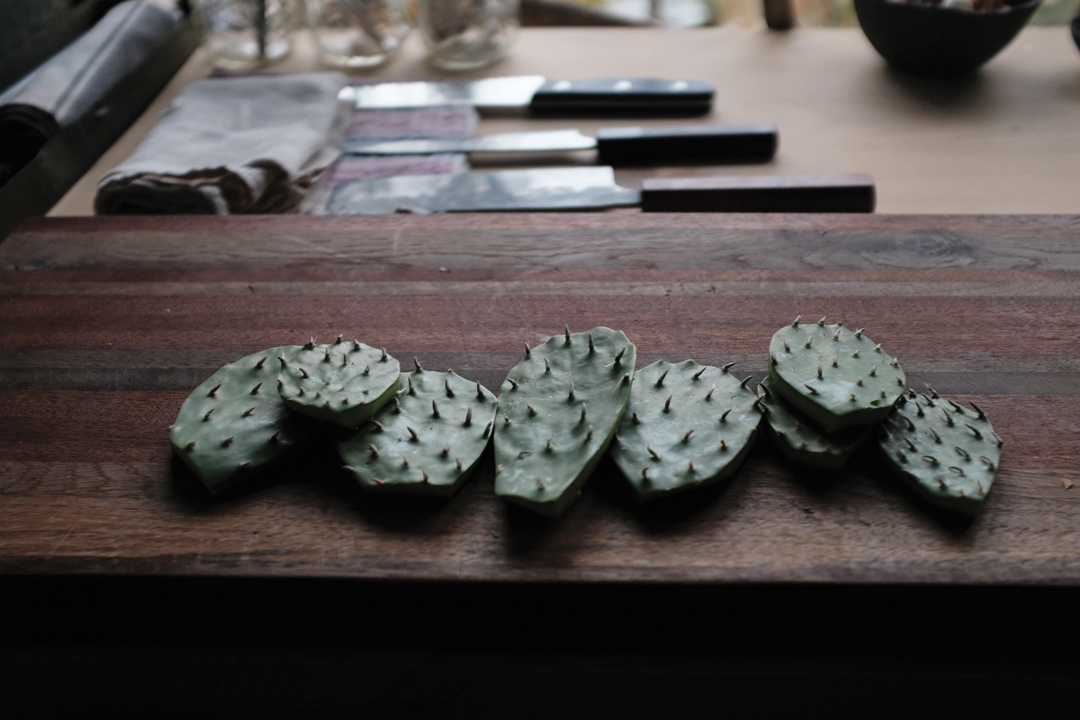
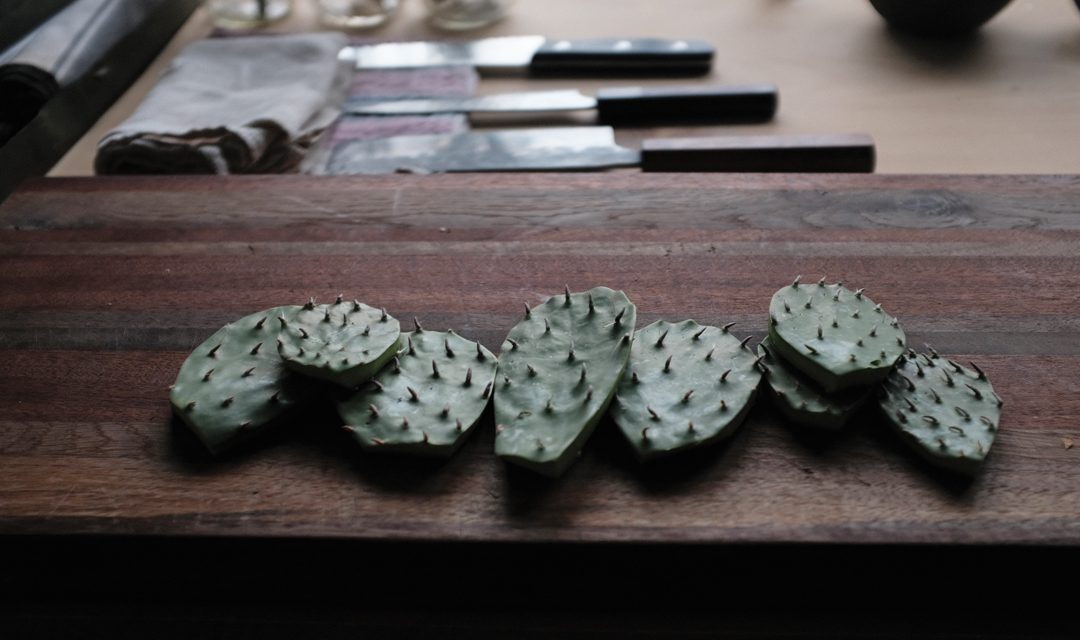
Foraged pads of the high-desert cactus that grow among piñon and chamiso, photo by Johnny Ortiz-Concha.
Foraged Treasures
At / shed, Ortiz-Concha is the source of almost every ingredient served to dinner guests, not discounting nature. Whatever ingredients he can’t provide himself, he sources from trusted local farmers and growers. “I forage throughout New Mexico, mostly northern New Mexico, and mostly around the farm and ranch, but not limited to,” he says. The twenty-three-acre farm and ranch north of Ojo Caliente is home for Ortiz-Concha, his wife and creative partner, jeweler Maida Branch, and their young daughter. They live in a two-hundred-year-old adobe house and are renovating a building on the property for / shed. Dinners currently take place at the historic Martinez Hacienda in Taos.
A forager must stay in tempo with the seasons. “In early warm season, we pick a lot of greens—the wild sorrel, wild watercress, dandelions,” Ortiz-Concha says. “In late warm season, we pick fruiting things, like wild sumac, chokecherries, ditch cherries, buffalo berries. Cactus fruit starts the cold season, which goes from leafy things to fruity things. Winter becomes more trees and shrubs: ponderosa bark, twigs, and needles; sagebrush. Chokecherries we pick at end of summer at their peak and then freeze them. We use every part, the juice and skins. You won’t come to a / shed dinner and not find chokecherry.”
His ingredients range from the intriguing—ditch cherries, buffalo berries—to ones so commonplace it’s a wonder they don’t show up on menus more often, like juniper berries, dandelions, and cactus fruit.
At / shed, New Mexico’s ever-changing seasons are visible on each plate, from spring’s lamb leg with quelites, Acoma red chile, and blue corn and cedar ash tortillas, to summer’s trout with wild onion and river mint, to autumn’s wild elk (hunted by the chef) with red beans. Holiday biscochitos are made with oshá root harvested from the mountains behind their ranch.
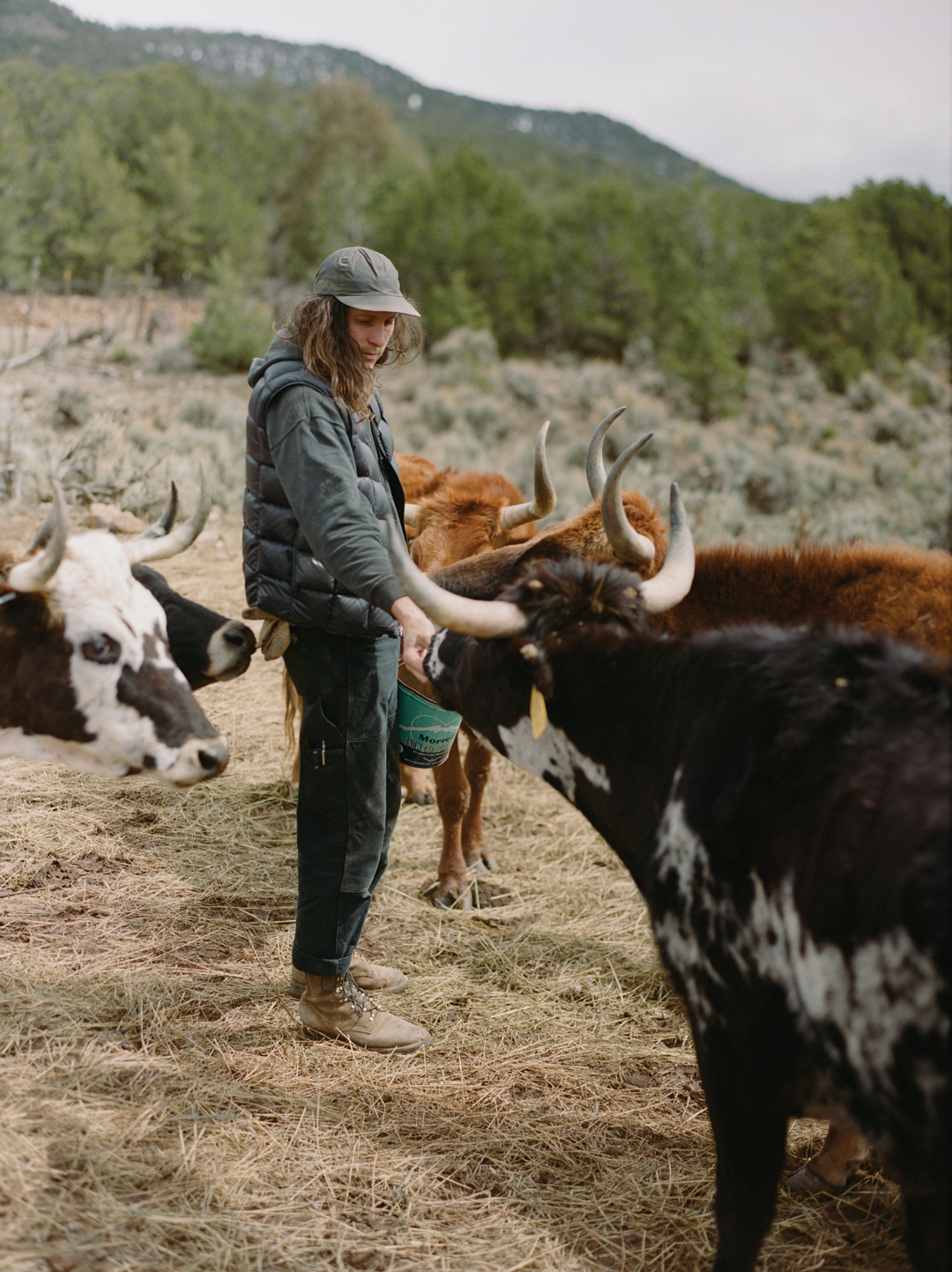
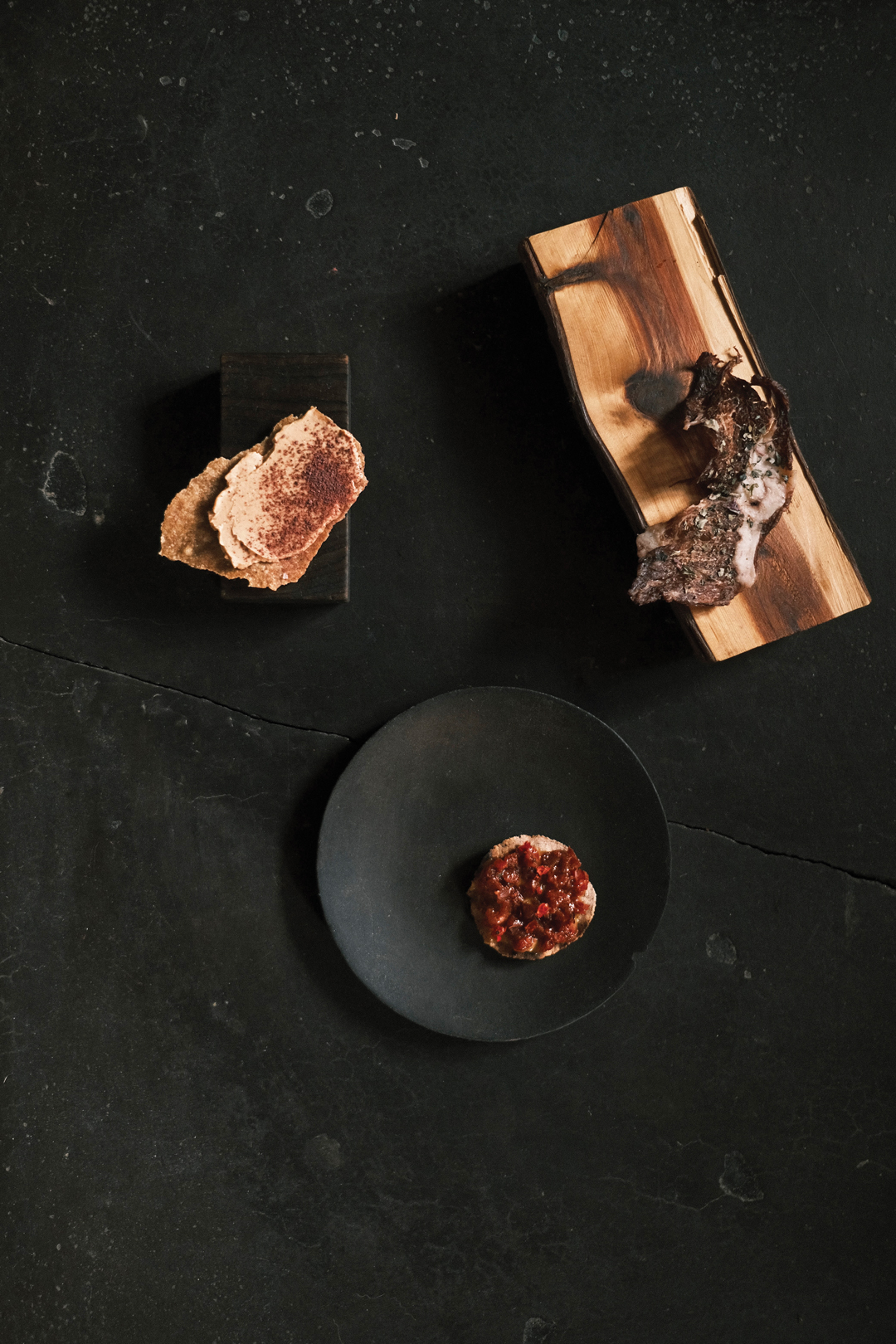
Ortiz-Concha with his family’s Criollo cattle, photo by Stefan Junir. Courses from the Criollo served at / shed, including raw Criollo (rosa de campo, red-capped bolete, red corn), carne seca (southern New Mexico lake bed salt, crow weed), and Criollo liver (chokecherry, Turkey Red wheat), photo by Johnny Ortiz-Concha.
Ortiz-Concha grew up partly with his mother’s Hispano family in Taos and partly with his father’s family on Taos Pueblo, where his grandfather raised cattle. He’s continuing the tradition, raising Criollo cattle and Churro sheep, both brought to New Mexico by the Spanish in the fifteenth century. “Our one dairy cow, Dolores, is the queen of the land,” Ortiz-Concha says. “We use her milk for butter. The meat cows we mostly use for ourselves and for / shed.”
In addition to foraging, Ortiz-Concha follows other traditions and practices of his Taos Pueblo ancestors, known as the Red Willow People. He cooks with an horno, harvests clay for his ceramicware from the same deposits his ancestors used for centuries, and pit-fires each piece. His connection to the land flows through everything he does, and everything has a purpose. “We might be pushing cows to a new field and we’ll find a rock that we’ll use on a plate,” he says, describing how the / shed table settings and ceramicware incorporate remnants from the wild—bouquets of cota, willow basketry, volcanic rock—further connecting diners to nature.
To preserve some of the food he forages, Ortiz-Concha adheres to the age-old practices of his ancestors, who did not cure their foods with salt. “Preservation here was by drying out your foods,” he says. “That’s the method we use the most. So we forage as much as we can while food is at its peak, and preserve it by sun-drying it.” Red-capped boletes, for instance, are harvested in summer, then dried so they can be used year-round.
A / shed dinner offers the chance to experience more than the edible treasures foraged from the wild and uniquely prepared. “There are different layers to the experience,” Ortiz-Concha says. “One is the food, just the flavor and exploration of that. Navigating New Mexico history through food is another way, and the other is sharing with community. Some people gather all three and maybe some gather from one or the other. It is based around sharing food with high integration and intention with others that’s nurturing for the body, the soul, and the mind. It could be a completely different experience each time.”
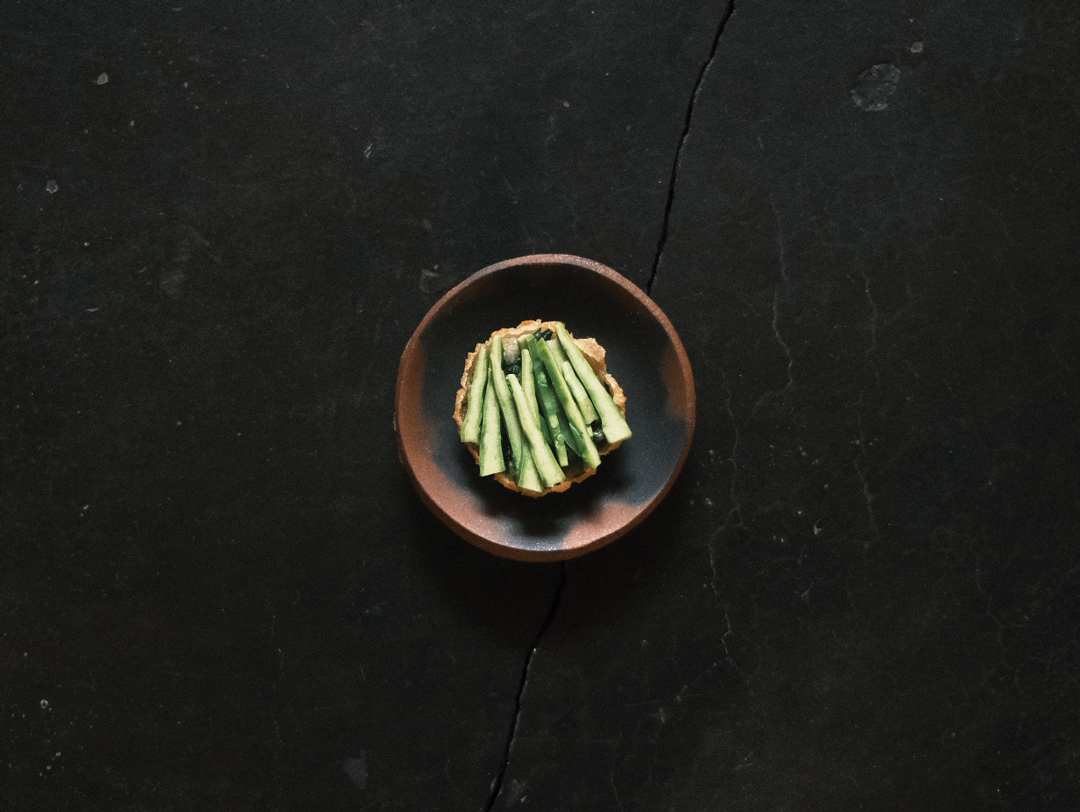
Cactus dish at / shed, photo by Johnny Ortiz-Concha.
The Land Holds Stories
Los Cerrillos
Located on the corner of Main and First Streets, Black Bird Saloon’s building dates to the 1880s. Its former lives include another saloon, the Monte Carlo Bar during post-Prohibition years, and the local newspaper, the Cerrillos Rustler. “It has always been a meeting place, a place to get a drink and food,” says Patrick, who renovated the building with Kelly after they bought it in 2014. “We’ve taken a place that existed and revived what was already there. We put our touches on it and Kelly put out her menu. We took it over and revived what was sleeping and now it’s become a vibrant spot.”
The couple researched the history of the Los Cerrillos area and looked into what people ate during the 1880s through the turn of the twentieth century. “I’m always taking inspiration from the Old West and then trying to incorporate flavors that have come from the region, from the Spanish, the Mexicans, and the Native Indians. My inspiration also comes from travel,” Kelly says. They’ve yet to find a viable local source for the rattlesnake and rabbit sausage, venison, elk, and bison they serve, but since they opened in 2017, they’ve sourced their game meats from an established North American company that buys from farms devoted to sustainability and humane treatment.
Patrick and Kelly are keenly cognizant of the area’s rich history and excited about its revitalization.
“Being in Cerrillos now, knowing what was there before and that it was a self-sustaining mining community with markets, restaurants, butcher shops, and bakeries, I feel that us being there and doing what we’re doing, introducing locally sourced food, that slowly it’s coming back,” Patrick says. He points out that their neighbor, the Cerrillos Station mercantile shop, now has a farmers market from mid-May through mid-October. Kelly talks about a couple who recently moved to town and raise goats. “They make cajeta,” she says. “There’s a real interest in bringing back a sustainable community to Los Cerrillos.”
Taos Pueblo Land
When Ortiz-Concha was just nineteen, a whirlwind of success swept him into the kitchens of some of the country’s top restaurants, starting with Grant Achatz’s three-star Michelin restaurant, Alinea, in Chicago and followed by The Willows Inn in Washington state. After a stint at San Francisco’s Michelin-starred restaurant Saison, he returned home to Taos. “I had been working in restaurants and been disenamored by the illusion of restaurants, which is OK, they’re businesses,” he says. “But I wanted to do something that was integral and by hand.”
Stepping into the rhythms of his Taos ancestors, Ortiz-Concha created an experience that extends well beyond food on a plate. He’s described / shed’s dinners as “ceremony or prayer that celebrate nature and the ‘fleeting of time.’” The monthly dinners are open only to members, or parciantes, whose monthly fees support / shed’s regenerative practices and continuing the ancient tradition of caring for the land and the animals it nurtures. Limited tickets are available starting at 11 am on the fifteenth of each month for the following month.
While devoted to / shed, Ortiz-Concha, with Branch, is also designing the interior space and the menu for Juliette, the restaurant (named for his mother) that will be part of the boutique Hotel Willa, which is replacing the Indian Hills Inn and slated to open this spring. “We’ll be part of it, but well-known Taos chef Noah Pettus will be running the kitchen,” he says. “We’ll be making sure there’s quality food, working with Squash Blossom Local Food and getting local produce.”
Each / shed dinner experience celebrates Ortiz-Concha’s connection to the land. “As a chef and through / shed, the whole emphasis of our project is to share the place that we come from and that we continue to inhabit and where our ancestors have spent much time,” he says. “Everything we do is connected to terrain. We cook food where you can taste the story and it has the story of where we came from. For / shed, everything revolves around that.”

Lynn Cline
Lynn Cline is the award-winning author of The Maverick Cookbook: Iconic Recipes and Tales From New Mexico. She's written for Bon Appétit, the New York Times, New Mexico Magazine, and many other publications. She also hosts Cline’s Corner, a weekly talk show on public radio’s KSFR 101.1 FM.