By Brook Brooks · Photos by Allison Ramirez

One morning in July 2024, a friend texted me to let me know the piñon cones were ready.
Ready for what? Mugolio.
Mugolio? Mugolio.
Mugolio, also known as green pine cone syrup, can be made from many different pine species, including New Mexico’s very own Pinus edulis, the two-needle piñon. Named for Pinus mugo, the mountain pine whose cones are traditionally gathered for it, mugolio originated in Italy and was brought to wider attention in the early 2010s by forager Eleonora Cunaccia, whose Dolomite Alps–harvested pine cone bud syrup reached American customers through a few boutique purveyors.
My aforementioned friend knows exactly how to bait me into hours-long foraging errands, so the next day I was out in my favorite piñon-juniper forest dropping resinous green piñon cones into a food-safe five-gallon bucket.
The dark, wildly aromatic syrup I decanted into jars a month later was a revelation. The color of molasses with pine and citrus notes, piñon cone sap is warming and elevating, especially in winter when I stir big spoonfuls into hot cocoa while pining for spring.
If you’re living in the Southwest and the piñon is not a tree in your cultural lineage, then set aside some listening time, as piñon is an important elder here.
Take a walk, without your bucket to start, and observe with all your senses the complex living infrastructure that is a piñon-juniper forest. Notice how piñons and junipers nurse each other, providing young seedlings with shaded cover. Keep your eyes and ears peeled for evidence of one or two of the thousand interrelations knitted to piñon: cottontail rabbit tracks, the chirps of a juniper titmouse, or the wispy pom-poms of a pink Apache plume.
Listen for the distinctive calls of Clark’s nutcrackers and the chatter of pinyon jays—two birds that have coevolved with piñon. If you spot a pinyon jay in fall, look through your binoculars for the telltale throat bulge: Its expandable esophagus can carry up to thirty seeds in a single run. The Clark’s nutcracker, the pinyon jay’s coconspirator in piñon storage and dispersal, does even better: Its sublingual pouch can hold nearly a hundred seeds.
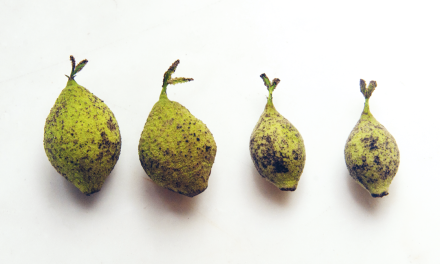
Piñon forests produce masting events every three to seven years, seasons where by summer every tree will be laden with bright green cones. Their cones are slow growing and require eighteen months to develop. The summer I discovered mugolio, 2024, was one of these epic masting years for piñon in northern New Mexico.
I’ve learned from many teachers, including local herbalist Dara Saville, that the ideal time to harvest a specific plant part is whenever the plant is pushing its energy to that part. When piñons and their mycorrhizae have determined through their own mysterious protocols that it’s time to reproduce, then all their energy is being pushed into the development of their cones.
The science of pine medicine aligns with Indigenous and folk uses of piñon: The alpha and beta pinenes found in piñon cones are anti-inflammatory, anti-microbial, and anti-oxidant. Needle teas or inner bark decoctions have historically been used by Zuni and other Southwestern tribes to treat fevers and flu. The Navajo and Apache burn pitch and needles to treat colds. Puebloans, Hopi, and the Spanish have used the pitch to draw out infections from wounds. This kinship between piñon and the peoples of the Southwest dates back thousands of years and is being carried forth by contemporary Indigenous chefs and educators like Lyla June Johnston, M. Karlos Baca, and Roxanne Swentzell.
Green piñon cone syrup is both a sweet thing and a medicinal thing, and it has an important place in my kitchen apothecary.
Does piñon also call you in? If so, then consider it an invitation to begin a friendship. And if during this slow-burn arboreal courtship, you find piñon branches covered and bending with glistening green, egg-shaped orbs, know that piñon has invited you, as it did me, to witness a rare masting event. Offer your gratitude and welcome piñon’s resinous midsummer medicine into your kitchen and into your world.


New Mexican Mugolio
Green piñon cones can be gathered at any stage of development, as long as they are green and sticky with resin. Bring a few pairs of food-safe nitrile gloves and wear clothes you don’t mind getting permanently sticky. You’ll want a food-safe container with a lid, like a large glass canning jar or a five-gallon bucket. If you weigh the empty vessel before filling it, you can weigh the full vessel again, subtract the weight of the empty one, and know exactly how much sugar to add. You don’t need to rinse the cones if you collect carefully.
When foraging, remember to gather in places where you have permission. Collect a few cones from many different trees, rather than stripping the cones from a single tree, so the life cycle of each tree can continue and so the other creatures we share these forests with can gather the mature pine nuts later in the season.
- 1 part green pine cones
- 1–2 parts sugar
- 1 tablespoon water or lemon juice per pound of
cones (optional)
In a lidded container, combine 1 part piñon cones with a minimum of 1 and up to 2 parts sugar by weight (not volume). Add 1 tablespoon of water, or 1 tablespoon of lemon juice, for every pound of cones; though optional, this can help kick-start the process.
If possible, place it in a sunny spot like a windowsill, to encourage the maceration process. If you have ants, nest the vessel in a slightly larger shallow basin and fill with water to create a protective moat.
Leave the lid cracked or open it briefly every few days to release any air escaping the cones. Shake the jar or stir the batch once a day or so, especially in the first week, to facilitate the maceration.
In about a month, when you notice the sugar has been completely liquified, put the cones and sugar in a nonreactive pan like an enamel Dutch oven, add a few tablespoons of water if the syrup is super thick, and place the stove on medium to medium low to slowly heat the syrup to a gentle simmer. Do not boil; the goal here is to completely melt the sugar and to reduce the liquid slightly.
Turn off heat, and strain into a clean, sterile container. Stored in the refrigerator, mugolio will keep for years.
On Choosing a Sugar
Some sugars are more hygroscopic than others, meaning they draw out and hold on to water and resist recrystallization. Most mugolio recipes call for the more hygroscopic dark and light brown sugars; ultra-processed white cane sugars have low to no water content and are less suitable. Coconut sugar, my personal favorite for its lower glycemic index, lands somewhere in the middle. If your syrup does recrystallize, reheat briefly to return it to a liquid state.
Piñon-Juniper Tonic
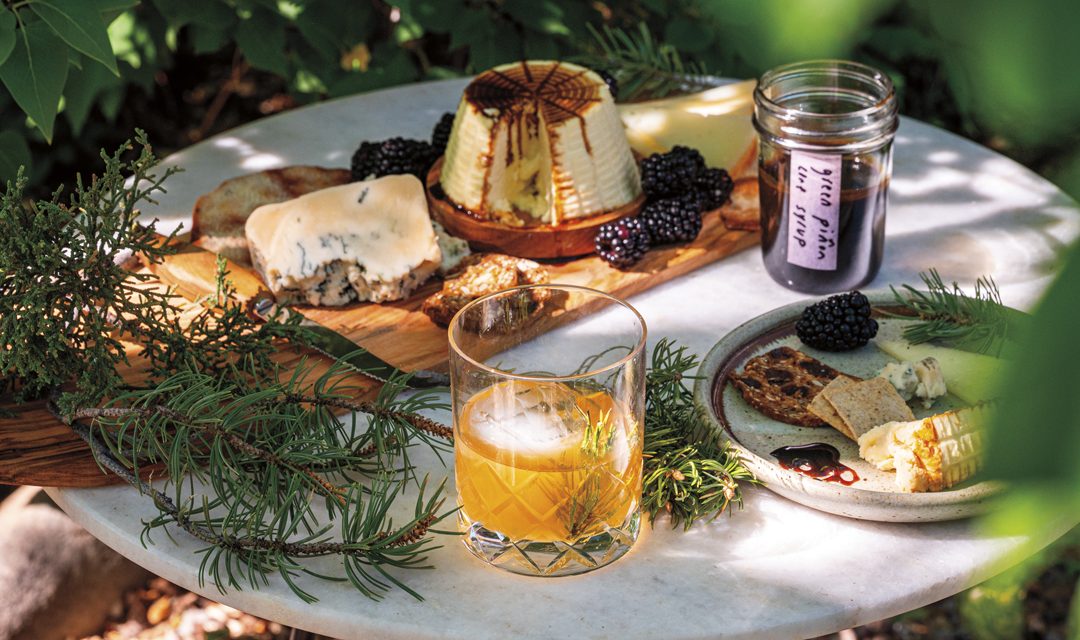
Mugolio has many uses. Longtime Santa Fean and fellow lover of green piñon syrup Saro Calewarts said she uses hers in salad dressings, makes red chile–spiced nuts using the syrup in place of sugar, and enjoys it on pancakes. I love mine drizzled on cheese boards, paired with a fatty meat like duck for holiday dinners, and stirred into hot drinks like tea, coffee, and hot chocolate. Swirled over yogurt or ice cream is an obvious but still delicious place for your piñon syrup.
In summer, I like to top a glass of sparkling water with half a teaspoon mugolio. I also love reuniting piñon and juniper in the glass by including mugolio in gin-based cocktails like this simple riff on a gin and tonic.
- 2 ounces gin
- 1/4 teaspoon green piñon cone syrup (mugolio)
- 4–6 ounces tonic
- Ice
Stir mugolio into gin, top with ice and tonic water (to taste). If desired, garnish with a piñon sprig.
Thank you to Kate Barnett for introducing me to mugolio and to Saro Calewarts for sharing her experiments with mugolio.
More Piñon Stories
Brook Brooks
Brook Brooks is a viticulturist, garage winemaker, writer, and educator based in Santa Fe. They cofounded and co-organize Last Ditch, a grape-farming collective that hosts place-based experiential work and educational opportunities in vineyards and cellars across the region.