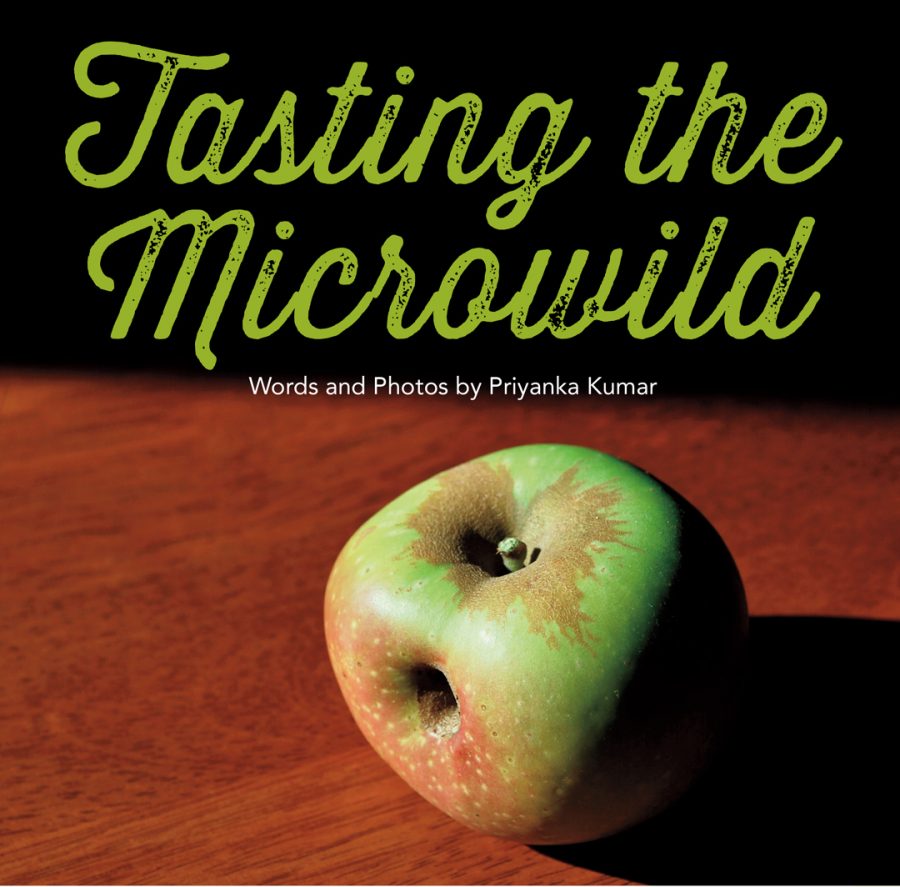
A historic variety of apple, Newtown Pippin.
When our resident chipmunk devours spring strawberries before they ripen, which he loves to do, I feel keenly disappointed. Undeterred, I celebrate Earth and Arbor Days on my knees in the garden, mulching strawberries and planting drought-tolerant penstemons for the black-chinned hummingbirds thrumming about. On the north side of our home, I plant milkweeds and columbines, even knowing the latter’s pale yellow blooms will soon be snipped by a family of deer.
Living near a network of arroyos—a wildlife corridor—allows me to honor our grounds as an extension of a microwild: a fragment or scrap of nature that is large enough to sustain notable biodiversity in plant and animal communities. A concept I developed in my book, The Light Between Apple Trees, the microwild invigorates my everyday life, and, to my delight, the practice of identifying, valuing, and extending microwilds has been embraced by readers too. The animals who use the nearby arroyo also wander into my scrap of nature. Here, biodiversity looks like a tarantula hawk wasp (our state insect) blown in by the wind, a green-tailed towhee on the trail of a dung beetle, and a bobcat sheltering by a stucco wall near apricot and apple trees—Newtown Pippin and Lobo—and a Muscadet de Dieppe, a French crabapple. I grew up with apple trees in the foothills of the Himalayas, and now my husband and I are fervent about growing and preserving historic apple varieties. The bobcat, with delicately pointed ears and a tail curled up like a comma, was seen slipping away when my husband watered the fruit trees that anchor us among our bird and mammal community.
On a recent spring morning, a baby cottontail sat eating Siberian elm seeds at the edge of the north garden where some valerians were getting ready to bloom. Mature cottontails often sift the elm seeds from mud piles and munch eagerly, doing us a service: Spring winds blow numberless elm seeds into our microwild, and these fast-growing trees are only too glad to sprout. Once they take root, it takes real effort to pull out elm saplings. So, my valerian-eating cottontails also keep the ground clear for herbs like lemon balm that are yawning out of the ground.

Early apple harvest.
The raggedy greens and misshapen fruit we grow and forage often find their way into our meals. Parsley, Mexican oregano, and basil are routinely tossed into our salads. In season, apricots, peaches, or apples foraged from nearby microwilds dress up leafy greens, as do edible flowers such as marigolds and nasturtiums. These wildly colored flowers give a mustardy tang to salads but I also relish their poetry. I grow nasturtiums from seed after soaking the seeds overnight and gladly give away a nasturtium or strawberry pot to friends. Common marigolds (Calendula officinalis) attract pollinators such as variegated butterflies but it is lesser known that these cheerful blooms are edible. The petals give a citrus whiff and sunny splash to salads, and they flavor rice, infusing it with a golden color—thus the name “poor man’s saffron.”
It upset the poet Rilke to observe people harvest too many flowers for, say, wedding celebrations only to have them wilt after the guests leave. More than a century later, I have experienced the same regret, but sprinkling flowers into salads only makes me want to grow more blooms. Violet-blue bee balm flowers are edible but I don’t grow enough to harvest. At a time when almost a third of North American bumblebee species are believed to be threatened and a similar portion of the world’s butterfly species are in peril, I leave all but a fraction of my flowers for these pollinators.
Sundry ingredients from our garden—zebra and cherry tomatoes, dandelion greens, chocolate mint, thyme, and spring onions—round out our “wild salads.” In good years, we can go to the grocery store less frequently, without giving up nutritious, plant-centered meals. Raw or cooked, our just-picked ingredients pop with flavor. One year, I reveled in an orchardist’s gift of tomatillos, which had a tang of garlic and an impressive shelf life—on a countertop, they stayed fresh for four months.
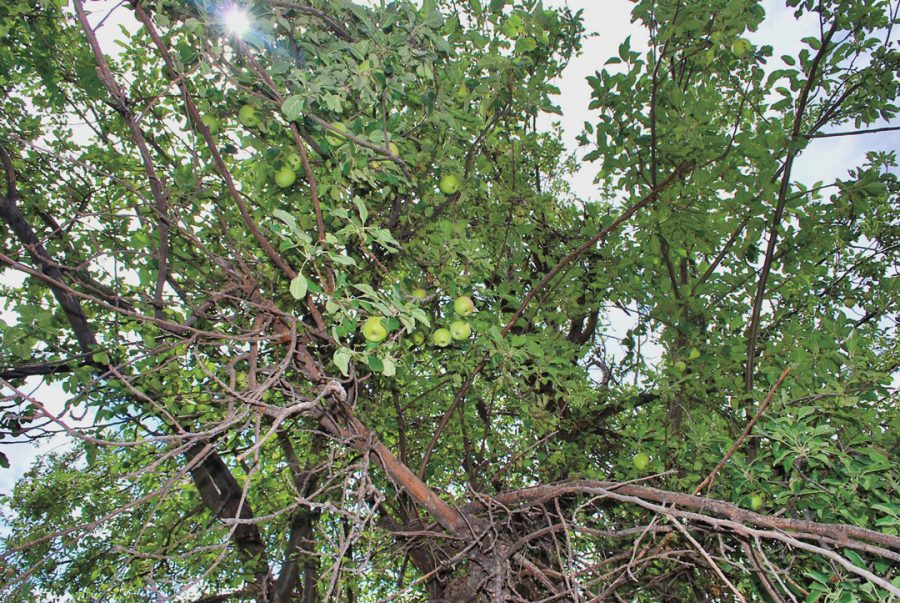
Feral apple tree in New Mexico forest.
Over the years of trying to grow apple trees in Santa Fe, I have come to know a few northern New Mexico orchardists. This spring I visited Jeff Hood, who lives in an ancient home on a five-acre property in Velarde. “I didn’t even know why my agent was showing me this place,” Hood told me. At the time, he’d felt surprised because the ninety-year-old adobe house was crumbling.
Later Hood’s agent walked him to the river. The Rio Grande runs wild here, green as emerald. “Now I knew why he’d brought me here!” Hood said, eyes sparkling. Years later, he still swims daily in the summers. Across the river is a farm field that the same family has owned for generations. Sandhill cranes stop by on their annual migrations and forage on leftover grain. Amid the cottonwoods that hew the spirited river, northern flickers kew excitedly. You can feel the pulse of the land. Hood restored the adobe house, instead of adding another structure on the property, and regularly welcomes a community of friends and thinkers to what is now called The Rio Grande Refuge. A yurt was added, where friends can stay; groups gather here to learn, garden, and prune old trees. Such creative approaches help us share the planet with wildlife.
Visiting the property with a few orchardists, I stood together with them in a circle, and we all held on to a circular rope with both hands before leaning back. As you straighten your arms and lean away from the rope, you feel the support of the circle and the knots in your shoulders and neck seem to loosen. This is what happens when we allow symbiosis to happen. When we let kids climb apple trees and eat fruit while sitting in the fork, they might befriend the trees. When cottontails wander through our gardens, we might grit our teeth as they snip the valerians, but their droppings also supercharge the soil. When we grow a microwild, we let birds plant herbs for us. The mystery bird who planted my second rosemary bush—a volunteer in my garden—has my gratitude each time I bake a sheet-pan dish with carrots, potatoes, and the fragrant, piney herb.
Hood’s microwild came with an apple orchard. Planted by the family who once stewarded this land, the trees bear Red Delicious apples, a relic from the 1940s when Americans saw The Wizard of Oz and grew obsessed with ruby-red apples. That spring afternoon, a group of us studied the orchard, considering how best to prune the apple trees. We’d picnicked on tamales made by Nixta, an Indigenous-owned Taos company, and Hood had put out a basket of apples from last fall’s harvest. While I am not a fan of this ubiquitous variety, the slightly wrinkled apples tasted better than any other Red Delicious I have eaten.
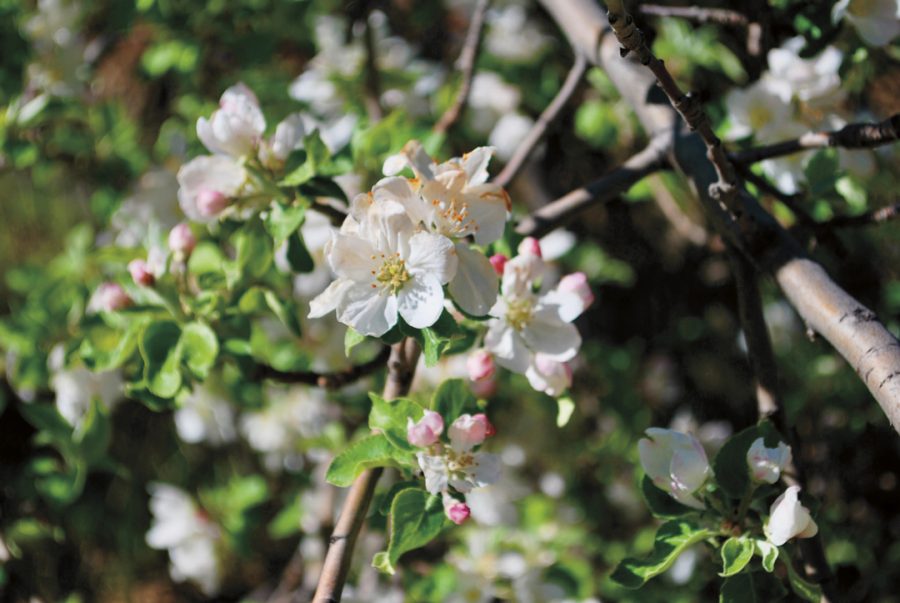
Apple blossoms.
A few weeks later, as we hiked down a familiar trail in the Santa Fe National Forest to the river alive with spring runoff, my daughter pointed out a black-headed grosbeak. I smiled because grosbeaks love to feed on small apples and berries. Indeed, alongside the trail, chokecherries were in bloom—the new growth of this native of the northern plains has red stems and buds like tiny pearls. We recalled the chokecherry jam we had last summer in El Rancho de las Golondrinas. A retired teacher comes from Colorado for the summer festivals to make tortillas with local kids; she and her sister are passing on this vital tradition. Over the years, tortilla making has been a hit with my kids and their friends. Last year, the woman stayed at her elderly father’s house in Española. “And the chokecherry bushes in his yard were producing so much!” she said. She harvested them and boiled them into a scrumptious jam. At the Las Golondrinas festival, I wrapped the jam in a hot tortilla and ate while gazing at the aging apple trees beyond, and followed it up with a Big Jim pepper, roasted in an outdoor oven, all these berry spicy flavors mingling.
Seeing chokecherry bushes along a forest trail or sniffing vanilla scent in the bark of a ponderosa pine can evoke unexpected richness too. When we got down to the river, the grosbeak off to its next foraging site, I wanted to check up on a feral apple tree. Walking over, I was delighted to see that the ancient tree still had some blossoms, many high up along the crown and some close enough for me to sniff. The sweet scent spoke of apples to come. Three years back I had seen this tree in glorious full bloom. Now I moved aside to allow some mountain bikers to whiz by. I can count on the apple tree to slow my internal rhythms. It is a respite. Bushtits twitter all around. I crane my neck to examine the top—the tree must be forty feet tall. It gives needed shade on sunny days, and a dose of poetry; the blossoms touching bits of sunlight are effervescently white. Near me I hear the pik-pik of a yellow-rumped warbler; farther away the kewing of a flicker mingles with a robin’s singsong call. Then my daughter calls out to me. It’s time to leave. Come fall, we will return to taste the fruit, alongside the chipmunks and grosbeaks. Now I must let the bees hovering in the air do their busywork. In “Oda al aire,” Pablo Neruda’s narrator meets the air and proposes:
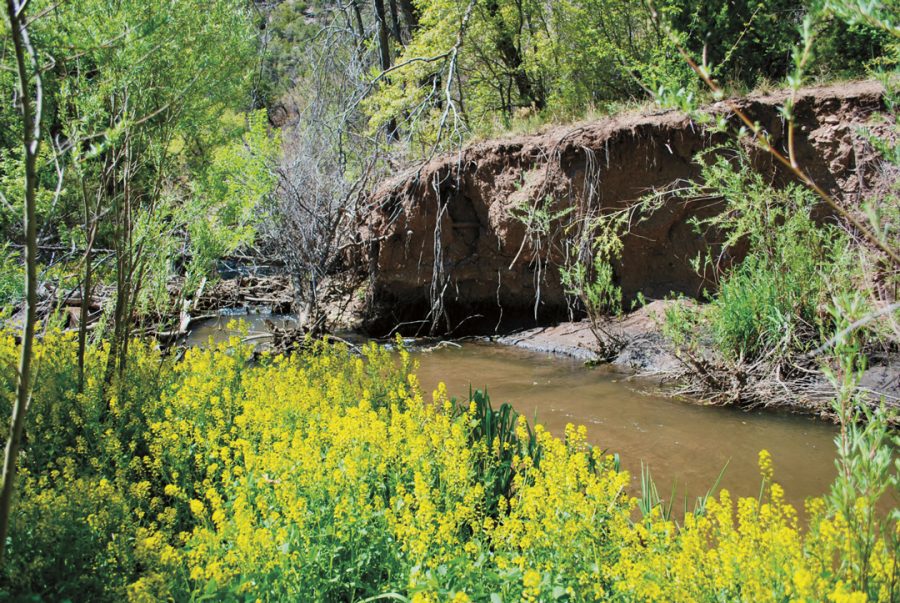
A microwild in northern New Mexico.
Let us go together
dancing around the world,
bringing down the flowers
of the apple tree
Finding our way into a microwild, whether on a friend’s land or our own or at the edges of a forest, is an invitation to experience oneness with feral fruit trees and the lively creatures who visit them. You can watch the bees do their busywork while the knots in your neck loosen.
Priyanka Kumar
Priyanka Kumar is an internationally acclaimed naturalist and the author of Conversations with Birds, The Light Between Apple Trees, and the forthcoming The Grassland Queen.