Rancho La Villita in Alcalde.
Indulge me in a futuristic daydream. I’m making dinner for friends and family—it’s October 10, 2040. My niece is starting a PhD program at the University of New Mexico focusing on circular economy policy, and we’re celebrating her birthday. On the menu are birria tacos made from local goat and chiles, with sides of tepary beans topped with a goat feta, a simple dish of sautéed nopales, and a greens and cucumber salad sourced from a local farm that specializes in hydroponic production. We’ll close the meal with a mesquite flour cake sweetened with a jujube caramel. It’s a warm day—eighty-three degrees—but sitting outside in the shade of the jujube (which I planted for her in 2026 on her birthday) makes for a perfect dining experience. The neighborhood is on water restriction again, but there’s been a strong El Niño this year. We’ve had just over nine inches of rain so far and the five-thousand-gallon water storage tanks below my garage are full of roof runoff. I should be able to water this and the other trees in my yard enough to keep them alive through the next year using only the water I’ve captured.
This might sound like science fiction—which it both is and isn’t. Lately, I’ve been trying to imagine how tomorrow’s meals might look based on projected future climate realities. I’ve spent a career as a systems thinker and doer advocating for a future where we value food, agriculture, land, and water for their interconnection and the multiple ways that they support joy, health, equity, nature, and culture. In the last year, I’ve spent a fair amount of time asking more nuanced questions about what the future of agriculture in New Mexico will look and feel and taste like—and inviting others to join me in this inquiry. Now I’m inviting you. What would it mean to confront our current climatic realities and sketch a road map to that future local feast?
On August 31, as I was beginning to put to paper some of the hard realities—and hard work, and creativity, and hope—that inform my thinking on the future of local agriculture, I learned of the passing of a visionary: noted writer, environmentalist, farmer, pacifist, and advocate Wendell Berry. Berry was unafraid to invoke and champion a different agricultural future. Over the course of his ninety-two years, he heralded small-scale, localized, and diverse agriculture as part of a solution for functioning rural communities and ecosystems. On January 4, 2009, Berry and fellow visionary Wes Jackson coauthored a New York Times op-ed arguing for a 50-Year Farm Bill. Their short, to-the-point essay notes the connection between industrial agriculture practices, soil loss and water contamination, degradation of cultural connection to land, and threats to our present and future food supply. Their proposed 50-Year Farm Bill would help articulate and incrementally move toward the perennialization of US agricultural systems—in other words, shifting to the multiyear, long-term planning and acting that is essential for climate change resilience.
In the fifteen years since that op-ed, unfortunately, the United States has not adopted a 50-Year Farm Bill. As I was writing this article, the Senate Agriculture Committee voted along party lines to advance the Agriculture Act of 2026, a long-overdue five-year federal Farm Bill. This legislation falls woefully short of providing the vision, tools, or funding for the system-wide transformation needed to address the climate and market realities challenging American farmers and ranchers.
In New Mexico, water issues are agriculture issues, and vice versa. The vast majority of both groundwater and surface water use in New Mexico is for agriculture—about 90 percent of direct consumption, according to a World Wildlife Fund study completed in 2025. Researchers also estimate that current use draws water reserves from aquifers and reservoirs at twice the rate at which they are replenished, a figure that will only increase as weather and precipitation become less and less predictable. While water use for agriculture has contributed to the depletion of regional aquifers and reservoirs for more than a century, extended drought and rising temperatures have increased the pressure, magnitude, and severity of water shortage, pushing the system to the brink. As experienced this summer in Albuquerque’s bosque and acequias, the tap will go dry. The WWF report also notes that New Mexico has lost 36 percent of irrigated farmland to reduced water resources in the last twenty years. At that rate, one might estimate that the state will have no agriculture by the end of the century.
To further darken the frame, New Mexico has one of the oldest farmer populations in the nation, with slow recruitment of younger farmers and ranchers. Conversations about the measurement and allocation of water are hard conversations to have. The same goes for changing the nuts and bolts of farming itself. Whether we take action or not, agriculture in New Mexico will dramatically change in the coming decade. While we could refuse to acknowledge the issue, there is a different approach: We can dive in and get strategic, collaborative, and proactive about our agricultural future.

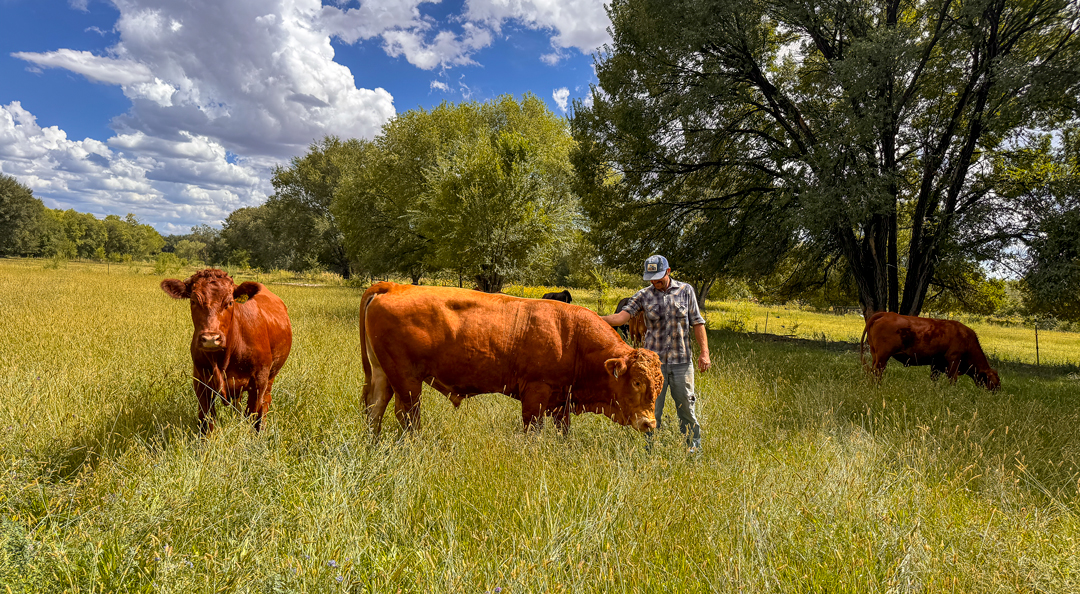
August Young of La Madre Farm with his gentle bull.
The road map to my imagined feast begins with reflecting on both the good and the bad—it requires being prepared for change and making space for grief. Flashback to late September: Soaking wet from the first rains in months, huddling in the Farm Stand in Corrales after a tour of Silver Leaf Farms during the National Farm Viability Conference, I recommended to a friend from Colorado who was attending the event that she purchase the pinto beans from Ness Farms rather than a bag from Rancho Gordo. As we talked about these local beans, I thought to myself, Will next year, or the year after that, be the last year to relish in the new season’s crop of this New Mexico staple? In 2025, longtime Estancia Valley farmers Dean and Ivellise Schwebach closed their farm because their well ran dry, their unrivaled sweet corn no longer a part of our culinary cycle. My heart ached thinking about their beans and corn. The next time I cook pintos, I will savor them differently. We will continue to lose these seasonal experiences and tastes that have defined our culinary culture. It is okay for us to shed a few tears, to sit with these losses and grieve. When the way I say “I love you” is through a pot of beans, the sadness is complicated. I’ll need to develop new ways to express my care and appreciation. And there will be new flavors and delicacies to express affection.
On that tour of Silver Leaf Farms, we plucked jujubes from several bushes at the farm gate. These highly drought-tolerant, high-elevation fruit trees can survive on eight inches of rainfall annually. While jujubes were planted in southern New Mexico a century or more ago, New Mexico State University established a research program for these trees only in 2010. Now they grace the hedges and orchards of farms across the state. You can find their date-like fruit in sausages and sauces and snack bars. Maybe this is what the future of New Mexico agriculture tastes like.
I love that we have a strong culinary culture in New Mexico and that our sense of place and identity is defined by seasonal foods that we grow here. Not every place has the strong and proud connection to food that we do. Just because the foods may change, that doesn’t mean our relationship to food has to, does it? Having food we are proud of—food that comes from our farms and gardens, that shapes both our celebrations and everyday dinners, that tells the stories of our place in their flavors and textures—can continue with different ingredients.
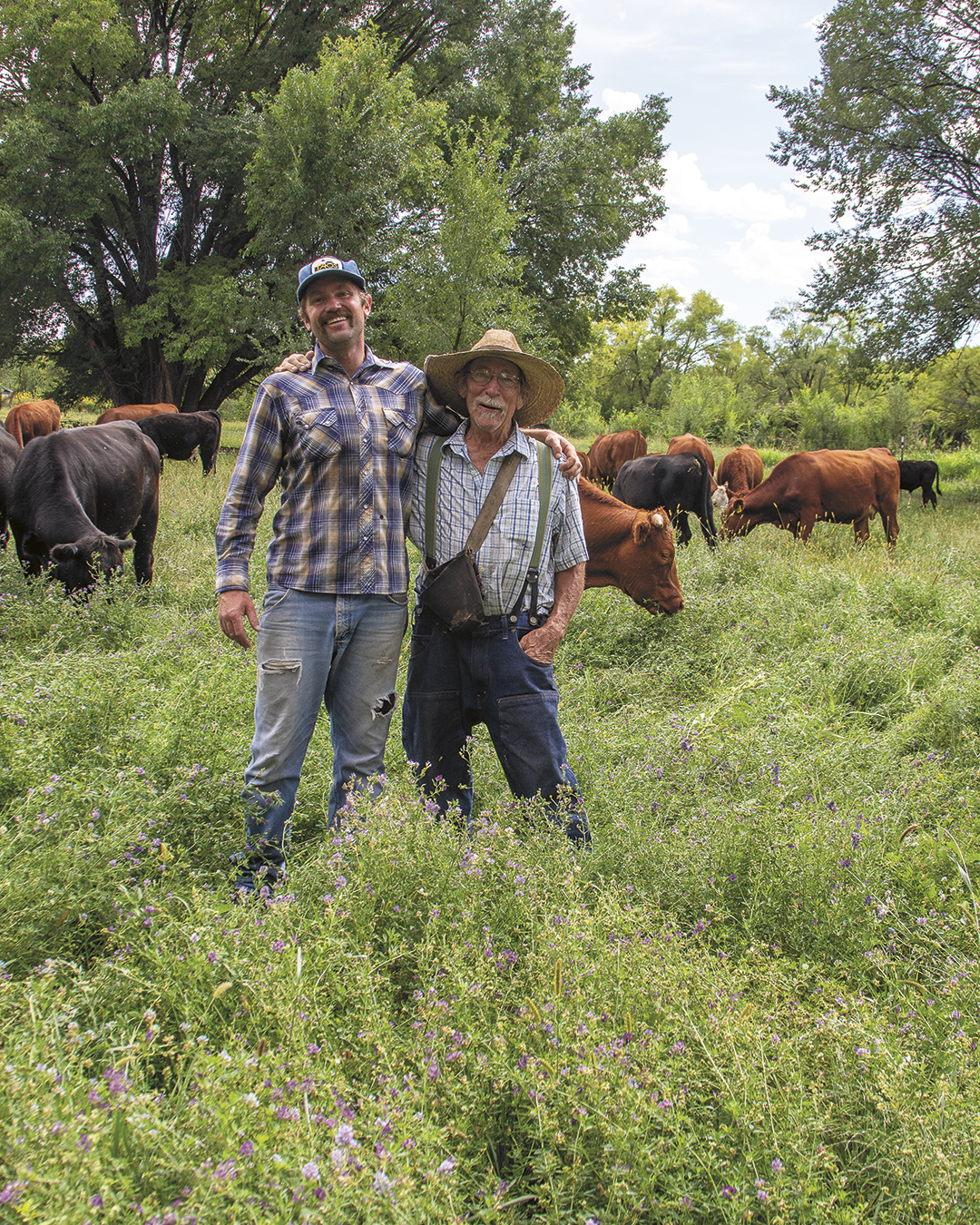
August Young and Ron Boyd at Rancho La Villita.
New Mexico has demonstrated its commitment to creating the systems and context that allow us to keep finding comfort and identity in the way we feed ourselves. Over the last decade, our state has invested millions of dollars to get New Mexico–grown food onto the plates of schoolkids and seniors. According to the New Mexico Food and Agriculture Policy Council Report Card, “farm-to-market sales [grown and consumed in New Mexico] contributed to 10.8 percent of the total crop and livestock sales of $3.71 billion in NM in 2022, up 17 percent from 2021.” Twenty years ago, a statewide food assessment called Dreaming New Mexico conducted by the nonprofit Bioneers estimated farm-to-market sales at just 1 to 2 percent of total crop and livestock sales. That’s a remarkable increase, but how can we ensure that New Mexican farmers can continue to grow food that feeds our bellies and our souls with less water and in a changing climate?
State-supported experiments are already underway, and I hope they lead to long-term investment in transforming and transitioning our food-producing landscapes. During the last two legislative sessions, state lawmakers allocated more than $15 million to the Agricultural Water Resilience program, a grant program that funds farmer-driven experimentation in using less water more effectively. The program made awards to forty-one projects in 2026, and will likely award twice as many in 2027. While this program signals support for farms and ranches to become more climate adapted, these one-off allocations, with much of the burden placed on farmers already juggling complexity, will not transform the system on their own.
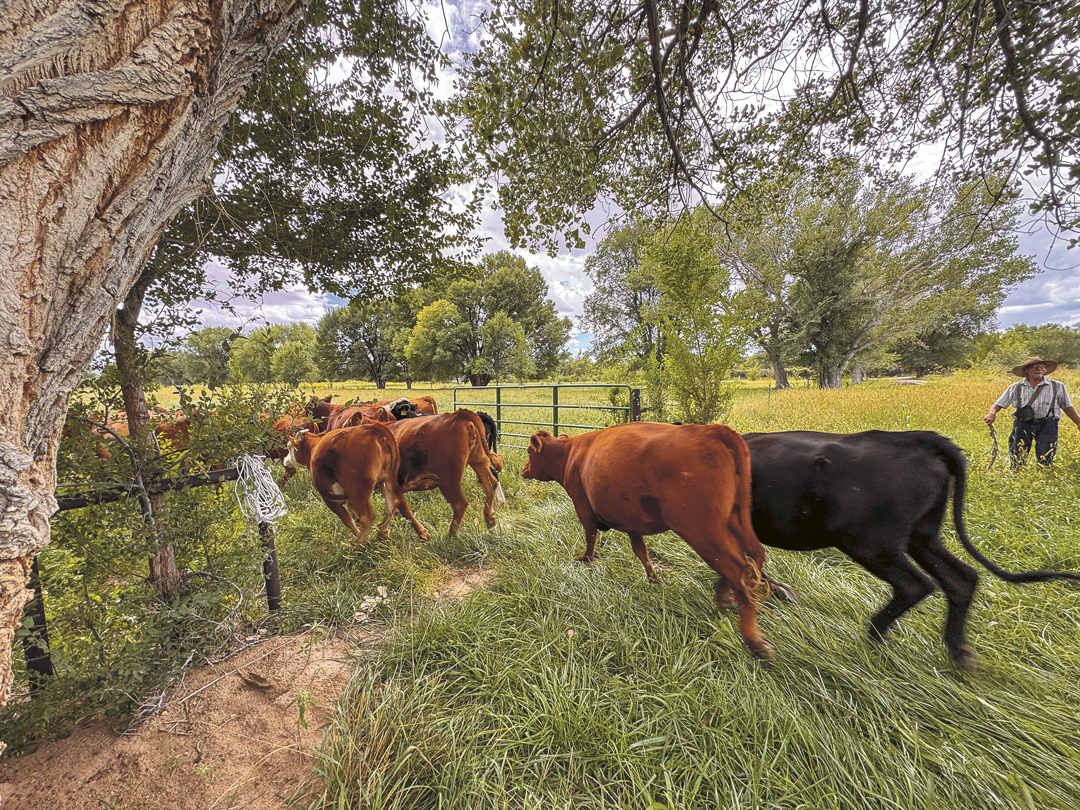
A La Madre Farms’ Akaushi cows moving into a new paddock.
This summer I spent time with August Young, a beef producer who grazes his cattle at Rancho La Villita, a diversified farm in Alcalde owned and operated by Ron Boyd and Debora Clare. Under the moniker A La Madre Farms, Young is raising Akaushi cows, a climate-adaptable, gentle breed that does well on grass, and sells beef directly to consumers and periodically through the New Mexico Grown program. Like many farmers, this is not his only profession; he is also a firefighter. His two professional hats give him a particular perspective on watershed function, and the need for an approach to agriculture that prioritizes soil health and the ability for the land to capture and hold water when we are fortunate enough to receive it.
Over a decade of working alongside Boyd and Clare, Young has engaged in a number of experiments in perennial diverse pastures, including grasses and forbs, that tolerate water fluctuation and increase soil organic matter, stability, water-holding capacity, and biodiversity. This approach means when it gets really dry or really wet, some portion of the field will survive, in turn keeping soil vital and holding water. He moves the cows as a dense herd through small paddocks over the course of the summer, a practice that adds nutrients, creates moderate soil disturbance, and allows for lots of rest and recovery of the plants. On the about ninety acres he grazes at La Villita, each paddock has different characteristics and soil quality, meaning that there’s not a single seed mix or watering schedule that works for everywhere. All of it takes attention and tweaking to maintain the delicate balance between water, soil, and food production. Unlike an alfalfa monoculture (where the nutrients from the soil and the water on the field are cut, baled, and removed), this approach to irrigated pastures means that the nutrients stay in the field, less water is used, and the plants still support not only his small herd of cows but numerous native species of bugs, reptiles, amphibians, and other animals.
When we talk about what would enable him to become more effective at adopting climate-adaptation strategies on the farm, one of the most pressing resources is simply more time. The need to work an off-farm job means he can’t give full and undivided attention to expanding his grazing operation and implementing the techniques he’s developed for pasture management on more acres. How would it look for our state to provide support to full-time land stewards engaged in food production, watershed management, and other ecosystem service provision? Could it be a health-care subsidy for farmers? A pension plan? Initiatives to support affordable land transfer to the next generation? Programs like these are as critical as the technical knowledge of shifting to new agricultural systems because they allow farmers to engage in the complex work of landscape transformation.
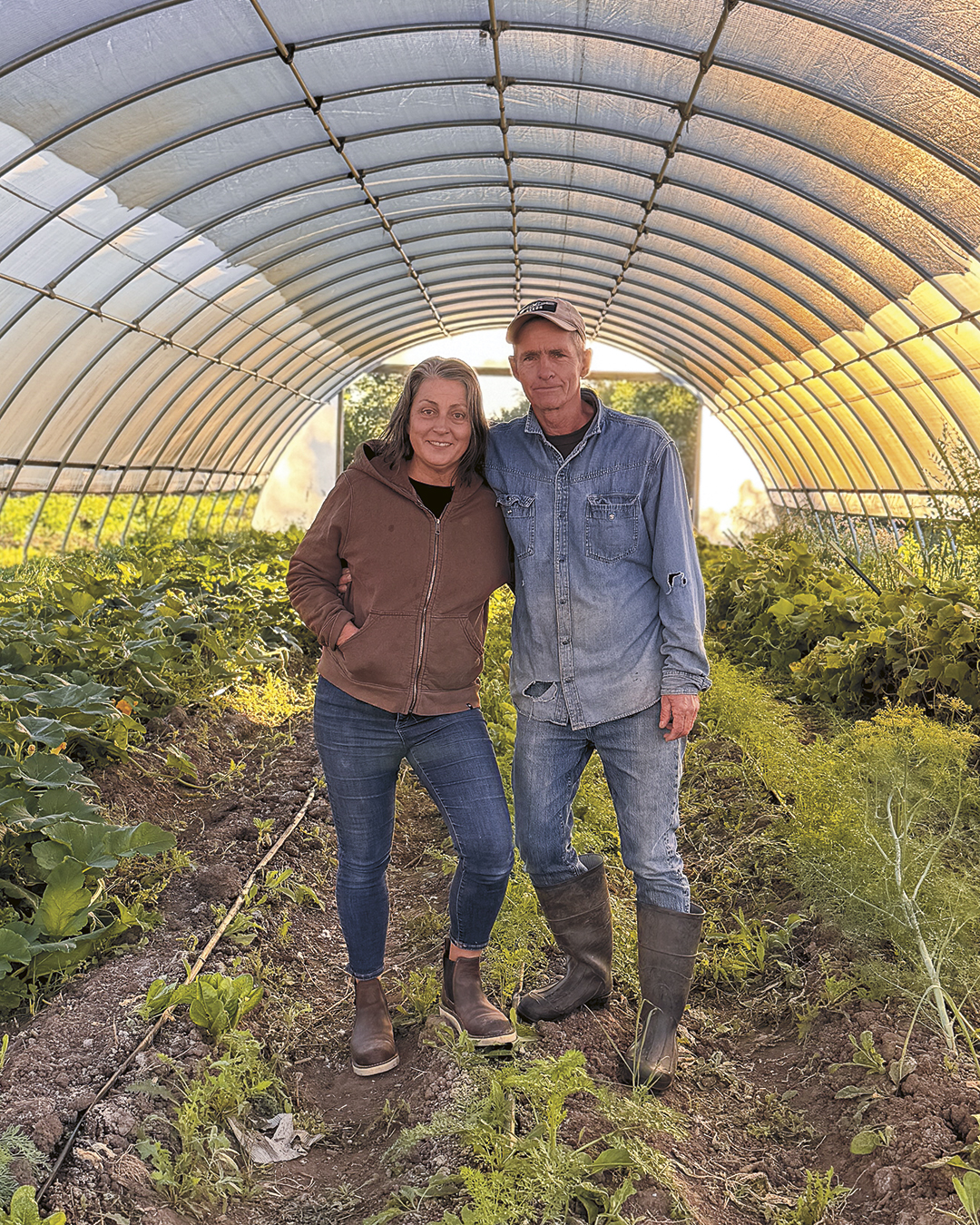
Patricia Allaire and Scott Newland of Simple Revolution? Farm!.
You can’t really phone in climate-adapted farming. Most farmers don’t know exactly what their farms need to adapt to new climate realities, but many are undertaking bold experiments to demonstrate what is possible in a hotter, drier climate. The “we do it this way because our grandfather did it this way” approach can only work if your grandfather annually evaluated, engaged in endless tweaking, and was not afraid to go back to the drawing board periodically. Scott Newland and Patricia Allaire of Simple Revolution? Farm! have spent decades dedicated to small trials and adaptation. From hedgerows to small diversified orchards to creative livestock integration, their farm is a veritable laboratory of innovative farm practices. And the reality is it’s never exactly the same one season to the next. Adaptation is their farming practice.
This doesn’t mean they are reinventing the wheel every year. Adding organic matter, mulching, diversification, planting perennials, and animal integration remain consistent as they modify their farm. Several of the perennial experiments they’ve undertaken recently include planting fast-growing, drought-adapted trees like Afghan pines, perennial fruit-bearing plants like strawberries, and native grasses for chicken forage in zones they won’t irrigate. The strawberries in particular did better than expected in their first season, Allaire suspects, because of the previous season’s animal manure and plenty of mulch. Native and climate-adapted tree planting has become a focus to help establish shade, which is key for so many other plants to survive the increasingly hot summer months. Newland and Allaire see their farm as a living system where each part is contributing to a whole, an agroecosystem where they are practicing agroecology. This is not just the model but the mindset that will help farmers in New Mexico produce food and support functioning ecosystems in the future.
This perspective of integrated and interconnected systems is also part of the greater shift needed for the future of agriculture in New Mexico. What would it look like for us to approach our landscapes this way, whether or not we consider ourselves farmers?
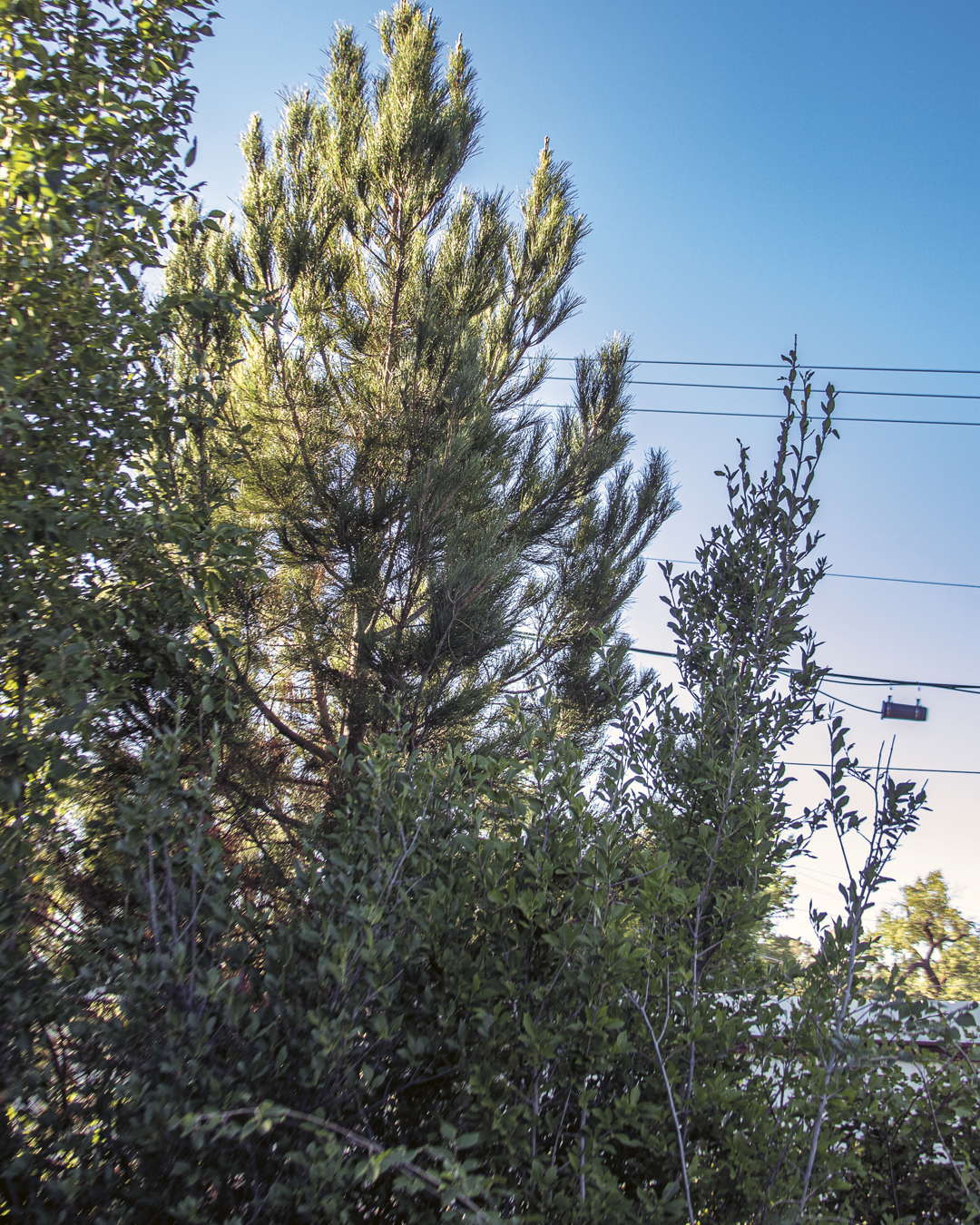
Afghan pines at Simple Revolution? Farm!.
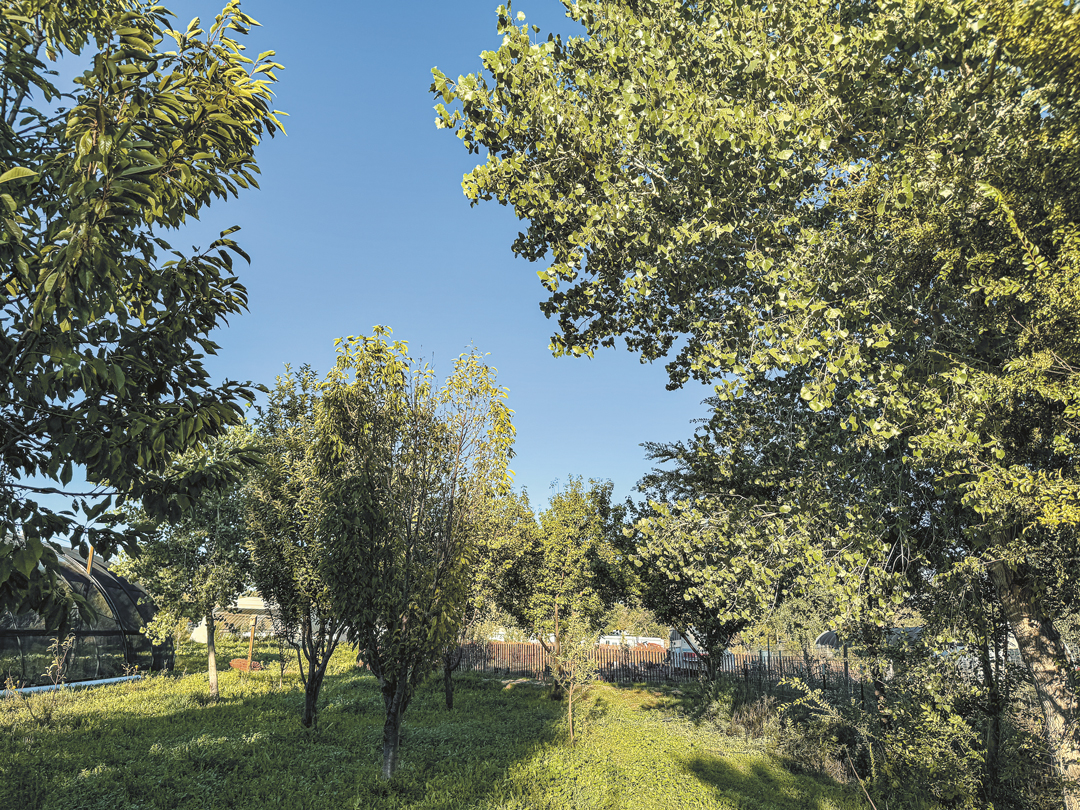
Fruit trees and cottonwoods are critical to the agroecology at Simple Revolution.
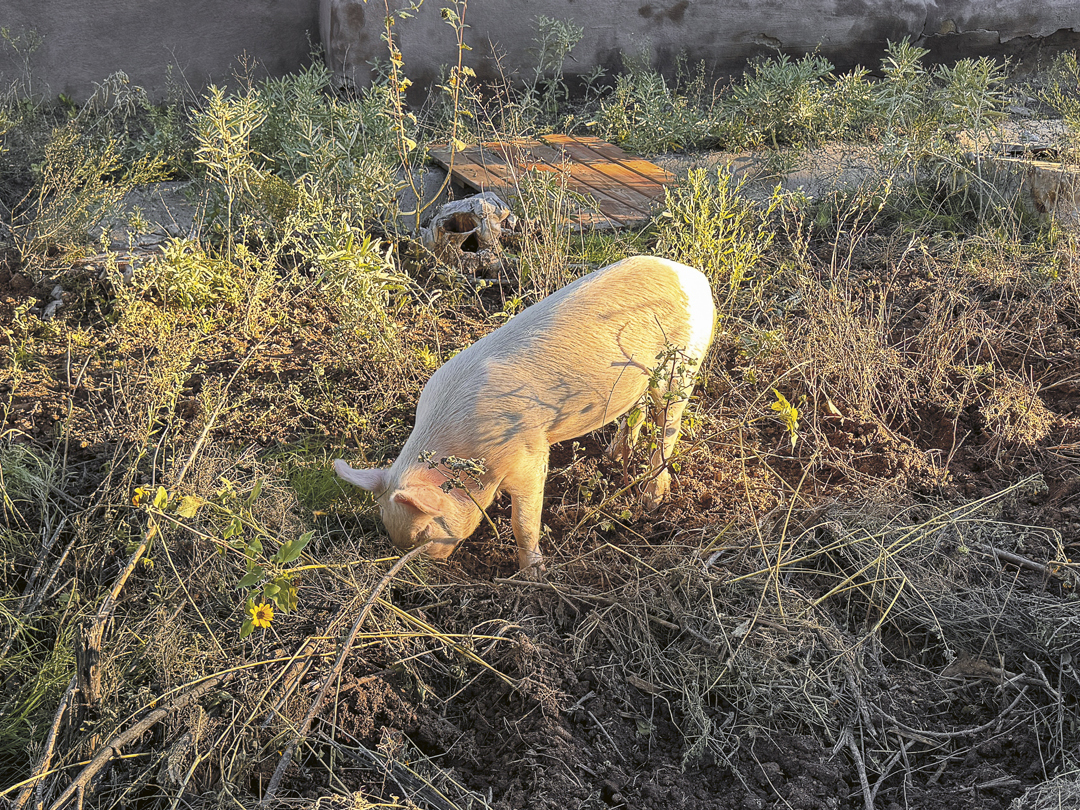
Pigs help turn the soil at Simple Revolution? Farm!.
There are, of course, ways to support local and regional farmers directly through our purchases and curiosity about their work, but shopping at the farmers market alone won’t get us there. We need long-term support for programs like New Mexico Grown so we have markets for farmers and ranchers to sell into here. We need research and demonstrations on how to modify existing agriculture production methods or to create new ones. We need community programs that recognize farming as a public service that provides not only food but habitat and biodiversity, water capture and retention, community health, and much more. And these larger systems require advocates, policymakers, planners, lenders, lawyers, teachers, researchers, public servants, and storytellers.
New Mexico has already begun to backstop the loss of federal funding and support for agriculture and conservation. To fully meet the moment, however, we will need a bold, brave, and focused vision of agricultural transformation, one that is independent of federal leaders with little understanding of on-the-ground realities or what we need to produce food in a hotter, drier climate. While weather extremes, water politics, market recession, and federal government failure make transforming agriculture seem intractable, New Mexico is well positioned to chart its course. We are rich in creative thinkers and leadership, living governance and decision-making models like acequia systems, and experience in collective work on wicked problems. And we have enough shared values—and, in this moment, funds—to reimagine and shape future food production and land stewardship that work for us.
Simple Revolution? Farm! operates a year-round farm stand at the corner of Gun Club and Isleta in Albuquerque; follow them @simplerevolutionfarm.
Email august.j.young@gmail.com to buy A La Madre beef.
Sarah Wentzel-Fisher
Sarah Wentzel-Fisher is a committed champion of the local food movement and of resilient and regenerative agriculture. A board member for both the Rocky Mountain Farmers Union and the Southwest Grassfed Livestock Alliance, she has worked as an organizer for the National Young Farmers Coalition, the editor of edible New Mexico, and the executive director of the Quivira Coalition. In her free time, you can find her feeding chickens, making pear butter from rescued fruit, and visiting with farmer friends around the state.