The New Wave of Indigenous Cuisine
By Deborah Jackson Taffa
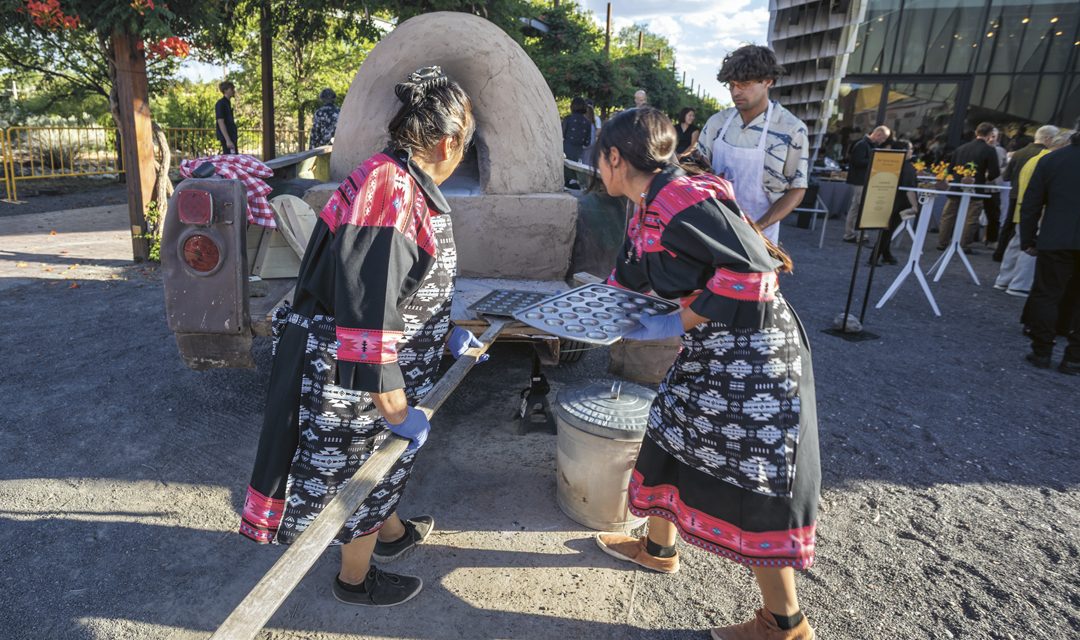
Cooking in an horno at SITE Santa Fe’s 2026 Annual Benefit. Photo by Shayla Blatchford.
Fifty years ago, the idea of dining on green chile stew with chicos inside the white walls of a contemporary art gallery would have felt unimaginable. Yet there I was in the high-fashion crowd at SITE Santa Fe’s thirty-first annual gala, a champagne glass momentarily stilled in one hand, and a small plate with venison meatballs in a wild blueberry sauce in the other, watching hoop dancers from the Lightning Boy Foundation take the stage. On the evening’s agenda was a roster of Indigenous chefs at the cutting edge of culinary arts, people who are working to decolonize ancestral foodways by using precolonial ingredients in their recipes.
Throughout my childhood in northern New Mexico, Indigenous foods were deeply localized, found in the quiet warmth of a family kitchen or a roadside flea market rather than at a fancy fundraiser heralded as a progressive dinner with dancing, music, and art. Watching the performers interlock their hoops into symbols of the natural world, I couldn’t stop thinking of my Abuela Herrera’s red chile tamales in Socorro, or my Grandma Antonio roasting a rabbit in her horno at Laguna Pueblo. The drums pounded through my body, and I felt my eyes mist up, wishing my grandmothers had lived to see our ancestors’ farming prowess acknowledged. Few people know that two-thirds of the world’s crops originated in the Americas. We wouldn’t have tomatoes for Italian ragú, cocoa and vanilla for French pain suisse, or potatoes for Jewish latkes if it weren’t for the contributions of Indigenous Americans.
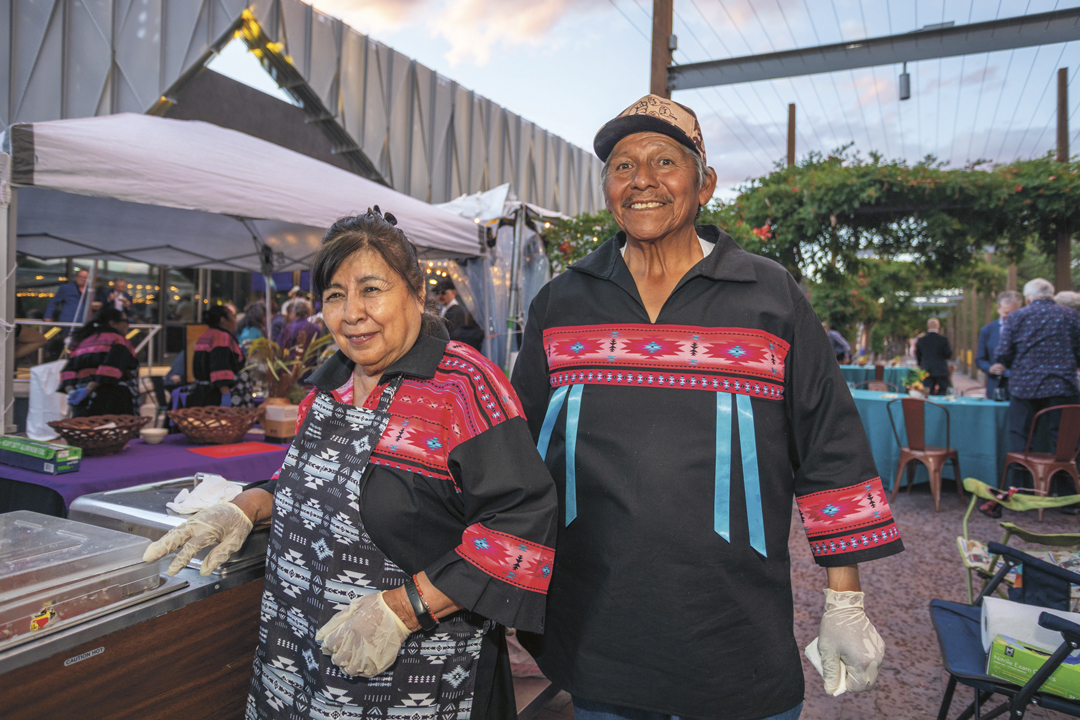
Norma and Hutch Naranjo at SITE Santa Fe’s 2026 Annual Benefit. Photo by Shayla Blatchford.
At its heart, SITE Santa Fe’s Annual Benefit was a celebration of the First Nation curator Candice Hopkins (Carcoss/Tagish First Nation), along with her landmark exhibition, Indian Theater: Native Performance, Art, and Self-Determination since 1969. But it was also a watershed moment for the chefs invited to display their culinary artistry. There was Crystal Wahpepah (Kickapoo Tribe of Oklahoma), maker of the venison meatballs and the first Native woman to own a restaurant in Northern California. She was joined by Chef Justin Pioche (Diné), winner of the Food Network’s Chopped special on Indigenous inspiration, who showcased spruce-cured salmon with sweet corn cake at the event. There was local favorite Norma Naranjo (Ohkay Owingeh), who offered my family’s comfort food via the green chile stew. And there was Brian Yazzie (Diné), who appeared once as a guest chef on Taste the Nation with Padma Lakshmi and who was serving blue corn and mesquite tartlets to the five hundred or so patrons milling around the courtyard after the performance.
Wandering amid the food tables after the Lightning Boys’ dancing was done, I nodded at various colleagues, Indigenous artists, musicians, storytellers, and performers. The room buzzed with conversation about the featured heritage dishes and food sovereignty movements taking place on our home reservations. Chatting with my Indigenous peers, I quickly discovered that I wasn’t the only one feeling an emotional portal back to the warmth of a loved one’s kitchen. An undeniable sense of shared history filled the air, a profound connection to memory, people, and land brought to life by the smell of Indigenous delicacies. Though everyone had a different story about how they came to realize they needed to eat more of their ancestral foods, we were all feeling the emotional impact of reclamation.
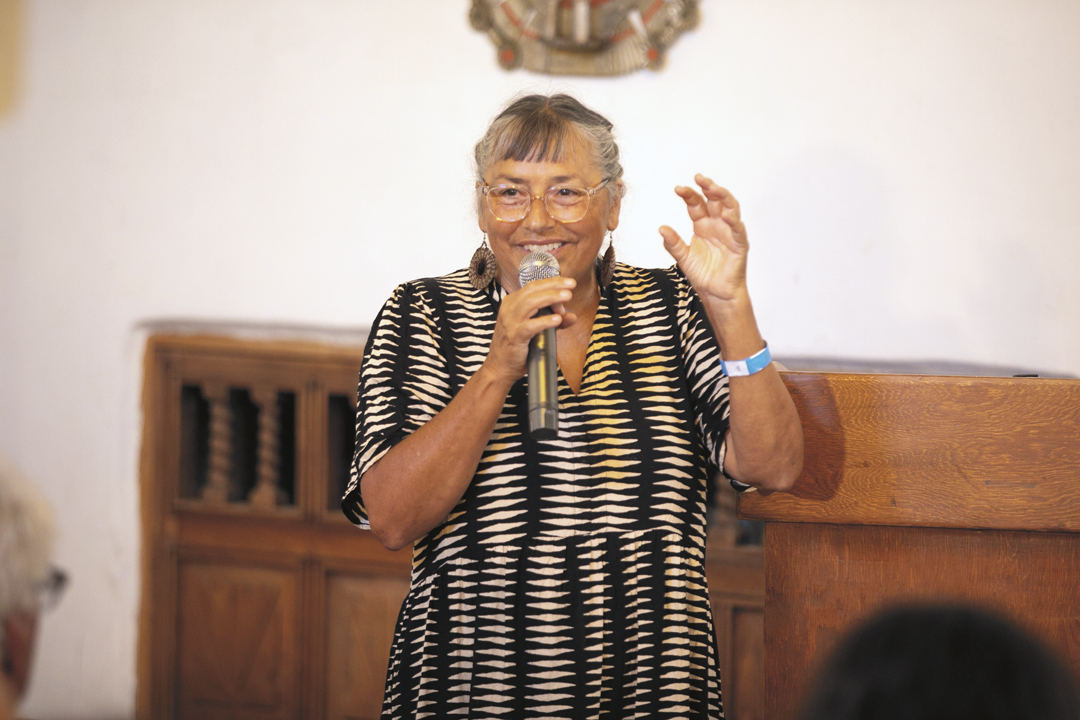
Roxanne Swentzell at the Indigenous Foodways Festival. Photo by Andrés Salazar.
The salmon and corn cakes were calling my name, so I joined the line behind the acclaimed sculptor Rose B. Simpson (Santa Clara Pueblo), a board member at the Institute of American Indian Arts, where I direct the MFA in Creative Writing program. As we waited, I asked after her mother, Roxanne Swentzell, a powerhouse in the food sovereignty movement. I had interviewed Swentzell the month prior, mostly about her seminal publication, The Pueblo Food Experience Cookbook: Whole Food of Our Ancestors, but also about her nonprofit, the Flowering Tree Permaculture Institute, which aims to restore damaged land, preserve traditional Indigenous lifeways, and teach sustainable farming.
“The idea for The Pueblo Food Experience started a little over ten years ago,” Swentzell told me. “The aim was to improve our health. We wanted to encourage our tribal members to grow ancestral crops again, not only to lose weight and live longer, but to gain cultural resilience.”
When I asked Swentzell if the experiment meant a return to her childhood diet, she said no. She explained that self-sustaining farming had declined at Santa Clara and Ohway Owingeh, her family homelands, before she was born in 1962. During World War II, the men went away to fight, after which there was a push toward a money-making model of survival. “I grew up in the town of Taos, and then my parents were going to school at Highlands University in Las Vegas. After that, my father got a job at St. John’s in Santa Fe. It was all grocery stores for us.”
For Swentzell and her family, the wake-up call came via her son, Porter Swentzell, who is a historian. “He was showing me old photographs of our people,” she told me. “And the further back in history we went, the healthier everyone looked. We were going, jeez, what happened to us?” Realizing how athletic Pueblo people had once been led Swentzell and her son to ask questions about what their ancestors had been eating one hundred years ago. From there, they studied archeological digs from ancestral Puebloan sites, created a list of precontact foods like maize, pumpkin, prickly pear fruit, and piñons, and resolved to undertake an experiment in conjunction with her son’s physician.
“My son was having really bad health issues,” she said. “His doctor told us he was headed for a heart attack in his twenties. They brought in a nutritionist who showed him a food pyramid. He came home and said, ‘Nothing on this pyramid comes from our continent.’ We discarded it, and he started eating our original foods, and the next time he had his blood tested, his health was drastically better.”
Driven by Porter’s success, the Swentzells took their experiment to the larger Pueblo community. Fourteen volunteers with a range of issues including diabetes, obesity, depression, and heart disease signed on to eat only ancestral foods for three months. “We held hands in our effort because it was not an easy diet, but we stuck it out and then went back for more blood tests. Each of us saw the same improvement [as my son], which blew the doctors away.”
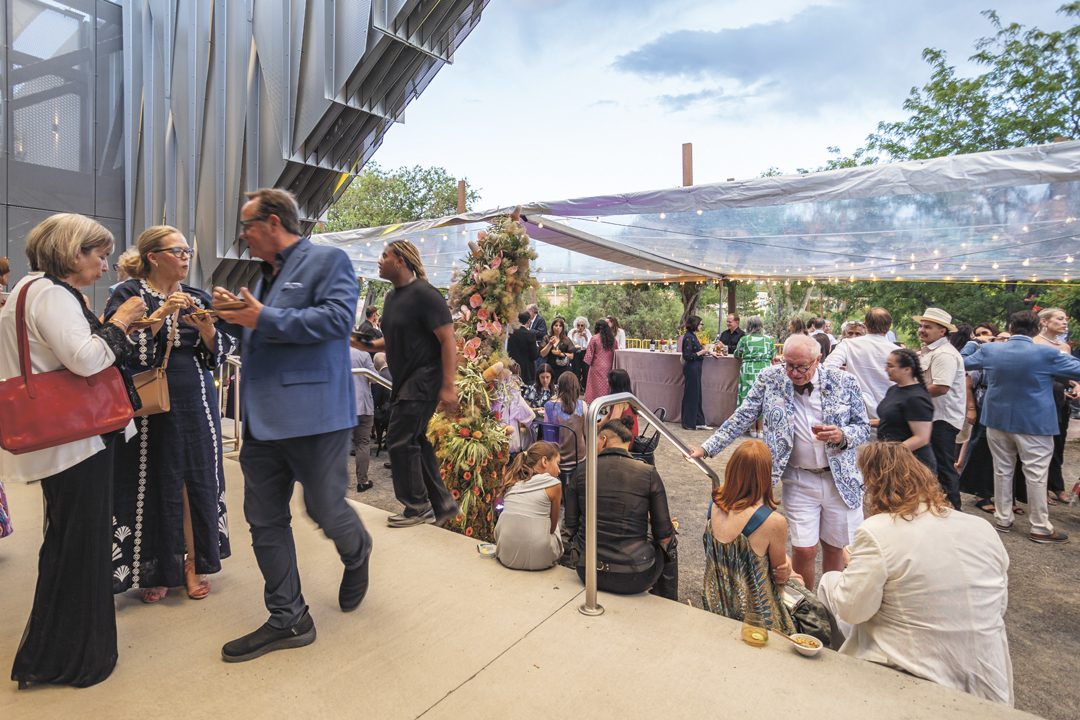
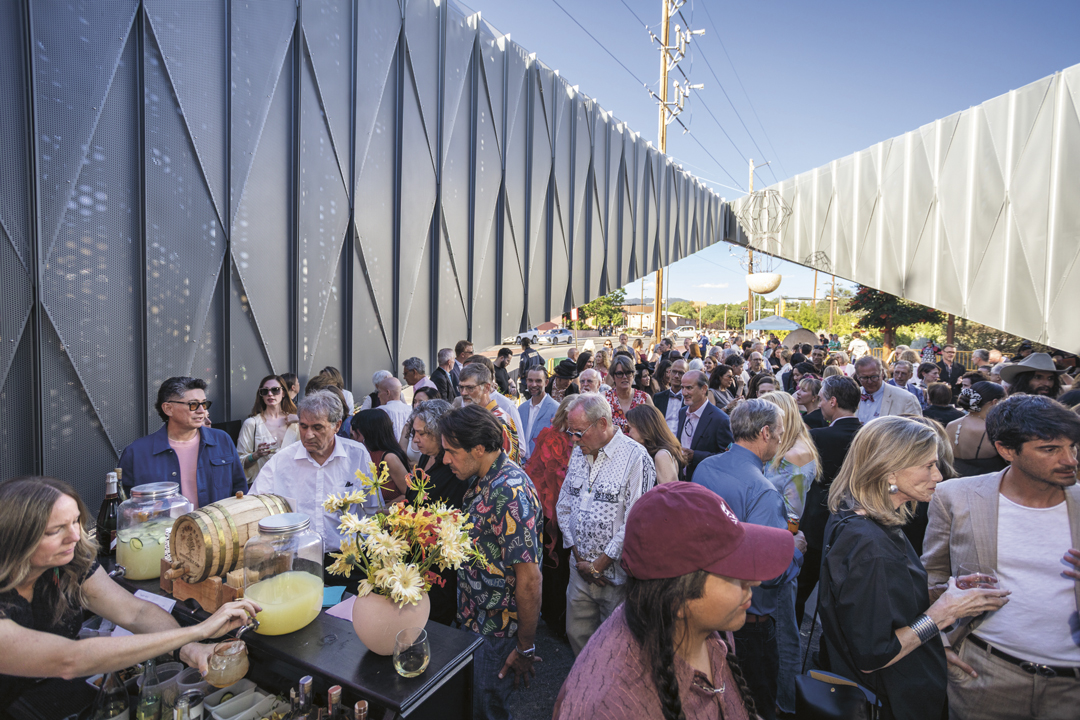
SITE Santa Fe’s 2026 Annual Benefit. Photos by Shayla Blatchford.
Swentzell’s story made me reflect on my own wake-up call. I grew up in Farmington, in the 1970s and ’80s, and I’ve often described my childhood as cleaved in two. There was the warmth of family before the arrival of Burger King and McDonald’s, and the loneliness after. It sounds trivial. But when the smell of my mother’s homemade corn tortillas cooking on a cast-iron skillet left the house, when her pinto beans were no longer boiling on the stove and my father had stopped grilling the rainbow trout we pulled out of local rivers, I lost more than our family dinners. I lost contact and conversations. My mother stopped moving. She went from gestational diabetes in her last pregnancy to full sugar sick, and her demeanor became recalcitrant and harsh.
Advice around the dinner table, support from family, the health and love in home-cooked foods—these things are hugely important to children. I needed the same togetherness I’d had in my earliest childhood. Instead, I grew up in a historically difficult reservation border town with an overworked father and a tired mother of seven kids who stopped cooking as soon as our family grew larger. It was all hamburgers in paper sacks around the television, pizza in cardboard boxes reheated and eaten alone. At school, I hated the erasure of my ancestors in the curriculum. At home, we were townies who had lost our connection to our foodways, the most elemental form of nutrition. Snotty kids at school called me a “bean eater,” and I grew into an angry teenager who was too easily slighted.
It’s unhealthy to be so disgruntled with society, but I was lucky. I started hiking long miles in the foothills. I revolted against my parents’ penchant for Kentucky Fried Chicken. I found Frances Lappé’s Diet for a Small Planet at a used bookstore downtown, and I began to tie fast food with capitalism in my mind. Suddenly, I had found a healthy way to rebel. No one had heard of a vegetarian in my family, yet I vowed to eat primarily plant-based protein. I attached myself to the athletic ethos of my ancestors, pledging to avoid alcoholism and diabetes. I refused to go to college, in favor of taking jobs as a maid at various national parks, leaning into what I called an outdoor education.
There are many reasons an Indigenous person who is not a professional chef might come to prioritize American staples in their diet. For the Swentzell family, it was a need for physical health. For others, it is a response to dairy or gluten intolerance. For me, it was a mental health crisis. I knew it wasn’t good to be angry and distrusting of others, yet my bitterness continued to feel tender for longer than I’d care to admit.
When I was in my twenties, my mother-in-law came from Milan, Italy, for a visit. My husband and I were living in Rio Rancho, and as I loved healthy cooking, she and I spent a lot of time in the kitchen together. She taught me how to make a dessert with apples, prunes, figs, pine nuts, walnuts, and raisins, spiced with cinnamon and port. It was held together with breadcrumbs in puff pastry. Notes from my journal that month in the early aughts tell me I learned to stuff dates with whole almonds before dipping them in dark chocolate as well.
The visit was fine until some new neighbors from down the street came over for dinner. They had just moved to New Mexico from Kansas City, Missouri, and were planning a trip to Rome. Maps were spread out on the table, and the evening turned toward a conversation about Western civilization. Suddenly, the wife from Kansas asked my mother-in-law what her favorite American food was. Everyone sat quietly for a minute. I could see their brains trying to work out what American food meant. I’m sure my mother-in-law was thinking about the great Chinese American restaurant we’d taken her to. Finally, she said she had eaten a wonderful steak in downtown Albuquerque, to which the Kansas lady replied, “I guess when you think about it, there is no such thing as American food.”
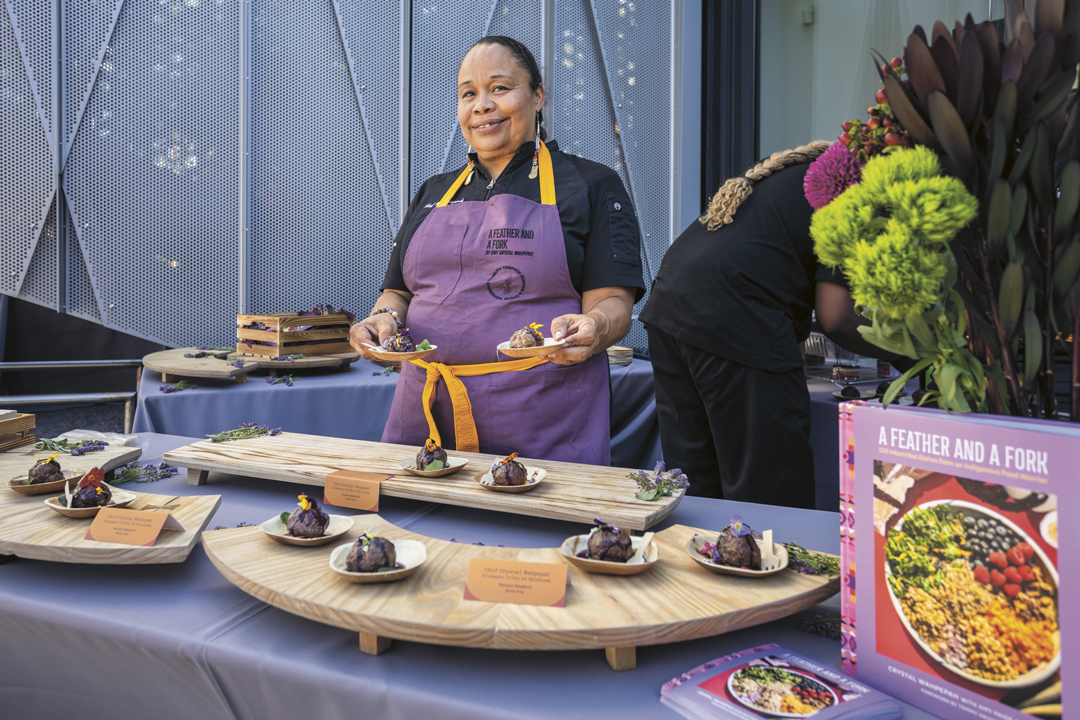
Crystal Wahpepah at SITE Santa Fe’s 2026 Annual Benefit. Photo by Shayla Blatchford.
Healing takes time when you imagine yourself alone. Reclamation can only be done in community. Overturning the notion that our Indigenous ancestors were primitive, lacking culture, art, and foodways, means all hands on deck to remedy the erasure. Americans are knowledgeable eaters. These days, they go out to enjoy sashimi, polenta, pancit, chow mein, paella, and falafel all the time. Yet they are largely ignorant about their own continental forebears, and this educational absence, despite recent improvements, was left to stand for too long.
My first encounter with community pushback came from the academic world in St. Louis. In 2013, a decade after the incident with my Italian mother-in-law, my daughter was earning her master of social work and public health via the Buder Center for American Indian Studies at Washington University. The center ran its second annual food sovereignty event in collaboration with student leaders and campus chefs, called Hunt. Fish. Gather. The first year the event was held, the three words were translated into the Alabama-Coushatta language: Mattibi. Imokwayli. Ittahnali. The year my daughter helped organize, the words were translated into the Wampanoag language: Ahchâôk. Ômâôk. Keepunumuk. The program consisted of a dinner, cooking demonstrations, research, evaluation, and oral presentations. My daughter Miquela and her organizing partner, Nakomis Maher (Mashpee Wampanoag), decided to invite Chef Nephi Craig (Apache/Diné), founder of the Native American Culinary Association and author of the book Our Knives Will Save Us: Dispatches from a White Mountain Apache Chef.
I will never forget how Chef Craig’s stories inspired my own remembrances. As I listened to him reflect about the moment he realized pasta sauce, essentially tomatoes, was the result of an American crop, I remembered the first time I was served polenta with rabbit in Italy. It was the same dish I’d eaten back home, yet no one recognized this fact, and when I tried to bring it up, the room grew awkward. They felt ownership over their cornmeal mush, and I knew my insistence was making me sound crazy and bitter. When Chef Craig confided that he had overcome mental obstacles, including alcoholism, with cooking, I knew a movement was about to take the country by storm.
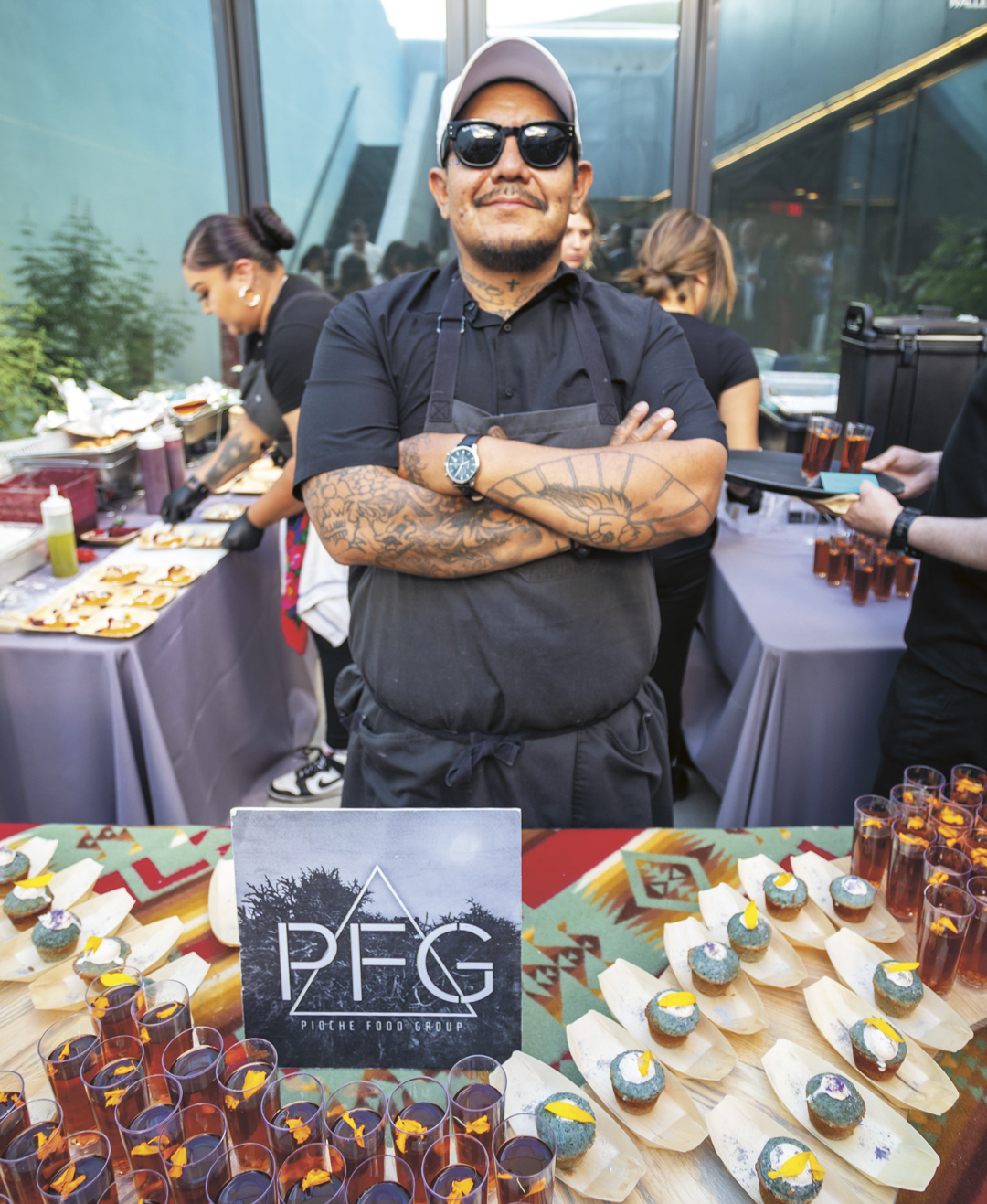
Justin Pioche at SITE Santa Fe’s 2026 Annual Benefit. Photo by Shayla Blatchford.
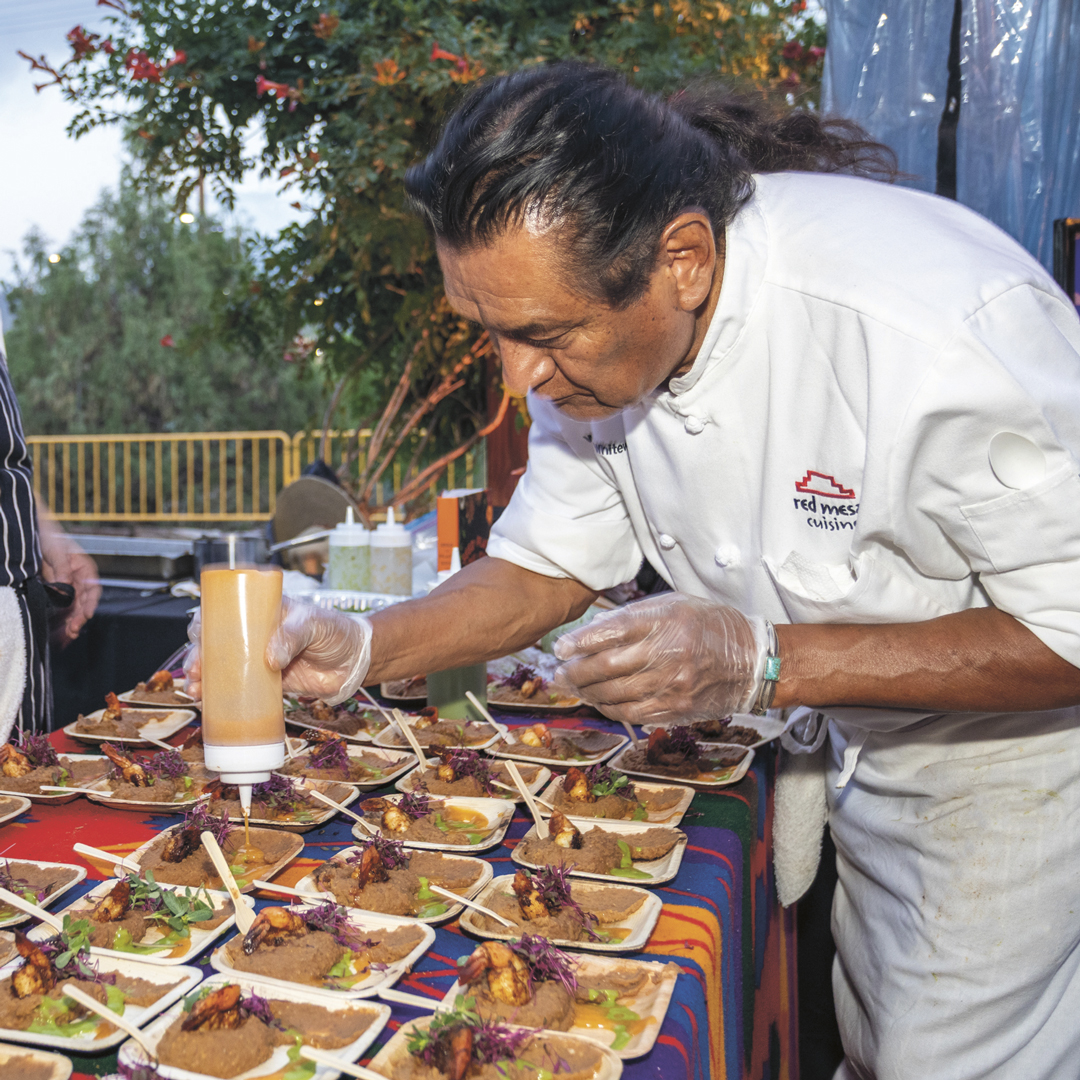
Walter Whitewater at SITE Santa Fe’s 2026 Annual Benefit. Photo by Shayla Blatchford.
In 2026, Indigenous chefs, scholars, anglers, farmers, and activists are leading the charge, which means the Indigenous food sovereignty movement continues to spread. After my daughter earned her degree in St. Louis, she accepted a professorship at the University of Hawaiʻi at Mānoa. She married a traditional Hawaiian whose Grandmother Kamahele helped reintroduce the Native Hawaiian language to North Shore elementary schools. With his family, she goes to traditional loʻi fields where they pick kalo, then use the lūʻau leaves to make lau lau, and the roots to make poi, my grandson’s first food.
It is a relief to see Indigenous food recognized, not as an artifact of the past but as an emerging gastronomic movement. From manoomin to chia and poi, from amaranth to quinoa and kanuchi, traditional ingredients and innovative dishes are emerging from kitchens where chefs are finally gaining the financial support they need. As I drove home from SITE Santa Fe after the gala, I reflected on what might emerge in future decades as these chefs enter the realm of artists.
The artistry of Indigenous cuisine was at the core of my conversation with Kate Nelson, an award-winning journalist who has long documented developments in Indigenous foods. A collaborator on Turtle Island: Foods and Traditions of the Indigenous Peoples of North America by James Beard Award–winning chef Sean Sherman (a.k.a. the Sioux Chef), Nelson has reported on culinary traditions from Minneapolis to Oaxaca, and she has a lot to say about the mistaken notion that Indigenous cuisine is primitive or simple.
“Our ancestors developed their crops using very sophisticated agricultural systems,” she told me over the phone. She said even in the desert around Phoenix, there were ancient irrigation systems. “In different regions, different climates, and under different conditions, we innovated to feed ourselves. People associate innovation with computers and the internet, but innovation is also reflected in the sophisticated farming and wide trade networks used by our ancestors.”
According to her, Indigenous chefs are getting more creative, and that freedom matters. Reclamation shouldn’t require an archaic return to past techniques. Rather, it should enable them to be as innovative as non-Indigenous chefs are allowed—and often encouraged—to be. “Indigenous foodways are not stuck in the past,” Nelson said. “There are certainly ancestral foods with traditions that have been carried on and preserved against all odds over time, but other Indigenous cuisine today is a creative new take. It is as flavorful and exciting and interesting as what people are doing in Italian, French, New American, or whatever kitchen you want to compare it to. It’s not like if you eat Indigenous cuisine, you’re suddenly sent back to the 1800s.”
She also wanted me to know that modern Indigenous cuisine doesn’t have one philosophy or definition. “Sean wants to cook without European ingredients, so no beef, pork, chicken, dairy, or cane sugar,” she said. “But there are other Native chefs with different philosophies. In the Southwest and Mexico, many use pork, which was introduced by the Spanish, because it has been part of the Indigenous foodways in those regions for centuries. There is no right or wrong way to approach it.”
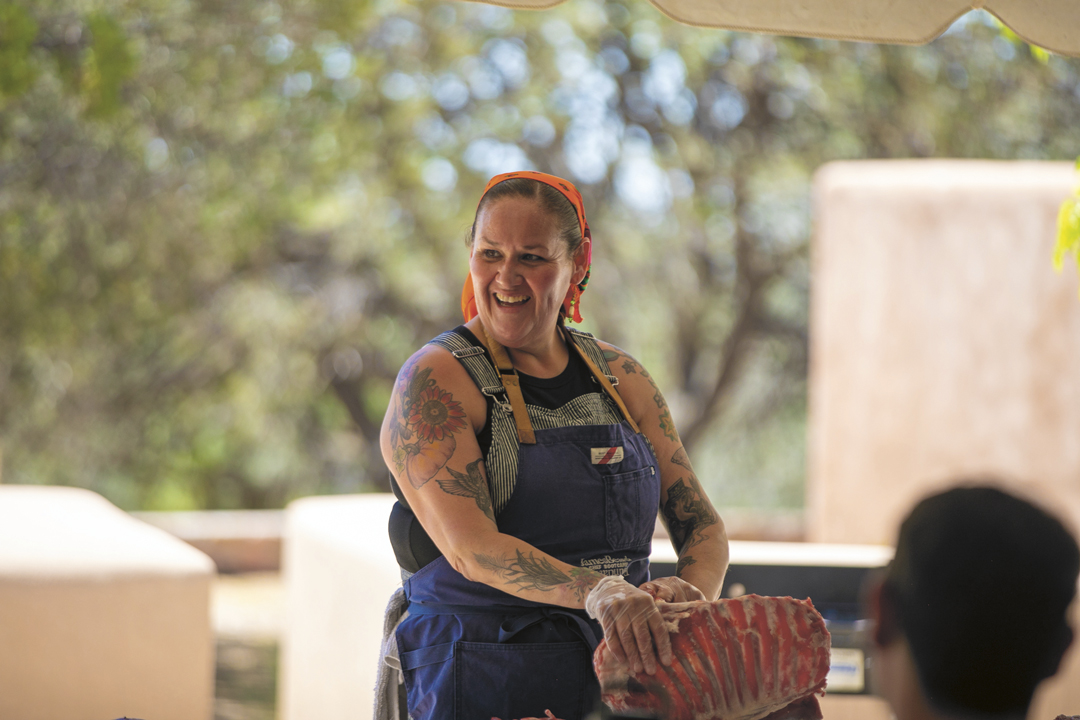
Elena Terry at the Indigenous Foodways Festival. Photo by Andrés Salazar.
To this, Chef Elena Terry (Ho-Chunk Nation) has something valuable to add. Terry has been part of the Indigenous food sovereignty scene for a long time, first with the Native American Food Sovereignty Alliance, and now as the founder of the nonprofit Wild Bearies, an educational outreach organization that uses ancestral foods, seed-to-table farming, and culinary training to help individuals recovering from emotional trauma and drug and alcohol abuse.
She has been tasked with serving as the first executive chef of Tall Grass, an Indigenous restaurant set to open at the Madison Museum of Contemporary Art in Wisconsin this winter, and she says it is important to remember there are sometimes not enough ancestral crops to go around.
“If I have twenty pounds of hand-harvested manoomin [wild rice], I might save one pound for the greater community, so that they can try it, and see how beautiful it is,” Terry said. “But I feel like feeding my First Nation community the wild rice is more important because there are some who have never eaten it. I want to celebrate the crop’s return, and share our message, but I also don’t want to deplete the staples or gouge the community on the price.”
As I pull into my Santa Fe garage after the evening at SITE, I hear Chef Terry’s admonition to remember why we do our work. After an evening with my Indigenous colleagues, I think of the Indigenous kids for whom many of us create. It’s the same for chefs and artists alike. Our relatives are our first and most important audience, and I value the reminder, the fact that she understands the tension between wanting to teach people about our lifeways while also taking care of ourselves.
On college campuses, via cooking shows, in community workshops, and in award-winning restaurants and museums, Indigenous chefs are on a mission to help Indigenous people heal, which makes their jobs sacred. The restoration of bodies and minds and the effort to heal is complicated. It lies in a balance between physical and mental well-being. It is not only found in our diets but in the restitution of respect for our ancestors. Seeing the world give them credit for their farming, good taste, and culinary contributions is a freeing and empowering step. In this way, our liberation has always been tied to the land.
Deborah Jackson Taffa
Deborah Jackson Taffa’s memoir, Whiskey Tender, was a finalist for the 2024 National Book Award. Named a top book of 2024 by The Atlantic, Time, and NPR, it won a Southwest Book Award andan International Latino Book Award. Taffa is a 2026 Howard fellow for her novel-in-progress. She is the director of the MFA in Creative Writing program at the Institute of American Indian Arts and a boardmember with the Santa Fe International Literary Festival.