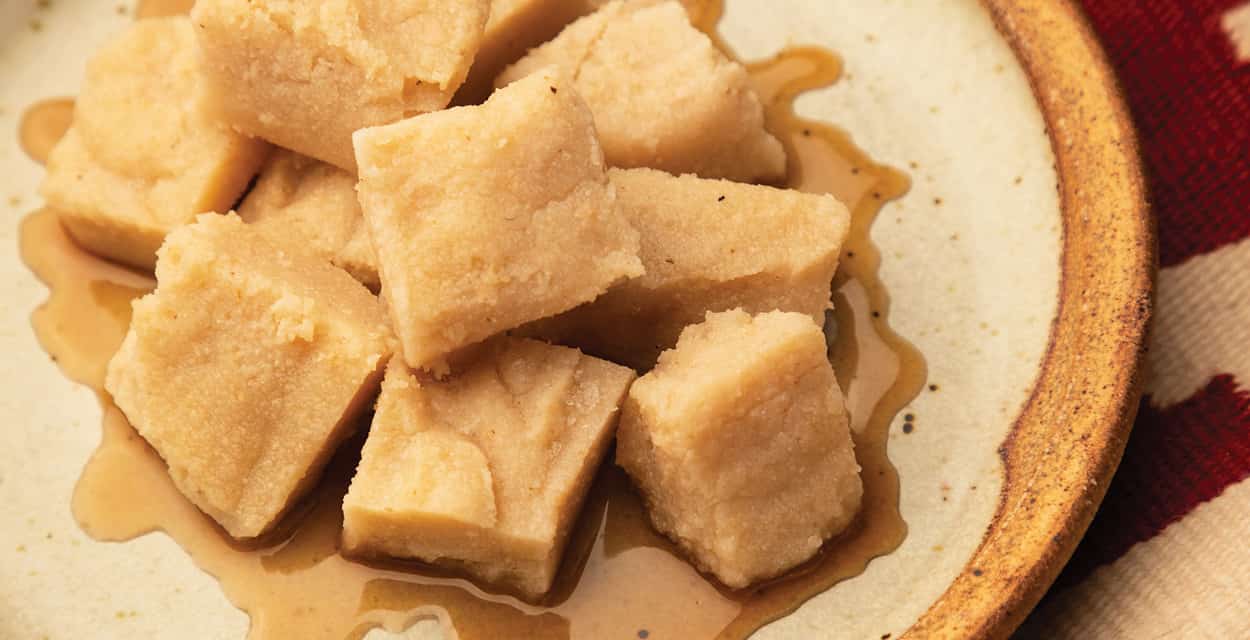
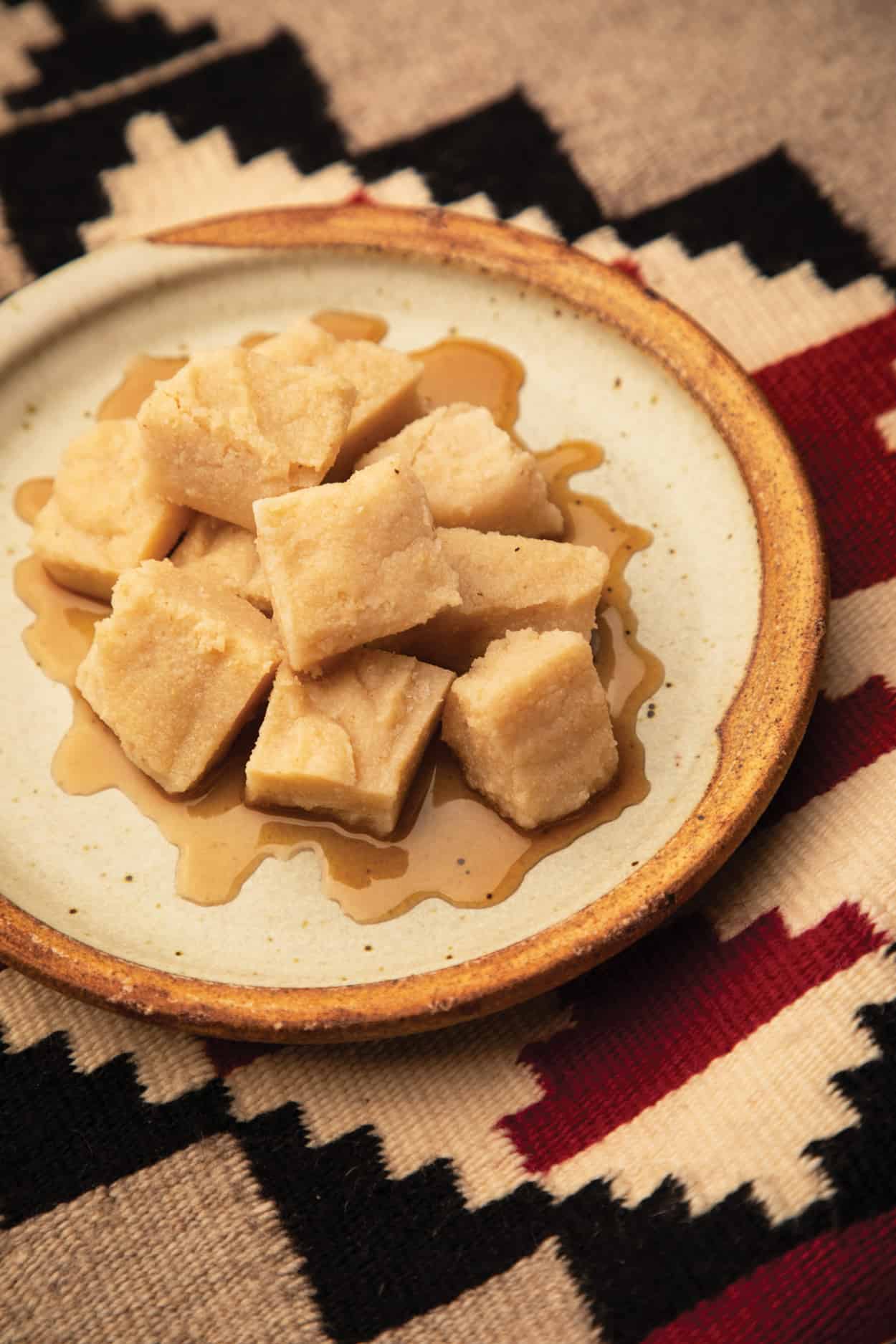
Before there was refrigeration on the Navajo reservation, this dish was prepared and then put outside in the snow overnight. In the morning, kids would eat the frozen corn mush for breakfast. Chef Walter remembers his grandmother, Grandma Susie Whitewater Begay, making this for him when he was a child.
Plant-based Navajo cook Grace Tracy shared her version of this corn dish with me and said that it was a variation of a popsicle she likes. She said, “The elder teaching is ‘Ash repels evil, as it has spiritual significance to protect. White corn is our identity and a gift from the Creator.’”
The delicate flavor for this corn ice is lightly sweet from the corn and maple syrup, and the texture is a lot like shaved ice. For those of you with a sweeter palate, drizzle some additional maple syrup onto the plate when serving. This recipe was inspired by both Grace, whose recipe I adapted, and Chef Walter’s memory of this dish while growing up.
Grace’s Corn Ice (Da’yis tiin)
Ingredients
- Makes 3 5x8-inch frozen containers
- 2 cups finely ground white cornmeal
- 5 cups water
- 3/4 cup pure maple syrup, plus more for drizzling
- 1/2 teaspoon kosher salt
- 1/2 teaspoon culinary ash (optional)
Instructions
- First toast the cornmeal. To do this, heat a large cast-iron skillet or heavy-bottomed pan over medium heat, then add the cornmeal and toast for around 10 minutes or until it turns a golden brown, stirring frequently to prevent burning and ensure that the cornmeal toasts evenly. The cornmeal will turn from a white color to a light brown. Remove from heat and reserve.
- In a large saucepan over medium heat, bring the water, maple syrup, salt, and culinary ash (if using) to a boil. Whisk in the toasted cornmeal, lower the heat to a simmer, and cook for 30 minutes, stirring frequently with a heatproof rubber spatula or whisk to prevent burning.
- After 30 minutes, transfer the mixture to a heatproof container or containers so that it comes up the sides approximately 1 inch. Let cool to room temperature before covering and freezing overnight. Place in an oblong, flat, hard plastic container so that it is easy to cut into small squares for serving after it has frozen, and then freeze.
- Remove from the freezer and let thaw for approximately 40 minutes before turning it out on a cutting board and slicing into small squares. Serve with a drizzle of additional maple syrup if desired.
Notes
A Note on Culinary Ash
Culinary ash dates back thousands of years and has been used by Native communities throughout the Americas for millennia. It is primarily made from shrubs and trees growing near or around the Native communities that use it. The Navajo primarily use juniper ash. Chef Walter Whitewater and his family have been using juniper ash in their traditional dishes since he was a little boy.
Juanita Tiger Kavena, author of Hopi Cookery, who has since passed, talks in her cookbook about the Hopi using the ash from corncobs, corn silk, and corn husks, as well as the four-wing saltbush (Atriplex canescens), which is also called chamisa. Her son, Wilmer Kavena Jr., whom I know as Chibbon (which is Creek for “little boy”), says that the four-wing saltbush is the preferred bush for the Hopi but that ash can be made from burning any bushes. He prefers to make ash from the four-wing saltbush since these bushes are more alkaline and work better with the corn. And Brandon Baugh from San Felipe Pueblo, my student from the Indigenous Concepts of Native American Food class at the Institute of American Indian Arts, researched the use of ash in his community and at San Felipe Pueblo for his final paper and presentation, and found that in his community they use juniper, four-wing saltbush, and onion ash. Other Native communities all over the United States use various materials, including the ash from certain types of wood.
Culinary ash can be sourced from Shimà of Navajoland and Blue Corn Custom Designs, among others.
Excerpted from Seed to Plate, Soil to Sky: Modern Plant-Based Recipes Using Native American Ingredients by Lois Ellen Frank. Copyright © 2023. Available from Hachette Go, an imprint of Hachette Book Group, Inc. Reprinted with permission of the author and Hachette Books.

Lois Ellen Frank
Lois Ellen Frank, PhD, is a Santa Fe–based chef, author, Native foods historian, culinary anthropologist, educator, photographer, and organic gardener. Her cookbook Foods of the Southwest Indian Nations won a James Beard Award, and she has spent over thirty years documenting and working with the foods and lifeways of Native American communities in the Southwest. Dr. Frank is the chef and owner of Red Mesa Cuisine, a catering company specializing in Indigenous cuisine and cultural education with a modern twist, where she cooks alongside Native American chef Walter Whitewater.