By Denise Chávez
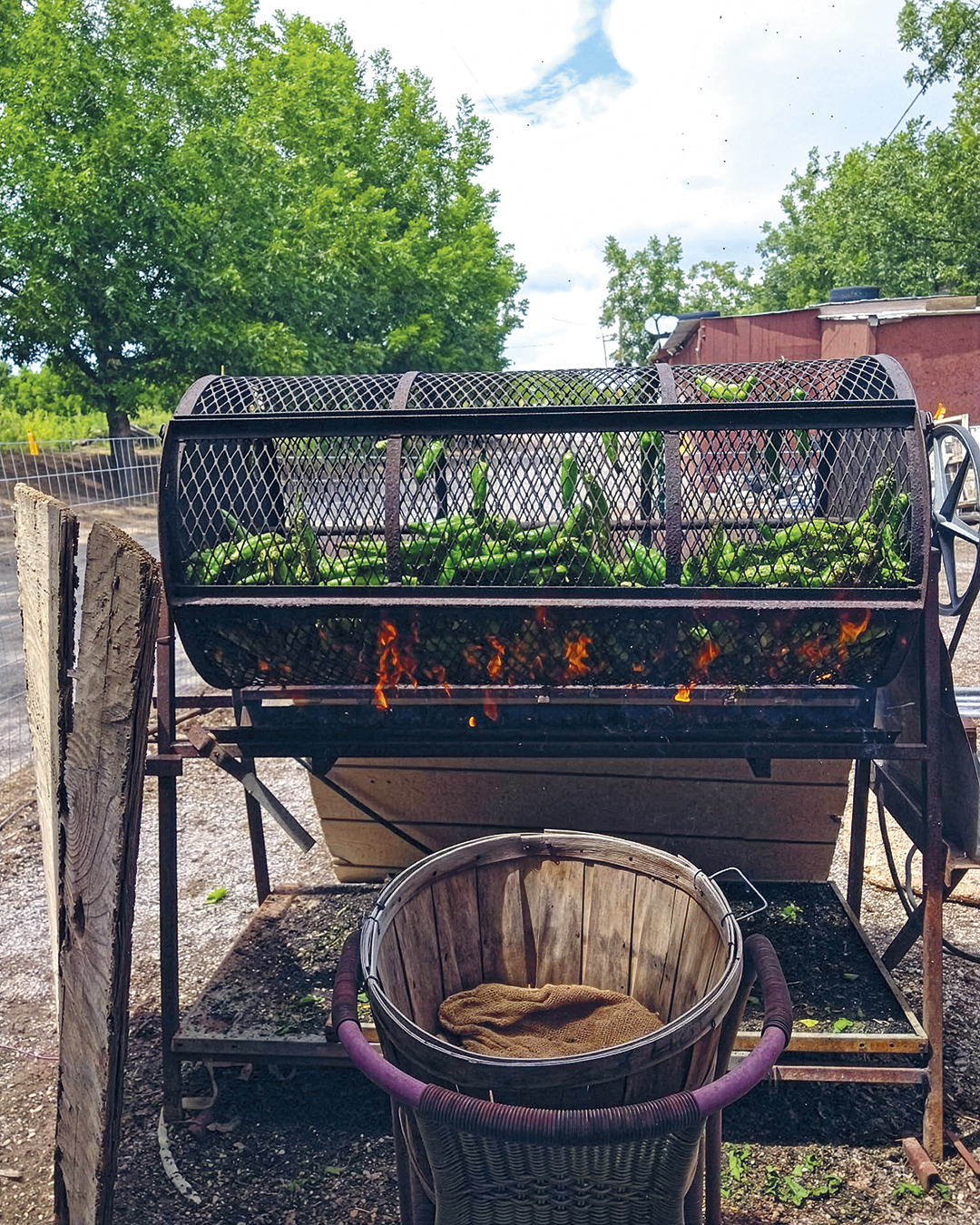
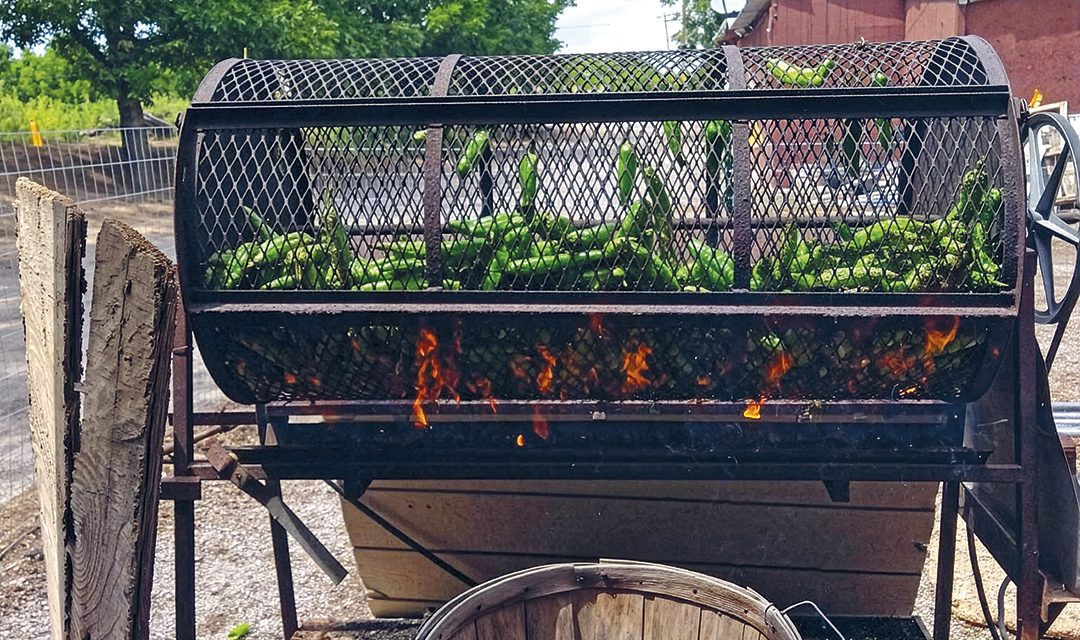
Chiles roasting at Road Runner Chile. Photo by Denise Chávez.
Avenida del Panteón.
Road to the Cemetery.
That’s the turn.
You will probably miss the sign, as I do every time, but the turn back is not far. Driving down that small dirt road to the Guerra family compound is a blessed reminder of what awaits.
I have always bought my chile late, in early October. I would drive north to Joe Luján Farms in Doña Ana, and before that, west to what was then the Chávez Farm, near the old Shalam Colony, where my grandfather Epifanio was a carpenter. Now as a devotee of Road Runner Chile, the drive south out to San Miguel has become a yearly sacred ritual.
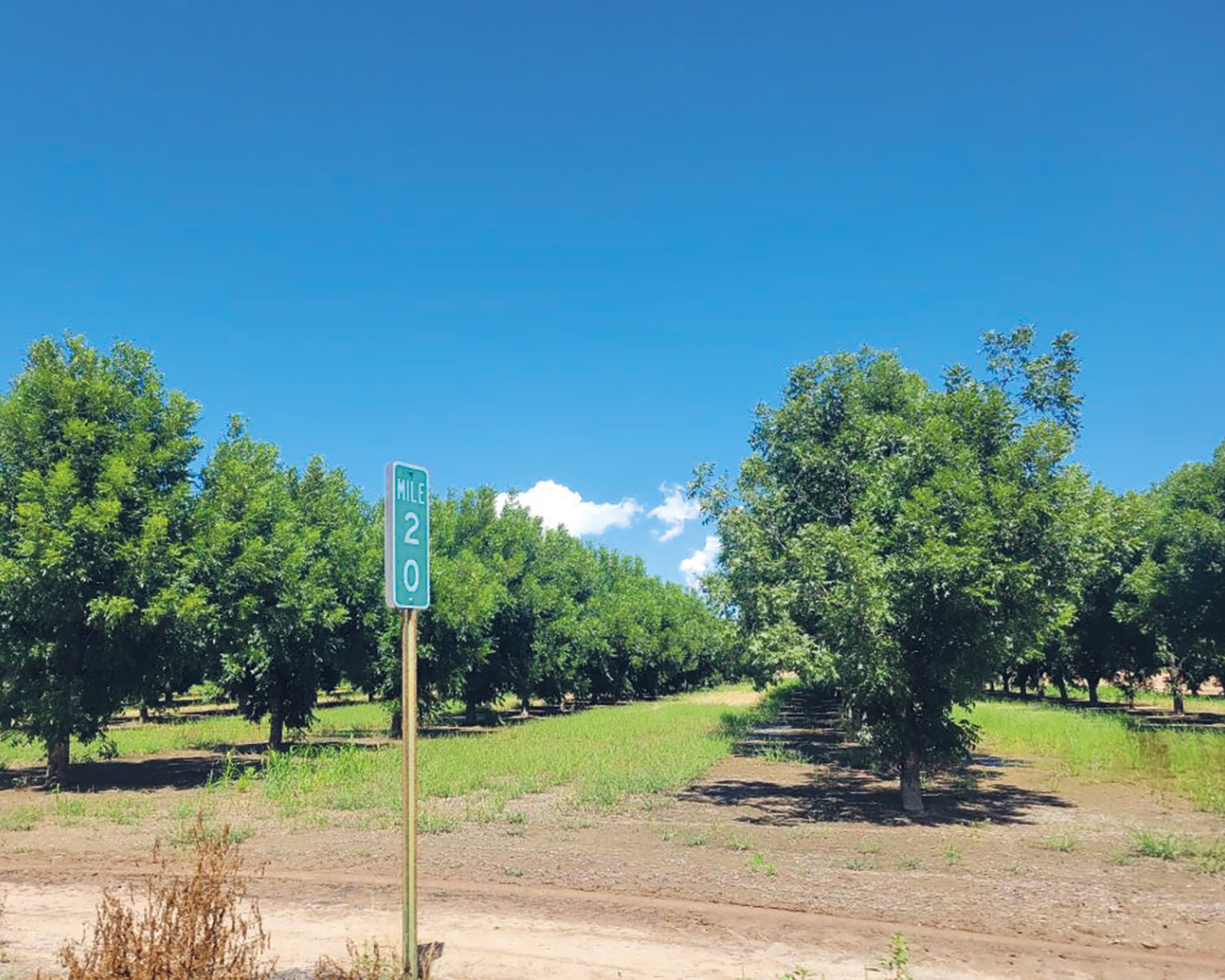
Pecan grove on highway NM 28. Photo by Denise Chávez.
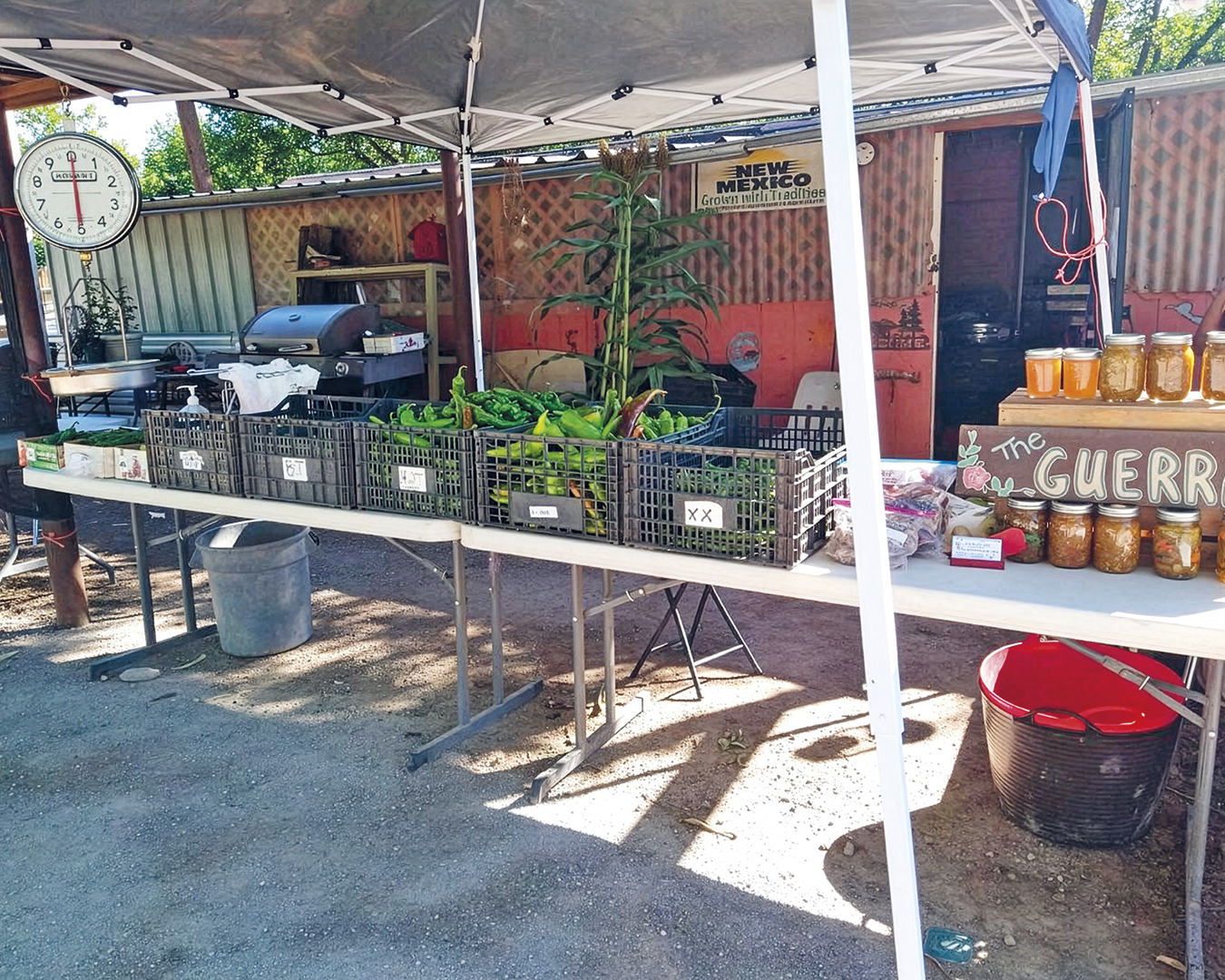
Road Runner Chile farm stand. Photo courtesy of Teresa Guerra.
I take highway NM 28, the back road to El Paso. The old road, that incomparable and remembered and loved road. El Camino Real de la Tierra Adentro, the 1,600-mile trade route from Mexico City to Ohkay Owingeh, formerly known as San Juan Pueblo. There was a curandera who once had her herb shop on the left. Also on the left was the house where my mother’s nemesis lived, she who had hopes to marry my father until my mother entered the picture and stole her man. Still farther south was Pájaro’s house, the beautiful hacienda revered by all who love Mexican architecture. Albino Alfonso Enríquez, known as Pájaro, was a young boy who was adopted by the local priest and then went on to become a farmer.
The drive from Las Cruces will take you through Stahmann Farms, one of the largest pecan orchards in the world. In the past, one could stop at their store and buy an orange soda and tins of chocolate-covered and chile pecans. Often, I would take my elderly father for rides. Always the adventure-seeking passenger, he preferred this route as an escape from the confines of his homebound life. He would eye the extensive rows of pecan trees and would exclaim with wonder, “Just look at that. They go all the way back.” Alas, the storefront closed years ago.
The ninety-year-old pecan trees are a wonder to pass through in any season. In the summer, their canopy brings the temperature in the groves down about twenty degrees. In the fall, the trees await the harvest, and in the winter, there is a great exhalation and rest in the forest where one anticipates the richness of pecans to come.
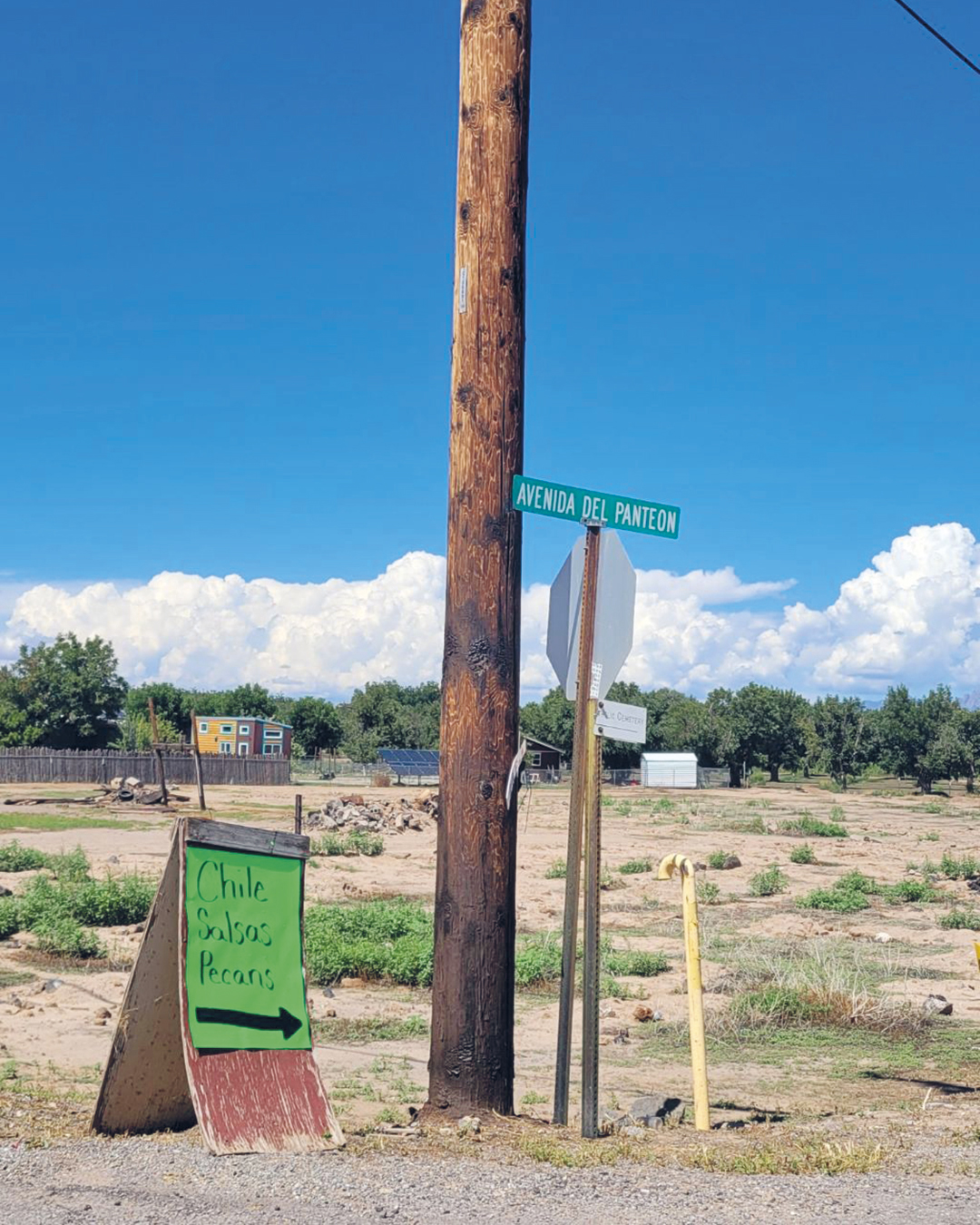
The turn to Road Runner farm. Photo by Denise Chávez.
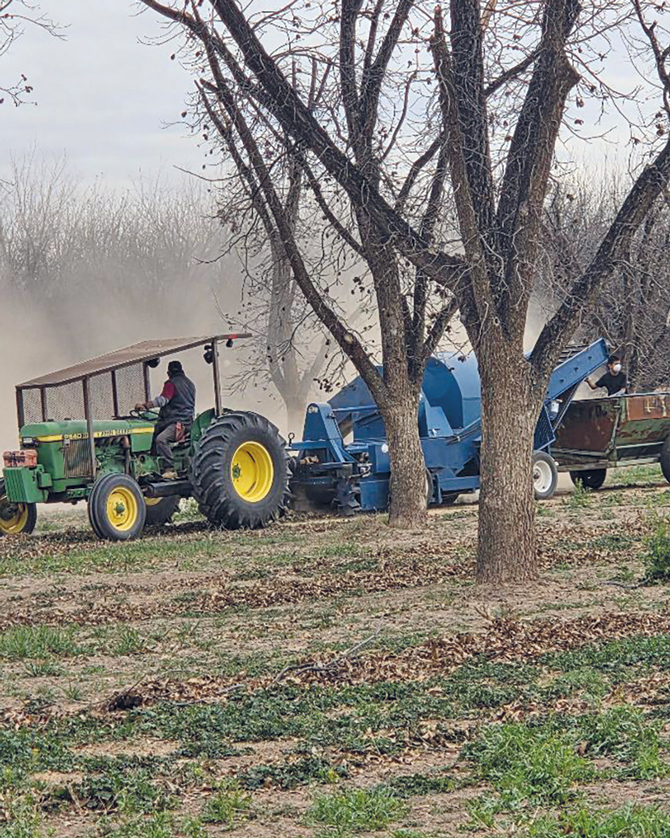
Harvesting pecans. Photo by Teresa Guerra.
I used to leave my classes at New Mexico State University and drive to Stahmann Farms to “study” with a boyfriend. We would park in one of those meandering irrigation paths that were not gated then. Do not take this as a recommendation. So loved is this orchard, these trees, that it is one of southern New Mexico’s unofficial wonders
of the world.
Avenida del Panteón. The sign is handwritten and that is good. Turn left and follow the dirt road until it bends, then take a right. You will see the sheds and houses of Road Runner Chile, the Guerra family compound, lovingly named by the family matriarch, María Elena Fielding Guerra, who loved correcaminos, the roadrunner, our official New Mexico state bird. Lorenzo Guerra and his sister Teresa “Tere” Guerra will greet you warmly. Siblings Manuel Jr., Martha, Hilario, and Maggie were a vital part of the family farm, and although some have moved on to other careers, farming is their legacy and you may find them helping. There is always family around, a niece studying at nearby New Mexico State University, or a compadre who is helping out with the roasting, and that is also good. This is a family business.
Some of the best chile I have ever eaten comes from this sacred earth.
“I love going out there and smelling el lodo,” Teresa tells me. “There is nothing like that smell when the deep earth is tilled and brought up. The dirt is fresh, like after a rain. It’s the scent of my childhood. The memories of my father.”
We are talking about the family farm that she and her brother Lorenzo own. She came into town from San Miguel, the farming community seventeen miles from Las Cruces on the Camino Real. It’s been hard to get together, the pecan harvest taking precedence, then equipment repair, followed by planting and then irrigation. Theirs is an ongoing sequence of work that defines farming life.
“We open the store in June and it runs until October. Our family helps. Our neighbors help. We are a collective. A cooperative. The work never stops. The land rests, we fix and clean equipment, we order seed, we prepare the land, and we plant.”
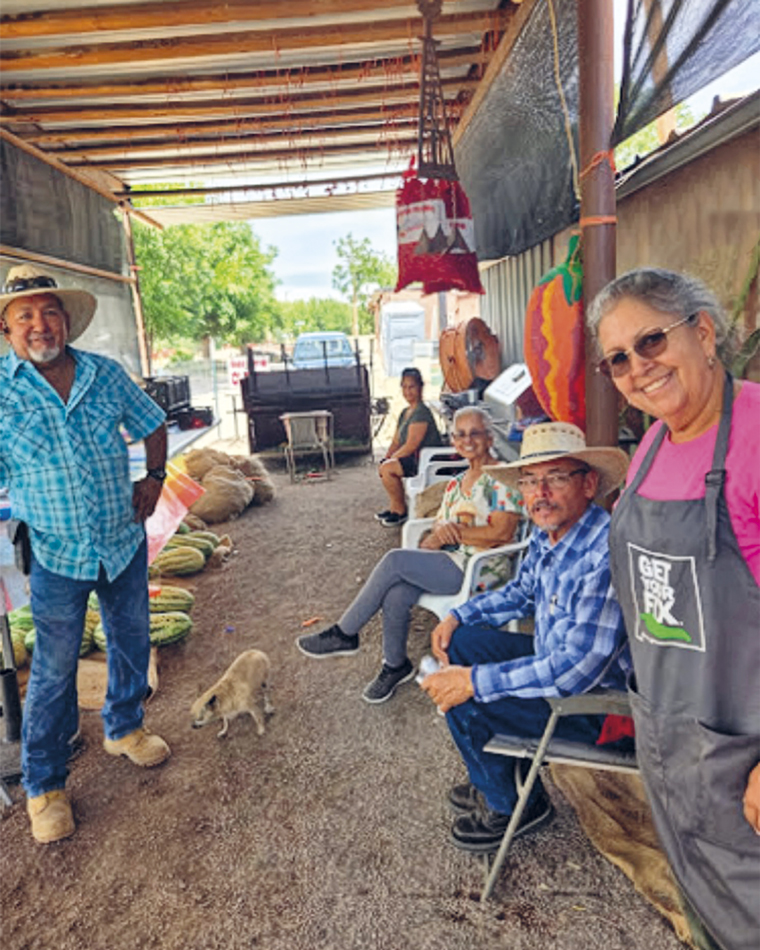
The Guerra family. Photo by Denise Chávez.
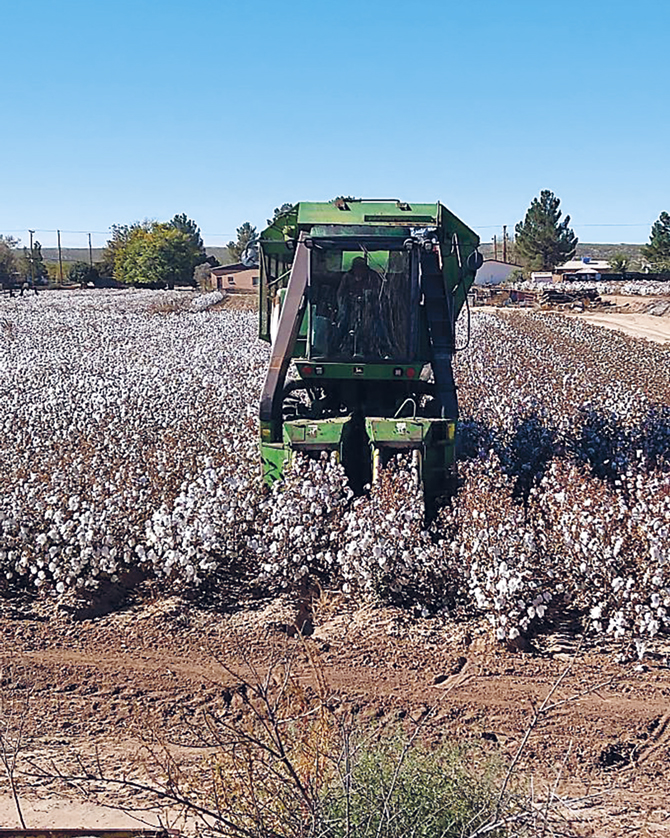
Harvesting cotton. Photo by Teresa Guerra.
In 2024, I missed getting chile for the season. I honestly don’t know what happened. I was finishing a novel, but that’s no excuse. It was the first year in many in which I missed out on ordering several costales of green chile—Sandía for salsa, and Big Jim for the chile rellenos. What happened to me? When I needed chile, I was forced to sheepishly and ashamedly enter Lowe’s Fiesta Foods and buy a plastic bag of prepared chile displayed in the warmer at the front of the store. The roasting was always uneven, and the pellejos/skins stubbornly clung to the half-cooked chile. They tasted all right, but it wasn’t the same as making that blessed journey to buy chile at Road Runner Chile.
To know where we come from is to know who we are.
Manuel Guerra, Teresa’s father, was born in Berino, New Mexico. His father, Albino Guerra, was born in Mesilla. María Elena Fielding, Teresa’s mother, was born in El Paso. Her mother, Juana Bonilla, grew up in the Segundo Barrio neighborhood of El Paso, and met her husband, Arkansas native James Fielding, in Fabens, Texas. James spoke no Spanish and Juana no English, but that didn’t stop them from falling in love and having five children.
At an early age, Manuel began to work on farms. He became a mayordomo in Clint, Fabens, and Ysleta, little towns in that far west stretch of Texas that is practically México, that is practically New Mexico. As mayordomo, he was in charge of managing farms and people, working as a leader, running the equipment, and in charge of all things related to the farm.
In 1961, Manuel was offered property to grow vegetables in San Miguel, New Mexico. His first year’s crop was so abundant that he gave much of it away. Neighbors and family filled the trunks of their cars. The next year the sales began. The richness of his land gave way to what is now Road Runner Chile. The neighbors, farmers as well, began an informal cooperative and now their products reach the community through a seasonal farm stand.
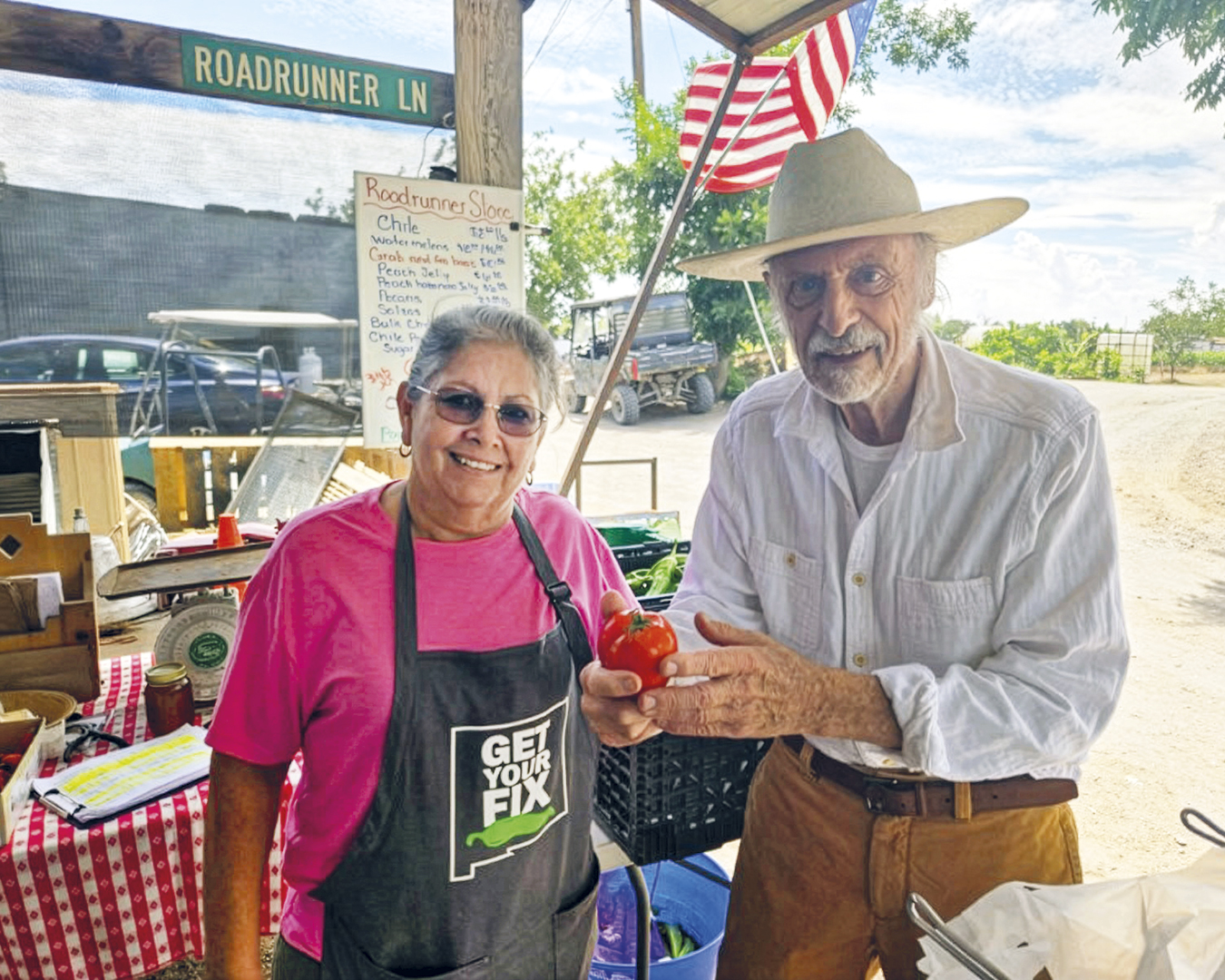
Teresa “Tere” Guerra and Denise Chávez’s husband, Daniel Zolinsky, at the Road Runner Chile farm stand. Photo by Denise Chávez.
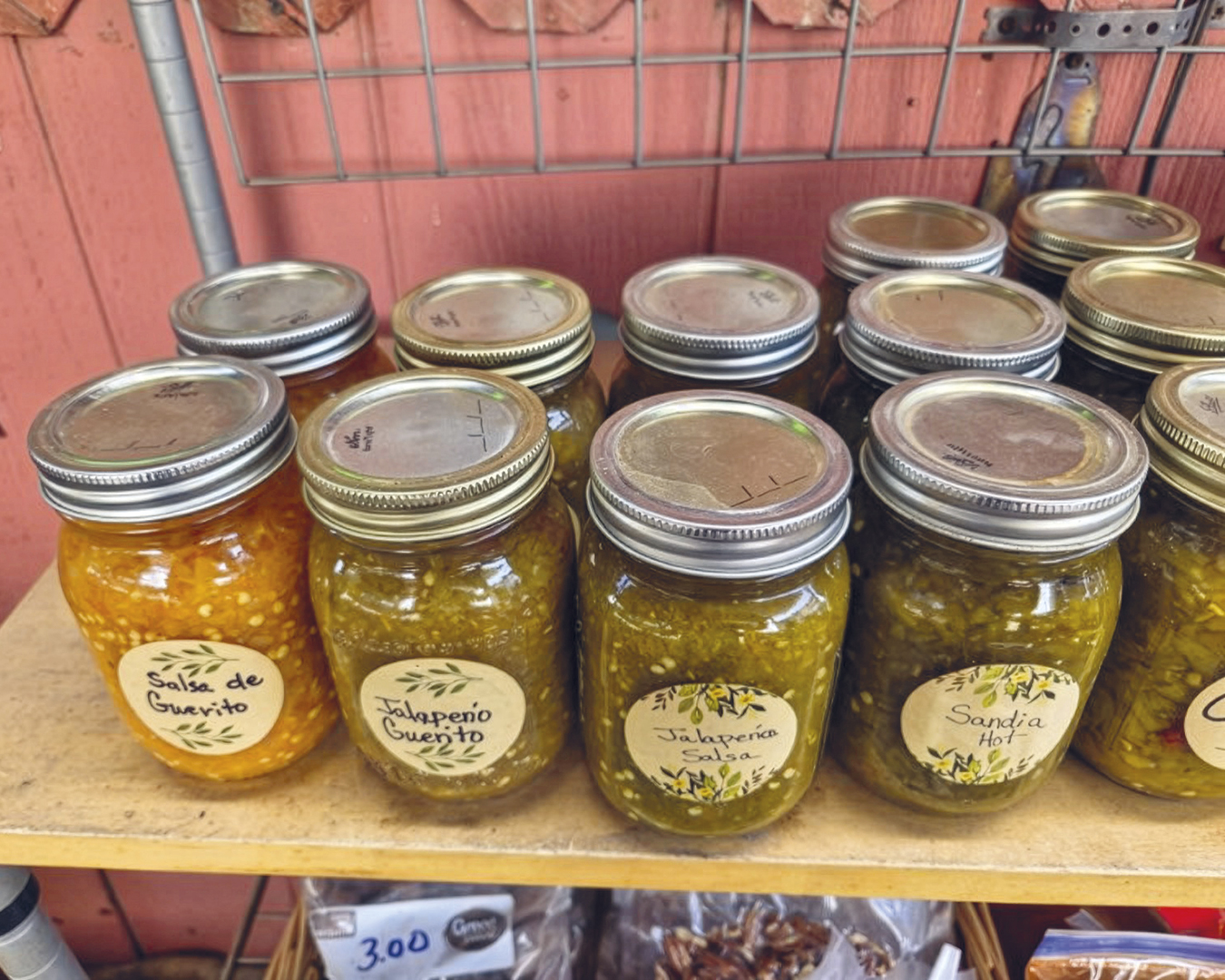
Variety of chiles for sale. Photo courtesy of Teresa Guerra.
Road Runner Chile crops include chile, watermelon, squash, white and red onions, sweet corn, cotton, and pecans. Teresa cans varieties of chile from mild to extra hot to extra-extra hot, ready for all taste levels, and also makes delicious jams, sold alongside the fresh produce.
As with many Borderland farm families, the history of the Guerra family is a rich blend of cultures, incorporating Indigenous roots with Mexican and Spanish ancestry as well as American Southern roots. The name Guerra has a history in Spain and Italy, and was associated with nobility. It connotes a warrior spirit and heritage. More than just a translation of the word “war,” it represents a legacy of strong people facing adversity and challenge. I learned from Teresa that the Guerras were prominent in the Mesilla Guard, a group of men who protected the town of Mesilla during the 1850s, when it was a small settlement amid shifting borders.
“You don’t often hear the Guerra name,” Teresa says.
She began research on her family when she was twenty years old. Her farmer’s blood runs through the generations, and farming is part and parcel of who the Guerras are. Their roots are deeply embedded in the Borderland. At times, they have experienced a seeming displacement, much like the Río Grande itself, changing routes, bypassing land, setting boundaries, creating new worlds.
“We are a back-and-forth people with solid roots,” Teresa says with conviction.
“When I do my research, I ask myself, ‘Who were our antepasados? What was their journey?’” she says. “The Guerras came from Spain, México, Texas, New Mexico. We’ve lived in Socorro, Tularosa, San Ysidro, Berino, Mesilla, San Miguel in New Mexico. Clint, Fabens, Ysleta in Texas. And we have traveled throughout the Southwest: Texas, New Mexico, Colorado, California. We come from Indigenous people, the Senecú, the Piro, the Isleta. Who knows what else? My dream is to write the history of the Guerra family. To honor my grandmother and two uncles in the San Miguel cemetery and my mother and her family in Berino as well as my family in the Mesilla cemetery.”
“The Guerras have always been farmers. Seven generations. Ay, you don’t make money with farming,” Teresa continues with a sigh. “But then again—it is a good life. There is the excitement of ‘tirando la linea—throwing the first row.’ I love that time. I’ll be in the field and Lorenzo will say, ‘Stand there. You are the post.’ And I will stand in the field as he centers the plow to where I am standing. He heads toward me and that is how we throw the first row.”
“The knowledge of those generations is transmitted to us, to Lorenzo and I, to our family. Lorenzo determines his planting season by how our fathers planted.” They work together with the cooperative to sell their crops at the farm store. Teresa outlines their season for me: “The first crop, zucchinis, come in June. Followed by the corn in July. The green chile is available mid-August. To get a full flavor of the chile, it’s best to wait until the first week of September, around Labor Day. Later on, the dried red chile is available the last part of November [into January]. Pecans are harvested in November. Unshelled pecans are available the last part of January or early February. We then take the pecans to be shelled. Shelled pecans are available in April or May. It’s a seasonal process.”
She speaks with great seriousness.
“You ask me, who works the land now? It’s hard to find workers. Many of them are young. Farming is slowly dying.”
Why?
“Farmers can’t afford leasing or selling.”
“Farm land is expensive.”
“There are water and worker problems.”
“And as we know, water is life.”
“How do I see our farm in the future?” Teresa is clear. “We will keep planting to feed ourselves, our neighbors. Others. We will keep going until we can’t anymore.”
“El sueño. My dream is to tell the story of the Guerras.”
This, then, is the beginning of the story of Los Guerras. Guerrilleros en muchos sentidos / in many positive ways: a family of dedicated farmers, warriors of the land, who continue to maintain and work and, yes, fight for their world, their family farm. Theirs is a legacy of care, persistence, hard work, hope, and love.
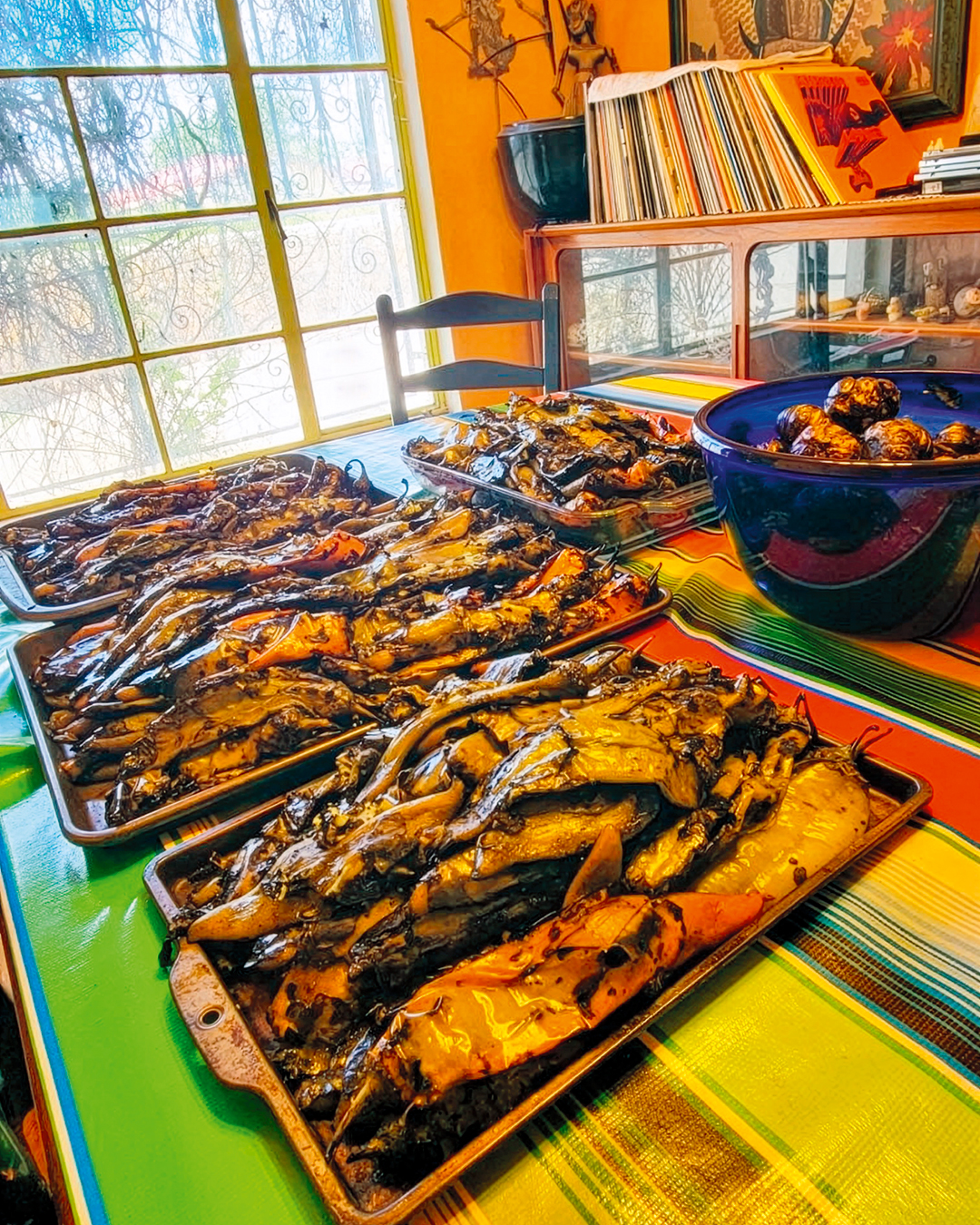
Roasted chile and ajo/garlic. Photo by Denise Chávez.
Driving home those seventeen miles from San Miguel to Las Cruces, the familiar and loved smell of the freshly roasted chile with the addition of ajo/garlic permeates the car. Since I learned that ajo could be added in at a chile-roasting event that took place on a high school football field in Pueblo, Colorado, years ago, I have added it to my yearly roasting. The principal of a school I was visiting asked me the salient question, “Con ajo or sin ajo?” Once roasted, I later separate the chile and ajo and place them in separate bags to freeze. The roasted ajo is delicious with any meal.
Returning home, my carga/charge is to unload two costales of chile, one at a time, spread them out on the dining room table, let them cool down, put them in freezer bags, and wait for them to rest, as placing them in a freezer hot will mess with the temperature controls. I once killed a refrigerator this way and had to buy a new one. Also, one has to be careful with the chile in the trunk of the car, as it may cause a loud and persistent bleeping that denotes an overheated trunk. Only in New Mexico.
The thing is to have patience. Do things carefully, making sure you have enough freezer bags, the right space to store the chile, that you don’t overpack the bags, and that you have the time to do the work with attention and care and, if possible, someone to help you.
The other big question in New Mexico is not red or green, but peeling or not peeling the chile. I do not peel my chile, as I believe the pellejo/skin preserves the flavor. Peelers and non-peelers are staunch adherents to their way of processing the chile. Just as some feel comfortable with blending the pellejo. These questions are so subjective that they are best left to each chile lover to discern their process.
Each of us has our rituals, our way of holding our knowledge and appreciating who we are and where we live. Every year, I remember how sacred this season is in southern New Mexico, my home and heartland. Those of us who have experienced a life with chile are blessed. Each chile season has great significance for me; the Guerra family have become dear friends.
As travelers on the great road, El Camino Real de La Tierra Adentro, we remember that our antepasados / the ancestors are never very far behind or ahead of us, but continue to nourish us with their spirit.

Denise Chávez
Denise Chávezis a writer and owner of Casa Camino Real bookstore in Las Cruces. She is the author of The King and Queen of Comezón; A Taco Testimony: Meditations on Family, Food and Culture; Loving Pedro Infante; Face of an Angel; and The Last of the Menu Girls, among other works. Chávez is the winner of the American Book Award and the New Mexico Governor’s Award in Literature. Her long-term project, Museo de La Gente / Museum of the People, is the formation of a community resource center, library, bookstore, and living archive of the Borderland region based in her hometown. After all the hullabaloo, she has decided to write a book called Biscochos/Biscochitos: The Cookie.