
A Cultural History of an Archetypal Fruit
By RoseMary Diaz

Envy, Fuji, Gala, Granny Smith, and Red Delicious apples, photo by RoseMary Diaz.
From vitamin-rich lunch-box staple to simple, saucy dinner accompaniment or from homey tarts and empanadas to elegant pommes bonne femme, the apple is one of our most loved and versatile culinary go-tos. With more than two hundred varieties of the fruit grown in the United States today—Roxbury Russet is the oldest—the apple is as quintessentially American as, what else, apple pie.
Save for a few species of crab apple that are native to North America, the modern apple originated much farther from home, when its first seeds took root in the rich earth of the Tien Shan mountains of Kazakhstan, east of the Caspian Sea. Not so incidentally, Almaty, the largest city in Kazakhstan, derives its name from the Kazakh word almatau, meaning “apple mountain,” and while under Russian rule was known as Alma Ata, which translates to “father of apples.” Later, apples were cultivated by the Etruscans, then by the ancient Greeks and Romans, whose aqueduct systems ensured plentiful harvests of the Firiki and Decio varieties. By 1500 BCE, varieties of the fruit were grown in Armenia, Anatolia, Georgia, Persia, and Assyria, where a clay tablet records the sale of an apple orchard. By way of the Silk Road, the fruit found its way into Europe, blossoming into numerous, still-grown varieties like Boskoop, Braeburn, Cox’s Orange, Kamzi, and Morgenduft. Megafauna also helped to disperse the apple’s seeds, as did some migrating birds who assured the fruit’s intercontinental success.
Like the ancient Greek and Roman orchards, whose fruiting depended on man-made aqueducts, many of the apple harvests in northern New Mexico have long been beholden to diligent water management practices, specifically those dictated by our centuries-old network of acequias. Historical records note that Santa Fe’s Acequia Madre was in use at the time of the Pueblo Revolt of 1680 and was likely built following the Spanish settlement of the city in 1610. A 1926 survey by the Manzano Forest Reserve identified a tree that is believed to have been planted prior to 1676, which makes New Mexico home to the oldest apple orchard in the United States. Apple production in the state peaked in the 1960s, in the heydey of the Red Delicious. This century, local orchardists and hobbyists grow heritage varieties such as Arkansas Black, McIntosh, Jonathan, and Brown Snout as well as modern cultivars like Ginger Gold, Gala, and Evercrisp.
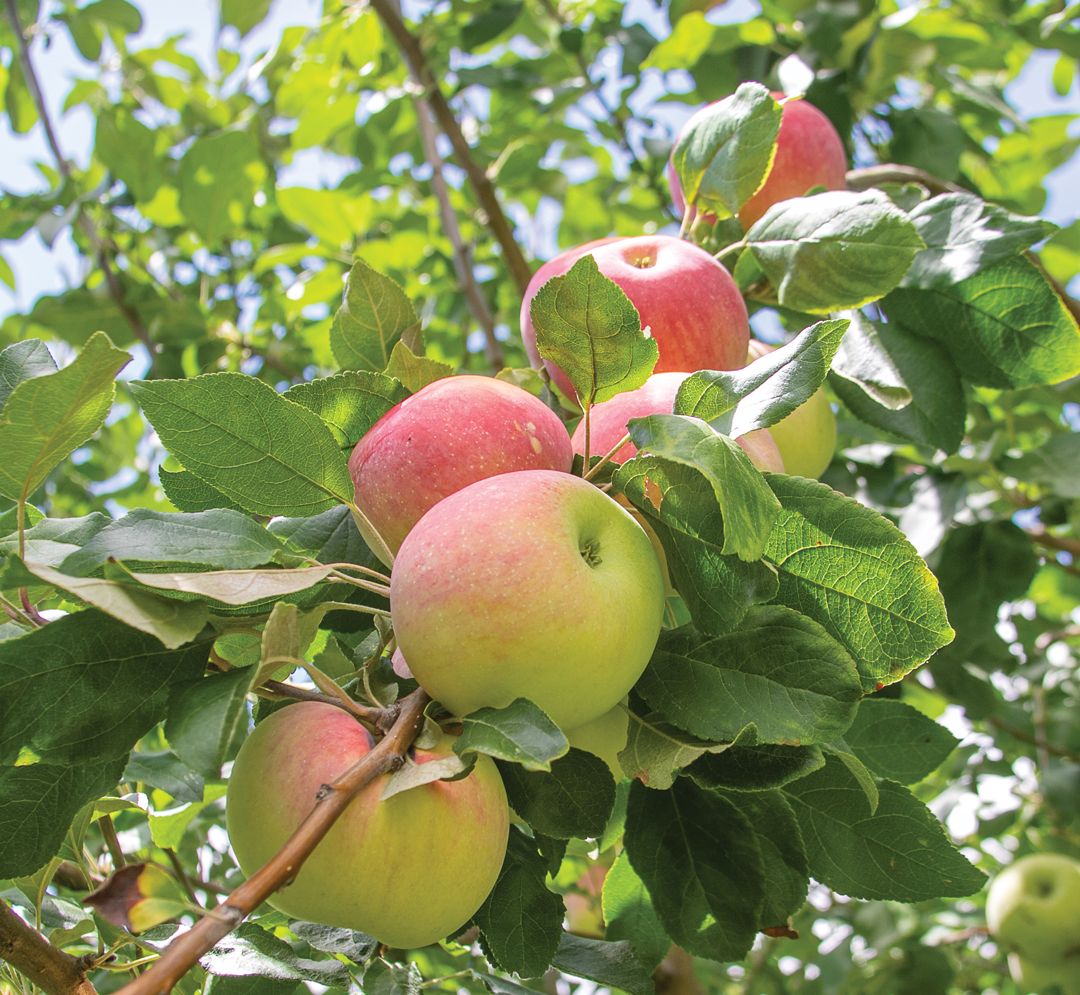
Apples growing at Montoya Orchard in Velarde, photo by Stephanie Cameron.
Of more than seventeen thousand apple varieties once cultivated in North America, only about 25 percent remain, and as of May 2021, the Lost Apple Project (yes, there is such a thing) listed twenty-nine varieties that are now extinct. But with an estimated thirty thousand unique varieties worldwide, all descended from the wild Malus sieversii of Central Asia, production remains undaunted, and the apple is perhaps the most universal of fruits. In 2024, global production is expected to exceed eighty million metric tons, with China, the United States, and Italy being the leading exporters. From Japan’s northern Aomori prefecture comes the world’s rarest and most expensive apple—the thin-skinned, mild-flavored Sekai Ichi, or “world’s number one,” a hybrid of Red Delicious and Golden Delicious that can retail for more than twenty dollars per fruit.
Given the apple’s far-flung origins, why is it so enshrined in our history? From its dubious role in the Garden of Eden to its legendary status as the crucial prop in Sir Isaac Newton’s discovery of gravity, tales of the apple tend toward the allegorical. Consider the familiar image of Johnny Appleseed spreading infinite pockets of apple seeds across the Midwest. The Massachusetts-born orchardist and conservationist did indeed sow thousands of seeds, but most of the resulting apples, like those planted by homesteaders in New Mexico, were likely pressed into cider. “One bad apple spoils the whole barrel,” “You are the apple of my eye,” “An apple a day keeps the doctor away”—more than any other, the fruit is embedded in our social lexicon.
The answer may lie partly in the apple’s impressive nutrient profile (the skin of Red Delicious contains the highest concentration of vitamin C, polyphenolic compounds, and anthocyanidins among all apple varieties), partly in the multitude of delectable possibilities it brings to the recipe book, and partly in its storied past, wherein its perseverance and proliferation through the ages have endowed it with spiritual qualities. For many, the hardiness of the fruit and its durability represent strength, growth, and the hope for prosperity. At Rosh Hashanah, the Jewish New Year, apples dipped in honey are eaten in hopes of a sweet year to come. The Osage have a ritual of filling a loved one’s casket with enough food to last the three days it takes to reach the afterlife, with apples being among the journey’s provisions. Throughout history, they have also signified beauty, luxury, pleasure, fertility, and love, as epitomized in the wedding gift of golden apples given to Hera in the Garden of Hesperides before her marriage to Zeus.
Whatever the reason, the apple will undoubtedly remain one of our most endeared fruits—at once offering flavors familiar and comforting, rare and unusual, and keeping us looking forward to new and interesting varieties to come.

Apples Bonne Femme
Serves 6
First appearing in Auguste Escoffier’s Le Guide Culinaire, pommes bonne femme showcases the apple with the simplest of French methods. This version is adapted from Jacques Pépin’s recipe in Essential Pépin. The baguette adds another layer of deliciousness as the bread soaks up the juices of the apples while cooking; omit, if preferred. Choose apples that can hold up during baking; dense, thicker-skinned varieties such as Gala, Fuji, Red Delicious, and Golden Delicious work well.

Apples Bonne Femme
Ingredients
- 6 large apples (2 pounds)
- 1/2 cup apricot jam or preserves
- 1/2 cup light maple syrup
- 6 teaspoons unsalted butter
- 6 teaspoons light brown sugar
- 6 tablespoons chopped nuts (optional)
- 6 1- inch-thick slices dry (day-old) baguette
- Cinnamon or nutmeg
- Mint, for garnish
Instructions
- Preheat oven to 375°F. Rinse and dry apples.
- Core apples, taking care to remove all pith and seeds. Cut about 1/4 inch off the bottom of each apple so it can stand upright on the baguette slice while cooking.
- Score apples about one-third of the way down, cutting through skin (no more than 1/4 inch deep) and drawing the incision all the way around. As the apples cook, the flesh will expand and the part above this cut will rise, almost like the cap of a mushroom.
- Arrange baguette slices in a gratin dish or baking dish that can second as a tabletop serving dish. Place an apple on top of each baguette slice.
- Place one teaspoon butter and one teaspoon brown sugar in the cored hole of each apple. Mix together apricot jam and maple syrup and pour into cored hole, allowing mixture to spill over and coat the apples. Sprinkle one tablespoon chopped nuts and a pinch of cinnamon or freshly grated nutmeg over each apple.
- Bake for 30 minutes.
- Baste apples and cook for another 30 minutes.
- Spoon some of the juice from the baking dish over the apples and let cool to lukewarm before serving. Garnish with a sprig of mint.
- Serve as is, or celebrate your apple creation by adding whipped cream, crème fraîche, or ice cream.

RoseMary Diaz
RoseMary Diazis a freelance writer based in Santa Fe. She studied literature and its respective arts at the Institute of American Indian Arts, Naropa University, and the University of California, Santa Cruz.