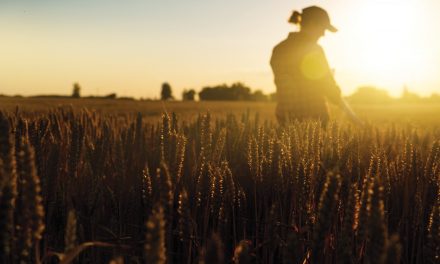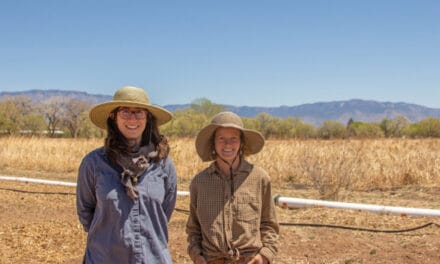

At dawn I look out past the cottonwood canopy at the silhouette of the Sandias. Venus shines in the violet blue. Along the ditch, dandelions and mustards stand tall in the morning crispness. I can feel the humidity of the water rushing below me as I stand at the checkgate of the acequia and slowly lower the wood gate to the bottom of the ditch. As the water rises and begins to make its way into the garden that I farm with my neighbor Drew Seavey, I grab the wooden trays of tomato, chile, and eggplant starts that we’ll plant just before the water reaches the row.
Drew and I grow garden vegetables on a quarter acre in Albuquerque, and this year, we decided to remove the drip tape fed from a well and instead try to grow all of this food with only acequia water. In an era of diminishing snowpack and perpetual summer water cuts to irrigation schedules, such a decision may seem confounding. But it stemmed from our reflection on plastic use in agriculture and a curiosity into whether growing a variety of garden produce with no plastic inputs, which was common just a few generations ago, was even possible at this point. It also stemmed from a recognition that acequia water recharges groundwater and community alike, and that, as precipitation becomes more precarious and as market growers increasingly opt for drip tape and wells, the art of growing a diverse garden from acequia water is well worth preserving.
As we shuffle on our knees down the row planting tomatoes, the water slowly but steadily follows us. I watch it with grateful anticipation and a subtle sense of amazement, a feeling of watching life itself make its way into the garden. For the past few years, the ditch has gone completely dry by late summer. We have gone without water for more than three weeks at a time, the type of dry spell that won’t threaten the long-term health of alfalfa or an orchard but can prove fatal for annual vegetables. Anticipating similar drought stress this year, we transplant the tomatoes beneath paper mulch, covered with burlap to keep the paper in place, to help retain soil moisture. We’ve hung a burlap shade (and wind) screen along the south side of the bed, which will also serve as trellis support. But even with these added shading and mulching measures, the staggering heat of last July is still vivid in my memory, and the question of how these plants will fare creeps into my thoughts as steadily as the floodwater creeping down the row.



After years of market farming, the idea of a plastic-free garden was a new challenge. As any gardener or farmer would know, plastic is ubiquitous in our food system—from the seedling trays to irrigation tubing, from greenhouse and high-tunnel coverings to mulches, from tools to storage materials—and to cut it out of even a portion of the garden is a daunting venture. But the more I considered it, the more it felt worthwhile. The world uses over twelve million tons of plastic annually in food production alone, and only a tiny fraction of it is recycled. A significant amount ends up in the soil as microplastic pollution, which accumulates in soils to the detriment of soil health and, possibly over time, human health. With my garden, one of my abiding goals has been to deepen my connection to the land, and to create a problem for the very land I’m trying to reconnect with felt counterproductive.
The challenge of growing food without plastic has only strengthened my appreciation of acequias, which I’ve been fortunate to be able to use to grow food both in Albuquerque and in rural northern New Mexico. My appreciation has usually focused on their history and cultural significance, the beauty of their tree-lined and nonlinear corridors, their ecological value, and the way they compel communities to engage with each other in basic and meaningful ways. On a personal level, I have developed a love for watching water attentively, shovel in hand, soaking in the sound of water moving over parched earth. I have become enamored with seeing the moon reflected between the rows and feeling the humidity of the flooded field on my skin at night, and have learned to eagerly anticipate the dragonflies and ducks and egrets that flock to the inundation. I have even grown to appreciate that the irrigation schedule forces me to wake up before dawn on a summer’s Saturday morning. I have ruminated on the elegance of using only gravity to power irrigation and have found a meditative quality to watching water fall ever so slightly, ever so slowly, from mountain toward sea through the rows of my high-desert field.
But for all my contemplation on the beauty of acequias, I hadn’t much considered their potential as an alternative to plastic-based agriculture before this season. Most growers in the country would not have the option, but we are fortunate to live in a land shaped by the serpentine hand-dug ditches that provided the lifeblood to communities long before plastic was conceived. While the trend in small-scale organic agriculture, here in New Mexico as well as throughout the country, is to save labor costs with plastic mulch, extend growing seasons with high tunnels, and combat climatic uncertainty by installing reliable irrigation systems involving drip tape, this ancient infrastructure offers a way to reimagine a food-centered future independent of fossil fuels, chemical companies, and landfills.
To more vividly imagine, and begin to create, this future for myself, my mind turned to those with far more experience growing crops with only acequias. My thoughts turned southward, to the sprawling chile fields of Socorro.

Mixed crops in Cecilia Rosacker’s field in early June, photo by Willy Carleton.
The tree-lined fields of Socorro in June have a quiet, dreamlike quality in the late afternoon as cottonwood seeds drift in the soft, warm breeze. I’m in one such field looking out at long rows of tiny plants straddled by cracked-earth aisles. I recognize corn and beans, cucumbers and okra, peppers and onions, all interspersed with buckwheat. None of these plants have been irrigated in nearly three weeks, yet they look happy. There is an art to growing a variety of mixed vegetables with only limited acequia water, and I’ve traveled south to Socorro, or more precisely Polvadera, to glimpse that art form in action and learn how seasoned growers have been able to produce thriving crops with summer water that only comes once every three weeks.
“I grow everything,” Cecilia Rosacker explains as we walk through the rows of her one-acre market garden. “Bell peppers, eggplant, chile, beans, cucumbers, corn, turnips, beets, chard, flowers, statice, dahlias, greens, sesame, okra. You name it, I’ve grown everything.” She explains that she irrigates the field once in the spring, then harrows the field before direct seeding each crop. Planting deep enough for the seeds to retain moisture is important, and for some seed, such as chile, she may come through with a harrow to scrape the top of the beds and remove a top layer of soil just in time for the sprouts to emerge. Once the seeds emerge, she uses a cultivating tractor to form beds around the rows, and as the season progresses, these beds get slightly higher and narrower as she cultivates closer to the plants. For newly planted seed, she waters once every two weeks for one cycle, and after that waters just once every three weeks.
Cecilia grew up with a large acequia-fed garden in her hometown of La Puebla, near Chimayó, so her education in the art of growing food with acequias started early. “When I was growing up, this [is] what everybody did. They had fields like this,” she says with a sweeping motion toward one of her cover-cropped fields, “and they irrigated off the Santa Cruz acequia, and this [is] how our parents fed us. We hand dug the ditches, from the acequia to the lower field. We didn’t use tractors.”
When it comes to growing vegetables, and especially chile, for market, Cecilia has also learned from local growers in Socorro. The late Albert Bustamante, in particular, taught her many of the techniques she still uses. “A lot of things I learned, I learned from Albert Bustamante. Plus, what we did up north growing up was only on five acres; now I have thirty.” She describes chile growers going out in April, after seeding in March, and walking the fields and sticking their fingers in the soil to see if the seeds have sprouted. Once they feel the sprouts, they come back in a week “and knock the tops of the beds off with a harrow.” There is an “art of planting deep and coming back and knocking the [soil] down,” she explains.
As our conversation continues, I reflect on the trend that, as more and more farmers and gardeners switch to wells and drip tape, the number of growers able to pass on this art form decreases. Newer growers might be incredulous that anyone could grow a chile that way at all. Cecilia nods. “A lot of people aren’t from here who are farming [and selling] at the markets. . . . They just don’t know, and they haven’t seen it. . . . And if you’ve never seen it, you’d probably be like ‘I don’t even know how you’d do it.’” To grow food well with only the acequia, you need to be able to ask old-timers how they’ve done it, she explains, and “you need to be organized and then that’s where you become part of this community, because ‘I need the water but you need it tomorrow’ . . . and we have to figure that out and we work with the mayordomo to figure that out.”
With acequia systems feeling the crunch from drought, such community organization will become both more vital and more challenging. Growing a garden even with abundant ditch water can be difficult, but the added stress of long-term drought and its strain on water delivery from acequias only makes the task tougher.

Corn, squash, and beans planted by Drew Seavey and Willy Carleton, photo by Drew Seavey.
As I write this in mid-July, it’s been nearly three weeks since Drew and I were last able to irrigate our crops. We are experiencing near-record high temperatures, and for over a week the acequia has been almost completely dry, save for the puddles where I watch crayfish scamper about in the mud. The squash plants have begun to vine out and their large yellow-orange blossoms beckon to me in the morning as I pull weeds from the dry soil around them. But by afternoon, the squash plants’ flowers are curled and their large green leaves grow wan and limp as they try to conserve water through the scorching heat. I watch their stress like a powerless parent, fighting an urge to individually haul water to each one of them. But there are far too many plants to water that way, and my goal is to learn how to keep the garden thriving even with limited acequia water. For the time being, I find solace in knowing that growers south of here have long managed with only one irrigation every three weeks. So I place pulled weeds at their base as mulch and continue down the row.
The latest news from the ditch rider is not so great: a late-June storm caused flood damage south of Abiquiu Dam, in turn causing a reduction of water flow from the dam that may take a month to resolve. So each morning, I peer to the western horizon for clouds and any potential signs of afternoon monsoons. I wonder when the water submerging those crayfish can once again be measured in feet and not inches.
Yesterday afternoon, Drew and I sat beneath the shade of an elm and surveyed our wilting crops. We exchanged our concerns but also an amazement at the strength of the plants to have already survived so much heat and water stress. I asked him what he’s hoping to get out of this garden, regardless of when our next opportunity to water comes. “For me, this garden was about wanting to continue these seeds and really be a link in the chain for that plant. Especially the corn. It feels really special to be included in this thousands-of-years-old tradition,” he told me, looking out over the field of corn with leaves curled in the heat. “Part of what I put out to the universe for this garden is connection, wanting to learn, wanting to find a way to live on Turtle Island in a sustainable way.” I nodded, grateful for his perspective. He added a bit later, “Whichever plants decide to give us the gift of seed this year, they’ll be going in the resilience hall of fame. It’s a good fitness test for a drier and drier outlook.”
This morning, dew once again moistens my boots as I walk the field. The corn leaves have uncurled overnight and the squash leaves have broadened, albeit temporarily given the hundred-degree forecast for today. I shift my focus to a hummingbird hovering momentarily amid the corn and listen to the chatter of morning birds and the rustle of cottonwood leaves in the wind. A bee disappears down a squash blossom. A delicate abundance surrounds me.

Willy Carleton is a historian, writer, and educator, helping aspiring gardeners and farmers hone their skills and deepen their connection to the land through the School of the Desert Garden. He is a former editor of edible New Mexico and is the author of "Fruit, Fiber, and Fire: A History of Modern Agriculture in New Mexico." You can follow his current ruminations on growing food in the drylands at desertgarden.substack.com.