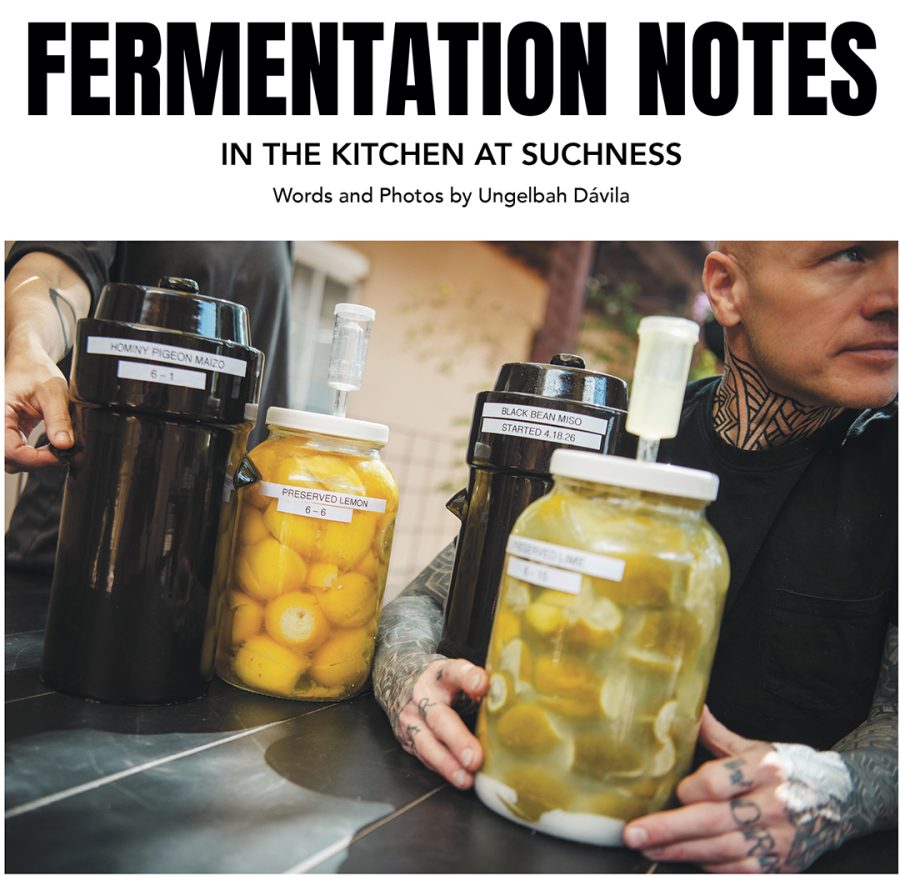
Kevin Sousa with his ferments at Suchness in Taos.
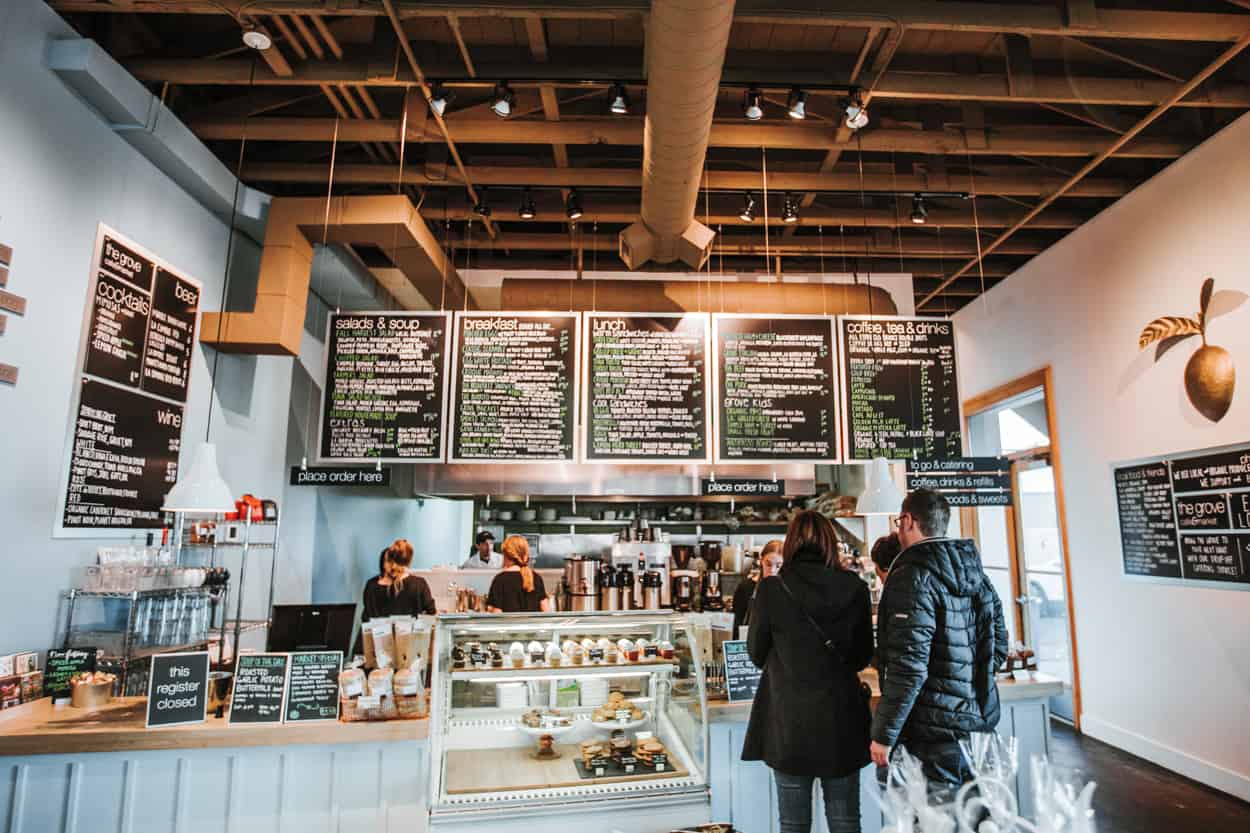
Housed in an adobe corner building on Camino de la Placita, just off the historic Taos Plaza, Suchness is recognizable by its round hot-pink sign. It stands out like a pop art traffic signal, telling visitors to slow down, take a seat, and experience an innovative yet intimate meal.
That call to pump the brakes is a guiding principle for husband-and-wife team Kevin and Meg Sousa, who opened the thirty-two-seat restaurant in 2024. The open layout, the tiny team of four, and even the shelves of fermenting ingredients can make a meal here worthy of suspending time. In just a few years of making Taos their home and gaining access to new food traditions and ingredients, such as the masa harina, posole, and Chimayó chile in their atole de grano, the Sousas have created a dining room that is special without, Kevin says, being “a special occasion restaurant.”
The close connection Kevin has to his menu is mirrored in the cozy atmosphere of a one-room space that subtracts the distance between the guests and the chef. “I would say it’s an open kitchen, even a little further than open,” Kevin tells me. “We like it to feel kind of homey, but at the same time serious. We really focus on the experience and making sure people feel taken care of, and the service is personal, but casual.”
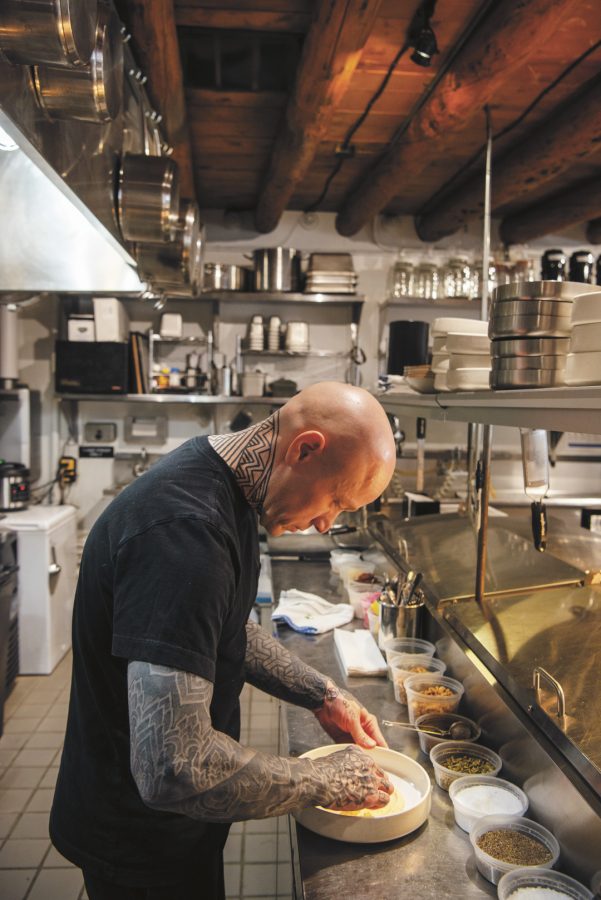
It’s a kitchen where fermentation is not so much a side project as a foundation for flavor. The chef’s fermentation practice dates to the early years of his culinary career, more than a decade and thousands of miles away in Pittsburgh. Of numerous Pennsylvania ventures, his most ambitious was Superior Motors, a restaurant built inside a former automobile dealership in Braddock—“a beautiful, brutal concrete space across from the last functioning steel mill in Pittsburgh,” Kevin recalls. More than half of the restaurant’s thirty-eight employees were people who lived in Braddock, he says, including at-risk youth and previously incarcerated people hired through the restaurant’s job training program. “We had an urban farm . . . we had a fermentation program and a foraging-and-fermentation person who also did foraging with us.”
The resulting abundance of produce naturally led to preservation. “With the farm and the foraging, you find yourself seasonally dependent on these big flushes of stuff,” he explains. “You want to support the farm. You want to take everything that’s available, and then you want to make sure you don’t throw anything away. So there’s a preservation aspect to it—a lot of pickling, a lot of fermenting, a lot of dehydrating.”
Like many restaurants, Superior Motors struggled during the Covid-19 pandemic. In 2020, Kevin sold his share; the restaurant never reopened (the remodeled space now houses Braddock Public House). A couple of years later, he and Meg decided to begin a new chapter. “We made the decision to leave Pittsburgh and kind of explore the country,” Kevin says. That journey eventually led to Taos.
“I remembered, as a young person, backpacking out here and hitchhiking and loving northern New Mexico,” he says. “We came and visited, and the pieces fell into place.” After working a season at the Stakeout in Taos, the couple found the space that would become Suchness.
There’s a trendy factor to fermented foods in restaurants, but Kevin points out that fermentation has been used in cooking for thousands of years and is used to make foods people consume every day. “I’m not the fermentation guy or the pickle guy,” he says. “It’s just a building block. It always has been in the food that I do.” He credits several authors with helping shape his understanding of the fermentation practice, including Sandor Ellix Katz, whose The Art of Fermentation he calls a bible for chefs. Another is his friend Jeremy Umansky, a chef and coauthor of Koji Alchemy: Rediscovering the Magic of Mold-Based Fermentation.
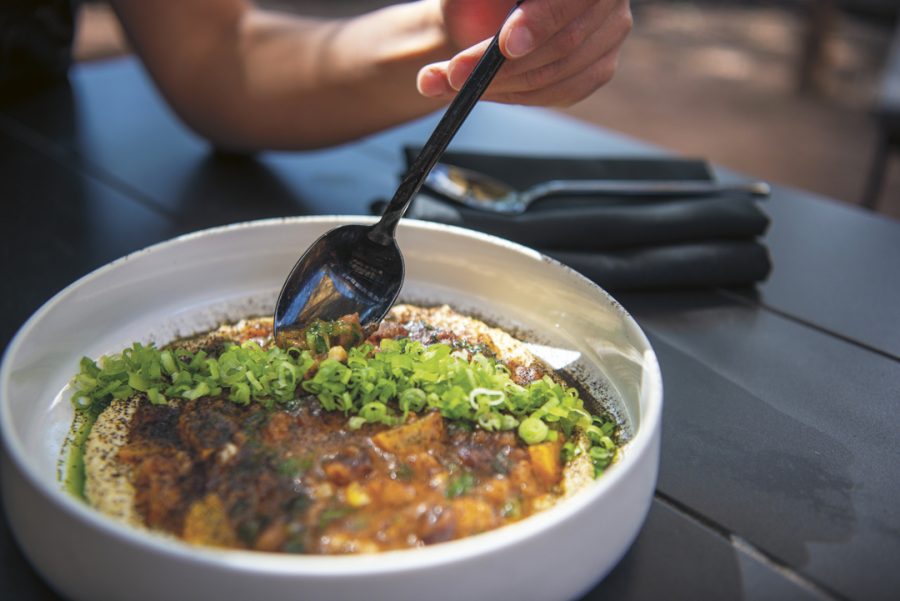
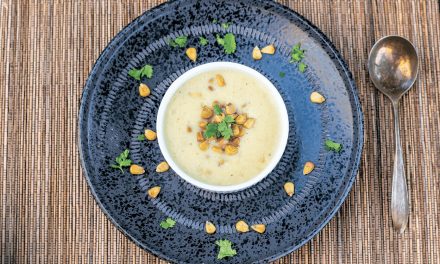
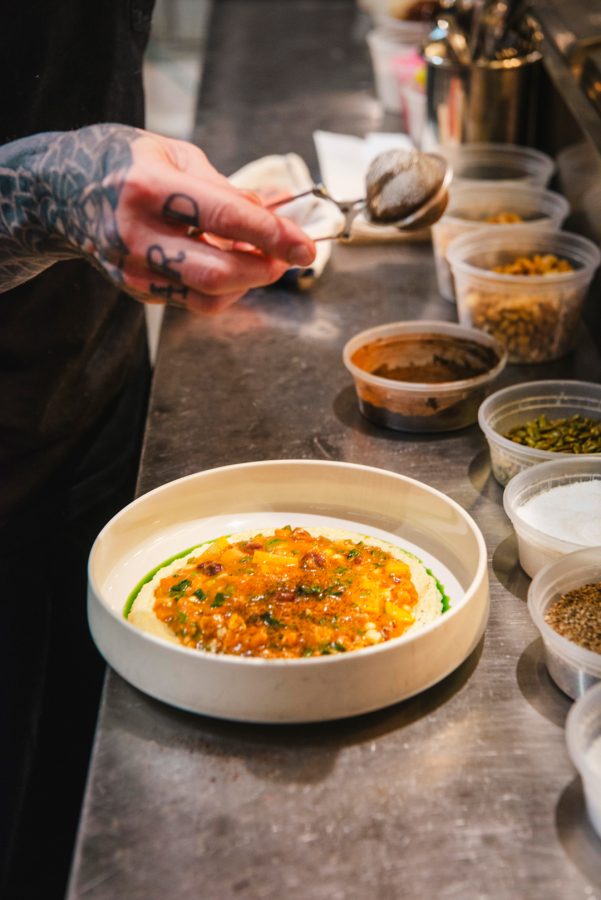
Atole de grano, made with masa harina, posole, dehydrated sweet corn, Chimayó chile, poblano, pattypan squash, preserved lime, green onions, and cilantro.
Mold may sound unappetizing, but when Kevin sets an unassuming container of koji spores on the table, they look as innocent as sugar or salt. As powerful as either of those base ingredients, koji spores produce an edible mold that has been used in Japanese cooking for centuries. “I wasn’t really down with koji until I did an event in 2013,” Kevin recalls. “Jeremy was there, and he got me hip to it. Then it just made a lot of sense.”
Koji works by producing enzymes that assist fermentation; without it, says Kevin, many staple ingredients wouldn’t exist, including soy sauce. He sources black beans from Old Gem Farm to make a miso paste with black beans and koji. He also makes a hominy-and-pigeon-pea miso. But it’s not just for fermenting beans: Kevin uses koji with beef and meats as well. “I use spores to inoculate cooked rice, then a period of growth leads to koji rice,” he says, which he then uses to make miso and to create shio koji, “an ingredient that I use to treat meats prior to cooking.” The multistep process encourages beneficial bacteria while suppressing harmful microbes, and he uses shio koji to age meats overnight before cooking them sous vide. “I’m a one-man show here,” he says. “A lot of this is front-loading some of the labor so I can produce a really consistent, delicious product by myself.”
Kevin also works with lacto-fermentation to make the most of seasonal ingredients from local farms like Umami Gardens and Rio Lucero Farms. “If I get an abundance of something from a local farm, or they say, ‘Hey, I’m going to have a ton of this,’ I’ll say, ‘Bring it, and I’ll deal with it.’” Those ingredients might become kimchi, sauerkraut, or fermented corn, which is the star of the plate when you order the atole de grano. After the fresh sweet corn is fermented, Kevin dehydrates it to create an umami-forward flavor he describes as “subtle sourness.” He finishes his atole with another of his creations: ground black lime. “You take limes, salt them, and then you put them in the dehydrator,” he says. “It’s one of the most amazing smells that you get.”
In the various jars and containers stored around the small kitchen at Suchness, you will also find preserved lemons and limes. “A lot of people will just use the rind,” says Kevin. “I take the whole lemon, the whole lime—seeds and all—puree it in a blender, and then I use it as a flavor builder.” The preserved citrus transforms dramatically during fermentation, and just a dollop can transform a dish. “The lime almost picks up like a coconut scent,” he says. “The lemon almost takes on like a lemongrass flavor.”
Rather than highlighting fermentation on the menu, Kevin prefers to let diners discover those flavors naturally. “If you read our menu, I don’t list every ingredient,” he says. “I want people to feel maybe not perplexed, but excited. Like, ‘Oh, my god, what is that?’” Many menu items contain fermented elements that guests may never realize are there. Dishes on the menu during my visit included fermented plum sauces, kimchi, fermented red pepper sauces, pickled ramps, vegan ricotta, and meats treated with shio koji.
Meg says one of her favorite aspects of Kevin’s cooking is the way he explores a single ingredient in multiple forms. “The thing I love about his food is that it’ll have lime, but it’ll be black lime and lime sauce and lime four different ways,” she says. “The atole de grano dish is corn four different ways. You could have one ingredient done a bunch of different ways in one dish—different textures, different flavors. It’s really cool.”
This might be why the restaurant appeals to vegan diners especially. “We have a lot of vegan guests, but we’re not a vegan restaurant,” says Meg. “Kevin cooks in such a broad palette that people can come and get a nice fine-dining meal, and it’s not just an afterthought.”
She is particularly excited about his house-made tempeh, another fermented food. “We’re working on potentially manufacturing that down the line,” she says. For Kevin, though, fermentation ultimately serves a simple purpose. “I think it’s really important to note that a lot of chefs use it as building blocks. It’s just a way of bringing interesting flavors and making things ourselves.”
112 Camino de la Placita, Ste B, Taos, 575-240-4251

Ungelbah Dávila
Ungelbah Dávila lives in Valencia County with her daughter, animals, and flowers. She is a writer, photographer, and digital Indigenous storyteller.