Words and Photos by Victoriano Cárdenas
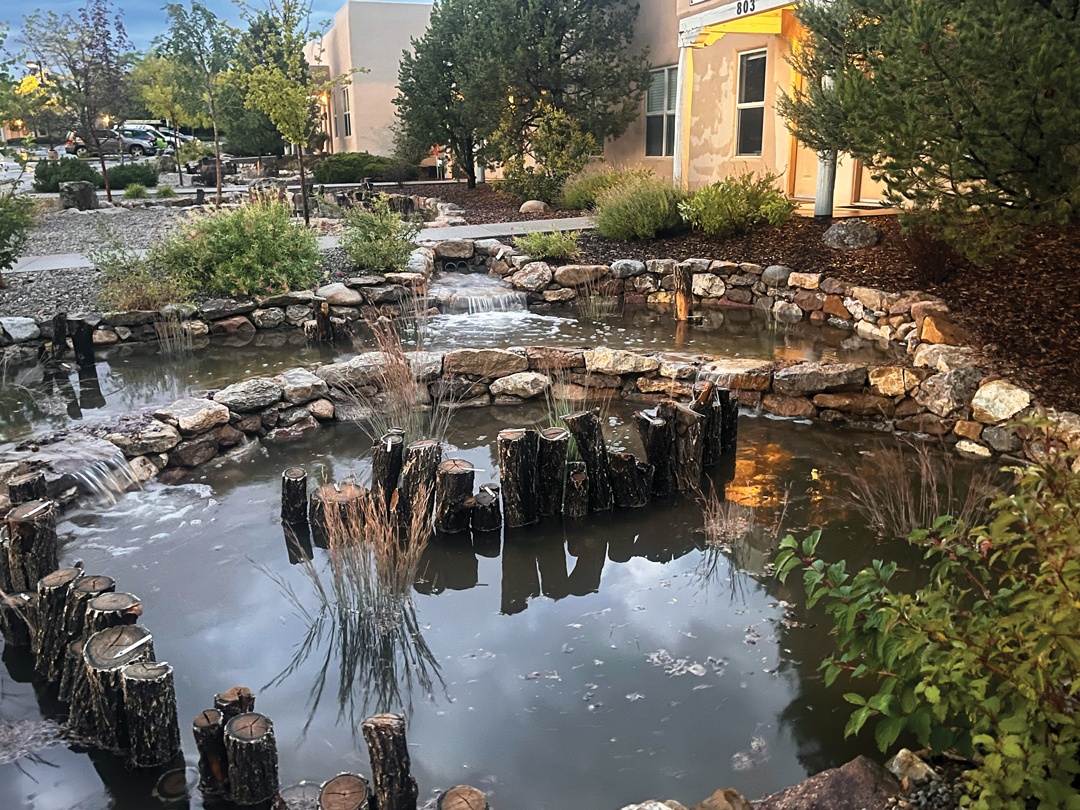
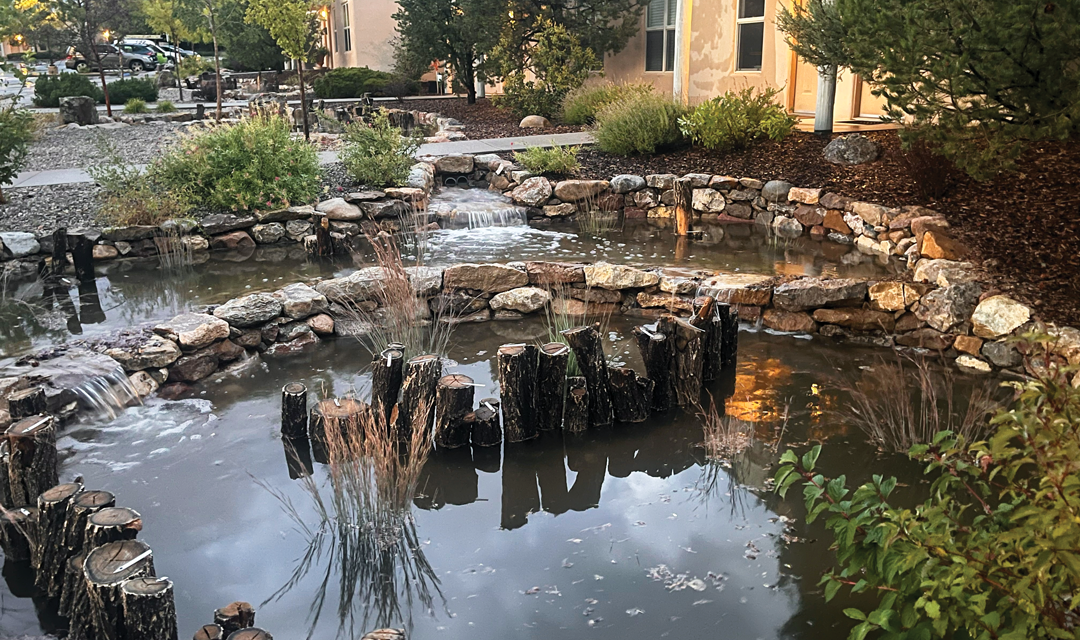
Rain gardens installed behind The RainCatcher’s office at Aspen Drive Office Condominium in Santa Fe. Photo by Reese Baker.
On a beautiful autumn morning in Santa Fe, Reese Baker walks me down the sidewalk behind his office, where he’s been installing rain gardens, part of a new urban stormwater paradigm called green stormwater infrastructure (GSI). Beside the sidewalk, partially buried logs are positioned upright in the earth to direct water when it rains, and boulders and trees are interspersed all the way down the sidewalk. When I drove up to the office park, I’d noticed the odd arrangement of the trees, logs, and rocks but didn’t identify the purpose they were serving.
“So, when it rains, all the water flows down this way—meandering, not rushing. That way, the mushrooms can break those logs down, plants can grow, animals can take shelter in the plants, all processing the water as it flows down the sidewalk,” Baker says. Before, “all the water used to rush down the parking lot and into the storm drains. Now, it’s watering these fruit trees, these grasses, and the mycelial network beneath. Now, the water’s doing something.”
Baker is both a scientist, studying for his PhD in biology at the University of New Mexico, and a land steward who has worked extensively with Southwestern water systems. In 2004, he founded The RainCatcher, a design-and-build company focusing on sustainable water systems and landscape design. Following the permaculture code of ethics (care of earth, care of people, sharing surplus), The RainCatcher employs water harvesting, water catchment, edible and sustainable landscapes, irrigation, wastewater treatment and reuse, erosion control, and restoration on public and private lands in central and northern New Mexico.
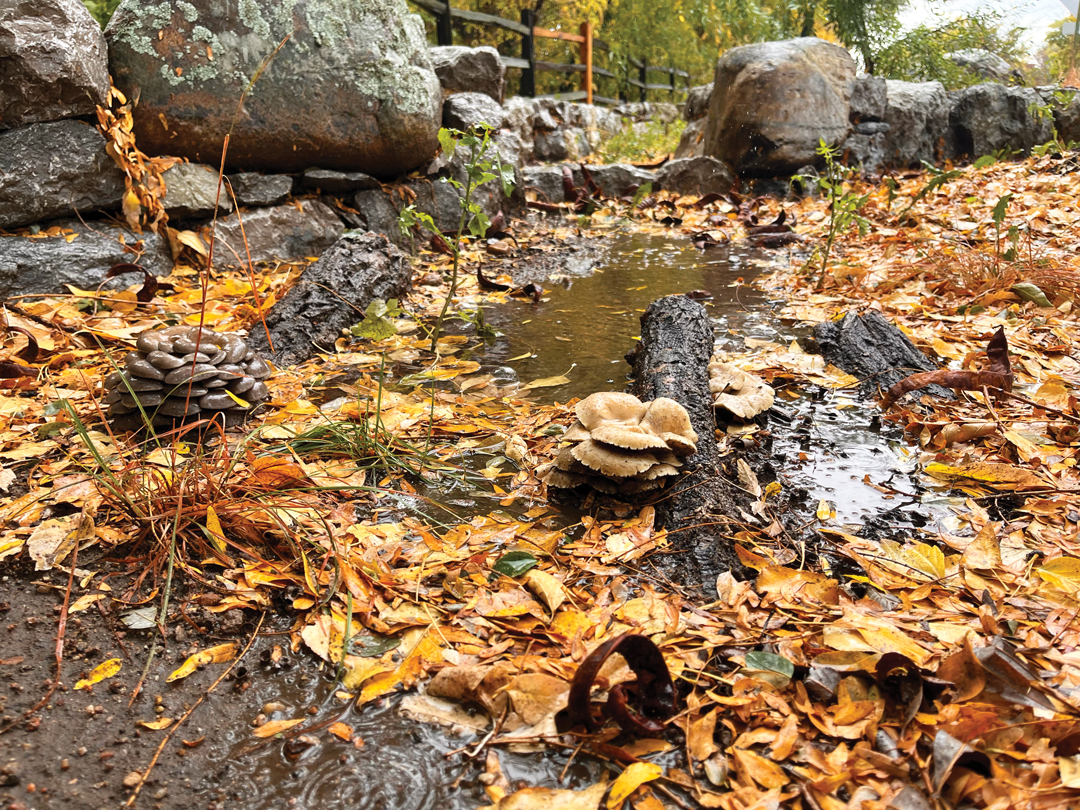
A water catchment system installed by The RainCatcher to support plant, animal, and fungal life. Photo by Reese Baker.
In September, New Mexico opened applications for $40 million in funds allocated to drill for and treat brackish water in an attempt to ease water shortages, but Baker offers an alternative vision, where we return to a model of harvesting instead of extracting.
“The city of Santa Fe is twenty-six square miles,” Baker says. “How many gallons of water do you think fall on Santa Fe in a year? Go on, guess.”
I’m not great at math, but I figure one city in the high desert can’t get that much rain. “Hmm, a hundred thousand gallons?” I guess.
He answers, “5.4 billion gallons. 5.4 billion gallons a year! And where is it going? It’s not refilling the aquifer. If we’re worried about water conservation, we don’t need to drill deeper. We need to collect what’s falling right out of the sky and running off the surface. I think in the long term we could start refilling our aquifer with these types of GSI systems.”
In Baker’s view, there is a path forward for restoring our aquifers. And, true to the interconnected design principles that guide permaculture, his vision for restoring aquifers is also a vision for tackling contamination, plastics, and chemicals in the environment, while facilitating the natural decomposition with which built environments often interfere.
“There are fungi, saprophytic fungi, the decomposers,” Baker says. “They’re sort of the interface between life and death. Basically, what I call the grand molecular disassemblers of nature. They break down stuff that’s impossible to break down, like wood. Even plastic. Say you take a log and throw it on the asphalt, the lignin it’s made of is gonna take hundreds, maybe thousands, of years to decompose. But if you bury it in the ground, it becomes a food source for these mycelial networks. If you look at where plastics came from, any of the stuff designed in a chemistry lab, it all comes from the molecular framework of lignin and can all be broken down by these guys. C’mon, let me show you.” We head out of the office and into the office parking lot, where an open space in the center teems with plant life.
“There was just a pit here before. And I convinced our board to let me redo it, and now look at it. All of the water that used to run off during storms, now it all gets collected here to water these trees and plants. And these wood posts you see buried here, they’re food sources for these fungi. The water pools in these areas with logs, and the mycelium that’s underneath takes all the parking lot water that’s severely polluted and processes everything that sinks down.”
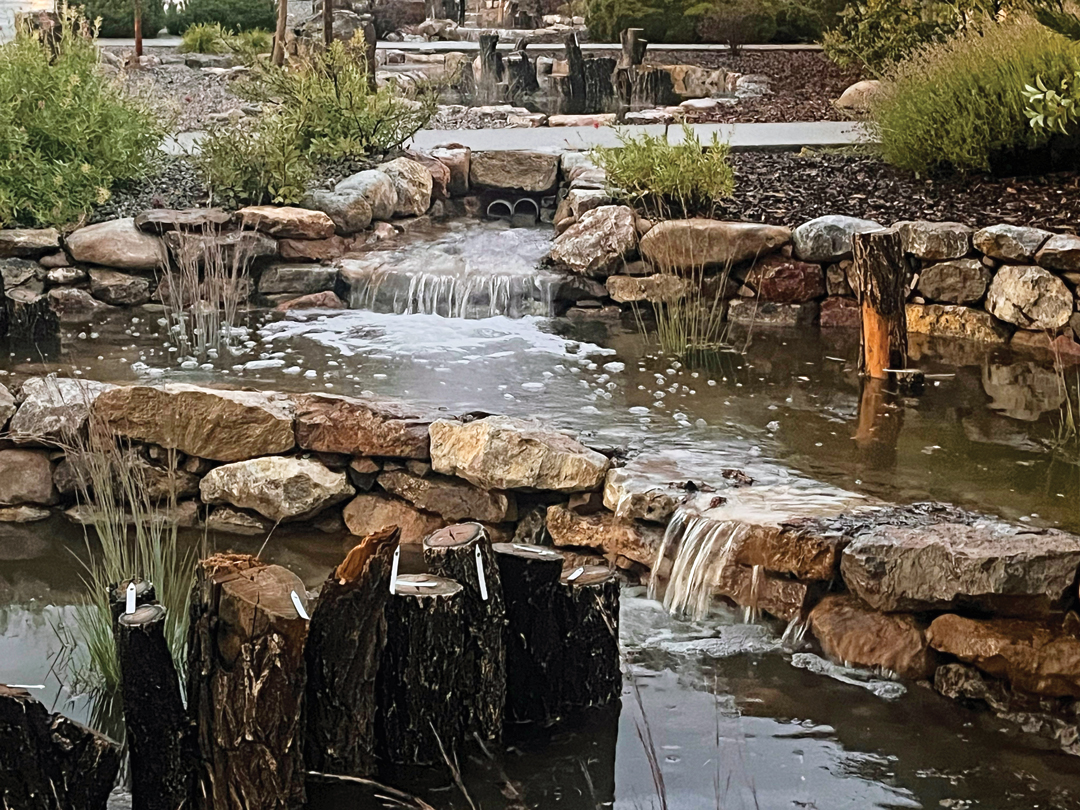
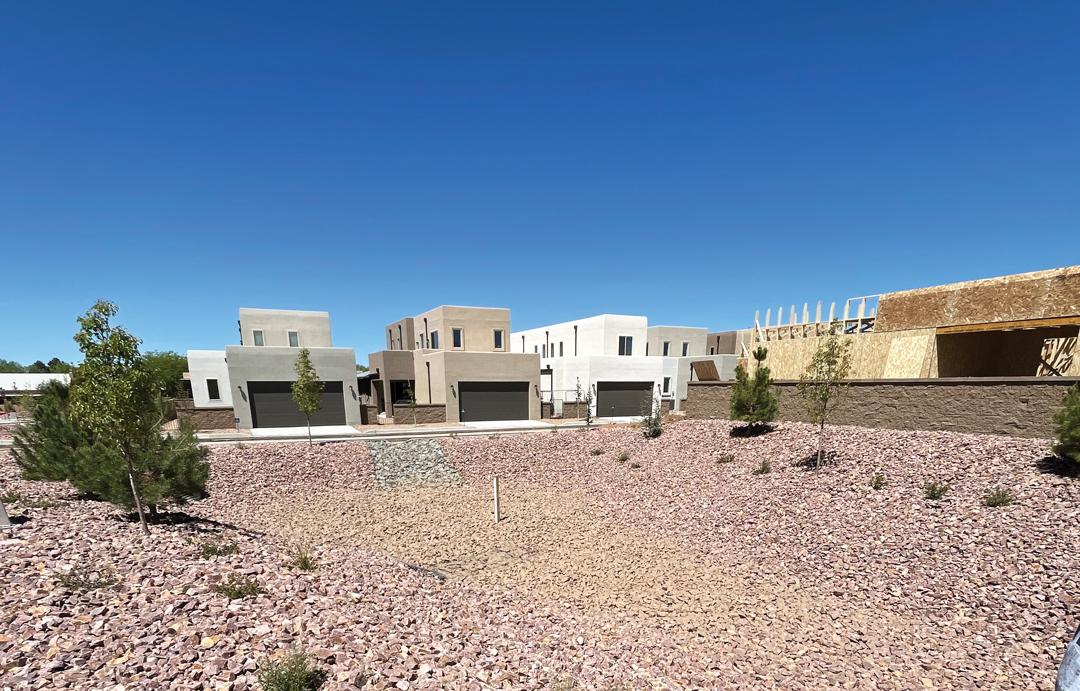
Green stormwater infrastructure and rain gardens compared to a conventional detention basin. Photos by Reese Baker.
With rain gardens and channels carved into urban spaces, water could stay relatively close to where it falls, creating streams and ecosystems within our cities and purifying the water as it flows. In addition to installing rain gardens and detention basins at private residences with The RainCatcher, Baker has also employed these concepts in public spaces, like at the Alameda Rain Gardens in Santa Fe, building features to capture stormwater and harness it to support ecosystems where the public can learn from and enjoy nature. The areas Baker has modified along the sidewalks behind the office park have also become ecosystems for animal, plant, and fungal life, all because of the work Baker is putting into the ground himself.
After leaving the office park, I drive back along the trees lining the sidewalks where Baker showed me how the water meanders down the street after a rain. Being a speculative fiction writer, I can’t help but wonder how Albuquerque, where I live, might look (and smell) if we cut down invasive ornamentals to instead cultivate mycelial networks and native plants, creating ecosystems for wildlife. I imagine the streets of Albuquerque lined with meandering streams and wetlands flowers, fruit on the trees, the sound of birds singing in the morning and frogs and crickets chirping in the evenings. I want that future too.
1925 Aspen, Ste 102-A, Santa Fe, 505-501-4407
Victoriano Cárdenas
Victoriano Cárdenas is a trans poet and writer from El Prado, and his ancestral home is El Torreón Hacienda. He grew up irrigating fruit orchards and fields of alfalfa with his grandfather, drawing water from the Acequia del Medio del Prado and the Acequia Madre del Prado. His debut book of poetry, Portraits as Animal, was published by Bloomsday in 2023.