After my first attempt at raising chickens back in 2015, I implemented a golden rule or, better yet, a superstition when it comes to raising birds: Don’t name them, and don’t get too attached. I’ve seen the comings and goings of about seventy-five hens and roosters over the years, and I mostly remember the names of the premature goings. The ways in which chickens go, as was to be driven home through my latest endeavor, are numerous.
Observing the social dynamics of these animals has taught me the true meaning of “henpecked.” Roosters are an enigma. I’ve gained respect for roosters after learning what they actually have to endure in order to survive. They are often the smallest hatchlings, but they have an innate sense of dominance and authority that belies their size. If they’re not careful about managing their masculinity and aggressive behavior, they tend to become victims of circumstance in a community where they are outnumbered and, for the most part, simply tolerated. If somehow they survive their adolescence, they grow to become the biggest and most colorful birds of the flock, which then assume their natural role as the “cocksure” protectors and progenitors. I’ve literally had to rescue rattlesnakes that stopped by for a quick breakfast of eggs and found themselves at the wrong end of an enraged descendant of the velociraptor.
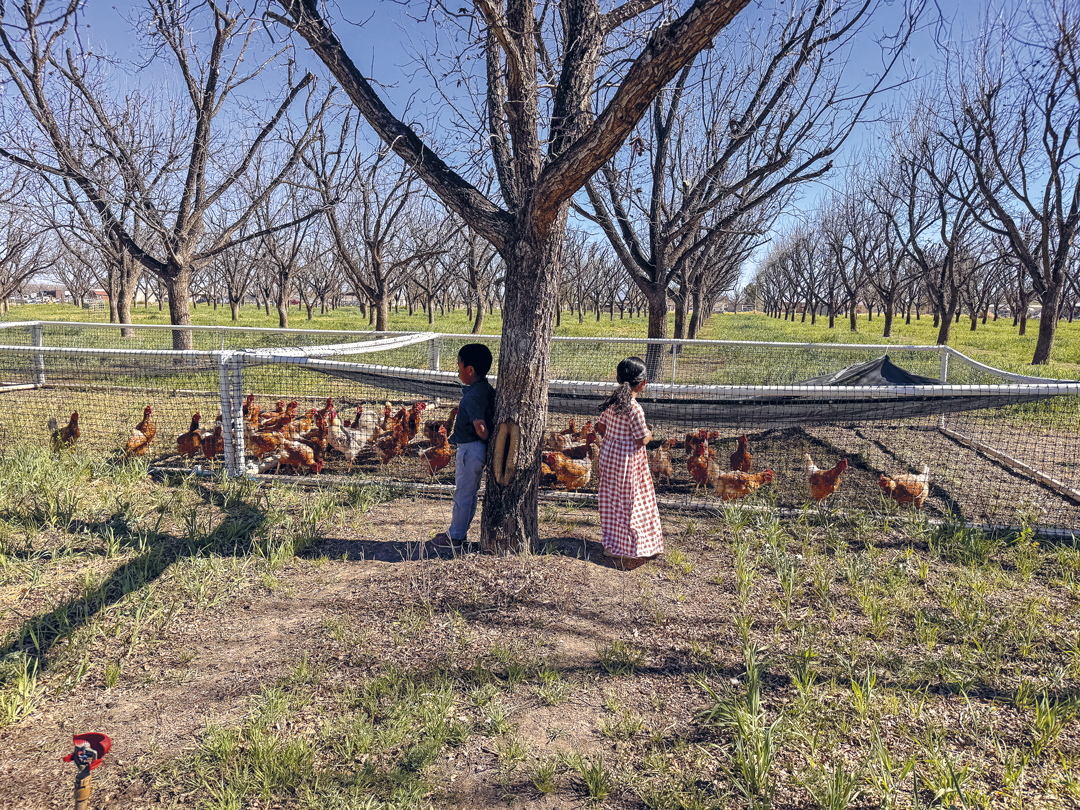
Louis and Maya of Tres Niños watch over their flock, housed in a movable chicken coop.
As it turns out, though, almost everybody likes chicken. Hawks, owls, raccoons, bobcats, coyotes, foxes, and, to my surprise, skunks all seem to have an appetite for poultry. Based on my experience, the fastest way to lose a bunch of chickens at once is as sport for your neighbors’ dogs. Ironically, the most frequently asked question by customers is whether or not your eggs are pasture raised, free-range, or cage free.
I had given up on raising birds after a mass extinction event on my farm in Anthony in 2020, but I was inspired in 2024 to reconnect with the effort in response to what I perceived as many people having made regrettable electoral choices based, in part, on the price of eggs. Understanding that the price of a commodity is often inflated due to lack of supply, I assumed my patriotic duty to produce eggs. I applied for and was awarded a USDA Urban Agriculture Micro-Grant through Farm to Table’s New Mexico Farmer Innovation Program. The process was relatively easy, but upon being rewarded, I was informed that funding for the grant program had been reduced due to the current administration’s decision to renege on or restrict funding for programs that didn’t align with its priorities. I was subsequently offered half the budget I’d proposed for my project, so I had to make adjustments to the plan. I could either build infrastructure to support the two hundred chicks I was planning to raise and wait another year to purchase chicks, or drastically reduce the scale of my project. While the latter was the more obvious choice, neither option was likely to produce enough eggs to sustain the impact I had initially hoped to make.
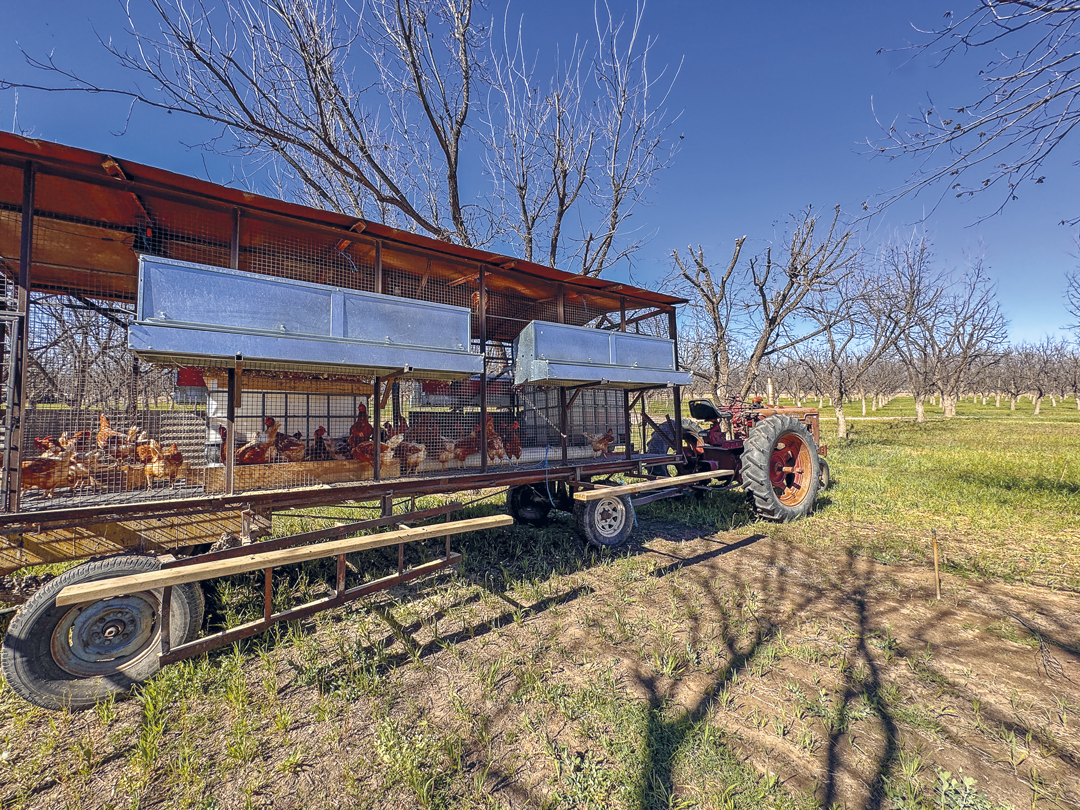
Chicken coop on wheels makes for easy moving.
Unsurprisingly, I wasn’t the only farmer in the area with eggs on my mind. Josh Bowman is a regenerative farmer who lives in nearby Mesquite, where he operates First Fruit Orchard: 135 acres of pecan trees throughout which graze herds of cows, sheep, and, now, chickens. I interviewed him in December 2022 for an article in edible New Mexico about how he applied regenerative methods on his pecan orchard and provided consulting for farmers interested in incorporating regenerative practices. We reconnected in the spring of 2025 while I was attending a field day he held at his farm. As we exchanged ideas about our farming plans, we realized we were both interested in producing eggs. After comparing some notes, we decided it would be a good idea to collaborate on a project, and this led to the gestation of Tres Niños Farm Fresh Eggs. My contribution to the project is mostly as an aggregator and distributor. I started by incubating a small flock that I hoped would eventually provide different flavor and color profiles to the overall egg inventory. In spite of my hesitance, my flock eventually became known as the “project chicks.” As if to validate my superstitions, three weeks ago three large dogs showed up in the middle of the night and relieved me of them all.
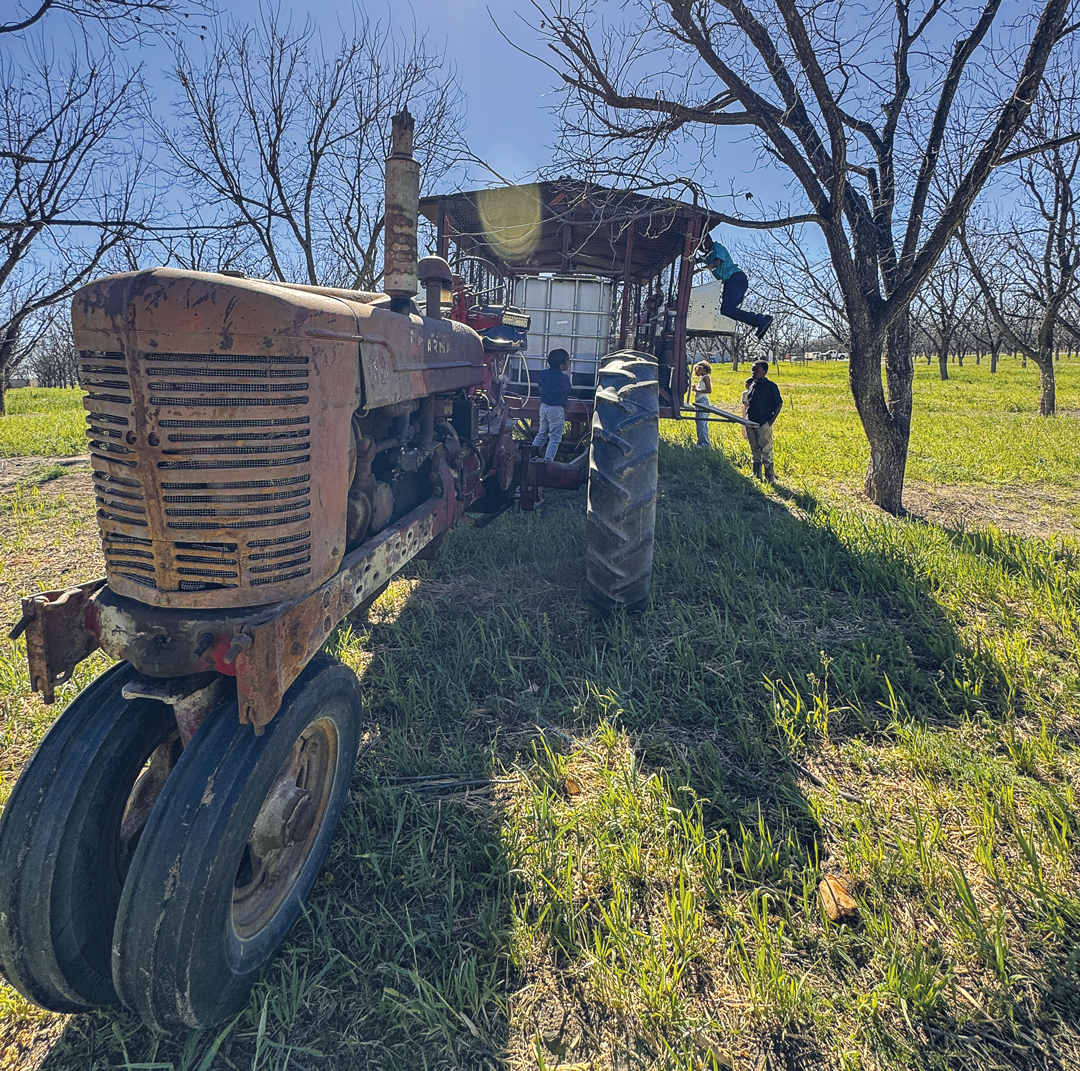
A tractor pulls the coop from field to field
Tres Niños is an endeavor that Josh had been considering for quite a while. According to him, “We had a vision for probably the last four years of having chickens on this farm. The first thought was, we have the resources, why aren’t we doing it?” Initially the idea was to offer the opportunity to someone else, but after not being able to find any takers, Josh decided to move forward with it and try to create an enterprise for his three young boys. Emerson (10), Ephraim (9), and Louis (6) are the managers and operators of Tres Niños, with occasional help from their sister Maya (5). Josh said, “The vision here was to provide an opportunity where my sons could get into small business and work their way in. If they enjoy it, they can expand it. If they don’t, there’s no loss. We just gained experience.”
The workday for the egg operation starts between 7 am and 8 am and involves feeding and watering the 164 chickens and hunting for eggs (between 80 and 100 dozen per week). The day ends with gathering all the birds from their grazing pasture and securing them in their mobile chicken coop. When asked if there was any indication of the impact that their grazing has had on the pasture, Josh responded, “The one field we pastured on all winter is by far the best-looking field out there. The field beside it looks pitiful. I wish I had them all over the farm.” Recently the flock has relocated from the wheat pasture to a pasture with a cover crop of clover, peas, vetch, barley, and oats.
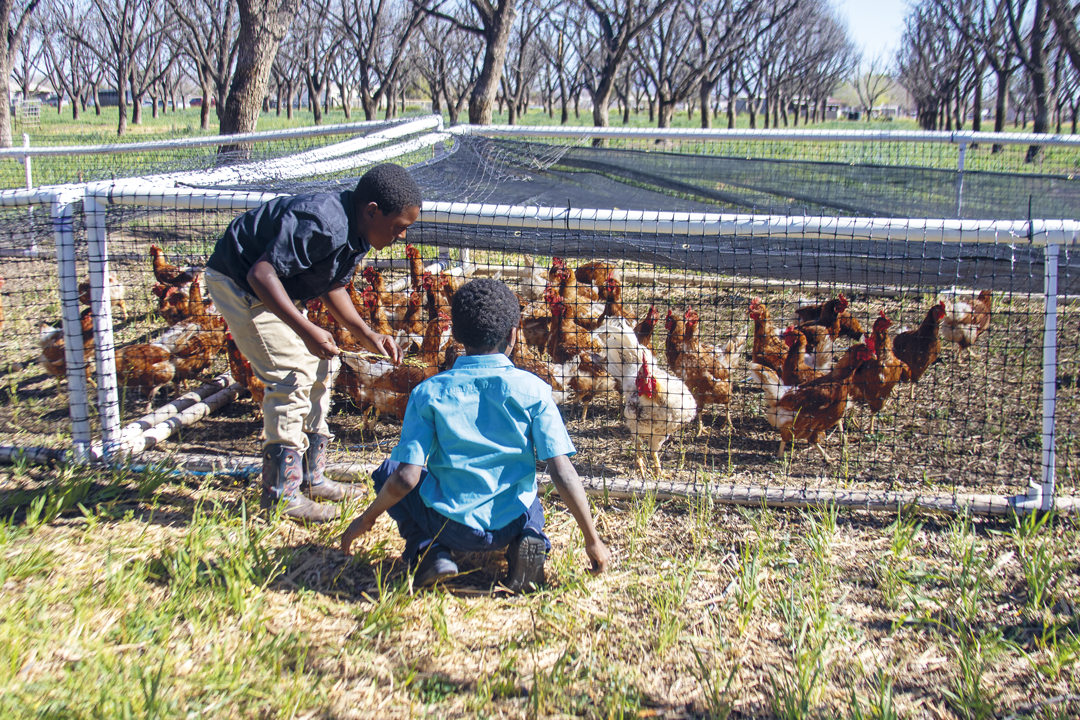
Emerson and Ephraim check their flock of Red Sex Link chickens.
The boys alternate days off, as the business requires attention seven days a week. The verdict is still out on just how much everyone “loves” the work, but they are definitely getting an experience that will instill in them an appreciation for hard work and dedication. When asked how many more chickens they would like to add to their operation, Ephraim, without hesitation, spoke for himself and his siblings: “No more.” I tried to hide my concern when I learned that although they have too many hens to name them, there is a rooster, and his name is Brewster. Good luck, bro!
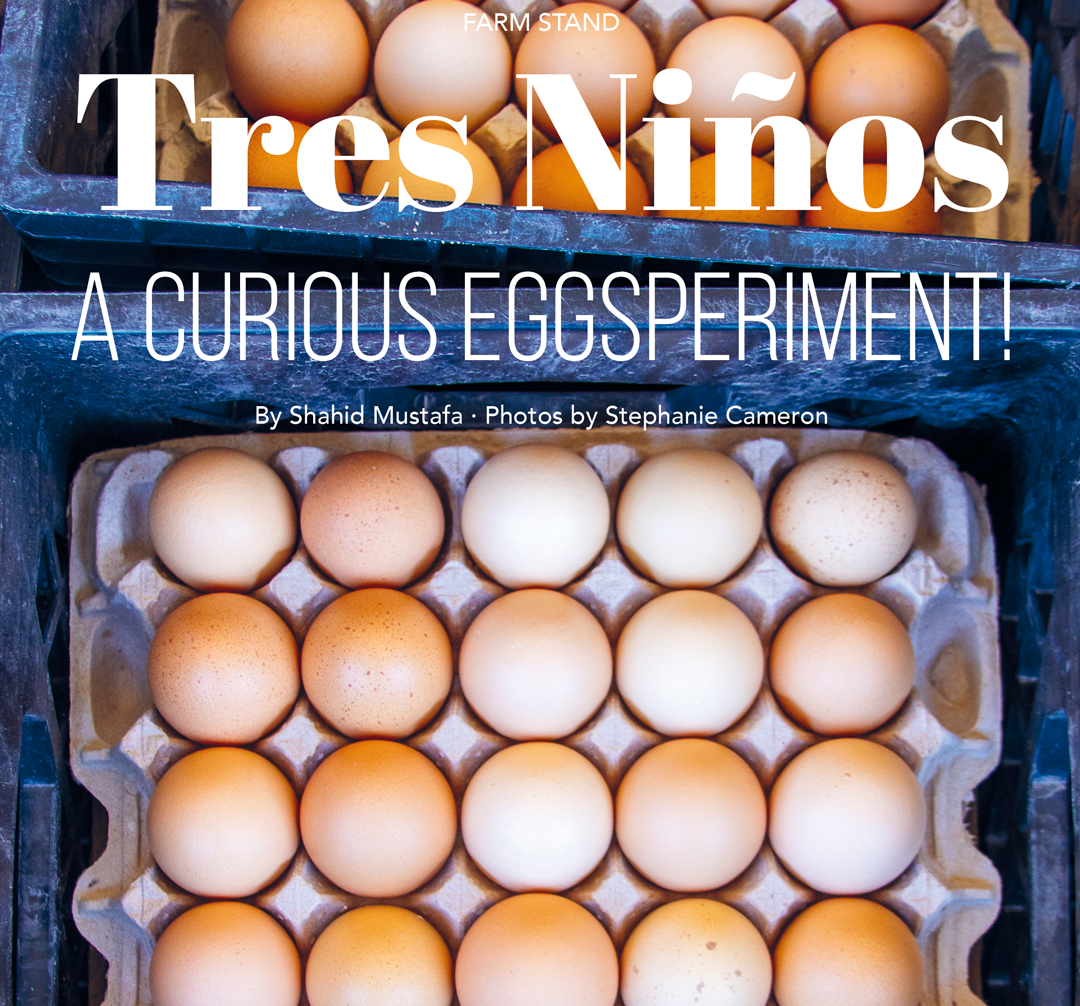
Tres Niños started with two hundred Red Sex Link chickens, which are a hybrid bred from Rhode Island Red roosters and Delaware hens. They produce large brown eggs, tolerate heat well, and have a calm temperament. They enjoy a daily diet of about sixty-five pounds of certified organic feed imported by the ton from Arizona (so much for my hopes to address the price of eggs), insects, and greens from the wheat field pasture. The eggs are sold at the Farmers and Crafts Market of Las Cruces, Ardovino’s Desert Crossing Farmers’ Market in Sunland Park, and through local CSA subscriptions, and are served at Ardovino’s restaurant. Net profits, says Josh, will be split between the children.

Shahid Mustafa
Shahid Mustafa owns and runs Taylor Hood Farms, practicing regenerative organic agriculture on more than three acres in El Paso, Texas, and offering a CSA with home delivery. Through his nonprofit organization DYGUP/Sustain (DYGUP stands for Developing Youth from the Ground Up), he has worked with the science department at Las Cruces High School to implement an environmental literacy curriculum and establish a one-acre plot where students receive credit for helping with all stages of vegetable production. With plans to become a certified organic farm and train a new generation of farmers, he hopes his efforts will be an inspiration for farmers to adopt the regenerative organic practice.