
By Anna Marija Helt
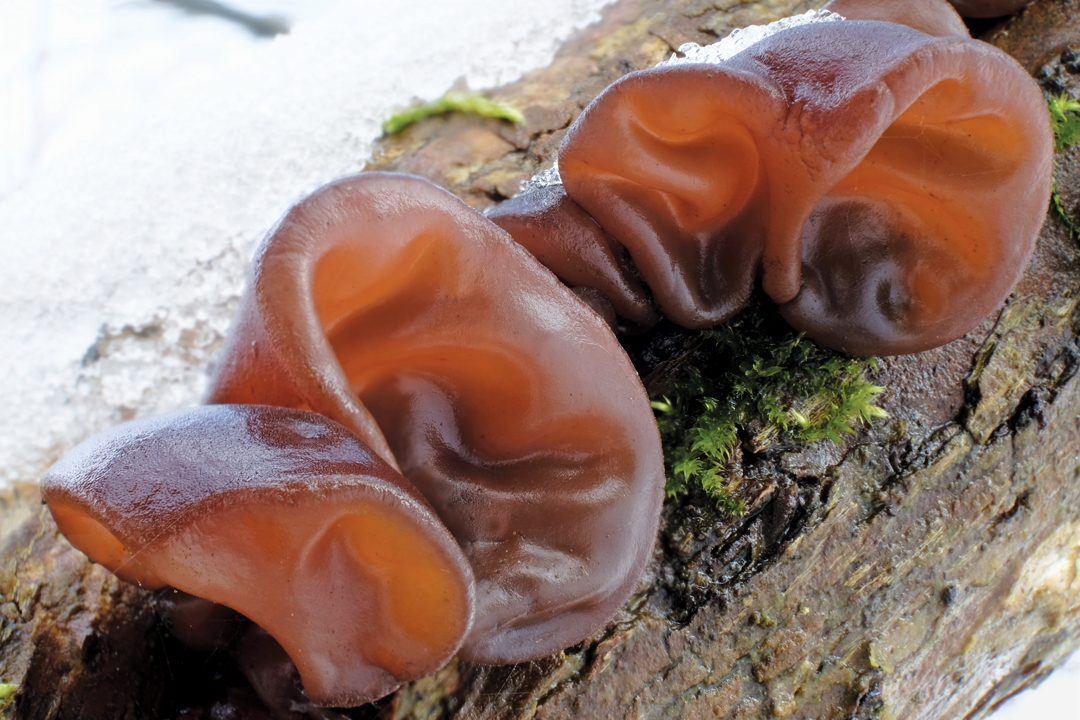
Wood ears (Auricularia americana), photo by Iwona Podlasińska.
What’s a mushroom-loving forager to do when the monsoon season is long past? Hunt for cold-weather mushrooms, of course. While the season is not nearly as bountiful as summer, winter foraging is a great excuse to get outdoors and may pay off with some tasty mushrooms for the kitchen.
The aptly named “winter mushrooms” (Flammulina velutipes and Flammulina populicola) make “antifreeze” that protects them from freezing temperatures and is being studied in food preservation. Winter mushrooms grow on dying or dead hardwoods such as aspen, cottonwood, and Siberian elm. When growing beneath the bark, they resemble their grocery store kin, enoki mushrooms: long, thin, pale, and topped with tiny caps. But when growing out of cracks in the bark, they’re much stouter, with a sticky orangish-to-reddish-brown cap and creamy-white-to-yellow gills beneath. The young stalks range from ivory to orangish brown, developing a dark brown or black velvety layer from the base upward as they mature. The velvety texture is critical for identification of these mushrooms, as the stalks of a dangerous look-alike, deadly galerina (Galerina marginata), also darken with age—but they are smooth or fibrous rather than velvety. While deadly galerina stalks have a ring around them and winter mushrooms don’t, the ring wears away too easily to be a reliable identifier.
Spore coloration also differs between winter mushrooms (white) and galerinas (rusty brown). Since individual spores are too tiny to see, making a spore print is a critical identification step, especially when learning a new mushroom. To spore print a mushroom, remove the stalk and place the cap gill-side-down on aluminum foil. Wet the cap with a drop of water to trigger spore release, cover it with a bowl, and let it sit overnight. Deadly galerinas can grow right next to winter mushrooms, so spore printing every single mushroom is essential to ensuring that you identify any inadvertently gathered galerinas. When examining the spore print, that of winter mushrooms will be white. If the print is brownish, the mushrooms could be galerina or another toxic species. If no spore print is produced, toss the mushrooms. It’s not worth the risk.

Winter mushrooms, photos by Anna Marija Helt.


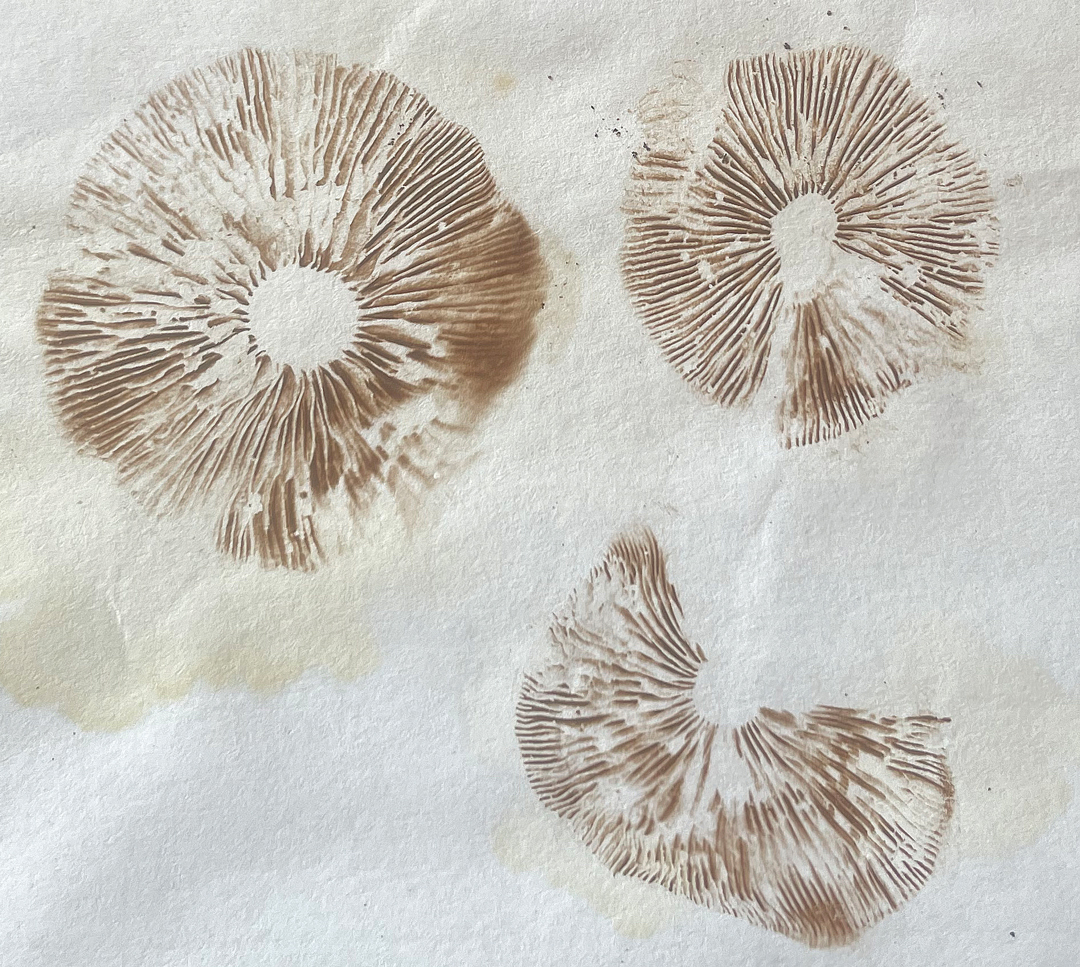
Winter mushroom spore print (white on black construction paper). Galerina spore prints (rusty brown on white paper). Photos by Anna Marija Helt.
Wood ears (Auricularia americana)—formerly called Auricularia auricula, a European species—grow on dead or dying conifers. They tolerate weather extremes and, when dried out, can revive with some precipitation or snow melt. Wood ears lack a stalk and resemble, well, an ear. The “inner” ear is a translucent reddish brown while the “outside” can be frosty looking from a coating of fine hairs. Wood ears are tough and rubbery. You can bend them and they won’t snap. Look-alikes belonging to certain Peziza species are more brittle and are easily snapped. Peziza species—not recommended for the kitchen because of largely unknown edibility—also tend to be cup shaped, while wood ears are more irregularly shaped and develop folds or wrinkles as they grow. Here is a specific case where spore prints won’t help with identification unless you own a microscope. Wood ear spore prints are white, as are those of many Peziza species.
You may have eaten wood ears without knowing it. They’re the crunchy brown bits in moo shu pork and hot and sour soup, and are often used in Chinese dumplings.
The most familiar mushrooms on this list, oyster mushrooms, continue the theme of cool-weather mushrooms that grow on wood, with two types common in New Mexico. The lung oyster (Pleurotus pulmonarius) is what you’ll look for in cool weather and it grows on dead or dying cottonwoods, while aspen oysters (Pleurotis populinus) grow on aspens and cottonwoods and are less likely to be found in winter. Typically growing in shelflike clusters, both mushrooms range from oyster shell to lung to kidney shaped, with whitish to cream-colored gills beneath. The mushroom’s upper surface can have a greasy sheen and ranges from whitish, especially for aspen oysters, to beige to pinkish or grayish brown. When present, the stubby stalk has gills running down it and is usually off center. The spores of lung oysters appear pale lilac if the spore print is heavy enough. A lighter spore print will be whitish, as will the spore print of aspen oysters.
By the way, oyster mushrooms are carnivorous. Despite being stationary, they paralyze and eat tiny worms called nematodes. Think of it as extra protein in your mushrooms.
As with any wild mushroom, do not eat winter, wood ear, or oyster mushrooms without painstaking and well-informed identification. Have at least two local guidebooks for reference, and reach out to the New Mexico Mycological Society (nmms.wildapricot.org) for assistance with identification. If you’re a novice forager, tag along with an experienced mushroom hunter. Learn when and specifically where the mushroom grows, and be familiar with all regional look-alikes. Above all, eat only mushrooms that you’ve identified with absolute certainty.
Not keen on foraging? No worries. Cultivated oyster and enoki mushrooms, along with dried wood ear mushrooms, are available at many grocery stores and Asian markets, and can be used just the same in these satisfying recipes.
Winter Mushroom Recipes

Egg Drop Soup with Wood Ears and Winter Mushrooms
Ingredients
- 1/2 cup fresh (or rehydrated) wood ears, sliced in 1/4-inch strips
- 1/2 cup fresh winter mushroom caps, sliced in quarters
- 4 cups chicken or turkey stock
- 1/4 teaspoon salt
- 1/4 teaspoon sugar
- 2 teaspoons tamari
- 1 teaspoon fresh chives, chopped
- 1/2 teaspoon toasted sesame oil
- 1 teaspoon fish sauce
- 1/2 teaspoon fresh ginger, grated
- 1/4 teaspoon ground white or black pepper
- 2 tablespoons arrowroot powder
- 3 eggs
Instructions
- Combine wood ears, winter mushrooms, salt, sugar, tamari, half of the chopped chives, and stock. Bring to a boil in a stockpot, then reduce heat and simmer for 10 minutes. Add sesame oil, fish sauce, pepper, and ginger.
- Slowly stir in arrowroot powder. Taste and adjust seasoning as desired. Lightly beat the eggs in a separate bowl and slowly drizzle into the pot while stirring.
- Ladle into four bowls and top with the remaining chives.

Simple Oyster Dry Sauté
Ingredients
- 1/2 pound fresh oyster mushrooms, lightly brushed to remove debris and sliced into halves or thirds
- 1/2 teaspoon salt
- 2 teaspoons extra-virgin olive oil
- 1 teaspoon softened butter
- 1/4 teaspoon black or white pepper
Instructions
- Preheat a medium-to-large sauté pan on medium high.
- Add a single layer of mushroom slices to the dry pan and sprinkle lightly with salt. Cook until mushrooms dehydrate a bit and start to curl up and lightly brown.
- Remove from pan and repeat process with remaining slices.
- After dry sautéing all the slices, return them to the pan and add olive oil, butter, and pepper. Cook for another 3–4 minutes.
- Serve, garnished with parsley, as a side dish, or use to top a pasta or risotto.

Anna Marija Helt
Anna Marija Helt, PhD, is a writer, microbiologist, and practicing herbalist in the Four Corners area. Through Osadha Natural Health and other organizations, she engages people with the natural world for their own well-being and that of the planet.