
Words and Photos by Madeleine Bavley

Early winter weeding at La Milpa Comunitaria.
It was a gray November afternoon when I visited La Milpa Comunitaria in Santa Fe’s Southside, and many of the plants in their garden had already begun their winter’s rest. Though having just completed their second season, much of the work here is yet to come. Small wonder that Analicia Guitrón and Mykayla Trujillo, two of the project’s three coordinators, were ready to reflect on its challenges and successes. As we walked the grounds, located on the Earth Care campus, both spoke of the project with the combination of gentleness and gumption that tending to the land teaches.
The project gets its name, and much of its guiding philosophy, from the concept of la milpa. La milpa is an ancient Mesoamerican agricultural method, still widely practiced today, that utilizes intercropping—i.e., growing two or more crops on the same plot of land. Most commonly, the method involves some combination of corn, beans, and squash, or the Three Sisters, the phrase commonly given to this practice in North America. Milpa comes from the Nahuatl words milli, or field, and pan, or together, and the method, which is comparably more diverse and dense than the monocropping common to industrial farming, improves soil health and increases crop resilience to environmental stressors such as pests and disease. It also tends to require less resource input and result in higher output, leading some to regard it as a useful way to increase food security.
Such was the guiding belief that led Irail Torres and María Hernandez, the project’s third coordinator, to start La Milpa Communitaria in 2024. Torres and Hernandez had migrated to the United States from Mexico and Guatemala, respectively, and both brought with them memories of growing up nurtured by their family milpas. From a motivation to bring that sort of cultural land connection to their children, and to others in the Spanish-speaking communities of Santa Fe, La Milpa Comunitaria was born.

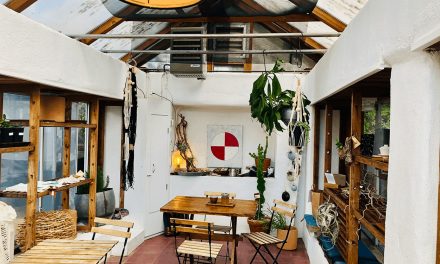
Art installation at La Milpa.
La Milpa Comunitaria is one of several projects that comprise Earth Care, a community development organization dedicated to health, sustainability, and justice. The project focuses, most fundamentally, on increasing food security on the city’s Southside. As Trujillo put it, their aim is “building with this land and bringing it back to health, and through that, bringing ourselves back to health at the same time.” They envision a community food forest, replete with demonstration gardens, community plots, and a peace garden. But, working as they are with a plot of land that was previously a construction staging zone, rehabilitating the space will be a process.
And the process has had its challenges. For one, they are limited in their resources. Also, the threat of ICE raids has made many noncitizens and citizens alike feel unsafe being active in their communities. Nonetheless, the project is still striving to meet its mission. “I mean, we started with nothing, basically,” Guitrón remarked. This past season, they cultivated garlic, kale, squash, chile, tomatoes, and tomatillos, while maintaining a variety of prennial plants—a far sight from the “nothing” they began with. In Trujillo’s words, “We have a big, big dream. And right now we’re just focusing on taking small bites, as we can, towards that big dream.”
As they continue to grow their grounds, the project is also growing its community. The on-site garden serves as a space for monthly workshops for participating families, many of whom were already connected to Earth Care’s programming. Other families got connected through word of mouth. The workshops center around empowering the families to grow food in their own homes, in whatever capacity, big or small, outdoors or indoors, in the ground or in a pot. They also run La Mano Colectiva, which provides an opportunity for the broader community to get involved with the project’s efforts by attending work days, such as one held last August to complete the site’s water catchment system. Collaboration seems to be at the core of all the work that they do. They’ve partnered with Tree New Mexico to plant a variety of fruit and shade trees, the international Xerces Society to plant a pollinator garden, and a local high school to provide a dual-credit program for students.

Winter rest at the onsite garden.
Collectively, their programs seek to combat food insecurity—a significant issue in New Mexico. New Mexico ranks fourth among states in food insecurity, with 16.6 percent of people considered food insecure, compared to the national average of 14.3 percent, according to Feeding America’s “Map the Meal Gap” study from 2023. With millions projected to lose Supplemental Nutrition Assistance Program (SNAP) benefits in the near future, this is an even more pressing issue.
As social safety nets are weakened on the federal level, developing networks of care on the local level is ever more essential. La milpa provides some lessons in how to do so, and La Milpa Communitaria seeks to share those lessons. Communities, whether they be comprised of plants or people, when diverse and dense, have the opportunity to collaborate, conserve, cultivate abundance, and maintain strength when confronted with stressors. While there may be slight differences in how communities define la milpa from region to region, perhaps a unifying definition is the practice of acknowledging and appreciating our interdependence.
Madeleine Bavley
Madeleine Bavley lives in Santa Fe, where she writes, bartends, and farms. Her writing engages land and labor issues, queer ecology, pleasure activism, and the entanglements of the human and more-than-human world.