
Local Hero, SUSTAINABILITY: LABOR PRACTICES
An interview with Casey Holland, farm manager
Photos by Stephanie Cameron

Chispas crew, from left to right: Casey Holland, Ethan Schiller, Lindsey Johnson, Alberto Romero, and Nico Estrada.
With more than 120 varieties of heirloom fruits, vegetables, and grains, in addition to milk goats, laying hens, sheep, rabbits, and geese, Chispas Farm is the embodiment of diversified agriculture. Established in 2001, Chispas is a small, regenerative, community-focused farm in the South Valley of Albuquerque. Casey Holland, Chispas’s farm manager since 2017, is committed to effecting positive social change around small-scale, sustainable agriculture. They strive to make access to nutritious, enriching food more affordable for all families while providing opportunities for their community to reconnect to the region’s agricultural roots and culture. During the growing season, the farm’s vibrant produce, from fava beans to bok choy to perilla to quince, is on display at the Downtown Growers’ Market in Albuquerque, and those who sign up for their CSA program sometimes find musicians performing when they stop by the farm to pick up their boxes.
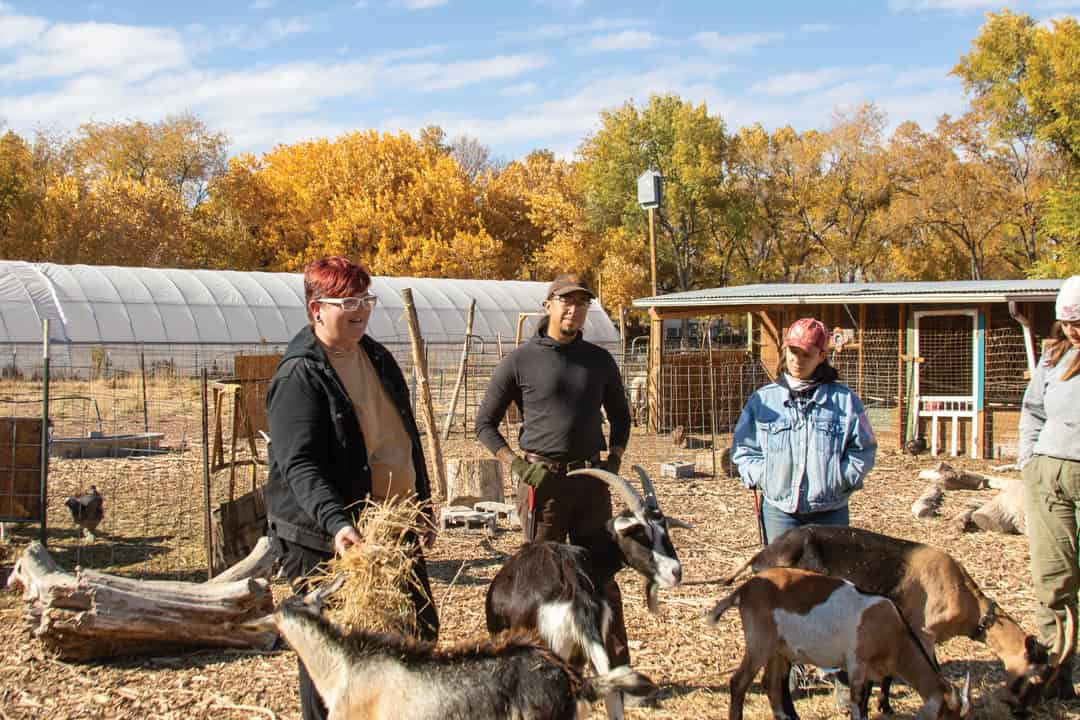

Left: Feeding goats at Chispas Farm. Right: Lindsey Johnson and Nico Estrada.
Talk about the farm’s path toward worker equity. What does that look like now and what are your goals for the future?
To be honest, when I first came to Chispas, there was quite a negative legacy on the farm around worker exploitation. The first steps toward worker equity came with acknowledging the harm that had come before and committing to positive change and new systems. First steps were paying more hourly, having farmworkers become official employees and no longer contractors of the farm, and now every farmworker who completes a season gets a profit share. We also offer a paid day off each month and are hoping to be able to offer continued raises, higher profit shares, and more paid leave for farmworkers. Another way we are building worker equity into the system is by no longer having every logistical component of farm management run by a single person who delegates and tells every person working on the farm what to do. In this way, we are building meaning and professional development into the positions on the farm, empowering our farmworkers to learn new skills and get an inside look at the off-field work that keeps the farm running. By creating opportunities for professional development for our farmworkers, we are also creating more sustainable workloads for the farmers with more experience and creating space for all farmers at Chispas to have more vibrant lives both on and off the farm. By having enough staff, enough pay, enough time off, and distributed responsibilities, together we are reenvisioning what running a farm looks like.
Sustainability is more often associated with stewardship of the land than with care for the people stewarding the land. How do sustainable and regenerative agricultural practices intersect with farmworker vitality and the long-term sustainability of a farm?
We firmly believe that sustainability of the land is inseparable from sustainability of the people who steward the land, and that part of healing our food systems will come with the acknowledgement that they are inseparable. Too often during my years of farming, I have seen the most well-meaning, sustainability-minded farmers need to find alternatives to farming or make sacrifices on their growing practices in order to be able to survive under our current economic system. The more we have farmers who are able to stay in place and work the land without sacrificing themselves and their needs, the more we can collectively envision a future where land and farmers are connected over the long run. Short-term relationships between land and farmers often lead to decision-making that is not always beneficial to the land itself. When you’re not sure if you will be there the next season or five seasons from now, the kinds of investments that are necessary in order to truly care for the ecology and the more-than-human residents really do not make sense from an economics standpoint. However, the more that farmers and farmworkers feel that they will be able to take care of themselves, their families, and the land over the long term, the more we are supporting folks in creating the kinds of systems we need for a sustainable food future.


Chispas crew on a beautiful fall day in Albuquerque’s South Valley.
How do your nonhuman farm residents contribute to the work of the farm?
Our more-than-human farm residents contribute to the farm in ways that are constantly astonishing. Right away when we invited animals and livestock onto the farm as part of our operations, a different kind of vibrancy began to emerge, where visitors were more excited to be here and immediately interacted differently with the space. Through working with the land, we have also cultivated spaces on the farm where we leave special offerings for the spirits of place that help us feel like we are reconnecting with the heritage of this land and honoring all who have stepped here before us.
Chispas is known for engaging community, whether through learning opportunities or parties. For you, what’s the mark of a meaningful farm event?
The mark of a meaningful farm event here at Chispas is connection. Whenever folks get to come to the farm and experience the magic of this place, connect with other community members and the more-than-human, and learn more about what is possible in our valleys, the better. In whatever ways we work with our community partners to make Chispas a place that feels like anything is possible and everyone is welcome, we are creating meaning and magic that extends far beyond the boundaries of the farm.
Anything else you’d like to share with edible readers?
Please reach out and find ways to get involved! We love building new connections, community partnerships, and new ways to engage at Chispas! Email us at chispasfarms@gmail.com or find us on Instagram!
229 Saavedra SW, Albuquerque, chispasfarm.com